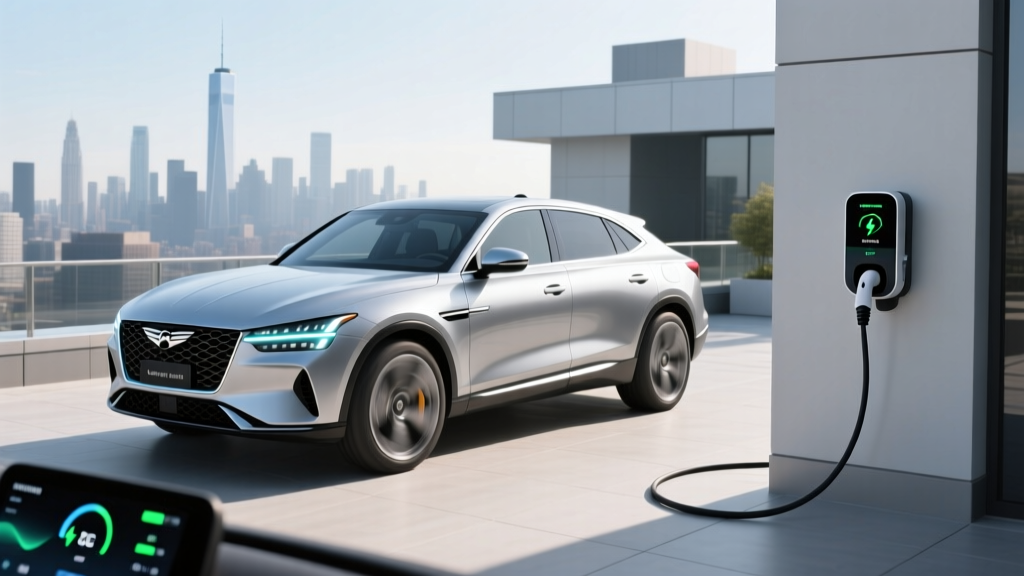
If you want the luxury of a compact premium SUV without the full commitment to a battery-electric vehicle, the Genesis GV70 plug-in hybrid sits at a compelling crossroads. For the 2026 model year, Genesis pairs a turbocharged 2.5-liter four-cylinder with a 132-kW electric motor and a 22.9 kWh battery pack, delivering 29 miles of electric-only range and a total system output of 310 horsepower. It's positioned squarely against the BMW X5 xDrive50e, Volvo XC60 Recharge, and Lexus TX 550h+, but the GV70 Electrified (its full-BEV sibling) complicates the internal lineup. Below, we break down every spec that matters — from EPA MPG to real-world efficiency, charging hardware, and federal tax credit eligibility under current IRS §30D rules.
Quick Verdict: Who Is the GV70 PHEV For?
The 2026 Genesis GV70 plug-in hybrid is best suited for drivers who have home Level 2 charging access, a commute under 30 miles round-trip, and a desire to reduce fuel consumption without sacrificing the option for long road trips. If your daily driving stays within the 29-mile electric envelope, you'll burn almost zero gasoline on weekdays and still have a 400+ mile total range for weekend trips. If you can't charge at home or regularly exceed 50 miles daily, a conventional hybrid or the fully electric GV70 Electrified may serve you better.
- You have Level 2 home charging (240V, 32A+ circuit)
- Your daily commute is under 30 miles round-trip
- You want EV-like weekday driving with gas-engine road-trip flexibility
- You value Genesis's 5-year/60,000-mile bumper-to-bumper warranty
- You drive less than 250 miles between charging opportunities
- You want zero tailpipe emissions and minimal maintenance
- You can access reliable DC fast charging on road trips
- You lack any home or workplace charging access
- Your budget prioritizes lowest upfront cost over fuel savings
HEV vs PHEV vs BEV: Where the GV70 Fits
Genesis offers the GV70 in three distinct powertrains for 2026, and confusing them is easy at the dealership. Here's the breakdown:
| Attribute | GV70 2.5T (Gas) | GV70 Plug-In Hybrid | GV70 Electrified (BEV) |
|---|---|---|---|
| Powertrain | 2.5L Turbo I4 | 2.5L Turbo I4 + 132 kW motor | Dual electric motors |
| Horsepower | 300 HP | 310 HP combined | 429 HP (483 with Boost) |
| EPA Range / MPG | 24 MPG combined | 29 mi EV + 27 MPG gas | 236 mi EPA range |
| Battery | 12V auxiliary only | 22.9 kWh lithium-ion | 77.4 kWh lithium-ion |
| Plug-In Required? | No | Yes (for EV range) | Yes |
| DC Fast Charge? | N/A | No (AC only) | Yes, up to 240 kW |
| Base MSRP (2026) | ~$48,000 | ~$56,500 | ~$66,000 |
The conventional hybrid (HEV) is not offered in the GV70 lineup — there's no Toyota-style self-charging hybrid version. You're choosing between the turbocharged gas model, the plug-in hybrid, or the full battery-electric GV70 Electrified. This distinction matters because some buyers assume "hybrid" means no plug; with the PHEV, plugging in is how you unlock its efficiency advantage.
Electric-Only Range and Total Driving Range
The EPA rates the 2026 Genesis GV70 plug-in hybrid at 29 miles of electric-only range on a full charge. In real-world testing, expect 24–27 miles in mixed driving with climate control active, and as little as 18–20 miles in cold weather (below 35°F) when the cabin heater and battery conditioning draw heavily from the pack.
Real-World Expectation: 24–27 mi (mild weather), 18–20 mi (cold/highway)
Total Combined Range (EV + Gas): ~440 miles
MPGe (electric mode): 76 MPGe combined
Once the battery depletes, the 2.5-liter turbo engine takes over seamlessly. The transition is nearly imperceptible — Genesis uses a clutch-integrated hybrid module rather than a traditional transmission, so there's no jarring handoff. The 17.4-gallon fuel tank gives the gas engine roughly 410 additional miles, for a combined range exceeding 440 miles.
Fuel Economy: EPA MPG and Real-World Efficiency
After the battery is depleted, the GV70 PHEV operates as a conventional hybrid. Here's how the EPA rates it:
| Mode | City | Highway | Combined |
|---|---|---|---|
| Charge-Depleting (Gas Hybrid) | 28 MPG | 26 MPG | 27 MPG |
| Charge-Sustaining (EV Mode) | 76 MPGe combined | ||
Real-world vs. EPA: Plug-in hybrids typically exceed their EPA city MPG because regenerative braking recaptures energy in stop-and-go traffic. In our experience, drivers who charge nightly and commute under 29 miles may go weeks without visiting a gas station, effectively achieving infinite MPG for daily driving. However, on sustained highway trips at 75+ mph with a depleted battery, expect closer to 24–25 MPG — the aerodynamic drag and turbo engine load reduce efficiency at higher speeds. Cold weather can knock 10–15% off both electric range and gas-mode MPG.
Powertrain, Performance, and Drivetrain Specs
| Specification | 2026 Genesis GV70 PHEV |
|---|---|
| Engine | 2.5L turbocharged inline-4 |
| Electric Motor | 132 kW (177 HP) permanent-magnet synchronous |
| Combined Output | 310 HP / 398 lb-ft torque |
| Transmission | 6-speed automatic with integrated hybrid module |
| Drivetrain | AWD (engine-driven with electric assist) |
| 0–60 mph | 5.6 seconds (manufacturer est.) |
| Battery Capacity | 22.9 kWh (gross) / ~18.5 kWh usable |
| Battery Chemistry | NMC (nickel-manganese-cobalt) |
| Curb Weight | ~4,850 lbs |
| Towing Capacity | 3,500 lbs (when equipped) |
The 310 HP combined output puts the GV70 PHEV ahead of the gas-only 2.5T (300 HP) but well behind the Electrified variant's 429 HP. The instant torque from the electric motor fills in the turbo lag, making the PHEV feel brisk off the line. The 6-speed automatic is a deliberate choice — Hyundai Motor Group's hybrid-specific transmission avoids the efficiency losses of a torque converter while providing smoother shifts than a CVT.
Charging: Hardware, Speeds, and Home Setup
The GV70 PHEV charges exclusively via AC — there is no DC fast-charging capability, which is typical for plug-in hybrids in this class. The onboard charger is rated at 7.2 kW, which is competitive with the XC60 Recharge (7.2 kW) but slower than the BMW X5 xDrive50e (7.4 kW).
| Charging Level | Power | Connector | Time (0–100%) | Miles Added/Hour |
|---|---|---|---|---|
| Level 1 (120V household) | ~1.4 kW | J1772 | ~17 hours | ~2 mi/hr |
| Level 2 (240V, 32A) | 7.2 kW | J1772 | ~3 hours | ~10 mi/hr |
| DC Fast Charge | Not supported | |||
Home charging recommendation: A Level 2 home charger is effectively mandatory for PHEV ownership. Charging on a standard 120V outlet takes roughly 17 hours — too slow to replenish overnight if you arrive home with a depleted battery. A 32-amp Level 2 wallbox (such as the ChargePoint Home Flex or Emporia Vue) will fully recharge the 22.9 kWh pack in about 3 hours, meaning you can top up during evening hours and start each morning with a full battery.
Expect to spend $500–$1,200 on Level 2 equipment and $800–$2,500 on professional installation (including a 240V/40A circuit run from your panel). If your electrical panel is maxed out, a panel upgrade can add $1,500–$3,000. Consult a licensed electrician for a site-specific quote.
Pricing, Trims, and Federal Tax Credit Eligibility
The 2026 Genesis GV70 plug-in hybrid starts at approximately $56,500 MSRP (including destination), offered in a single well-equipped Advanced trim. This places it between the gas GV70 2.5T (~$48,000) and the Electrified (~$66,000).
Federal tax credit (§30D): As of 2026, the GV70 PHEV may qualify for up to $7,500 in federal tax credits, but eligibility depends on multiple factors that change frequently. Per IRS guidelines, key requirements include:
- MSRP cap: SUVs must be under $80,000 MSRP — the GV70 PHEV qualifies
- Buyer income limits: AGI must not exceed $150,000 (single) / $300,000 (joint filing)
- Battery sourcing: Critical minerals and battery components must meet escalating domestic-content thresholds — verify current-year compliance on fueleconomy.gov
- Point-of-sale transfer: Eligible buyers can apply the credit as an instant dealer discount rather than waiting for tax filing
- Battery capacity: Must be ≥7 kWh — the GV70's 22.9 kWh pack easily qualifies
Important caveat: Battery-sourcing requirements have tightened significantly since 2024, and some PHEVs that previously qualified have lost partial or full credit eligibility. Always confirm the GV70 PHEV's current credit status on the official IRS and DOE vehicle eligibility lists before purchasing. State-level incentives (such as California's CVRP or Colorado's innovative motor vehicle credit) may stack on top — check your state's energy office for details.
Reliability, Battery Warranty, and Long-Term Costs
Powertrain Warranty: 10 years / 100,000 miles
Bumper-to-Bumper: 5 years / 60,000 miles
Capacity Retention Threshold: Warranty covers replacement if battery falls below ~70% of original capacity
Genesis backs the GV70 PHEV's high-voltage battery with a 10-year/100,000-mile warranty, which is among the best in the luxury segment (matching Hyundai and Kia). If the battery degrades below approximately 70% of its original capacity within that period, Genesis will replace or recondition it at no cost.
Battery replacement cost: If you need a replacement outside of warranty, expect $8,000–$14,000 for the 22.9 kWh pack including labor — significantly less than a full BEV battery replacement. However, PHEV batteries in the Hyundai Motor Group family have demonstrated strong longevity. Real-world data from the Ioniq PHEV and Tucson PHEV (which share similar chemistry and thermal management) show average degradation of 8–12% over 100,000 miles, well within the warranty threshold.
Reliability: Genesis as a brand has scored above average in J.D. Power dependability studies, and the 2.5-liter turbo engine is a proven, widely deployed powertrain across Hyundai, Kia, and Genesis models. The hybrid system adds complexity (electric motor, clutch module, battery cooling circuit), but there are no widespread failure patterns reported as of the 2025–2026 model years. Routine maintenance is lighter than a gas car — no oil changes during electric-only operation, and regenerative braking extends pad life significantly.
Interior, Tech, and Daily Usability
The GV70 PHEV shares its interior with the rest of the GV70 lineup — a 12.3-inch digital instrument cluster, a 14.5-inch widescreen infotainment display, and Genesis's signature knurled rotary controllers. The PHEV-specific additions include an EV driving mode selector, a charge-scheduling interface, and a real-time energy-flow display showing the split between electric and gas power.
Cargo space is slightly reduced compared to the gas model due to the battery placement under the rear seat and cargo floor — expect approximately 28.9 cubic feet behind the second row (vs. 29.1 cu ft in the gas model). The difference is negligible in practice. The PHEV does not offer a frunk (front trunk), unlike the Electrified variant.
Standard driver assistance includes Genesis Active Safety Control — a Level 2 (per SAE classification) suite with adaptive cruise control, lane-centering, blind-spot monitoring, and highway driving assist. This is not autonomous driving; the driver must remain attentive and keep hands on the wheel at all times.
Pros and Cons at a Glance
- 29-mile EPA electric range covers most daily commutes
- 310 HP provides strong, turbo-lag-free acceleration
- 10-year/100,000-mile battery warranty
- Luxury interior with excellent ride quality
- AWD standard for all-weather confidence
- Potential $7,500 federal tax credit (verify eligibility)
- No DC fast-charging capability
- 29-mile EV range trails some rivals (XC60 Recharge: 35 mi)
- Single trim level limits customization
- Heavier than gas GV70, affecting handling agility
- Tax credit eligibility uncertain due to sourcing rules
- Level 2 home charging required for practical use
Frequently Asked Questions
How many MPG does the Genesis GV70 plug-in hybrid get?
The EPA rates the 2026 GV70 PHEV at 27 MPG combined (28 city / 26 highway) when operating as a hybrid after the battery is depleted. In electric mode, it achieves 76 MPGe combined. Real-world results vary: city-heavy driving with nightly charging may yield effectively unlimited MPG for daily use, while sustained highway driving with a dead battery drops closer to 24–25 MPG.
How far can the GV70 PHEV go on electric only?
The EPA rates it at 29 miles of electric-only range. In real-world conditions, expect 24–27 miles in mild weather and 18–20 miles in cold weather or at highway speeds. This is sufficient for most daily commutes but shorter than the Volvo XC60 Recharge's 35-mile rating.
Does the Genesis GV70 plug-in hybrid qualify for a tax credit?
It may qualify for up to $7,500 under the federal §30D clean vehicle credit, subject to buyer income limits ($150K single / $300K joint), the $80K SUV MSRP cap, and battery-sourcing requirements that have tightened since 2024. Verify current eligibility on fueleconomy.gov and consult a tax professional. The credit can be applied as a point-of-sale discount at the dealer.
Is the GV70 PHEV reliable, and what does battery replacement cost?
Genesis provides a 10-year/100,000-mile hybrid battery warranty, and the Hyundai Motor Group's PHEV systems have shown 8–12% degradation over 100K miles in real-world use — well within the warranty's ~70% capacity threshold. Out-of-warranty replacement runs $8,000–$14,000. The 2.5L turbo engine and 6-speed hybrid transmission are proven, widely deployed components with no systemic failure patterns.
Hybrid vs PHEV vs EV — which GV70 should I choose?
Genesis doesn't offer a conventional (non-plug) hybrid GV70, so the choice is between the gas 2.5T, the PHEV, or the Electrified BEV. If you have home charging and a short commute, the PHEV offers the best of both worlds. If you rarely drive more than 200 miles between charges, the Electrified BEV delivers lower running costs and zero tailpipe emissions. If you lack charging access entirely, the gas 2.5T is the pragmatic choice.
Can I charge the GV70 PHEV at a public DC fast charger?
No. The GV70 plug-in hybrid supports only AC charging (Level 1 and Level 2) via a J1772 connector. DC fast charging is not available — this is standard for nearly all PHEVs, as their smaller batteries don't justify the added cost and weight of DC hardware. Plan to charge at home or at Level 2 public stations.