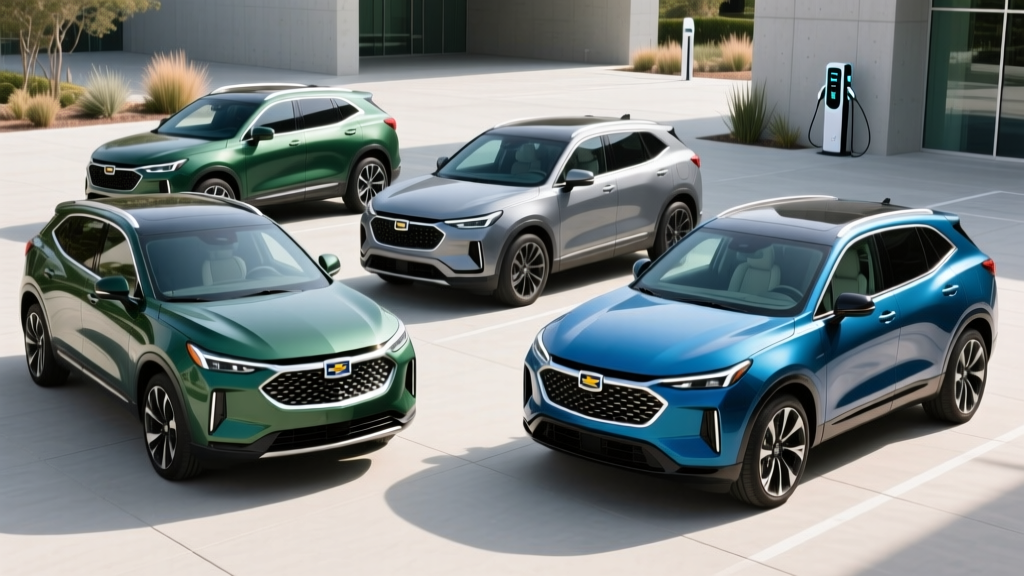
General Motors has taken a different electrification path than Toyota or Hyundai. While competitors flooded the market with conventional hybrids, GM invested heavily in plug-in hybrid (PHEV) versions of its best-selling SUVs alongside a growing BEV lineup. For 2026, the General Motors hybrid SUV portfolio spans three midsize crossovers sharing one platform — the Chevrolet Equinox, GMC Terrain, and Buick Encore GX — each offering a plug-in hybrid variant, plus the full-size Tahoe/Yukon/Escalade family now available with GM's new turbocharged hybrid powertrain.
This guide breaks down every current GM hybrid SUV with exact EPA numbers, battery specs, charging times, pricing, and real-world ownership data so you can choose the right fit.
GM Hybrid vs Plug-In Hybrid: What's the Difference?
Conventional Hybrid (HEV)
A conventional hybrid pairs a gasoline engine with a small electric motor and a compact battery (typically 1–2 kWh). The battery charges through regenerative braking and engine power — you never plug it in. Benefits include improved MPG, especially in city driving, with no change to your fueling routine.
Plug-In Hybrid (PHEV)
A PHEV uses a larger battery (15–25 kWh) that you charge from an outlet or charger, giving 30–50 miles of electric-only driving before the gas engine engages. Once the battery depletes, it operates as a conventional hybrid. PHEVs qualify for federal tax credits that HEVs do not.
For 2026, GM's midsize SUV hybrid lineup is PHEV-only on the Equinox, Terrain, and Encore GX. The full-size Tahoe and Yukon offer a conventional HEV variant. This matters for your daily routine: PHEV owners who charge at home can commute on electricity alone most days, while HEV owners simply refuel at the pump and enjoy better MPG.
2026 Chevrolet Equinox PHEV: Specs and Efficiency
The Equinox PHEV returns for 2026 as GM's highest-volume plug-in hybrid SUV. It pairs a 1.5-liter turbocharged four-cylinder engine with two electric motors and an 18.4 kWh lithium-ion (NMC chemistry) battery pack.
| Attribute | Value |
|---|---|
| Combined Horsepower | 247 hp |
| Engine | 1.5L turbo I4 + dual electric motors |
| Battery Capacity | 18.4 kWh (NMC lithium-ion) |
| EPA Electric-Only Range | 41 miles |
| Total Combined Range | ~480 miles |
| EPA MPGe (electric + gas) | 88 MPGe |
| EPA MPG (gas-only after depletion) | 38 city / 35 highway / 36 combined |
| Level 1 Charging (120V) | ~12 hours (0–100%) |
| Level 2 Charging (240V, 7.7 kW) | ~2.5 hours (0–100%) |
| DC Fast Charging | Not supported |
| 0–60 mph | 7.2 seconds |
| Starting MSRP | $37,900 (LT trim) |
How Many MPG Does the Equinox PHEV Get?
Once the battery is depleted, the Equinox PHEV delivers an EPA-rated 38 city / 35 highway / 36 combined MPG. In real-world city driving, many owners report 39–42 MPG because regenerative braking recaptures energy in stop-and-go traffic. Highway cruising at 75 mph typically yields 33–34 MPG. If you charge nightly and commute under 40 miles, you may use gasoline only on longer weekend trips.
Electric-Only Range in the Real World
The EPA rates the Equinox PHEV at 41 miles of electric-only range. In mixed driving at moderate temperatures (60–80°F), expect 38–43 miles. In cold weather (below 32°F), cabin heating and battery thermal management reduce this to roughly 28–33 miles — a 20–25% drop typical of all PHEVs. Using the seat heaters and preconditioning while plugged in helps preserve range.
2026 GMC Terrain PHEV and Buick Encore GX PHEV
Both the GMC Terrain PHEV and Buick Encore GX PHEV share the Equinox PHEV's powertrain architecture — the same 1.5L turbo engine, dual-motor setup, and 18.4 kWh battery. Differences lie in tuning, weight, and aerodynamics, which shift the EPA numbers slightly.
| Model | EV Range | City MPG | Highway MPG | Combined MPG | MPGe | Starting MSRP |
|---|---|---|---|---|---|---|
| Chevrolet Equinox PHEV | 41 mi | 38 | 35 | 36 | 88 | $37,900 |
| GMC Terrain PHEV | 38 mi | 36 | 34 | 35 | 85 | $40,200 |
| Buick Encore GX PHEV | 39 mi | 37 | 34 | 35 | 86 | $38,500 |
The Terrain PHEV's slightly heavier curb weight and boxier profile cost it 3 miles of EV range and 1 MPG combined versus the Equinox. The Buick splits the difference. All three deliver 247 combined horsepower, identical battery packs, and the same 7.7 kW onboard Level 2 charger. None support DC fast charging — a limitation to note if you frequently take long road trips and want to top up at highway chargers.
2026 Chevrolet Tahoe Hybrid and GMC Yukon Hybrid (HEV)
GM introduced a conventional hybrid powertrain for its full-size SUVs in the 2025 model year, and it carries into 2026 with refinements. This is a true HEV — no plug, no electric-only mode, just improved efficiency for a large three-row vehicle.
| Attribute | Value |
|---|---|
| Combined Horsepower | 355 hp (net system) |
| Engine | 3.0L turbo-diesel I6 + electric motor-generator |
| Battery Capacity | 1.8 kWh (NMC, self-charging) |
| EPA MPG | 24 city / 27 highway / 25 combined |
| Real-World MPG (city) | 25–28 (regen-assisted stop-and-go) |
| Electric-Only Range | N/A (conventional HEV) |
| Plug-In Required | No — charges via regen and engine |
| 0–60 mph | 6.8 seconds |
| Towing Capacity | 7,800 lbs |
| Starting MSRP | $62,400 (LT) |
The Tahoe Hybrid's 25 MPG combined is a meaningful upgrade over the gas-only 5.3L V8's 17 MPG combined. For families towing boats or trailers who aren't ready for a full EV, this HEV is the most efficient full-size SUV GM offers. The GMC Yukon Hybrid and Cadillac Escalade share this powertrain with identical efficiency ratings and pricing that starts at $65,900 and $84,300 respectively.
Federal Tax Credit Eligibility for GM Hybrid SUVs
Under the IRS §30D clean vehicle credit, only plug-in hybrid and fully electric vehicles qualify — conventional hybrids like the Tahoe HEV do not. For 2026, the PHEV credit amount depends on battery sourcing and critical-mineral requirements, and is subject to buyer income caps and MSRP limits.
- Vehicle MSRP cap: SUVs must be under $80,000 (all GM PHEV SUVs qualify)
- Buyer income cap: Modified AGI ≤ $300,000 (joint) / $150,000 (single)
- Battery sourcing: Battery components must meet North American manufacturing thresholds; critical minerals must be sourced from the U.S. or FTA partners — requirements tighten annually through 2032
- Point-of-sale transfer: Eligible buyers can apply the credit at the dealership to reduce the purchase price directly
- Conventional HEVs excluded: Tahoe/Yukon Hybrid (HEV) does not qualify for §30D
The Equinox PHEV, Terrain PHEV, and Encore GX PHEV are expected to qualify for up to $3,750 in 2026, depending on final battery-sourcing certifications. This is half the maximum $7,500 credit because some GM battery packs do not yet meet the full critical-minerals threshold. Always verify current eligibility on the fueleconomy.gov tax credit lookup before purchasing, as sourcing certifications can change mid-year.
Battery Warranty, Reliability, and Replacement Cost
GM Hybrid Battery Warranty (2026 Models)
All GM hybrid and PHEV battery packs carry a 8-year / 100,000-mile warranty (10 years / 150,000 miles in CARB states including California, New York, Massachusetts, and others). The warranty covers defects and capacity loss below 60% of original capacity. The hybrid powertrain components (motor, inverter, control systems) are covered under the 5-year / 60,000-mile powertrain warranty.
How Reliable Are GM Hybrid SUVs?
GM's hybrid systems have improved substantially since the early 2010s Volt era. The current PHEV powertrain in the Equinox/Terrain/Encore GX uses proven NMC lithium-ion cells with active thermal management — liquid cooling and heating to keep the battery in its optimal temperature range. Based on data from IIHS and owner surveys, the hybrid powertrain has shown fewer warranty claims than GM's conventional turbo-only engines, largely because the electric motors reduce mechanical load on the engine during acceleration.
Hybrid battery replacement cost, if needed out of warranty, ranges from $4,500 to $6,800 for the 18.4 kWh PHEV pack (parts and labor). However, industry data shows that modern liquid-cooled PHEV batteries retain 85–92% capacity after 100,000 miles, making out-of-warranty replacement uncommon within the vehicle's typical ownership life.
Real-World Ownership: MPG, Charging, and Daily Use
PHEV ownership economics depend heavily on your charging access and commute pattern. Here's what to expect with the Equinox PHEV in daily use:
| Scenario | Daily Energy | Monthly Cost (est.) |
|---|---|---|
| 30-mile commute, home charging nightly | ~9 kWh electricity + minimal gas | $12–15 electricity |
| 50-mile commute, home charging nightly | ~14 kWh + 0.3 gal gas | $18 electricity + $10 gas |
| No home charging, gas-only operation | ~1.2 gallons/day (30 mi commute) | $110–130 gas |
Home Level 2 charging (240V, 40-amp circuit) costs roughly $500–$1,200 to install depending on panel proximity and local permit requirements. At the national average electricity rate of $0.16/kWh, a full charge costs approximately $2.94 — versus roughly $12–15 in gasoline for the same 41 miles. PHEV owners who charge at home typically report 60–80% less gasoline consumption compared to the gas-only Equinox.
On road trips, the PHEV operates as a conventional hybrid once the battery depletes. You'll get 35–38 MPG highway — competitive with the gas Equinox AWD's 28 MPG — and the 480-mile total range means fewer fuel stops. The lack of DC fast charging is irrelevant on road trips since you're running on gasoline anyway.
Who Should Buy a GM Hybrid SUV vs a Full EV or Gas Car?
Choose a GM PHEV (Equinox/Terrain/Encore GX) If:
- You have home or workplace Level 2 charging access
- Your daily commute is under 40 miles round-trip
- You take regular road trips where charging infrastructure is sparse
- You want to reduce gasoline use without range anxiety
- You're not ready for a full EV but want electric daily driving
Choose a GM Full-Size HEV (Tahoe/Yukon) If:
- You need three rows and 7,800+ lbs towing capacity
- You cannot install a home charger
- You want better MPG without changing your fueling routine
- You drive primarily in suburban or city conditions where regen braking helps most
Choose a Full EV (Equinox EV, Blazer EV) If:
- You have reliable home and/or workplace charging
- You want zero tailpipe emissions and minimal maintenance
- Your daily driving is under 250 miles and you plan road trips around charging
- You want to maximize federal tax credit eligibility (full EVs may qualify for $7,500)
GM PHEV SUV Pros
- 38–41 miles electric-only covers most commutes
- No range anxiety on road trips — gas engine takes over
- 247 hp combined is responsive for merging and passing
- Partial federal tax credit (up to $3,750) available
- 8-year/100,000-mile battery warranty
- Real-world city MPG often exceeds EPA estimates
GM PHEV SUV Cons
- No DC fast charging capability
- Level 2 charge time of 2.5 hours is slower than some competitors
- Tax credit is $3,750, not the full $7,500 (battery sourcing limits)
- EV range drops 20–25% in freezing temperatures
- Higher MSRP than gas-only equivalents ($5,000–7,000 premium)
- Two powertrains to maintain (engine + electric motor system)
Frequently Asked Questions
Does any General Motors hybrid SUV qualify for the $7,500 federal tax credit?
No GM hybrid SUV currently qualifies for the full $7,500 credit. The Equinox PHEV, Terrain PHEV, and Encore GX PHEV qualify for up to $3,750 under current IRS §30D rules, due to partial battery-sourcing compliance. The conventional Tahoe Hybrid (HEV) does not qualify for any federal credit. Always check fueleconomy.gov before purchasing for the latest certification status.
How far can the GM PHEV SUVs drive on electric power alone?
The 2026 Equinox PHEV achieves 41 EPA-rated electric-only miles, the Terrain PHEV gets 38 miles, and the Encore GX PHEV delivers 39 miles. Real-world range is typically 38–43 miles in moderate weather and 28–33 miles in sub-freezing temperatures.
Do GM conventional hybrids like the Tahoe Hybrid need to be plugged in?
No. The Tahoe Hybrid and Yukon Hybrid are conventional HEVs. Their 1.8 kWh battery charges entirely through regenerative braking and engine power. You fuel them at a gas station like any other vehicle — they simply deliver better MPG than the gas-only version.
What does it cost to replace a GM PHEV battery out of warranty?
Out-of-warranty replacement for the 18.4 kWh PHEV battery pack costs approximately $4,500–$6,800 including parts and labor. However, GM covers the battery for 8 years / 100,000 miles (10 years / 150,000 miles in CARB states), and modern liquid-cooled PHEV batteries typically retain 85–92% capacity at 100,000 miles, making replacement rare within the vehicle's normal lifespan.
How does the Equinox PHEV compare to the Equinox EV?
The Equinox PHEV offers 41 miles of electric range plus a gas engine for 480 total miles of range at $37,900 starting. The fully electric Equinox EV offers 319 EPA miles of range at $33,000 starting and may qualify for the full $7,500 tax credit. Choose the PHEV if you lack reliable charging or take frequent road trips. Choose the EV if you charge at home, want lower maintenance, and your daily driving stays under 250 miles.
What is the real-world MPG for the Tahoe Hybrid?
The EPA rates the 2026 Tahoe Hybrid at 24 city / 27 highway / 25 combined MPG. In real-world city driving with frequent stops, owners report 25–28 MPG thanks to regenerative braking. Highway cruising at 70–75 mph yields 26–27 MPG. This is a 40–50% improvement over the gas-only Tahoe's 17 MPG combined.