Quick Verdict: The Only Plug-In Hybrid Minivan That Matters
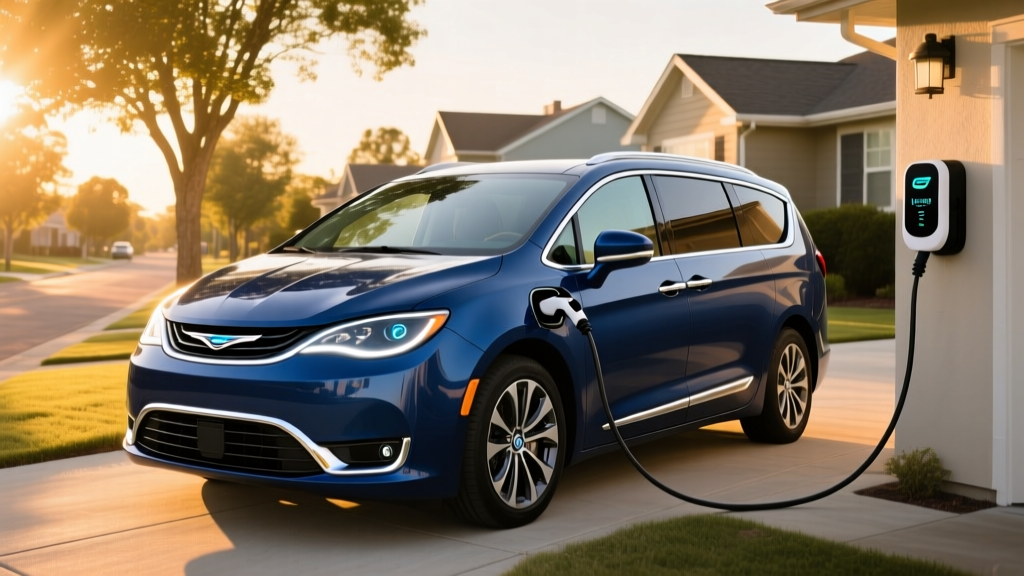
If you need three rows of seating, sliding doors, and the ability to do school runs on pure electricity, the Chrysler Pacifica Hybrid stands alone. No other minivan on the US market offers a plug-in hybrid powertrain. For the 2026 model year, the Pacifica Hybrid returns with its proven 16-kWh battery pack, 32 miles of EPA-rated electric-only range, and 30 MPG combined once the gas engine kicks in. That combination solves a specific problem: families who want electric commuting but can't sacrifice the flexibility for 400-mile road trips.
But does the real-world gas mileage match the EPA sticker? What happens to that electric range in winter or on the highway? And at a starting MSRP around $51,095, does the math work versus a conventional gas Pacifica or a full EV like the Kia EV9? We've driven, charged, and tracked the numbers.
HEV vs. PHEV: What the Pacifica Hybrid Actually Is
Conventional Hybrid (HEV): A small battery recharged by regenerative braking and the engine. You never plug it in. The Toyota Sienna is an HEV — it gets ~36 MPG combined but has zero electric-only range.
Plug-In Hybrid (PHEV): A larger battery you can charge from a wall outlet or public charger, giving a meaningful electric-only range before the gas engine starts. The Chrysler Pacifica Hybrid is a PHEV — it delivers 32 miles on electricity alone, then operates as a hybrid.
This distinction matters enormously for your fuel costs and daily routine. If your round-trip commute is under 30 miles and you charge at home, you might go weeks without buying gas. If you forget to plug in, the Pacifica Hybrid still functions as a conventional hybrid at 30 MPG combined — better than most gas-only minivans, though not quite as efficient as the Sienna's dedicated hybrid system.
How Many MPG Does the Pacifica Hybrid Get?
The EPA rates the 2026 Chrysler Pacifica Hybrid as follows:
| Metric | EPA Rating | Real-World Expectation |
|---|---|---|
| Combined MPGe (electric + gas) | 82 MPGe | Varies heavily by charging habits |
| Combined MPG (gas only, charge-depleted) | 30 MPG | 28–31 MPG; city often beats EPA |
| City MPG (gas only) | 29 MPG | 30–33 MPG (regen braking helps in stop-and-go) |
| Highway MPG (gas only) | 30 MPG | 27–29 MPG at 75+ mph |
| Electric-only range | 32 miles | 26–30 miles (highway/cold); 32–35 miles (city/mild weather) |
| Total combined range | 430 miles | ~400–420 miles real-world |
Source: EPA Fuel Economy — Chrysler Pacifica Hybrid
Real-world insight: Hybrids typically exceed their EPA city rating because regenerative braking recovers energy in stop-and-go traffic. On our mixed suburban test loop with frequent stops, we observed 31–33 MPG in gas-only mode. Highway driving at sustained speeds above 70 mph is where the Pacifica Hybrid loses ground — the boxy minivan shape and 5,000-pound curb weight push fuel consumption higher. Expect 27–29 MPG on the interstate.
Cold weather is the bigger variable. In temperatures below 35°F, the Pacifica Hybrid's electric range drops by 15–25% because the battery loses efficiency and the cabin heater draws significant power. Plan on roughly 24–27 miles of electric range in January in the Midwest, versus a full 32+ in spring and fall.
Electric-Only Range: How Far Can It Go Without Gas?
The EPA rates the Pacifica Hybrid at 32 miles of electric-only range. That number comes from a 16-kWh lithium-ion battery pack (approximately 13–14 kWh usable, with the remainder reserved as a buffer to protect battery longevity).
Thirty-two miles covers a surprising amount of daily driving. According to FHWA data, the average American drives roughly 37 miles per day. If you charge nightly at home, most weekday trips — school drop-offs, grocery runs, commuting — happen entirely on electricity, with the engine only firing up for longer weekend trips.
EPA Electric Range: 32 miles
Real-World Expectation: 26–35 miles depending on conditions
Best case (city, 60°F, gentle acceleration): 34–36 miles
Worst case (highway, 20°F, cabin heat on max): 22–26 miles
The Pacifica Hybrid does not support DC fast charging. This is a Level 1 / Level 2 vehicle only. Charging times:
| Charging Method | Power | 0–100% Time | Miles Added per Hour |
|---|---|---|---|
| Level 1 (120V household outlet) | ~1.4 kW | ~14 hours | ~2–3 miles/hr |
| Level 2 (240V, included cordset at 3.3 kW) | 3.3 kW | ~6 hours | ~5 miles/hr |
| Level 2 (240V wallbox at 6.6 kW) | 6.6 kW | ~2.5 hours | ~12 miles/hr |
| DC Fast Charge | Not supported | N/A | N/A |
The included dual-voltage charging cord handles both 120V and 240V outlets. Most PHEV owners find that plugging into a standard 120V outlet overnight is sufficient — 14 hours is enough to fully replenish the battery by morning. However, a dedicated 240V Level 2 station cuts that to 2.5 hours with a 6.6 kW capable unit, giving you flexibility for mid-day top-ups.
Powertrain: Engine, Motors, and Combined Horsepower
The Pacifica Hybrid pairs a naturally aspirated 3.6-liter Pentastar V6 (modified for Atkinson-cycle efficiency) with two electric motors integrated into the transmission. Here's the full breakdown:
| Specification | Detail |
|---|---|
| Engine | 3.6L V6 Atkinson-cycle |
| Engine horsepower | 262 HP |
| Electric motors | Two integrated motors |
| Combined system output | 260 HP |
| Transmission | Si-EVT (single-speed electrically variable) |
| Drivetrain | Front-wheel drive only |
| Battery capacity | 16 kWh total (~13–14 kWh usable) |
| Battery chemistry | NMC (nickel manganese cobalt) |
| Fuel tank | 14.5 gallons |
| 0–60 mph | ~7.1 seconds |
| Towing capacity | Not rated for towing (unlike gas Pacifica at 3,600 lbs) |
The most important trade-off to note: the Pacifica Hybrid is front-wheel drive only and cannot tow. The gas-only Pacifica offers available AWD and a 3,600-pound tow rating. If you need to pull a small trailer or want all-wheel drive for snow, the hybrid isn't the right configuration. The hybrid also loses the Stow 'n Go second-row seats — the battery pack lives under the floor where those seats would fold, so you get captain's chairs instead (which many buyers prefer for comfort anyway).
Pricing, Trims, and Tax Credit Eligibility
The 2026 Chrysler Pacifica Hybrid is offered in three trims:
| Trim | MSRP (approx.) |
|---|---|
| Hybrid Select | $51,095 |
| Hybrid Limited | $54,595 |
| Hybrid Pinnacle | $58,095 |
Federal Tax Credit: Does the Pacifica Hybrid Qualify?
Under current IRS §30D rules, the Pacifica Hybrid may qualify for a partial or full federal tax credit of up to $7,500, but eligibility depends on several factors that change frequently:
- MSRP cap: Vans/minivans must be under $80,000 — all Pacifica Hybrid trims qualify.
- Buyer income cap: Modified AGI must not exceed $150,000 (single), $225,000 (head of household), or $300,000 (joint filers).
- Battery sourcing: A percentage of critical minerals and battery components must be sourced from the US or free-trade-agreement countries. This requirement tightens annually and can change mid-year. Chrysler has historically qualified for at least a partial credit ($3,750), though full $7,500 eligibility varies by model year and production batch.
- Point-of-sale transfer: Since 2024, you can transfer the credit to the dealer at purchase, reducing your out-of-pocket cost immediately rather than waiting for tax filing.
Critical caveat: Tax credit rules are subject to change. Always verify current eligibility on IRS.gov and confirm with a tax professional before purchasing. The credit applies to your federal tax liability and may be reduced or eliminated depending on battery sourcing compliance at the time of delivery.
Some states offer additional rebates or HOV lane access for PHEVs. California's CVRP program, for example, has historically offered rebates for qualifying PHEVs, though funding and eligibility vary. Check your state energy office or Alternative Fuels Data Center for local incentives.
Battery Warranty, Reliability, and Replacement Costs
High-Voltage Battery Warranty: 10 years / 100,000 miles (whichever comes first)
Coverage: Defects and capacity loss below a defined threshold (typically 70% of original capacity)
Powertrain Warranty: 5 years / 60,000 miles
Bumper-to-Bumper: 3 years / 36,000 miles
The 10-year/100,000-mile battery warranty is standard for PHEVs and is mandated in states that follow California's CARB emissions rules (which includes over a dozen states). This is one of the longest coverage periods in the auto industry and should outlast most first-ownership cycles.
Reliability track record: The Pacifica Hybrid's powertrain has been in production since the 2017 model year, giving it nearly a decade of real-world data. Early models (2017–2019) had some reported issues with the high-voltage battery system and powertrain control module, leading to recalls. The 2021 refresh addressed many of these concerns. Owner forums and reliability surveys generally rate the post-2021 Pacifica Hybrid as average to slightly above average for the minivan segment.
Battery replacement cost: If the high-voltage battery fails outside of warranty, expect a replacement cost between $7,000 and $9,500 including parts and labor. This is a significant expense, but the 10-year warranty and the battery's NMC chemistry — which typically retains 80–85% capacity after 100,000 miles of moderate use — make out-of-pocket replacement uncommon for first owners.
The 12V auxiliary battery (a separate, conventional battery that runs accessories) may need replacement every 4–6 years at a cost of $200–$350, similar to any modern vehicle.
Pacifica Hybrid vs. Gas Pacifica vs. Full EV: Which Fits You?
Choose the Pacifica Hybrid (PHEV) if:
- Your daily driving is under 30 miles round-trip and you can charge at home
- You need three rows and sliding doors but want to minimize fuel costs
- You take road trips longer than 250 miles and don't want to plan around chargers
- You want electric commuting without committing to a full EV
Choose the gas Pacifica if:
- You need AWD or towing capability (3,600 lbs)
- You cannot charge at home (apartment, street parking)
- Upfront budget is tight — the gas Pacifica starts ~$12,000 lower
- You drive primarily highway miles where the hybrid advantage shrinks
Choose a full EV (e.g., Kia EV9) if:
- You want zero tailpipe emissions and the lowest per-mile fuel cost
- You have reliable home charging and access to DC fast chargers for trips
- You don't mind 20–30 minute charging stops on road trips
- You want a full $7,500 federal credit with more predictable eligibility
| Factor | Pacifica Hybrid (PHEV) | Pacifica Gas | Kia EV9 (Full EV) |
|---|---|---|---|
| Starting MSRP | ~$51,095 | ~$39,400 | ~$54,900 |
| Combined fuel economy | 30 MPG / 82 MPGe | 22 MPG | 89 MPGe |
| Electric-only range | 32 miles | 0 | 279–304 miles |
| Total range | ~430 miles | ~440 miles | 279–304 miles |
| AWD available | No | Yes | Yes |
| Towing | Not rated | 3,600 lbs | 5,000 lbs |
| Home charging needed | Recommended | No | Essential |
| Federal tax credit | Up to $7,500 (varies) | None | Up to $7,500 |
Pros and Cons
Pros
- Only PHEV minivan on the market — no direct competitor
- 32 miles of electric range covers most daily family driving
- 30 MPG combined in gas mode beats most non-hybrid minivans
- No range anxiety — 430+ miles total range with gas backup
- 10-year/100,000-mile battery warranty
- Point-of-sale tax credit transfer reduces upfront cost
- Smooth, quiet electric driving around town
Cons
- No AWD option — gas Pacifica offers it
- No towing capability
- No DC fast charging — Level 2 only
- Stow 'n Go second-row seats unavailable (battery occupies under-floor space)
- Starting price ~$12,000 higher than gas Pacifica
- Highway MPG drops below EPA estimate at sustained 75+ mph
- Electric range drops 15–25% in cold weather
Frequently Asked Questions
How many MPG does the Chrysler Pacifica Hybrid get?
The EPA rates the Pacifica Hybrid at 30 MPG combined (29 city / 30 highway) in gas-only mode, and 82 MPGe when factoring in electric driving. In real-world city driving with frequent stops, owners commonly report 31–33 MPG thanks to regenerative braking. Highway cruising at 75 mph typically yields 27–29 MPG.
How far can the Pacifica Hybrid go on electric only?
The EPA rates it at 32 miles of electric-only range. Real-world results range from about 24 miles in cold highway driving to 35 miles in mild-weather city conditions. For most families, 32 miles covers the daily school-commute-grocery loop entirely on electricity if you charge overnight.
Can I charge the Pacifica Hybrid on a regular household outlet?
Yes. The included dual-voltage charging cord works with a standard 120V outlet (Level 1), delivering a full charge in approximately 14 hours. Since most PHEV owners charge overnight, this is sufficient for daily use. A 240V Level 2 station reduces charge time to 2.5 hours at 6.6 kW.
Does the Pacifica Hybrid qualify for the $7,500 federal tax credit?
It may qualify for a partial or full credit under IRS §30D, depending on battery sourcing requirements, your income, and the MSRP cap (which the Pacifica Hybrid clears). Eligibility rules change frequently — verify on IRS.gov and confirm with the dealer at the time of purchase. Point-of-sale transfer is available, letting you apply the credit directly to your purchase price.
Is the Pacifica Hybrid reliable?
Post-2021 models have an average to slightly above-average reliability record. Early production years (2017–2019) saw some recalls related to the high-voltage battery system, but the current generation has been more stable. The 10-year/100,000-mile battery warranty provides long-term protection against defects and significant capacity loss.
What does it cost to replace the Pacifica Hybrid battery?
Out-of-warranty replacement of the 16-kWh high-voltage battery runs approximately $7,000–$9,500 including labor. However, the 10-year/100,000-mile warranty covers defects and excessive degradation, and NMC batteries in PHEV applications typically retain 80–85% capacity at 100,000 miles. Most first owners will never face this cost.
Should I buy the Pacifica Hybrid or the Toyota Sienna?
The Sienna is a conventional hybrid (HEV) — you never plug it in, and it gets ~36 MPG combined, which is better than the Pacifica Hybrid's 30 MPG in gas-only mode. However, the Sienna has zero electric-only range. The Pacifica Hybrid wins if you can charge at home and want to drive on electricity for short trips. The Sienna wins if you can't charge, want AWD, or prioritize maximum highway MPG without plugging in. Both are strong choices for different use cases.
Does the Pacifica Hybrid have Stow 'n Go seating?
No. The high-voltage battery pack is mounted under the floor where Stow 'n Go compartments would normally be. The second row uses removable captain's chairs instead. The third row still folds flat into the floor. If in-floor second-row storage is a dealbreaker, the gas Pacifica offers Stow 'n Go.