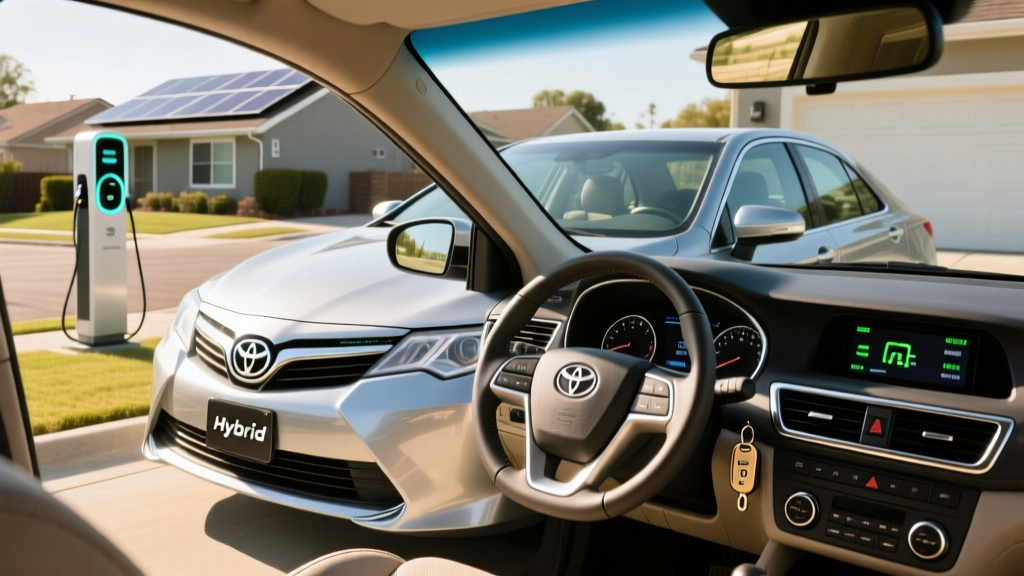
If you're researching the fuel economy 2012 Camry Hybrid, you're likely looking at a used midsize sedan that promised Prius-like efficiency in a more spacious, conventional package. More than a decade after it rolled off the line, the 2012 Toyota Camry Hybrid (model code XV50) remains one of the most popular used hybrids on the road — and for good reason. But does its EPA sticker hold up in 2026? What should you expect from a 14-year-old hybrid battery? And how does it compare to a modern PHEV or full EV?
This guide covers every number that matters: EPA and real-world MPG, the hybrid powertrain specs, battery warranty and replacement costs, and a clear-eyed look at who should still consider this car today.
2012 Camry Hybrid Fuel Economy: EPA Numbers and Real-World MPG
The 2012 Toyota Camry Hybrid LE carries an EPA rating of 43 MPG city / 39 MPG highway / 41 MPG combined. The XLE trim, due to slightly heavier equipment and larger wheels, is rated at 40 city / 38 highway / 40 combined. These figures come directly from fueleconomy.gov, the official EPA source.
| Trim | City MPG | Highway MPG | Combined MPG | Fuel Tank | EPA Range |
|---|---|---|---|---|---|
| LE | 43 | 39 | 41 | 17.0 gal | ~697 mi |
| XLE | 40 | 38 | 40 | 17.0 gal | ~680 mi |
Real-World MPG vs. the EPA Sticker
Toyota's Hybrid Synergy Drive system excels in stop-and-go city driving, where regenerative braking recaptures energy and the electric motor handles low-speed propulsion. In practice, many owners report exceeding the EPA city figure — 44–47 MPG is common in urban commuting with moderate acceleration. Highway driving is a different story: at sustained 70–75 MPH speeds, expect 35–38 MPG due to aerodynamic drag and the engine running more frequently.
Powertrain and Hybrid System Specs
The 2012 Camry Hybrid pairs a 2.5-liter Atkinson-cycle four-cylinder engine (2AR-FXE) with a permanent-magnet electric motor through Toyota's eCVT transaxle. This is a conventional hybrid (HEV) — it does not plug in. The battery recharges through regenerative braking and the gasoline engine.
| Gas Engine | 2.5L 4-cyl Atkinson-cycle (2AR-FXE), 156 hp / 156 lb-ft |
| Electric Motor | Permanent-magnet synchronous, 105 kW (141 hp) |
| Net Combined Output | 200 hp |
| Transmission | eCVT (planetary gearset, no traditional gears) |
| Hybrid Battery | Nickel-metal hydride (NiMH), 1.6 kWh (gross) |
| 0–60 MPH | ~7.6 seconds |
| Drive Wheels | Front-wheel drive |
| Curb Weight | ~3,435 lbs (LE) |
Note that the combined 200 hp figure is not simply the engine and motor added together — Toyota's power-split device blends the two power sources, and peak outputs don't occur at the same RPM. Still, 200 hp made this one of the quickest midsize hybrids of its era, and it remains adequate for highway merging and passing today.
HEV vs. PHEV vs. EV: Where the 2012 Camry Hybrid Fits
The 2012 Camry Hybrid is a conventional hybrid (HEV). It has no plug, no electric-only driving range to speak of (the EV mode allows roughly 1 mile at very low speeds, which is essentially negligible), and no eligibility for federal EV tax credits. Here's how it compares structurally to the other powertrain types available in 2026:
| Attribute | HEV (e.g., 2012 Camry Hybrid) | PHEV (e.g., 2026 RAV4 Prime) | BEV (e.g., 2026 Camry-class EV) |
|---|---|---|---|
| Plugs in? | No | Yes (Level 1/2) | Yes (Level 1/2/DC) |
| Battery Size | ~1.6 kWh NiMH | ~18 kWh NMC | ~70–85 kWh NMC/LFP |
| Electric-Only Range | ~1 mi (negligible) | 35–42 mi | 250–350 mi (EPA) |
| Total Range | ~680–700 mi | ~550+ mi combined | 250–350 mi |
| Federal Tax Credit (§30D) | Not eligible | Up to $7,500 (if eligible) | Up to $7,500 (if eligible) |
| Home Charging Needed? | No | Recommended | Essential |
| Oil Changes? | Yes (every 5k–10k mi) | Yes (less frequent) | No |
Choose the 2012 Camry Hybrid if: You want maximum simplicity, no charging infrastructure, low purchase price on the used market ($7,000–$11,000 in 2026), and proven long-term reliability. It's ideal for apartment dwellers or anyone without access to home charging.
Choose a PHEV if: You can charge at home, have a short commute (under 40 miles), and want electric-only daily driving with gas-engine backup for road trips. A new PHEV may qualify for the §30D credit, subject to IRS eligibility rules including MSRP caps, buyer income limits, and battery sourcing requirements.
Choose a BEV if: You want zero tailpipe emissions, have reliable home or workplace charging, and are ready to plan around DC fast charging for road trips.
Hybrid Battery Lifespan, Warranty, and Replacement Cost
This is the top concern for any used-hybrid buyer — and it should be. The 2012 Camry Hybrid uses a nickel-metal hydride (NiMH) battery pack, which is less energy-dense than modern lithium-ion but has a well-documented track record for longevity.
How Long Does the Battery Actually Last?
Real-world data from owner communities and repair shops shows the NiMH pack in the 2012 Camry Hybrid commonly lasts 150,000–200,000 miles before significant degradation triggers a check-engine light or noticeable fuel-economy drop. Some examples exceed 250,000 miles with original batteries, but this is the exception. The key factors affecting lifespan:
- Heat exposure: Batteries in hot-climate states (Arizona, Texas, Florida) tend to degrade faster than those in cooler regions.
- Driving habits: Frequent deep discharge cycles and heavy acceleration accelerate cell degradation.
- Age: Even low-mileage examples will see NiMH cell degradation after 14+ years. Calendar aging matters.
Battery Replacement Cost in 2026
If the hybrid battery fails, you have several options:
| Replacement Option | Cost Range | Warranty | Notes |
| New OEM Toyota Battery | $3,500–$4,500 (parts + labor) | 3 yr / 36,000 mi | Most reliable option; dealer-installed |
| Refurbished / Reconditioned | $1,500–$2,500 | 1–3 yr (varies) | Replaced weak cells; quality varies by shop |
| Used Salvage Battery | $500–$1,200 | 30–90 days | Risky — unknown remaining life |
| Aftermarket New (e.g., Dorman) | $2,000–$3,000 | 2–3 yr | Growing availability; decent middle ground |
Given that a clean 2012 Camry Hybrid sells for roughly $7,000–$11,000 in the 2026 used market, a $4,000 OEM battery replacement is a significant percentage of the car's value. Factor this into your purchase decision — ideally, buy one with a recently replaced battery and documentation, or budget for a replacement within your ownership window.
Tax Credits and Incentives: Does It Qualify?
No. The 2012 Camry Hybrid does not qualify for the federal §30D New Clean Vehicle Credit. That credit applies only to new plug-in vehicles (BEVs and PHEVs) meeting specific battery sourcing, MSRP, and buyer income requirements. As a conventional hybrid with no plug, the Camry Hybrid has never been eligible for §30D — not when it was new, and certainly not on the used market in 2026.
Some states historically offered rebates for conventional hybrids, but most of those programs have expired or shifted focus to plug-in vehicles. Check your state's current energy office or DMV website for any residual incentives, but plan your budget assuming no tax credits or rebates apply.
Reliability and Long-Term Ownership Costs
The 2012 Camry Hybrid's reputation for reliability is well-earned. The 2AR-FXE engine is a proven design shared with the Camry gas model, and the eCVT transaxle has no traditional clutch packs or bands to wear out — it's a planetary gearset with very few failure points. Toyota's hybrid system has been in continuous production since 1997, and by 2012 it was thoroughly mature.
Key ownership considerations in 2026:
- Brakes: Regenerative braking reduces pad wear significantly. Many owners report 80,000–100,000+ miles on original brake pads.
- eCVT fluid: Toyota recommends changing the transaxle fluid (Toyota WS ATF) every 60,000 miles under severe use. At ~$150–$250 per service, this is minor.
- Inverter coolant: The inverter cooling system should be inspected; coolant replacement is due at 100,000 miles and every 50,000 miles thereafter.
- Insurance: Typically comparable to or slightly lower than the gas Camry — no EV premium surcharge.
Pros
- 41 MPG combined EPA; often exceeds city rating in real-world driving
- Proven, simple HEV system with no plug-in requirement
- Spacious midsize cabin with 15.4 cu-ft trunk
- Low maintenance costs (no plug changes, long brake life)
- Strong resale value retention for a 14-year-old vehicle
- Smooth, quiet hybrid powertrain with 200 hp
Cons
- Hybrid battery warranty expired; replacement costs $1,500–$4,500
- No federal tax credit eligibility
- Dated infotainment (no Apple CarPlay / Android Auto natively)
- NiMH battery less tolerant of extreme heat than modern LFP
- Highway MPG drops to 35–38 at sustained 70+ MPH speeds
- Safety tech limited to 2012 standards (no AEB, no lane-keeping)
Who Should Buy the 2012 Camry Hybrid in 2026?
This car fits a specific buyer profile well:
Ideal for: Budget-conscious commuters who drive 15–40 miles daily in mixed city/highway conditions, especially those without access to home or workplace charging. If you live in an apartment, park on the street, or simply want zero charging hassle, a used Camry Hybrid offers 40+ MPG with gas-station convenience and Toyota reliability at a sub-$10,000 entry price.
Less ideal for: Anyone with a home garage who could install a Level 2 charger — a modern PHEV like the 2026 Toyota RAV4 Prime or Prius Prime would give you 35–42 miles of electric-only commuting and still provide a gas engine for road trips, plus potential §30D tax credit eligibility. Similarly, if you drive mostly highway miles, a modern diesel or a high-MPG gas car may close the efficiency gap at sustained speeds where the Camry Hybrid's advantage narrows.
Not ideal for: Buyers prioritizing the latest ADAS features (automatic emergency braking, lane-centering, adaptive cruise). The 2012 model predates these technologies. If safety tech is a priority, look at a 2018+ Camry Hybrid with Toyota Safety Sense, which carries a 52 MPG combined EPA rating and modern driver assistance.
Frequently Asked Questions
How many MPG does the 2012 Camry Hybrid get?
The EPA rates the 2012 Camry Hybrid LE at 43 city / 39 highway / 41 combined MPG. The XLE trim is rated at 40 city / 38 highway / 40 combined. Real-world city driving often exceeds the EPA city figure (44–47 MPG), while sustained highway driving at 70+ MPH typically yields 35–38 MPG.
Does the 2012 Camry Hybrid need to be plugged in?
No. This is a conventional hybrid (HEV), not a plug-in hybrid. The battery charges through regenerative braking and the gasoline engine. You never plug it in — just fill up at any gas station.
How long does the 2012 Camry Hybrid battery last?
The NiMH hybrid battery typically lasts 150,000–200,000 miles, though calendar aging (14+ years as of 2026) is also a factor. Some units fail earlier in hot climates; others exceed 250,000 miles. The original 8-year/100,000-mile warranty has expired for all 2012 models.
What does it cost to replace the hybrid battery?
A new OEM battery from Toyota costs approximately $3,500–$4,500 installed. Refurbished options run $1,500–$2,500, and aftermarket new batteries (e.g., Dorman) cost $2,000–$3,000. Given the car's used market value of $7,000–$11,000 in 2026, this is a significant expense to budget for.
Does the 2012 Camry Hybrid qualify for any tax credit?
No. The federal §30D credit applies only to new plug-in vehicles (BEVs and PHEVs). The Camry Hybrid is a conventional hybrid with no plug and has never been eligible for federal EV tax credits. Check your state's energy office for any residual hybrid incentives, but most have expired.
Is the 2012 Camry Hybrid reliable?
Yes — it has an excellent reliability record. The 2AR-FXE engine and eCVT transaxle are proven designs with few failure points. The main reliability risk in 2026 is hybrid battery degradation due to age, which is a known and budgetable expense rather than a catastrophic failure.
How does the 2012 Camry Hybrid compare to a newer Camry Hybrid?
The 2025–2026 Camry Hybrid uses Toyota's fifth-generation hybrid system with a lithium-ion battery and achieves 51 city / 49 highway / 50 combined MPG — a substantial improvement. It also includes Toyota Safety Sense 3.0 (AEB, lane-centering, adaptive cruise) and Apple CarPlay/Android Auto. If your budget allows $30,000+, a new Camry Hybrid is the objectively better vehicle, but at 3–4x the used price of a 2012 model.
Sources: EPA fuel economy data from fueleconomy.gov; IRS §30D credit rules from irs.gov; Toyota hybrid battery warranty and specifications from manufacturer documentation.