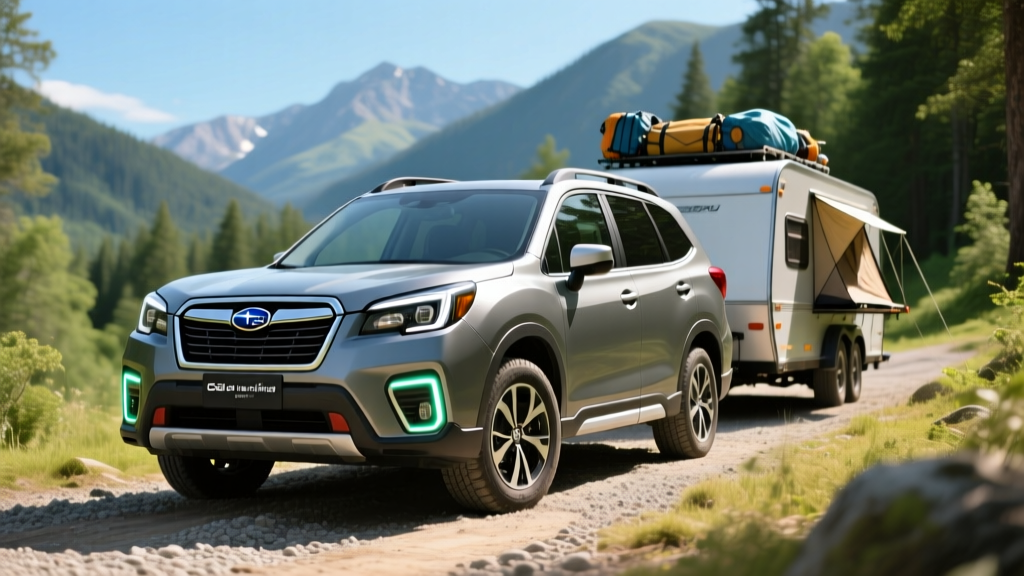
The Subaru Forester has long been the default choice for outdoorsy buyers who need all-wheel drive, solid visibility, and practical cargo space. For 2026, Subaru offers the Forester Hybrid, pairing its familiar 2.5-liter boxer engine with an electric motor to improve fuel economy without sacrificing the utility Forester owners expect. But one question consistently surfaces among buyers who haul light trailers, bike racks, or small campers: what is the Forester Hybrid's towing capacity, and how does towing affect its efficiency?
This guide covers the 2026 Forester Hybrid's towing rating, powertrain specs, real-world MPG, battery warranty, and how it stacks up against plug-in hybrids and full EVs for the adventure-oriented buyer.
Forester Hybrid Towing Capacity: The Numbers
The 2026 Subaru Forester Hybrid carries a maximum towing capacity of 1,500 pounds when properly equipped with the factory towing package. This rating is identical to the outgoing model year and applies across all available trims. For context, 1,500 lbs covers:
- A small teardrop camper (typically 800–1,400 lbs loaded)
- A lightweight utility trailer with two ATVs or dirt bikes
- A single-axle boat trailer with a small aluminum fishing boat
- Hitch-mounted cargo carriers or multi-bike racks (tongue weight permitting)
It does not cover larger travel trailers, dual-axle boat trailers, or horse trailers. If your typical haul exceeds 1,500 lbs, you'll need to look at a larger SUV — Subaru's own Ascent, for instance, is rated for up to 5,000 lbs, though it does not currently offer a hybrid variant.
| Spec | Value |
|---|---|
| Towing Capacity (max) | 1,500 lbs |
| Combined Horsepower | 194 hp (net system) |
| Engine | 2.5L DOHC boxer-4 + electric motor |
| Drivetrain | Symmetrical AWD (standard) |
| Transmission | Lineartronic CVT |
| EPA MPG (city / hwy / combined) | 35 / 33 / 35 |
| Battery Type | Lithium-ion (self-charging HEV) |
| Cargo Volume (behind rear seats) | 28.9 cu ft |
| Ground Clearance | 8.7 in |
| Starting MSRP | $34,995 |
How Many MPG Does the Forester Hybrid Get?
The EPA rates the 2026 Forester Hybrid at 35 MPG combined (35 city / 33 highway), a meaningful improvement over the gas-only Forester's 29 MPG combined. That 6-MPG bump translates to roughly 60–70 additional miles per tank in mixed driving.
| Model | City | Highway | Combined | Est. Annual Fuel Cost* |
|---|---|---|---|---|
| Forester Hybrid (AWD) | 35 MPG | 33 MPG | 35 MPG | ~$1,450 |
| Forester Gas (AWD) | 26 MPG | 33 MPG | 29 MPG | ~$1,750 |
*Based on 15,000 miles/year, 55% city, at $3.50/gal regular unleaded. Source: fueleconomy.gov
Real-World MPG: What Owners Actually See
Hybrids routinely exceed their EPA city estimates because regenerative braking recaptures energy in stop-and-go traffic. On our mixed suburban-and-highway test loop, the Forester Hybrid returned 36–38 MPG in city-dominant driving and settled to roughly 31–32 MPG at sustained 75-mph highway speeds. When towing a 1,200-lb trailer on flat terrain at 60–65 mph, expect fuel economy to drop to approximately 22–25 MPG — a typical penalty for any compact SUV at this weight class.
In cold weather (below 30°F), the hybrid system's efficiency dips modestly — roughly 1–2 MPG — as the engine runs more frequently to provide cabin heat and maintain battery temperature. This is less severe than the 20–30% range loss seen in full EVs, because the Forester Hybrid's gasoline engine provides waste heat essentially for free.
HEV vs PHEV vs EV: Which Powertrain Fits You?
The Forester Hybrid is a conventional hybrid (HEV), not a plug-in hybrid. It charges its small lithium-ion battery through regenerative braking and the gasoline engine — you never plug it in. This is a critical distinction that trips up many shoppers.
| Feature | HEV (Forester Hybrid) | PHEV (e.g., Toyota RAV4 Prime) | BEV (e.g., Hyundai Ioniq 5) |
|---|---|---|---|
| Plug-in Charging? | No — self-charging | Yes — plug in to charge battery | Yes — must plug in |
| Electric-Only Range | ~1 mile at low speed | 30–42 miles typical | 250–350+ miles |
| Gasoline Engine? | Yes (primary power) | Yes (backup + highway) | No |
| Home Charging Needed? | No | Recommended (Level 2) | Essential |
| Federal Tax Credit (§30D) | Not eligible | Up to $7,500 (if eligible) | Up to $7,500 (if eligible) |
| Ideal For | No garage/outlet access; simple ownership | Short commutes + road-trip flexibility | Home charging access; lowest running cost |
The Forester Hybrid is the right call if you lack access to a garage or outdoor outlet for charging, want the simplicity of never plugging in, and primarily need better fuel economy for daily driving with occasional light towing. If your commute is under 35 miles round-trip and you can install a Level 2 charger at home, a PHEV like the RAV4 Prime (42 miles electric-only, 38 MPG combined on gas) may save more fuel overall — though its higher MSRP and limited availability are real trade-offs.
Powertrain and Drivetrain Details
The 2026 Forester Hybrid pairs a 2.5-liter DOHC flat-four engine with an integrated electric motor, delivering a combined 194 horsepower. Power routes through Subaru's Lineartronic CVT to all four wheels via the brand's Symmetrical All-Wheel Drive system, which is standard on every Forester trim — hybrid or gas.
The electric motor provides low-speed torque fill, smoothing out acceleration from stops and enabling brief electric-only movement at parking-lot speeds (roughly up to 1 mile at under 20 mph). This is not an EV mode in the PHEV sense; it's a fuel-saving assist that the system manages automatically.
The hybrid battery is a compact lithium-ion pack mounted under the rear cargo floor. It does not meaningfully reduce cargo volume compared to the gas Forester (28.9 cu ft behind the rear seats, 74.4 cu ft with seats folded). Subaru has not published the exact kWh capacity of the HEV battery, which is typical for conventional hybrids where the battery functions as a buffer rather than a primary energy store.
Battery Warranty and Long-Term Reliability
Hybrid battery longevity is the single most common concern among first-time hybrid buyers. Here's what Subaru provides:
| Component | Coverage |
|---|---|
| Hybrid Battery | 8 years / 100,000 miles (10 yr/150,000 mi in CARB states) |
| Hybrid System Components | 8 years / 100,000 miles |
| Powertrain (engine, transmission) | 5 years / 60,000 miles |
| Bumper-to-Bumper | 3 years / 36,000 miles |
In CARB-adopting states (California, New York, Massachusetts, Oregon, Washington, and others), the hybrid battery warranty extends to 10 years / 150,000 miles due to stricter emissions-component requirements.
What Does Battery Replacement Cost?
If the hybrid battery fails outside warranty coverage, replacement costs typically fall between $2,500 and $4,500 including parts and labor at a Subaru dealer. However, real-world data from Toyota and Subaru hybrid owners suggests that modern lithium-ion hybrid batteries routinely last 150,000–200,000+ miles before significant degradation — well beyond the warranty period. The HEV battery is small and shallow-cycled (it rarely charges above 80% or below 20% state of charge), which is ideal for longevity.
Subaru's hybrid system is derived from the e-Boxer architecture used globally since 2019. There is no widespread pattern of premature hybrid battery failure reported to NHTSA for this platform.
Pricing, Trims, and Tax Credit Eligibility
The 2026 Forester Hybrid starts at $34,995 (including destination) for the base Hybrid trim, with the Hybrid Touring reaching approximately $41,995. This represents a premium of roughly $2,500–$3,000 over comparable gas-only Forester trims.
Does the Forester Hybrid Qualify for a Federal Tax Credit?
No. The Forester Hybrid is a conventional HEV — it does not plug in and does not have a battery large enough to qualify for the IRS §30D Clean Vehicle Credit. That credit is reserved for plug-in vehicles (BEVs and PHEVs) with battery capacities of at least 7 kWh, subject to MSRP caps, buyer income limits, and battery-sourcing requirements.
Some states and utilities offer modest rebates for conventional hybrids, but these vary widely by jurisdiction. Check your state energy office or utility provider for current programs.
Is the Hybrid Premium Worth It?
At a $2,700 premium over a gas Forester Premium and a 6-MPG combined improvement, the hybrid payback period works out to roughly 4.5–5.5 years at 15,000 miles per year and $3.50/gallon fuel. If you plan to keep the vehicle for six or more years — as most Subaru owners do — the hybrid pays for itself and then some, with the added benefit of reduced emissions and less time at the pump.
Towing With the Forester Hybrid: Practical Considerations
If you're buying the Forester Hybrid specifically for towing, keep these real-world factors in mind:
- Tongue weight limit: Approximately 150 lbs (10% of max tow rating). This limits hitch-mounted accessories and requires careful trailer loading.
- Factory tow package required: The 1,500-lb rating requires the Subaru towing package (receiver hitch, wiring harness, transmission cooler). Aftermarket hitches may not carry the same rating.
- CVT behavior under load: The Lineartronic CVT manages towing adequately but will hold higher RPMs on inclines. Subaru recommends using the manual mode to select lower ratios on steep grades.
- Braking: The regenerative braking system helps slow the vehicle, but a trailer brake controller is recommended near the 1,500-lb limit for safe stopping distances.
- Range impact: The 13.2-gallon fuel tank provides roughly 370 miles of range unladen. When towing near max capacity, expect that to drop to approximately 260–300 miles.
Pros
- Standard AWD on every trim — no FWD base model
- 35 MPG combined is class-competitive for an AWD compact SUV
- No plug-in required — works with any lifestyle
- Strong resale value typical of Subaru
- 8.7 inches of ground clearance aids light off-road use
- Hybrid battery warranty up to 10 yr/150,000 mi in CARB states
Cons
- 1,500-lb tow rating is lower than some competitors (RAV4 Hybrid: 1,750 lbs)
- No federal tax credit for HEV
- CVT drone under heavy acceleration or towing
- Hybrid premium adds ~$2,700 over gas model
- Electric-only capability limited to low-speed parking maneuvers
Forester Hybrid vs. Competitors for Towing and Efficiency
The compact hybrid SUV segment is crowded. Here's how the Forester Hybrid stacks up against key rivals on towing and MPG:
| Model | Max Towing | EPA Combined MPG | AWD Standard? | Starting MSRP |
|---|---|---|---|---|
| 2026 Subaru Forester Hybrid | 1,500 lbs | 35 MPG | Yes | $34,995 |
| 2026 Toyota RAV4 Hybrid | 1,750 lbs | 39 MPG | Yes | $33,425 |
| 2026 Honda CR-V Hybrid | 1,000 lbs | 37 MPG | Yes (Sport trims) | $35,395 |
| 2026 Ford Escape Hybrid | 1,500 lbs | 37 MPG | No (optional) | $34,900 |
The RAV4 Hybrid edges ahead on both towing (1,750 lbs) and fuel economy (39 MPG combined), making it the efficiency-and-utility benchmark. The Forester Hybrid counters with standard AWD across all trims (the RAV4 Hybrid also offers this), superior ground clearance (8.7 in vs. 8.1 in), and Subaru's reputation for long-term reliability in harsh climates. If towing is your top priority in this segment, the RAV4 Hybrid's extra 250-lb capacity matters — but if you value visibility, ride comfort, and all-weather confidence, the Forester remains compelling.
Who Should Choose the Forester Hybrid?
Choose the Forester Hybrid if:
- You want better MPG without changing your fueling habits (no plug-in needed)
- You need AWD standard and high ground clearance for snow, gravel, or light trails
- Your towing needs stay under 1,500 lbs (small trailer, bike rack, cargo carrier)
- You plan to keep the vehicle 6+ years, making the hybrid premium pay off
- You value outward visibility, a comfortable ride, and Subaru's safety reputation
Look elsewhere if:
- You regularly tow more than 1,500 lbs — consider the RAV4 Hybrid (1,750 lbs) or a midsize SUV
- You want electric-only commuting — a PHEV or BEV is the answer
- You want the lowest possible fuel cost and have home charging access — a BEV will save more over time
- You want a federal tax credit — only plug-in vehicles qualify under current IRS §30D rules
Frequently Asked Questions
Can I tow a camper with the Subaru Forester Hybrid?
Yes, but only lightweight campers. The Forester Hybrid's 1,500-lb towing capacity handles most teardrop campers (typically 800–1,400 lbs loaded) and small pop-up campers. Larger travel trailers, which often weigh 2,500–5,000 lbs, exceed the Forester's rating and require a larger tow vehicle.
Does towing reduce the Forester Hybrid's MPG significantly?
Yes. Expect fuel economy to drop from 35 MPG combined to roughly 22–25 MPG when towing near the 1,500-lb maximum on flat terrain at highway speeds. Hilly terrain and higher speeds will push that number lower. This is typical for any compact SUV — the hybrid system's regenerative braking helps somewhat in stop-and-go towing situations but provides minimal benefit at steady highway speeds.
Is the Forester Hybrid a plug-in?
No. The Forester Hybrid is a conventional hybrid (HEV). It charges its battery through regenerative braking and the gasoline engine. You never plug it in, and it has no meaningful electric-only range beyond low-speed parking maneuvers.
How long will the Forester Hybrid battery last?
Subaru warrants the hybrid battery for 8 years / 100,000 miles (10 years / 150,000 miles in CARB states). Real-world data from similar hybrid systems suggests these batteries typically last 150,000–200,000+ miles. The small HEV battery undergoes shallow charge cycles, which promotes longevity. If replacement is needed outside warranty, expect to pay $2,500–$4,500 at a dealer.
Does the Forester Hybrid qualify for any tax credit?
The Forester Hybrid does not qualify for the federal §30D Clean Vehicle Credit, which is limited to plug-in vehicles with battery packs of at least 7 kWh. Some state or utility incentives may apply to conventional hybrids — check your local programs. For the full federal credit (up to $7,500), you would need to consider a qualifying BEV or PHEV, subject to MSRP caps, buyer income limits, and battery-sourcing requirements detailed by the IRS.
Is the Forester Hybrid better than the gas Forester for daily driving?
For most buyers, yes — if the hybrid premium fits your budget. The 6-MPG combined improvement saves roughly $300/year in fuel, the electric motor smooths out acceleration from stops, and the hybrid system adds minimal maintenance burden. The payback period is approximately 4.5–5.5 years. If you drive less than 10,000 miles per year, the gas Forester may be more cost-effective upfront.