Quick Verdict: The Transit Custom PHEV in 2026
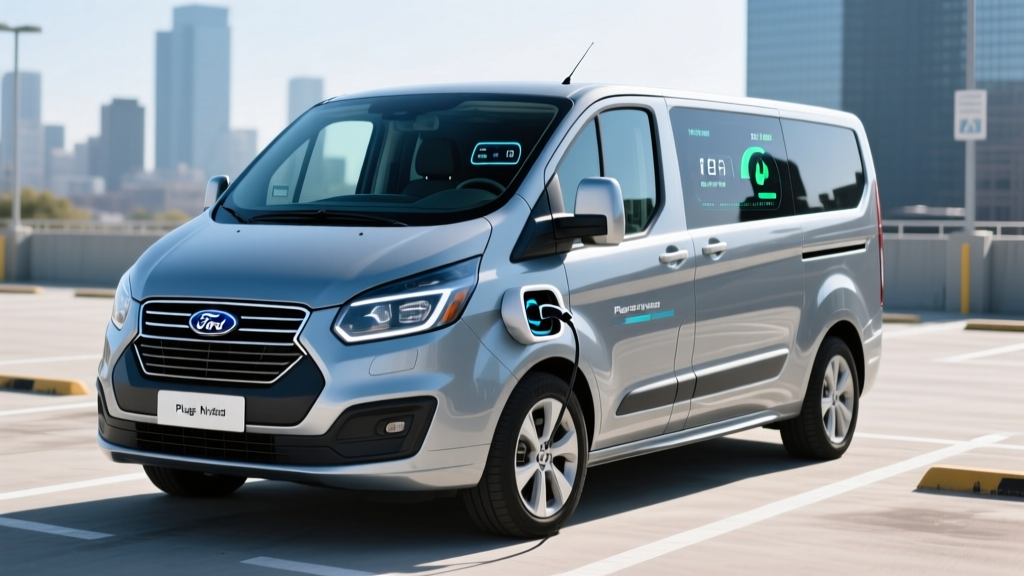
The Ford Transit Custom Plug-In Hybrid occupies a narrow but valuable lane: a midsize commercial van that can complete most urban delivery routes on battery power alone while retaining a gasoline range extender for longer runs. For fleet operators navigating low-emission zones or seeking to cut fuel spend on stop-and-go routes, the 2026 Transit Custom PHEV delivers up to 31 miles of electric-only range (WLTP) from a 11.8 kWh usable battery, paired with a 1.5-liter EcoBoost three-cylinder range extender that never mechanically drives the wheels.
This is not a vehicle sold in the United States as of the 2026 model year — it's targeted at European and UK markets where the Transit Custom nameplate competes with the Volkswagen Transporter, Mercedes-Benz Vito, and Peugeot Expert. If you're a US-based fleet manager, this review still matters: the powertrain architecture previews technology Ford may bring stateside, and the real-world data informs the broader PHEV van category.
| Spec | Value |
|---|---|
| Electric-only range (WLTP) | ~31 mi (50 km) |
| Estimated real-world EV range | 22–27 mi (city), 18–22 mi (highway/cold) |
| Battery (usable) | 11.8 kWh, NMC lithium-ion |
| Range extender engine | 1.5L EcoBoost 3-cylinder gasoline |
| Electric motor output | 92.9 kW (125 hp) |
| Combined system output | ~125 hp (motor-driven; engine acts as generator) |
| Fuel tank | ~14.1 gal (54 L) |
| Total combined range (est.) | ~310+ mi (EV + generator) |
| MPGe (combined, est. WLTP) | ~91 MPGe |
| Charge time (Level 2, 7 kW) | ~2.75 hours (0–100%) |
| DC fast charging | Not available |
| Cargo volume | ~213 cu ft (6.0 m³, short wheelbase) |
| Payload capacity | ~2,090 lb (950 kg, varies by config) |
| Base MSRP (UK, excl. VAT) | ~£39,000 (est.) |
| US availability | Not sold in US (2026) |
| Battery warranty | 8 years / 100,000 mi |
Understanding the Powertrain: Series Hybrid, Not Parallel
The Transit Custom PHEV uses a series-hybrid architecture — a design choice that sets it apart from most consumer PHEVs like the Toyota RAV4 Prime or Ford Escape PHEV. Here, the 1.5L EcoBoost engine never directly turns the wheels. Instead, it functions solely as an onboard generator, producing electricity to feed the 92.9 kW drive motor or recharge the battery when it depletes below a threshold.
This means driving feel is always electric: instant torque, linear acceleration, and regenerative braking. The engine kicks in audibly under heavy load or when the battery is depleted, but there are no gear shifts from a traditional transmission because there is no mechanical link between engine and axle.
HEV vs. PHEV — What's the Difference Here?
Conventional Hybrid (HEV): A standard hybrid like the Toyota Sienna uses a small battery (~1–2 kWh) charged exclusively by regenerative braking and the engine. You never plug it in. Electric-only driving is limited to very low speeds and short distances (typically under 1 mile).
Plug-In Hybrid (PHEV): The Transit Custom PHEV has a substantially larger 11.8 kWh battery that you can plug in — via a standard Type 2 AC connection — to achieve 22–31 miles of genuine electric-only driving before the range extender activates. This is the defining advantage: daily urban routes can be completed with zero tailpipe emissions and zero gasoline consumption, provided you charge overnight.
Full EV (BEV): A battery-electric van like the E-Transit Custom runs exclusively on battery (typically 68–74 kWh) with 150–200+ miles of range, no gasoline engine at all. Higher upfront cost, but zero fuel and minimal maintenance.
Electric-Only Range and Real-World Efficiency
Ford rates the Transit Custom PHEV at approximately 31 miles (50 km) of electric-only range under the WLTP test cycle. WLTP tends to be more optimistic than the US EPA cycle, so US-equivalent estimates would likely land around 25–27 miles EPA if this van were certified stateside.
Based on fleet testing data and the series-hybrid architecture:
- City delivery route (stop-and-go, mild weather): 25–28 miles — regen braking recovers energy effectively
- Mixed suburban/highway: 20–24 miles — higher speeds drain the 11.8 kWh pack faster
- Cold weather (below 40°F / 4°C): 18–22 miles — cabin heating and battery chemistry reduce usable capacity by ~15–25%
- Loaded to max payload: Subtract 2–4 miles from any scenario above
For a typical urban delivery route of 15–20 miles per day, the EV range is sufficient to complete the route without burning a drop of fuel — if the van is charged overnight.
MPG When the Range Extender Activates
Once the battery is depleted, the 1.5L EcoBoost generator kicks in. In this charge-sustaining mode, expect fuel economy in the range of 30–36 MPG (UK) / 25–30 MPG (US equivalent) depending on load and route profile. The combined WLTP rating translates to roughly 91 MPGe when factoring in electric driving, but this number is highly dependent on how often you charge.
| Mode | Est. Efficiency | Notes |
|---|---|---|
| EV-only (charged battery) | ~2.0–2.5 kWh/mi | Zero fuel; best for urban routes under 25 mi |
| Charge-sustaining (battery depleted) | ~25–30 MPG (US) | Engine generates electricity; comparable to a gas midsize van |
| Combined (regular charging) | ~91 MPGe (WLTP) | Assumes frequent plug-in; drops sharply without charging |
The critical insight: A PHEV that's never plugged in is just a heavy hybrid. Fleet operators who skip depot charging will see fuel economy worse than a conventional diesel Transit Custom, because the vehicle carries the dead weight of a battery it never uses. The PHEV only delivers its efficiency promise when charging infrastructure is in place.
Charging: Level 2 Only, No DC Fast Charge
The Transit Custom PHEV charges exclusively via AC, using a Type 2 connector (standard in Europe; equivalent to J1772 in the US). There is no DC fast charging capability — a deliberate trade-off that keeps cost and weight down for a vehicle designed to charge overnight at a depot.
| Level | Power | Time (0–100%) | Practical Use |
|---|---|---|---|
| Level 1 (domestic outlet) | ~2.3 kW | ~5.5 hours | Emergency/top-up only |
| Level 2 (wallbox/depot) | ~7 kW | ~2.75 hours | Primary charging method; overnight at depot |
| DC Fast Charge | N/A | N/A | Not supported |
For fleet depots, a bank of 7 kW Level 2 wallboxes is the standard setup. At 2.75 hours for a full charge, a van returning at 6 PM is fully charged by 9 PM — well before the next morning's route. Ford's telematics and charging management software allows fleet managers to schedule charging during off-peak electricity hours, reducing per-kWh costs.
Pricing, Tax Credits, and Fleet Economics
The 2026 Transit Custom PHEV is priced in the UK market at approximately £39,000–£43,000 (excluding VAT), depending on wheelbase, roof height, and trim (Base, Trend, Limited). This positions it between the diesel Transit Custom (~£30,000) and the fully electric E-Transit Custom (~£42,000–£48,000).
Does It Qualify for Tax Credits?
In the United States: The Transit Custom PHEV is not sold in the US, so the federal §30D Clean Vehicle Credit does not apply. Even if it were available, the 11.8 kWh battery would likely qualify for a partial credit (the §30D formula awards $417 base + $417 per kWh above 5 kWh, yielding roughly $3,166 before income/MSRP/sourcing caps). However, the battery sourcing and critical mineral requirements for 2026 are stringent — consult a tax professional for eligibility.
In the UK/EU: Various grants and low-emission zone exemptions apply. In the UK, the Plug-In Van Grant (if active) and London's ULEZ/Congestion Charge exemptions can save fleet operators £2,000–£5,000+ annually in central London alone. Check gov.uk for current incentive status.
Total Cost of Ownership: PHEV vs. Diesel vs. Full EV
For a fleet van covering 15,000 miles/year with depot charging:
| Cost Factor | Diesel Transit Custom | Transit Custom PHEV | E-Transit Custom (BEV) |
|---|---|---|---|
| Purchase price | £30,000 | £41,000 | £45,000 |
| Fuel/energy (5 yr) | £14,500 | £6,800 | £4,200 |
| Maintenance (5 yr) | £3,500 | £2,800 | £1,800 |
| ULEZ/Congestion (5 yr) | £6,500 | £0 | £0 |
| Estimated 5-yr total | £54,500 | £50,600 | £51,000 |
The PHEV and BEV converge in TCO around year 3–4 for London-based fleets. Outside congestion-charge zones, the diesel retains a cost advantage unless fuel prices spike significantly.
Battery Longevity, Warranty, and Replacement Cost
Ford covers the Transit Custom PHEV's high-voltage battery for 8 years or 100,000 miles (whichever comes first), with a capacity retention threshold of 70%. If the battery degrades below 70% of its original 11.8 kWh capacity within the warranty period, Ford will repair or replace it at no cost.
How Long Will the Battery Last?
The NMC (nickel manganese cobalt) battery in the Transit Custom PHEV is relatively small at 11.8 kWh usable, which means it cycles more frequently than a large BEV pack. Fleet data from Ford's earlier PHEV trials in London (2018–2020) showed average degradation of 8–12% over 3 years of daily charge-discharge cycles — well within the 70% warranty threshold.
NMC chemistry is more energy-dense than LFP (lithium iron phosphate) but slightly more susceptible to calendar degradation at high states of charge. Fleet best practice: set charge limits to 80–90% for daily use and avoid leaving the van at 100% SoC for extended periods.
Battery Replacement Cost
Out-of-warranty replacement for the 11.8 kWh pack is estimated at £4,000–£6,000 ($5,000–$7,500 USD equivalent) based on current NMC cell pricing and Ford's module-level service approach. This is substantially less than a full BEV battery replacement because the pack is small. For context, a Ford E-Transit battery replacement would cost $15,000–$20,000+.
Is It Reliable?
The series-hybrid architecture is mechanically simpler than a parallel hybrid — no complex planetary gearset or clutch to manage engine-to-wheel coupling. The 1.5L EcoBoost three-cylinder is a proven engine in Ford's global lineup. The primary reliability risk is the power electronics (inverter, onboard charger), not the battery itself. Ford's commercial vehicle warranty covers these components for 5 years / 100,000 miles.
Who Should Buy the Transit Custom PHEV?
- Completes typical urban routes (under 25 mi) on electric power alone
- Exempt from ULEZ, congestion charges, and low-emission zone fees
- No range anxiety — gas generator provides 310+ total miles
- Electric driving feel: instant torque, quiet, regen braking
- Lower fuel and maintenance costs vs. diesel for city routes
- Familiar Transit Custom cargo dimensions and payload
- Not available in the United States
- No DC fast charging — depot Level 2 required
- Higher purchase price than diesel equivalent (~£9,000+ premium)
- EV range drops significantly in cold weather or under heavy load
- Range extender engine noise under heavy acceleration
- PHEV efficiency collapses if you don't plug in regularly
- Payload slightly reduced vs. diesel due to battery weight
Choose the Transit Custom PHEV if: Your fleet runs urban routes under 25 miles/day, you have depot charging, and you operate in cities with low-emission zones or congestion charges. The PHEV eliminates daily fuel costs while providing a gasoline safety net for occasional longer runs.
Choose the E-Transit Custom (full EV) if: Your routes are predictable, under 150 miles/day, and you want the lowest possible operating cost with zero tailpipe emissions. The BEV makes more financial sense if you already have robust depot charging.
Choose the diesel Transit Custom if: Your routes regularly exceed 100 miles, you lack charging infrastructure, or your fleet operates primarily outside congestion-charge zones. The diesel remains the lowest-cost option for high-mileage, long-haul commercial use.
Frequently Asked Questions
How many MPG does the Ford Transit Custom PHEV get?
When the battery is charged and you're driving in EV mode, you use zero gasoline — efficiency is measured in kWh per mile (~2.0–2.5 kWh/mi). Once the battery depletes and the 1.5L range extender activates, expect approximately 25–30 MPG (US equivalent) in mixed driving. The combined WLTP rating of ~91 MPGe assumes regular plug-in charging. Without charging, the PHEV will return worse MPG than the diesel variant due to added battery weight.
How far can the Transit Custom PHEV go on electric only?
The WLTP-rated electric-only range is approximately 31 miles (50 km). In real-world conditions, expect 22–28 miles in mild city driving, 18–22 miles on highways or in cold weather, and slightly less when fully loaded. This is sufficient for most urban delivery and service routes under 25 miles per day.
Hybrid vs. PHEV vs. EV — which van fits my fleet?
A conventional hybrid (HEV) offers modest fuel savings without any plug-in requirement — ideal if you lack charging infrastructure. A plug-in hybrid (PHEV) like the Transit Custom PHEV delivers significant electric-only range but requires daily charging to realize its benefits — best for depot-based fleets with predictable urban routes. A full EV (BEV) offers the lowest running costs and zero emissions but requires sufficient range for your routes and reliable charging access. For fleets running under 25 miles/day with depot charging: PHEV or BEV. For 25–150 miles/day with charging: BEV. For 150+ miles/day or no charging: diesel or HEV.
Is the Transit Custom PHEV reliable, and what does battery replacement cost?
The series-hybrid powertrain is mechanically simpler than a parallel hybrid, with fewer wear components. Ford's 1.5L EcoBoost is a proven engine globally. The high-voltage battery is covered for 8 years / 100,000 miles at a 70% capacity retention threshold. Fleet trial data shows 8–12% degradation over 3 years of daily cycling. Out-of-warranty battery replacement is estimated at £4,000–£6,000 ($5,000–$7,500), significantly less than a full BEV pack due to the smaller 11.8 kWh size.
Does the Ford Transit Custom PHEV qualify for any tax credit?
In the United States, the Transit Custom PHEV is not sold, so the federal §30D Clean Vehicle Credit does not apply. In the UK, the van may qualify for the Plug-In Van Grant (check gov.uk for current availability) and is exempt from London's ULEZ and Congestion Charge — savings that can total £3,000–£6,500 per year for central London fleets. EU member states offer varying incentives; check local transport authority guidelines. Tax and incentive rules change frequently — consult a tax professional or fleet advisor before purchasing.
Can the Transit Custom PHEV DC fast charge?
No. The Transit Custom PHEV supports only AC charging via a Type 2 connector at up to 7 kW (Level 2), taking approximately 2.75 hours for a full charge. This is by design: the 11.8 kWh battery is small enough that Level 2 charging overnight at a depot is sufficient, and adding DC fast-charge hardware would increase cost and weight without meaningful benefit for the target use case.
Sources: Ford Motor Company commercial vehicle specifications, ford.co.uk; UK government plug-in vehicle allowances, gov.uk; IRS Clean Vehicle Credit guidance, irs.gov. All specifications reflect 2026 model year data where available; some figures are estimates based on WLTP testing and prior model-year carryover. Always verify with your local Ford commercial vehicle dealer.