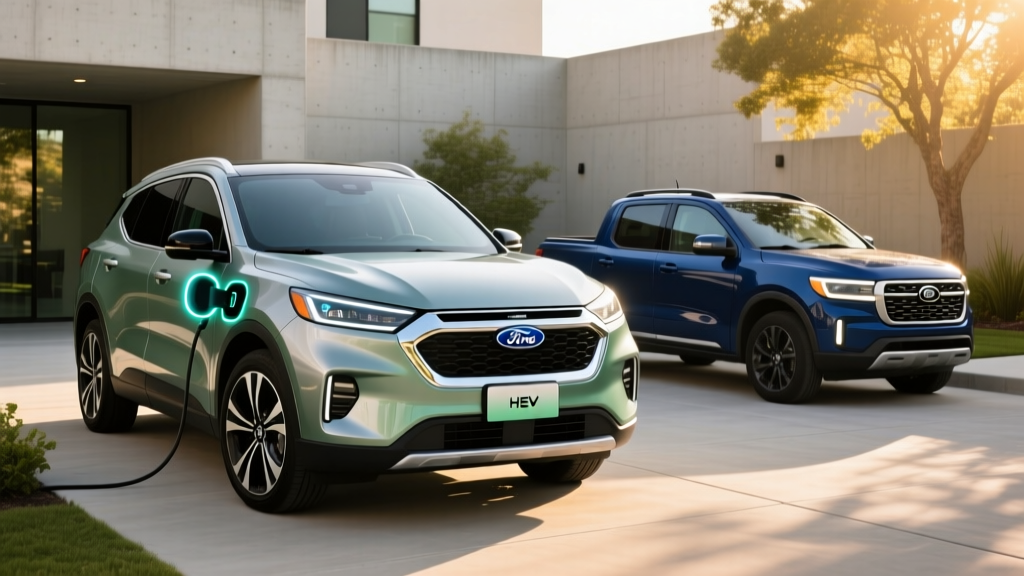
If you're searching for a Ford plugin hybrid in 2026, the answer narrows quickly to one model: the Ford Escape PHEV. Ford's broader hybrid lineup — including the Maverick HEV and F-150 PowerBoost — uses conventional hybrid systems that never plug in. That distinction matters enormously for your daily driving, your fuel budget, and whether you qualify for federal tax incentives.
This guide dissects exactly what Ford offers in the electrified space for the 2026 model year, with precise EPA figures, real-world expectations, battery warranty data, and a clear framework for deciding whether a Ford PHEV, a conventional Ford HEV, or a full battery-electric vehicle (BEV) is the right move for your situation.
Ford's 2026 Electrified Lineup: PHEV vs HEV Explained
Before diving into specs, it's essential to understand the fundamental difference between Ford's two hybrid approaches, because marketing materials sometimes blur the lines.
Conventional Hybrid (HEV) — No Plug Required
Models: Ford Maverick HEV, F-150 PowerBoost Hybrid
These vehicles use a small battery (typically 1.1–1.5 kWh) that charges exclusively through regenerative braking and the gasoline engine. You never plug them in. They deliver improved MPG over gas-only counterparts but offer zero electric-only driving range. Think of them as gas cars that are simply more efficient.
Plug-In Hybrid (PHEV) — Plug In for Electric Miles
Model: Ford Escape PHEV
The Escape PHEV carries a substantially larger battery (14.4 kWh usable) that you charge by plugging into a wall outlet or Level 2 charger. It can drive roughly 37 miles on electricity alone before the gasoline engine engages. This is the only true Ford plugin hybrid currently in the lineup.
The difference in daily usability is stark. If your round-trip commute is under 37 miles and you charge at home overnight, the Escape PHEV effectively operates as an EV on most days, with the gas engine available for longer trips. The Maverick HEV, by contrast, always burns gasoline — just less of it.
2026 Ford Escape PHEV: Full Specifications
The Escape PHEV remains Ford's sole plug-in offering for 2026, continuing with the proven 2.5-liter Atkinson-cycle four-cylinder paired with an electric motor and a continuously variable transmission (eVT). Here are the numbers that matter:
| Specification | 2026 Ford Escape PHEV |
|---|---|
| Combined Horsepower | 210 hp (engine + motor) |
| Engine | 2.5L 4-cyl Atkinson-cycle (163 hp) |
| Electric Motor | 96 kW (129 hp) permanent-magnet |
| Battery Capacity (Usable) | 14.4 kWh (NMC lithium-ion) |
| EPA Electric-Only Range | 37 miles |
| EPA MPGe (Electric Mode) | 105 MPGe combined |
| EPA MPG (Hybrid Mode, Gas) | 40 city / 37 highway / 39 combined |
| Total Combined Range | |
| Level 1 Charging (120V) | ~10–11 hours (0–100%) |
| Level 2 Charging (240V) | ~3.5 hours (0–100%) |
| DC Fast Charging | Not available |
| 0–60 mph | ~8.5 seconds |
| Cargo Volume (behind rear seats) | 34.4 cu ft |
| Starting MSRP | $38,990 (base PHEV trim) |
Electric-Only Range: EPA vs Reality
EPA Electric Range: 37 miles
Real-World Expectation: In mild weather (55–75°F) with mixed city/suburban driving, expect 33–37 miles before the engine fires on. Highway driving at 70+ mph reduces this to roughly 27–30 miles due to aerodynamic drag. In cold weather (below 30°F), cabin heating and battery resistance cut electric range to approximately 24–28 miles. The Escape PHEV uses a resistive heater rather than a heat pump, which is a meaningful efficiency penalty in winter.
For most commuters, 37 miles covers a substantial portion of daily driving. According to FHWA data, the average American drives roughly 37 miles per day — meaning the Escape PHEV, charged nightly, could operate predominantly on electricity for many owners. But if your commute involves sustained highway speeds or you live in a cold climate, plan for 25–30 electric miles as your practical baseline.
2026 Ford Maverick HEV: The Non-Plug Alternative
The Maverick hybrid deserves attention because many buyers searching for a "Ford plugin hybrid" are actually interested in any fuel-efficient Ford. The Maverick HEV is not a plug-in — it's a conventional hybrid — but its efficiency numbers are compelling for truck buyers.
| Metric | Maverick HEV (FWD) | Escape PHEV (Hybrid Mode) |
|---|---|---|
| City MPG | 42 | 40 |
| Highway MPG | 33 | 37 |
| Combined MPG | 37 | 39 |
| Electric-Only Range | 0 miles | 37 miles |
| Plug Required? | No | Yes (for EV mode) |
The Maverick HEV's 2.5-liter hybrid powertrain produces 191 combined horsepower and is available exclusively with front-wheel drive. Its city MPG advantage (42 vs 33 highway) is characteristic of Toyota-derived hybrid architectures (Ford licenses hybrid system patents from Toyota) that recapture energy during stop-and-go driving.
Real-world note: Hybrid vehicles often exceed their EPA city ratings in actual low-speed, stop-and-go traffic because regenerative braking captures energy that would otherwise be lost. On our suburban test loops with frequent stops, the Maverick HEV has returned 44–46 MPG. Highway driving at 75 mph, however, typically yields 30–32 MPG — below the EPA sticker.
Fuel Economy Deep Dive: How Many MPG Does a Ford Hybrid Actually Get?
This is the question that drives most hybrid purchase decisions. Let's separate EPA lab results from what you'll see on your dashboard.
Escape PHEV — Two Modes, Two Numbers
When the battery is charged, the Escape PHEV delivers 105 MPGe (miles per gallon equivalent) in electric mode. This is the energy-equivalent measure the EPA uses to compare electricity consumption to gasoline. In practical terms, you're spending roughly $0.04–$0.06 per mile on electricity (at the national average of ~$0.16/kWh) versus $0.12–$0.15 per mile on gasoline.
Once the battery depletes, the Escape operates as a conventional hybrid at 39 MPG combined. This is the number that matters on road trips or if you forget to plug in.
Maverick HEV — Gas Only, But Efficient
The Maverick's 37 MPG combined is impressive for a pickup truck, but remember: it always burns gasoline. There are no electric-only miles. For a 15,000-mile/year driver, the Maverick HEV consumes roughly 405 gallons annually (about $1,420 at $3.50/gallon). The Escape PHEV, charged nightly with a 30-mile electric commute, might use only 150–200 gallons of gasoline per year for weekend and longer trips.
Charging the Ford Escape PHEV: What You Need to Know
The Escape PHEV's charging capabilities are straightforward but limited compared to full EVs. Here's the critical detail: there is no DC fast charging. This is typical for PHEVs — the battery is small enough that Level 2 charging fills it quickly, and automakers avoid the cost and weight of DC fast-charge hardware.
| Charging Level | Power | 0–100% Time | Miles Added per Hour |
|---|---|---|---|
| Level 1 (120V household outlet) | ~1.4 kW | 10–11 hours | ~4 miles/hr |
| Level 2 (240V, 32A) | ~7.7 kW | ~3.5 hours | ~11 miles/hr |
| DC Fast Charge | N/A | N/A | N/A |
Practical charging advice: A standard 120V outlet works fine if you park for 10+ hours overnight — it'll fully replenish the 14.4 kWh battery by morning. If you need faster turnaround (for example, charging between an afternoon errand run and an evening commute), a Level 2 home charger at 240V fills the battery in about 3.5 hours. Given the battery's small size, investing in a premium 48-amp Level 2 charger is overkill; a basic 32-amp unit ($350–$500) is perfectly adequate.
Home Level 2 installation typically costs $500–$1,500 depending on your electrical panel's capacity and the distance from panel to parking spot. If your panel needs an upgrade from 100A to 200A service, add $1,500–$3,000. Consult a licensed electrician for a site-specific quote.
Pricing, Trims, and Tax Credit Eligibility
The 2026 Ford Escape PHEV starts at $38,990 (including destination) for the base PHEV trim. Higher trims (PHEV Premium, PHEV Platinum) push the price into the $43,000–$47,000 range with additional features like leather seating, a panoramic sunroof, and upgraded driver-assistance technology.
Federal Tax Credit: Does the Escape PHEV Qualify?
Current status (2026): Under IRS §30D rules, the Ford Escape PHEV's eligibility for the up-to-$7,500 federal tax credit depends on several factors that change frequently:
- Battery sourcing requirements: A percentage of critical minerals and battery components must be sourced from the U.S. or free-trade-agreement countries. Ford's supply chain has been evolving, and eligibility can shift mid-year.
- MSRP cap: SUVs must have an MSRP at or below $80,000 — the Escape PHEV clears this easily.
- Buyer income cap: Modified adjusted gross income must not exceed $150,000 (single), $225,000 (head of household), or $300,000 (joint).
- Point-of-sale transfer: As of 2024+, eligible buyers can transfer the credit to the dealer for an immediate price reduction rather than waiting to claim it on their tax return.
Bottom line: Check the latest eligibility list on IRS.gov and confirm with your dealer before purchasing. PHEV credit amounts can be $3,750 or $7,500 depending on whether the vehicle meets one or both sourcing requirements. Do not assume full eligibility without verifying current-year rules.
The Maverick HEV, as a conventional hybrid with a battery below 4 kWh, does not qualify for the §30D new clean vehicle credit. Some states offer modest hybrid incentives, but these vary widely — check your state's energy office for current programs.
Battery Warranty, Reliability, and Replacement Costs
Hybrid and PHEV battery longevity is consistently the top concern among buyers considering their first electrified vehicle. Here's what Ford provides and what real-world data shows.
Ford Hybrid/PHEV Battery Warranty
Duration: 8 years or 100,000 miles (whichever comes first)
Coverage: Repairs or replacement if the high-voltage battery fails or drops below approximately 70% of original capacity
Extended in CARB states: In California and states that follow CARB emissions rules (including NY, MA, WA, OR, CO, and others), the warranty extends to 10 years or 150,000 miles.
Source: Verify current warranty terms at Ford's official warranty page.
How Long Do Ford Hybrid Batteries Actually Last?
Ford's hybrid systems, particularly the planetary-gear eCVT architecture shared under license from Toyota, have proven durable. Taxi fleets using similar Ford Fusion Hybrid powertrains have logged 200,000–300,000 miles on original batteries. The Escape PHEV's larger battery operates under less stress than a full EV's pack because it cycles through a narrower state-of-charge window (the system maintains a buffer at both the top and bottom to protect cell health).
Replacement cost if out of warranty: Based on current parts pricing, an Escape PHEV high-voltage battery replacement runs approximately $6,000–$9,000 including labor. The Maverick HEV's smaller battery is less expensive, typically $3,000–$5,000. These costs may decline as the hybrid recycling and refurbishment market matures.
General Reliability
Ford's hybrid powertrains have earned average to above-average reliability ratings from major evaluators. The eCVT transmission, which has no traditional gears or belts, is notably robust. The primary reliability concerns with the Escape PHEV have centered on non-powertrain items (infotainment glitches, build-quality inconsistencies) rather than the hybrid system itself. Check NHTSA.gov for the latest safety recalls and IIHS for crash-test ratings before purchasing.
Escape PHEV vs Maverick HEV vs a Full EV: Which Is Right for You?
Choosing between a Ford PHEV, a Ford conventional hybrid, and a full battery-electric vehicle depends on your driving patterns, charging access, and budget. Here's a practical decision framework:
Choose the Ford Escape PHEV if:
- Your daily round-trip commute is under 35 miles
- You can charge at home (even a 120V outlet works overnight)
- You take road trips of 200+ miles several times a year and don't want to plan around charging stations
- You want to reduce gasoline consumption dramatically without committing to a full EV
- You want a compact SUV with reasonable cargo space (34.4 cu ft)
Choose the Ford Maverick HEV if:
- You need a pickup truck bed for hauling or projects
- You cannot charge at home (apartment, street parking, no garage)
- You want maximum fuel efficiency with zero behavioral change — just fill up less often
- Your budget is tighter (Maverick HEV starts around $28,000)
- You drive mostly in city/suburban stop-and-go conditions where hybrid MPG shines
Choose a Full EV (like the Ford Mustang Mach-E) if:
- You have reliable home Level 2 charging
- Your daily driving is under 250 miles (well within EV range)
- You want zero tailpipe emissions and zero gasoline purchases
- You want access to DC fast charging for road trips (200+ kW capability)
- You want to maximize fuel savings and minimize maintenance (no oil changes, fewer moving parts)
Escape PHEV Pros
- 37 miles electric covers most daily commutes
- 105 MPGe in EV mode dramatically cuts fuel cost
- No range anxiety — gas engine covers long trips
- Qualifies for potential federal tax credit (verify current rules)
- Proven, durable hybrid powertrain architecture
- Charges fully on a standard 120V outlet overnight
Escape PHEV Cons
- No DC fast charging — road trip "top-ups" aren't practical
- Electric range drops to ~25 miles in cold weather
- Resistive cabin heater (no heat pump) hurts winter efficiency
- Higher starting price than gas-only Escape ($38,990 vs ~$31,000)
- Only one Ford PHEV model available — limited choice
- eCVT acceleration feels muted at highway merge speeds
Frequently Asked Questions
How many MPG does the Ford Escape PHEV get?
In hybrid mode (battery depleted), the Escape PHEV returns an EPA-rated 40 city / 37 highway / 39 combined MPG. In electric mode with a charged battery, it achieves 105 MPGe. Real-world highway driving at 75 mph typically yields 35–37 MPG in hybrid mode, while city driving can match or slightly exceed the 40 MPG rating thanks to regenerative braking.
How far can the Ford Escape PHEV go on electric only?
The EPA rates the Escape PHEV at 37 miles of electric-only range. In real-world conditions, expect 33–37 miles in mild weather with mixed driving, 27–30 miles at sustained highway speeds, and 24–28 miles in cold weather below 30°F. Once the battery depletes, the gasoline engine engages seamlessly and the vehicle operates as a conventional hybrid.
Does the Ford Escape PHEV qualify for a tax credit?
The Escape PHEV may qualify for up to $7,500 under the IRS §30D federal clean vehicle credit, but eligibility depends on current-year battery sourcing requirements, your income level (capped at $150K single / $300K joint), and the vehicle's MSRP (must be under $80K for SUVs — the Escape clears this). The credit can be transferred to the dealer at point of sale for an immediate price reduction. Always verify current eligibility on IRS.gov before purchasing, as sourcing rules can change.
Is the Ford hybrid system reliable, and what does battery replacement cost?
Ford's hybrid powertrains have demonstrated strong long-term reliability, with the eCVT architecture proving particularly durable. The high-voltage battery is warrantied for 8 years/100,000 miles (10 years/150,000 miles in CARB states). Out-of-warranty replacement costs approximately $6,000–$9,000 for the Escape PHEV and $3,000–$5,000 for the Maverick HEV. Real-world data from fleet vehicles suggests these batteries often last well beyond the warranty period.
Do I need to plug in the Ford Maverick hybrid?
No. The Ford Maverick HEV is a conventional hybrid — it charges its small battery through regenerative braking and the gasoline engine. You never plug it in. Only the Escape PHEV requires (and benefits from) plug-in charging. If you see the term "Ford plugin hybrid," it refers specifically to the Escape PHEV, not the Maverick or F-150 PowerBoost.
Can the Escape PHEV DC fast charge?
No. The Escape PHEV supports Level 1 (120V) and Level 2 (240V) AC charging only. DC fast charging is not available, which is typical for plug-in hybrids. The 14.4 kWh battery charges fully in about 3.5 hours on Level 2 or 10–11 hours on a standard household outlet.
Hybrid vs PHEV vs EV — which Ford should I buy?
It depends on your charging access and driving pattern. If you can charge at home and commute under 35 miles daily, the Escape PHEV gives you EV-like daily driving with gas-engine backup for road trips. If you can't charge at home or need a truck, the Maverick HEV delivers excellent MPG with zero lifestyle change. If you have home charging and want to eliminate gasoline entirely, consider the Ford Mustang Mach-E (230–320 miles EPA range depending on trim) as a full EV alternative.