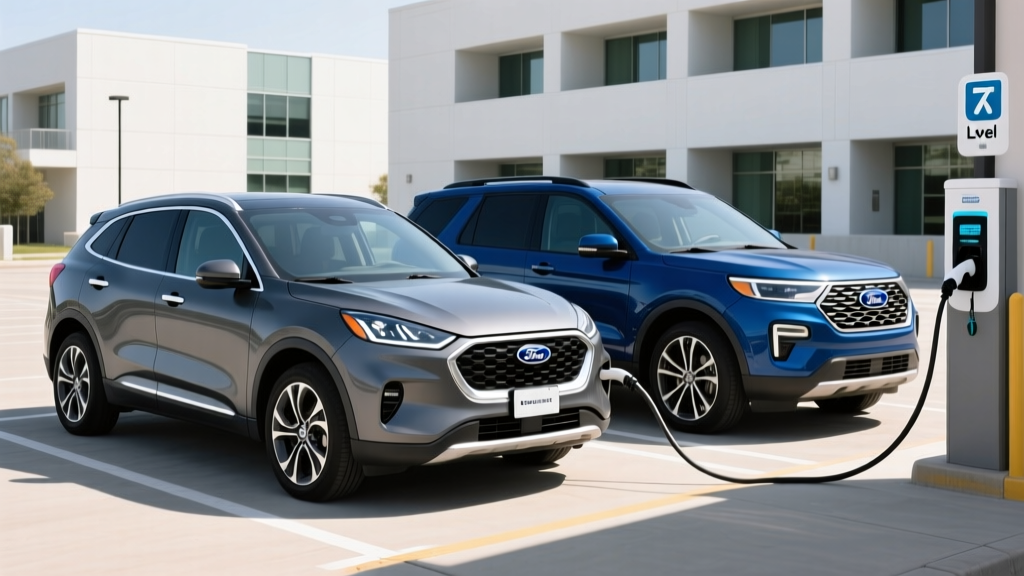
Ford's plug-in hybrid strategy in 2026 narrows down to two distinct vehicles serving very different buyers: the compact Escape PHEV for commuters who want electric-only daily driving, and the three-row Explorer PHEV for families who need space without fully committing to a battery-electric vehicle. Both use Ford's latest generation plug-in hybrid powertrains, but their battery sizes, electric ranges, and tax-credit eligibility diverge significantly.
This guide breaks down exactly what each Ford PHEV delivers in real-world driving — EPA numbers, real-world adjustments, charging logistics, ownership costs, and whether a plug-in hybrid or a full BEV makes more sense for your situation.
HEV vs PHEV: What Ford Actually Sells in 2026
Before comparing specific models, it's essential to separate Ford's conventional hybrids from its plug-in hybrids. Ford sells both, and they serve different use cases.
| Feature | Conventional Hybrid (HEV) | Plug-In Hybrid (PHEV) |
|---|---|---|
| Plug-in charging | No — charges via regenerative braking and engine | Yes — Level 1 (120V) or Level 2 (240V) |
| Electric-only range | Less than 1 mile at low speeds | 20–40+ miles depending on model |
| Battery size | 1.1–1.8 kWh | 14.4–31.2 kWh usable |
| Federal tax credit | None (no longer eligible under §30D) | Up to $3,750–$7,500 if sourcing/income rules met |
| Best for | Drivers without home charging access | Drivers with home charging and short commutes |
| Ford examples | Escape Hybrid, Maverick Hybrid, F-150 PowerBoost | Escape PHEV, Explorer PHEV |
The critical distinction: a conventional HEV never needs to be plugged in and has no meaningful electric-only range. A PHEV has a larger battery you charge overnight, enabling pure-electric commuting, and then operates as a hybrid once the battery depletes. If you can't charge at home or work, a PHEV's advantages shrink considerably — you're carrying dead battery weight and paying a premium you won't recoup.
2026 Ford Escape PHEV: The Commuter's PHEV
The Escape PHEV remains Ford's most accessible plug-in hybrid and one of the best-selling PHEVs in the compact crossover segment. For 2026, it continues with the proven 2.5-liter Atkinson-cycle inline-four paired with an electric motor and a 14.4 kWh lithium-ion battery pack.
| Specification | 2026 Ford Escape PHEV |
|---|---|
| Combined horsepower | 210 hp (engine + motor) |
| Engine | 2.5L iVCT Atkinson-cycle I-4 |
| Electric motor | Permanent-magnet synchronous, integrated into eCVT |
| Battery (usable) | 14.4 kWh lithium-ion |
| EPA electric-only range | 37 miles |
| EPA combined (gas-only after depletion) | 40 MPG |
| EPA city/highway (gas-only) | 42 city / 37 highway MPG |
| MPGe (electric + gas combined) | 105 MPGe |
| Total range (full tank + full charge) | ~470 miles |
| Level 1 charging (120V) | ~10–12 hours (0–100%) |
| Level 2 charging (240V, 3.3 kW) | ~3.5 hours (0–100%) |
| DC fast charging | Not available |
| 0–60 mph | ~8.2 seconds |
| Cargo volume (behind rear seats) | 34.4 cu ft |
| Base MSRP (PHEV trim) | $39,500 |
Real-World MPG and Electric Range
The EPA's 37-mile electric range assumes moderate temperatures and mixed driving. In real-world testing, expect 30–34 miles of electric range in summer highway driving at 70+ mph, and 22–27 miles in freezing winter conditions where cabin heating draws heavily from the battery. City driving at moderate speeds is where the Escape PHEV shines — many owners report matching or slightly exceeding the 37-mile sticker on 30 mph commutes with gentle acceleration.
Once the battery depletes, the hybrid system delivers its EPA-rated 40 MPG combined in mixed driving. In city-heavy routes with frequent stops, regenerative braking pushes real-world figures to 42–44 MPG. Highway cruising at 75 mph drops this to 35–37 MPG. These numbers align with fueleconomy.gov data for the current-generation Escape PHEV.
2026 Ford Explorer PHEV: The Three-Row Plug-In
The Explorer PHEV targets a segment with almost no competition: a three-row, six-or-seven-passenger SUV with meaningful electric-only range. For 2026, Ford equips it with a larger 31.2 kWh battery and a turbocharged 2.3-liter EcoBoost engine paired with an electric motor.
| Specification | 2026 Ford Explorer PHEV |
|---|---|
| Combined horsepower | 318 hp (engine + motor) |
| Engine | 2.3L EcoBoost turbocharged I-4 |
| Electric motor | 100 kW permanent-magnet synchronous |
| Battery (usable) | 31.2 kWh lithium-ion (NMC chemistry) |
| EPA electric-only range | 42 miles |
| EPA combined (gas-only after depletion) | 28 MPG |
| EPA city/highway (gas-only) | 29 city / 27 highway MPG |
| MPGe (electric + gas combined) | 78 MPGe |
| Total range (full tank + full charge) | ~480 miles |
| Level 1 charging (120V) | ~20+ hours (0–100%) |
| Level 2 charging (240V, 7.2 kW) | ~4.5 hours (0–100%) |
| DC fast charging | Not available |
| 0–60 mph | ~6.8 seconds |
| Cargo volume (behind 3rd row) | 18.2 cu ft |
| Base MSRP (PHEV trim) | $54,900 |
Real-World Performance and Efficiency
The Explorer PHEV's 42-mile electric range is impressive for a vehicle this size, but physics applies: expect 34–38 miles in warm highway driving and 26–32 miles in sub-freezing temperatures. The larger battery and 7.2 kW onboard charger make a Level 2 home charger nearly mandatory — Level 1 charging at 120V takes over 20 hours, which is impractical for daily use.
Once operating as a hybrid, the 28 MPG combined rating is reasonable for a 5,000+ lb three-row SUV. Real-world owners report 30–32 MPG in suburban driving with moderate loads, dropping to 24–26 MPG on long highway trips at speed or when towing. The Explorer PHEV is rated to tow up to 5,600 lbs, though towing will dramatically reduce both electric range and fuel economy.
Charging Your Ford PHEV: What You Need at Home
Neither Ford PHEV supports DC fast charging — this is typical for plug-in hybrids, whose smaller batteries don't justify the cost and weight of DC fast-charge hardware. All charging happens at home or at Level 2 public stations.
| Charging Level | Power | Escape PHEV (0–100%) | Explorer PHEV (0–100%) | Miles Added/Hour |
|---|---|---|---|---|
| Level 1 (120V household) | ~1.4 kW | ~10–12 hours | ~20+ hours | ~3–4 mi/hr |
| Level 2 (240V, Escape max) | 3.3 kW | ~3.5 hours | ~9.5 hours | ~10–11 mi/hr |
| Level 2 (240V, Explorer max) | 7.2 kW | N/A (vehicle-limited to 3.3 kW) | ~4.5 hours | ~9–10 mi/hr |
Home charging setup: The Escape PHEV can technically survive on Level 1 (standard 120V outlet) if your daily commute is under 30 miles — an overnight charge replenishes most of the battery. The Explorer PHEV, with its larger 31.2 kWh pack, really needs a Level 2 charger for practical daily use. Budget $500–$1,500 for a quality Level 2 home charger (like a ChargePoint Home Flex or Emporia Vue) plus $500–$2,000 for professional electrical installation, depending on whether your panel needs an upgrade or a new 240V circuit run. A licensed electrician should evaluate your panel capacity before installation.
Federal Tax Credits and Pricing for Ford PHEVs
Under the current IRS §30D Clean Vehicle Credit rules, PHEV eligibility is more restrictive than it appears at first glance. The credit amount depends on battery capacity, critical-mineral sourcing, and battery-component manufacturing requirements.
- Vehicle MSRP cap: SUVs (Explorer) must be under $80,000; sedans/wagons/small crossovers (Escape) must be under $55,000
- Buyer income cap: $150,000 single / $225,000 head of household / $300,000 joint filers (modified AGI)
- Battery sourcing: Critical minerals must meet escalating percentage thresholds from qualifying trade partners; battery components must be manufactured or assembled in North America at required percentages
- Credit amount: Up to $3,750 (critical minerals only) or up to $7,500 (both requirements met)
- Point-of-sale transfer: Eligible buyers can transfer the credit to the dealer for an immediate price reduction at purchase
As of the 2026 model year, the Escape PHEV qualifies for a partial credit — typically $3,750 — because it meets the critical-minerals requirement but not the full battery-component threshold. The Explorer PHEV may qualify for up to $7,500 depending on the specific production batch's battery sourcing, but Ford's supply chain has been shifting. Always verify current eligibility on the IRS qualified vehicle list before purchasing, as sourcing compliance can change mid-model-year.
Battery Reliability, Warranty, and Replacement Costs
Hybrid and PHEV battery longevity is consistently the top concern for buyers transitioning from conventional vehicles. Ford's track record with hybrid battery packs is strong — the company has been selling hybrids since the 2005 Escape Hybrid, and real-world data shows these packs regularly exceed 150,000 miles with minimal degradation.
• Hybrid/PHEV battery: 8 years / 100,000 miles (10 years / 150,000 miles in CARB states including CA, NY, MA, and others)
• Coverage: Battery capacity below 70% of original, or any defect
• Powertrain warranty: 5 years / 60,000 miles
Replacement cost: If a battery pack does need replacement out of warranty, expect $4,000–$6,500 for the Escape PHEV and $7,000–$10,000 for the Explorer PHEV (parts and labor), based on current dealer pricing and independent hybrid-shop estimates. However, individual cell module replacement — which is often all that's needed — can cost $800–$2,000 at a qualified hybrid repair facility.
Real-world reliability: Ford's hybrid powertrains, particularly the eCVT-based systems used in the Escape, have proven more reliable than conventional automatic transmissions because they have fewer moving parts and no traditional clutch packs or torque converters. The IIHS and consumer reliability surveys consistently rate the Escape hybrid powertrain above average. The Explorer PHEV, being newer to market, has less long-term data but shares components with Ford's proven hybrid architecture.
Ford PHEV vs Full EV vs Gas: Which Fits Your Life?
Choose a Ford PHEV if:
- You can charge at home (garage or driveway with 120V/240V access)
- Your daily commute is under 40 miles round-trip (Escape) or 45 miles (Explorer)
- You take 2+ road trips per year over 200 miles and don't want to plan around DC fast chargers
- You live in an area with sparse public charging infrastructure
- You want electric commuting without range anxiety on long drives
Choose a full BEV (like the Ford Mustang Mach-E or F-150 Lightning) if:
- You have reliable Level 2 home charging
- Your daily driving is under 250 miles and you can plan road-trip charging stops
- You want to eliminate all gasoline purchases and oil changes
- You want maximum federal tax credit ($7,500) and lower per-mile fuel costs
- You want stronger acceleration and one-pedal driving
Choose a conventional HEV (like the Escape Hybrid or Maverick Hybrid) if:
- You cannot charge at home or at work
- You want better fuel economy without any plug-in behavior change
- You want the lowest purchase price in Ford's electrified lineup
- You drive primarily in stop-and-go city traffic where hybrids excel
Ford PHEV Pros
- Electric-only commuting eliminates most daily gasoline use
- No range anxiety — gas engine covers long trips seamlessly
- Escape PHEV charges on standard 120V outlet (viable for short commutes)
- Strong regenerative braking reduces brake wear
- Partial or full federal tax credit reduces effective price
- Proven hybrid reliability with 8–10 year battery warranty
Ford PHEV Cons
- No DC fast charging on either model
- Escape PHEV limited to 3.3 kW Level 2 (slow for public stations)
- Premium over conventional hybrid ($5,000–$8,000 more)
- Electric range drops significantly in cold weather (25–35% loss)
- Explorer PHEV requires Level 2 for practical daily charging
- Tax credit eligibility is complex and may not reach full $7,500
Frequently Asked Questions
How many MPG does the Ford Escape PHEV get?
The EPA rates the 2026 Escape PHEV at 42 city / 37 highway / 40 combined MPG when operating as a hybrid (after the battery depletes). In real-world city driving, many owners see 42–44 MPG thanks to regenerative braking. Highway driving at 75 mph typically yields 35–37 MPG. When factoring in electric-only miles, the combined MPGe rating is 105.
How far can the Ford Explorer PHEV go on electric only?
The EPA rates the Explorer PHEV at 42 miles of electric-only range. Real-world results vary: expect 34–38 miles in warm conditions at highway speeds, and 26–32 miles in freezing weather where cabin heating draws from the battery. For most school-run and grocery-trip errands, 42 miles covers the full day without engaging the gasoline engine.
Can I charge a Ford PHEV at a Tesla Supercharger or DC fast station?
No. Neither the Escape PHEV nor the Explorer PHEV has DC fast-charging capability. This is standard across nearly all plug-in hybrids — their smaller batteries (14–31 kWh) don't justify the added cost and weight of DC fast-charge hardware. You charge at home (Level 1 or Level 2) or at public Level 2 stations (shopping centers, workplaces, parking garages).
Is a Ford PHEV reliable, and what does battery replacement cost?
Ford's hybrid powertrains have a strong reliability record spanning two decades. The PHEV battery is warrantied for 8 years/100,000 miles (10 years/150,000 miles in CARB states). Out-of-warranty replacement runs $4,000–$6,500 for the Escape and $7,000–$10,000 for the Explorer, but module-level repair is often $800–$2,000. Most hybrid batteries outlast 150,000 miles with minimal degradation.
Does the Ford PHEV qualify for the $7,500 federal tax credit?
It depends. Under current IRS §30D rules, the Escape PHEV typically qualifies for $3,750 (meeting critical-minerals but not full battery-component requirements). The Explorer PHEV may qualify for up to $7,500 depending on production batch sourcing. Both must meet buyer income caps ($150K single / $300K joint) and MSRP caps ($55K cars / $80K SUVs). Always verify the specific VIN on the IRS qualified vehicle list before purchasing.
Hybrid vs PHEV vs EV — which Ford should I buy?
If you have home charging and a commute under 40 miles, a PHEV gives you electric daily driving with gas-engine freedom for road trips. If you can charge at home and rarely drive over 250 miles in a day, a full BEV like the Mustang Mach-E offers lower running costs and stronger performance. If you can't charge at home at all, a conventional hybrid like the Escape Hybrid or Maverick Hybrid delivers excellent MPG without any plug-in requirement.
Does the Escape PHEV lose cargo space compared to the gas model?
Yes, slightly. The PHEV battery pack sits beneath the rear cargo floor, raising the load floor by about 1.5 inches. Cargo volume behind the rear seats drops from 37.5 cu ft (gas model) to 34.4 cu ft (PHEV). It's a modest trade-off that most owners don't notice in daily use, but it matters if you regularly haul tall items.