Quick Verdict: A Proven Hybrid Sedan Aging Gracefully
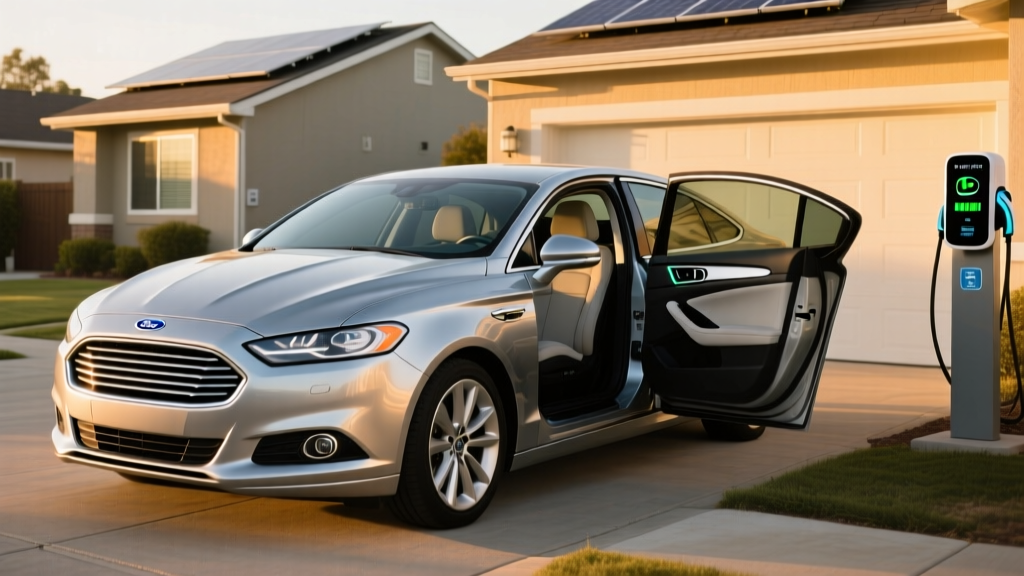
The 2014 Ford Fusion Hybrid is a conventional hybrid (HEV) — meaning it never plugs in and generates all its electricity internally through regenerative braking and its gasoline engine. Now well into its second decade on the road, this midsize sedan remains one of the more compelling used hybrid purchases for budget-conscious commuters who want strong city fuel economy without the complexity or cost of a plug-in hybrid or full electric vehicle.
With an EPA combined rating of 44 MPG, a comfortable ride, and a hybrid battery system that has proven durable past 150,000 miles in many real-world examples, the 2014 Fusion Hybrid punches above its weight in the used market. But buyers in 2026 need to weigh its aging tech, lack of modern ADAS features, and eventual battery replacement costs against its low entry price. Here's everything you need to know.
| Spec | Value |
|---|---|
| Powertrain Type | Conventional Hybrid (HEV) — no plug |
| Engine | 2.0L Atkinson-cycle 4-cylinder |
| Engine Horsepower | 141 hp @ 6000 rpm |
| Electric Motor Output | 118 hp |
| Combined System Horsepower | 188 hp |
| Transmission | eCVT (planetary gearset) |
| Hybrid Battery | 1.4 kWh lithium-ion (usable capacity ~1.1 kWh) |
| Battery Chemistry | Lithium-ion (NMC) |
| EPA MPG (City / Highway / Combined) | 44 / 41 / 44 |
| Fuel Tank | 13.5 gallons |
| Total Driving Range | ~594 miles (EPA combined) |
| 0-60 mph | ~7.8 seconds |
| Original MSRP (S trim) | $26,995 |
| Typical Used Price (2026) | $6,500 – $10,500 |
HEV vs PHEV: What the 2014 Fusion Hybrid Is (and Isn't)
Ford offered two electrified Fusion variants during this generation, and confusing them is a common mistake among used-car shoppers:
| Feature | Fusion Hybrid (HEV) | Fusion Energi (PHEV) |
|---|---|---|
| Plugs in? | No — self-charging | Yes — Level 1/Level 2 |
| Battery Size | 1.4 kWh | 7.6 kWh |
| Electric-Only Range | ~1 mile (low-speed only) | 19 miles (EPA) |
| EPA Combined MPG / MPGe | 44 MPG | 88 MPGe (charge-depleting) / 38 MPG (gas only) |
| Total Range | ~594 miles | ~550 miles |
| DC Fast Charging | No | No |
| Federal Tax Credit (at launch) | None | $3,750 (expired) |
This article focuses on the conventional Fusion Hybrid (HEV). If you're looking at a listing that mentions "plug-in" or "Energi," that's a different vehicle with different economics — see our EPA comparison tool to pull up both side by side.
The HEV's small 1.4 kWh battery exists solely to buffer energy recovered from braking and to enable brief electric-only assist at low speeds. You never plug it in, and you never need to think about charging infrastructure. The gasoline engine and regenerative braking handle everything.
Fuel Economy: EPA Ratings vs. Real-World MPG
| Driving Condition | EPA MPG |
|---|---|
| City | 44 MPG |
| Highway | 41 MPG |
| Combined | 44 MPG |
The Fusion Hybrid's 44 MPG city rating is notably higher than its highway figure — a hallmark of conventional hybrids. Regenerative braking recovers kinetic energy in stop-and-go traffic that would otherwise be lost as heat, and the electric motor handles low-speed propulsion where gasoline engines are least efficient. On the highway, the gasoline engine does most of the work with less hybrid assistance, so efficiency drops.
Real-World MPG Expectations
Owner-reported data on Fuelly and similar tracking platforms clusters around 39–43 MPG combined in mixed driving. Several factors shift the number:
- City-heavy commuting: 42–46 MPG is common. The hybrid system shines below 45 mph.
- Highway-dominant driving (70+ mph): Expect 36–40 MPG. Aerodynamic drag and reduced regen opportunities cut efficiency.
- Cold weather (below 35°F): MPG drops 5–12%. The engine runs longer to heat the cabin and maintain battery temperature, and cold battery chemistry reduces charge/discharge efficiency.
- Aggressive acceleration: Heavy throttle use forces the engine to operate outside its optimal efficiency band. Drivers who accelerate gently and coast to stops consistently report 45+ MPG.
Compared to a 2014 Toyota Camry Hybrid (EPA 41/38/40 combined), the Fusion Hybrid holds a slight edge on paper, though real-world results often converge within 1–2 MPG depending on driving style.
Powertrain and Driving Experience
The 2014 Fusion Hybrid pairs a 2.0-liter Atkinson-cycle four-cylinder engine (141 hp, 129 lb-ft of torque) with a permanent-magnet electric motor (118 hp, 117 lb-ft). Combined system output is 188 horsepower, routed through Ford's eCVT — not a belt-driven CVT like those in some competitors, but a planetary gearset (similar in concept to Toyota's Hybrid Synergy Drive) that seamlessly blends engine and motor power.
The result is smooth, linear acceleration with none of the rubber-band "drone" associated with traditional CVTs. The 0-60 mph time of roughly 7.8 seconds is adequate for merging and passing, though it won't feel quick by modern standards. The electric motor's instant torque delivery gives the car a responsive feel from a stop that belies its horsepower number.
One notable characteristic: the Fusion Hybrid can operate on electric power alone up to approximately 62 mph under light loads, though sustained electric-only driving is limited to roughly one mile given the small battery. The transition between electric and gas power is well-isolated — most drivers won't notice the engine engaging unless accelerating hard.
Battery Lifespan, Warranty, and Replacement Cost
Original Hybrid Battery Warranty
Coverage: 8 years / 100,000 miles (whichever comes first)
Capacity threshold: Ford warranted the battery against defects and excessive capacity loss, though no specific degradation percentage was published for the HEV.
2026 status: Original warranty has expired for all 2014 Fusion Hybrids. Any battery coverage now depends on aftermarket warranty or replacement.
How Long Does the Battery Actually Last?
The 1.4 kWh lithium-ion pack in the 2014 Fusion Hybrid has proven reasonably durable. Because the hybrid system uses a relatively shallow charge-discharge window (the battery management system keeps the state of charge between roughly 40% and 80%), the cells experience less stress than those in a full EV or PHEV that routinely cycles through deeper ranges.
Real-world data from owner forums and fleet reports suggests:
- 100,000–130,000 miles: Most original batteries show minimal degradation — perhaps 5–8% capacity loss, which is largely imperceptible in daily driving.
- 130,000–180,000 miles: This is where failures become more common. Cells may develop imbalances, triggering a check-engine light and reduced hybrid function.
- 180,000+ miles: Many batteries reach this point, but replacement becomes increasingly likely. Some high-mileage examples have surpassed 200,000 miles on the original pack.
Battery Replacement Cost
If the hybrid battery fails outside warranty, replacement options include:
- New OEM battery (Ford dealer): $3,000 – $4,500 including labor. Prices have moderated as the platform ages and supply stabilizes.
- Remanufactured battery: $1,500 – $2,800. Several third-party suppliers offer refurbished packs with 1–3 year warranties. Quality varies — verify cell sourcing and warranty terms.
- Individual cell replacement: $800 – $1,500. A qualified hybrid technician can identify and replace only the failed modules within the pack. This is the most cost-effective option but requires specialized diagnostic equipment.
For a car worth $6,500–$10,500, a full OEM battery replacement represents a significant percentage of the vehicle's value. Factor this into your purchase decision — check whether the battery has already been replaced, and if so, whether it was OEM or remanufactured.
Pricing, Tax Credits, and Total Cost of Ownership
The 2014 Ford Fusion Hybrid originally started at $26,995 for the S trim, with the SE and Titanium trims climbing to approximately $30,000–$35,000 when optioned. In the 2026 used market, expect to pay:
- $6,500 – $8,000: Higher-mileage examples (120,000+ miles), fair condition, base S trim
- $8,000 – $10,500: Lower-mileage examples (70,000–100,000 miles), SE or Titanium trim, clean history
Tax Credit Eligibility
The 2014 Fusion Hybrid did not qualify for the federal EV tax credit at any point — conventional hybrids (HEVs) have never been eligible under IRS §30D, which applies only to plug-in electric vehicles. The Fusion Energi (PHEV variant) did qualify for a $3,750 credit when new, but that benefit has long since expired.
For current plug-in vehicle tax credit rules, consult the IRS §30D guidance directly, as income caps, MSRP limits, and battery-sourcing requirements change frequently.
Five-Year Ownership Cost Estimate
Here's a realistic cost projection for a 2026 buyer purchasing a 2014 Fusion Hybrid at $8,500 with 95,000 miles and driving 12,000 miles/year:
| Category | Estimated Cost |
|---|---|
| Purchase Price | $8,500 |
| Fuel (44 MPG combined, $3.40/gal avg) | $4,636 |
| Insurance (avg $1,100/yr) | $5,500 |
| Maintenance (oil, brakes, tires, fluids) | $2,800 |
| Potential Battery Replacement | $0 – $3,000 |
| Depreciation (est. resale ~$3,500) | –$5,000 |
| Total (no battery replacement) | ~$16,436 |
| Total (with battery replacement) | ~$19,436 |
For comparison, a similarly aged gas-only 2014 midsize sedan averaging 26 MPG combined would cost roughly $7,846 in fuel over the same period — a $3,210 fuel premium that partially offsets the hybrid's higher potential repair costs.
Pros, Cons, and Who Should Buy
Pros
- Strong city fuel economy (44 MPG EPA, often exceeded in real-world stop-and-go)
- No charging infrastructure needed — ideal for apartment dwellers or those without garage access
- Smooth, quiet powertrain with seamless engine/motor transitions
- Comfortable ride quality and spacious interior for a midsize sedan
- Low used-market entry price ($6,500–$10,500)
- Proven hybrid system architecture with widespread mechanic familiarity
Cons
- Highway MPG (41) trails city rating — less ideal for long-distance commuters
- Aging technology: no Apple CarPlay/Android Auto, limited ADAS features
- Original battery warranty expired — replacement is an out-of-pocket risk
- Trunk space reduced by battery placement (12.0 cu ft vs. 16.0 cu ft in gas Fusion)
- No federal or state tax credits available for used HEV purchase
- 2014 model year predates Ford's updated SYNC 3 infotainment (SYNC 2 is slow by modern standards)
Who Should Choose This Hybrid?
Choose the 2014 Fusion Hybrid if: You commute primarily in city or suburban traffic, don't have access to home charging, want to minimize fuel costs without changing your refueling habits, and are comfortable buying a 12-year-old vehicle with the maintenance risks that entails.
Consider a PHEV (like a used Fusion Energi or newer Toyota RAV4 Prime) if: You have access to a Level 1 or Level 2 charger at home, your daily commute is under 25 miles (making electric-only mode viable), and you want to reduce gasoline consumption further without committing to a full EV.
Consider a full EV (like a used Chevrolet Bolt or newer Hyundai Ioniq 5) if: You have reliable home charging, want to eliminate gasoline entirely, value modern infotainment and ADAS features, and are willing to pay a higher upfront cost for lower operating expenses and available federal/state incentives.
Frequently Asked Questions
How many MPG does the 2014 Ford Fusion Hybrid get?
The EPA rates the 2014 Fusion Hybrid at 44 MPG city, 41 MPG highway, and 44 MPG combined. Real-world owner reports typically cluster between 39–43 MPG in mixed driving, with city-heavy commutes occasionally exceeding 45 MPG and sustained highway driving dropping to 36–40 MPG.
Does the 2014 Fusion Hybrid need to be plugged in?
No. The 2014 Fusion Hybrid is a conventional hybrid (HEV) that charges its small battery entirely through regenerative braking and the gasoline engine. You never plug it in. If you see a Fusion listing that mentions plugging in, that's the Fusion Energi — a separate plug-in hybrid (PHEV) model.
How far can the 2014 Fusion Hybrid drive on electric power alone?
Only about one mile at low speeds (under 62 mph) under very light loads. The 1.4 kWh battery is too small for meaningful electric-only range. Its purpose is to assist the gasoline engine and capture braking energy, not to replace it. For real electric-only driving, you'd need the Fusion Energi PHEV (19 miles EPA electric range) or a full BEV.
Is the 2014 Fusion Hybrid reliable?
The powertrain — particularly the eCVT and hybrid system — has proven reliable, with many examples surpassing 150,000 miles without major issues. The gasoline engine is a proven Ford design. The main reliability risk is the hybrid battery, which may require replacement between 130,000–180,000 miles. Non-hybrid components (suspension, electronics, interior) carry the same wear expectations as any 12-year-old sedan. Check NHTSA recall data for any outstanding service campaigns before purchasing.
What does it cost to replace the hybrid battery?
A new OEM battery from a Ford dealer costs approximately $3,000–$4,500 installed. Remanufactured batteries run $1,500–$2,800, and individual cell-module replacement can be done for $800–$1,500 by a qualified hybrid technician. Given the car's used value of $6,500–$10,500, a full OEM replacement is a significant investment — prioritize examples where the battery has already been replaced or shows strong health diagnostics.
Does the 2014 Ford Fusion Hybrid qualify for any tax credit?
No. Conventional hybrids (HEVs) have never qualified for the federal §30D clean vehicle tax credit, which requires plug-in capability and minimum battery capacity thresholds. Some states previously offered hybrid-specific rebates, but nearly all have expired or shifted to plug-in vehicles. Check your state's current incentive programs, but do not expect any purchase incentive for this model.
Hybrid vs PHEV vs EV — which should I choose?
It depends on your charging access and driving pattern. A conventional hybrid (HEV) like the Fusion Hybrid is the simplest path to better fuel economy — no plug, no behavior change, modest cost. A plug-in hybrid (PHEV) offers 20–40 miles of electric range for daily commutes plus a gas engine for longer trips, but requires home charging to realize its benefits. A full EV (BEV) eliminates gasoline entirely with 200–350+ miles of range, but requires reliable home or workplace charging and a higher upfront investment. If you can't charge at home, the HEV is your best option. If you can charge and commute under 30 miles, a PHEV maximizes savings. If you want zero tailpipe emissions and have charging covered, a BEV offers the lowest operating cost.