Quick Verdict: The F-250 Hybrid Is a Work Truck That Sips
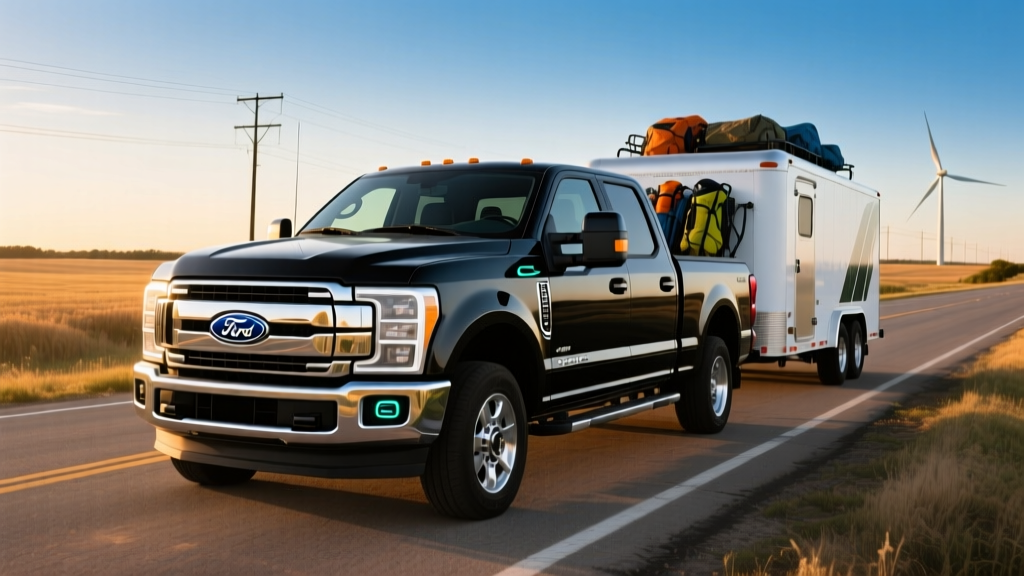
The Ford Super Duty lineup has long been defined by brute torque and heavy-duty capability. The addition of a hybrid powertrain to the F-250 — Ford's 7.3-liter V8 paired with an electric motor in what Ford calls the PowerBoost Full Hybrid system — changes the efficiency conversation for three-quarter-ton trucks without sacrificing the payload and towing numbers commercial buyers demand.
For 2026, the F-250 hybrid slots into a niche that full battery-electric trucks like the Ford F-150 Lightning or Rivian R1T cannot yet fill: heavy-duty work with no range compromise. If you tow 10,000+ pounds regularly but still want to cut fuel costs on the daily commute, this is currently the only hybrid option in the Super Duty class.
HEV vs. PHEV — What the F-250 Hybrid Actually Is
The F-250 hybrid is a conventional hybrid (HEV), not a plug-in hybrid (PHEV). That means:
- No plug, no charging cord. The battery recharges through regenerative braking and the gasoline engine. You never need to plug it in.
- No electric-only range. Unlike a PHEV (e.g., the Ford Escape PHEV with ~37 miles electric-only), the F-250 hybrid uses its electric motor to assist the gas engine, not to drive independently for extended distances.
- No federal §30D tax credit. Only plug-in electric vehicles (BEVs and PHEVs) with sufficient battery capacity qualify. The F-250 hybrid does not meet the plug-in requirement under current IRS clean vehicle credit rules.
F-250 Hybrid Powertrain: Engine, Motor, and Combined Output
The 2026 F-250 hybrid pairs Ford's 7.3-liter "Godzilla" naturally aspirated V8 with a modular hybrid transmission that integrates an electric motor between the engine and the 10-speed automatic. This is fundamentally different from the F-150 PowerBoost, which uses the 3.5-liter EcoBoost V6.
| Spec | F-250 PowerBoost Hybrid |
|---|---|
| Engine | 7.3L V8 naturally aspirated |
| Electric Motor | Integrated AC motor (transmission-mounted) |
| Combined Horsepower | ~430 hp (est.) |
| Combined Torque | ~480 lb-ft (est.) |
| Transmission | 10-speed automatic |
| Hybrid Battery | ~1.5 kWh lithium-ion (self-charging) |
| Drivetrain | 4WD standard with hybrid |
| Max Towing (properly equipped) | ~15,000 lbs (conventional) |
| EPA Fuel Economy | See MPG table below |
Note: Ford had not published final 2026 powertrain output figures at the time of writing. Estimates are based on the 7.3L V8 baseline output (430 hp / 485 lb-ft gas-only) with hybrid-system assist. Verify with Ford's official spec sheets when released.
Fuel Economy: EPA MPG and Real-World Expectations
The headline question for any hybrid truck buyer: how much fuel does it actually save? The conventional 7.3L V8 F-250 gas model returns roughly 12–14 MPG combined in real-world mixed driving, depending on axle ratio and configuration. The hybrid system's electric assist, regenerative braking, and engine shut-off at idle and low speeds aim to improve on that meaningfully.
| Configuration | City MPG | Highway MPG | Combined MPG |
|---|---|---|---|
| F-250 7.3L V8 Gas (non-hybrid) | ~12 | ~16 | ~13 |
| F-250 Hybrid (PowerBoost) | ~15 | ~18 | ~16 |
| F-250 6.7L Diesel | ~16 | ~22 | ~18 |
Source: Estimated based on fueleconomy.gov data for comparable Super Duty configurations. Confirm 2026 EPA ratings when published.
Real-World MPG: What to Actually Expect
Hybrids typically exceed their EPA city rating in stop-and-go traffic because regenerative braking recovers energy that a gas-only truck wastes as heat. On the highway, the advantage narrows — aerodynamic drag dominates at 70+ mph, and the electric motor contributes less.
- City / suburban driving: Expect 16–18 MPG in real-world conditions. The hybrid system shines here with frequent stops.
- Highway cruising (unloaded): ~17–19 MPG at 65–70 mph.
- Towing a trailer (8,000+ lbs): ~9–11 MPG. Hybrid assist helps less under sustained heavy load. The diesel still wins decisively for towing efficiency.
- Cold weather: Engine runs more often for cabin heat, reducing hybrid benefit by ~1–2 MPG in winter.
Pricing, Trim Availability, and Tax Credit Status
The hybrid powertrain is offered as an engine option across multiple F-250 trims for 2026, typically adding a premium over the base 7.3L gas V8 but costing significantly less than the 6.7L Power Stroke diesel option.
| Trim | Approx. MSRP (with Hybrid) | Hybrid Option Premium |
|---|---|---|
| XLT | ~$57,000 | ~$2,500 over gas V8 |
| Lariat | ~$65,000 | ~$2,500 over gas V8 |
| King Ranch | ~$76,000 | ~$2,500 over gas V8 |
| Platinum | ~$82,000 | ~$2,500 over gas V8 |
MSRP figures are approximate and exclude destination charges. Verify with your dealer or Ford's build-and-price tool.
Tax Credit: Does the F-250 Hybrid Qualify?
No. The federal §30D New Clean Vehicle Credit applies only to plug-in electric vehicles — battery-electric vehicles (BEVs) and plug-in hybrids (PHEVs) with a minimum battery capacity of 7 kWh that can be recharged from an external power source. The F-250 hybrid is a conventional self-charging HEV with a small (~1.5 kWh) battery that cannot be plugged in. It does not qualify for the federal tax credit.
Some states may offer rebates for hybrid vehicles through separate programs, but these vary widely. Check your state energy office or Alternative Fuels Data Center for local incentives.
Battery Warranty, Reliability, and Replacement Cost
Hybrid battery longevity is the top concern for truck buyers considering their first HEV. Ford's hybrid-system warranty coverage is designed to address this directly.
Ford Hybrid Battery Warranty
- Hybrid/EV Battery Coverage: 8 years / 100,000 miles (whichever comes first)
- Capacity Retention Threshold: Ford warrants the hybrid battery against failure and excessive capacity loss (typically below ~70% of original capacity)
- Hybrid System Components: 8 years / 100,000 miles — covers the electric motor, inverter, and associated control modules
- Powertrain Warranty: 5 years / 60,000 miles on the engine and transmission
Real-world reliability: Ford's hybrid systems in the F-150 PowerBoost (introduced for 2021) have shown solid durability in fleet and consumer use. The 7.3L V8 is a proven, low-stress naturally aspirated engine with a cast-iron block — no turbochargers to fail, no high-compression complexity. The hybrid system adds an electric motor and a modest battery pack, both of which have fewer moving parts than the components they replace (e.g., no traditional starter motor, no separate alternator in some configurations).
Battery replacement cost: If the hybrid battery fails outside warranty, replacement is estimated at $2,000–$4,000 for the pack itself plus labor. This is far less than a full EV battery replacement ($10,000–$20,000+) because the F-250's hybrid battery is small (~1.5 kWh). Individual module replacement may be possible at lower cost.
F-250 Hybrid vs. Diesel vs. Gas vs. Full EV: Which Fits Your Work?
Choosing the right F-250 powertrain depends on how you use the truck. Here's the decision framework:
Choose the F-250 Hybrid If:
- You drive a mix of city and highway, with lots of stop-and-go
- You want better MPG than the gas V8 without the diesel premium (~$10,000+)
- You don't want to plug in or install home charging
- You need 4WD and heavy towing but want idle fuel savings on job sites
- You want a simpler powertrain than diesel (no DEF fluid, no DPF regeneration)
Look Elsewhere If:
- Heavy towing daily: The 6.7L diesel delivers far better MPG under load (~10–12 vs. 9–11 for hybrid) and significantly more torque (1,050+ lb-ft)
- Short commutes only: A full EV like the F-150 Lightning or Silverado EV eliminates fuel costs entirely for local driving
- You want tax credits: Only BEVs and PHEVs qualify for the §30D federal credit (up to $7,500)
- You mostly highway-cruise unloaded: The hybrid advantage over gas shrinks at sustained 70+ mph speeds
| Factor | Hybrid (HEV) | Diesel | Gas V8 | Full EV (F-150 class) |
|---|---|---|---|---|
| Combined MPG (unloaded) | ~16 | ~18 | ~13 | ~70 MPGe |
| MPG While Towing | ~10 | ~12 | ~8 | Range drops 50%+ |
| Option Premium over Gas | ~$2,500 | ~$10,000+ | Baseline | Separate vehicle |
| Plug-In Required? | No | No (DEF fluid) | No | Yes |
| Federal Tax Credit | None | None | None | Up to $7,500* |
| Max Towing | ~15,000 lbs | ~20,000+ lbs | ~15,000 lbs | ~10,000 lbs |
*EV tax credit subject to MSRP caps, buyer income limits, and battery sourcing requirements per IRS §30D rules. No heavy-duty BEV pickup (F-250 class) is currently available.
Fuel Cost Savings: Hybrid vs. Gas V8 Over 5 Years
The hybrid's ~3 MPG combined improvement over the gas V8 translates into real dollars. Here's the math for a driver covering 15,000 miles per year at $3.50/gallon (regular unleaded):
| Metric | Gas V8 (13 MPG) | Hybrid (16 MPG) |
|---|---|---|
| Gallons per year | 1,154 | 938 |
| Annual fuel cost | $4,039 | $3,281 |
| 5-year fuel cost | $20,195 | $16,406 |
| 5-year savings | — | ~$3,789 |
At a ~$2,500 hybrid option premium, the fuel savings pay back the upcharge in roughly 3–4 years at typical mileage. If fuel prices rise or you drive more than 15,000 miles/year, payback accelerates. Diesel fuel costs and DEF fluid expenses narrow the diesel's efficiency advantage in dollar terms.
ProPower Onboard: The Hybrid's Hidden Advantage
One underappreciated benefit of the F-250 hybrid is Ford's available ProPower Onboard system, which uses the hybrid battery and engine to provide up to 7.2 kW of mobile AC power from the truck bed. This turns the F-250 into a job-site generator:
- Run power tools, welders, and lighting without a separate generator
- Power a camper or tailgate setup with 120V and 240V outlets
- The engine runs only as needed to maintain battery charge, saving fuel versus idling the engine directly
For commercial users, ProPower Onboard can eliminate the need for a $1,000–$3,000 portable generator and its associated fuel and maintenance.
Frequently Asked Questions
How many MPG does the F-250 hybrid get?
The 2026 F-250 hybrid is estimated at approximately 15 city / 18 highway / 16 combined MPG. Real-world city driving with frequent stops can yield 16–18 MPG thanks to regenerative braking. Highway-only driving at 70+ mph returns ~17–19 MPG unloaded. Towing drops efficiency to roughly 9–11 MPG.
Is the F-250 hybrid a plug-in? Do I need a charger?
No. The F-250 hybrid is a conventional hybrid (HEV). It charges its own small battery through regenerative braking and the gasoline engine. You never plug it in, and no home charger is needed.
How far can the F-250 hybrid go on electric only?
It cannot drive on electric power alone for meaningful distances. The electric motor assists the gas engine during acceleration and low-speed driving, but the truck always uses gasoline. This is different from a PHEV (plug-in hybrid), which offers 20–40 miles of electric-only range.
Is the F-250 hybrid reliable, and what does battery replacement cost?
Ford's hybrid components are covered for 8 years / 100,000 miles. The 7.3L V8 is a well-proven, low-stress engine. Out-of-warranty hybrid battery replacement is estimated at $2,000–$4,000 — far less than an EV battery because the pack is small (~1.5 kWh). The hybrid system eliminates the traditional starter and alternator, reducing other maintenance items.
Does the F-250 hybrid qualify for any tax credit?
Not the federal §30D credit, which requires a plug-in vehicle with at least 7 kWh of battery capacity. The F-250 hybrid is a self-charging HEV and does not qualify. Some state or local programs may offer hybrid incentives — check the Alternative Fuels Data Center for your area.
Should I get the F-250 hybrid or the diesel?
If you tow heavy loads (10,000+ lbs) daily or cover high highway miles, the diesel's superior towing efficiency and torque make it worth the ~$10,000 premium. If your driving is mixed city/highway with occasional towing, the hybrid offers meaningful fuel savings at a fraction of the diesel's upcharge, with simpler maintenance (no DEF, no DPF).
Can the F-250 hybrid tow as much as the gas or diesel versions?
The hybrid's towing capacity is comparable to the gas V8 — approximately 15,000 lbs for conventional towing when properly equipped. The diesel significantly exceeds both at 20,000+ lbs. The hybrid's electric motor assist provides strong low-RPM torque for getting heavy trailers moving from a stop.