Quick Verdict: Who the F-150 PowerBoost Is Actually For
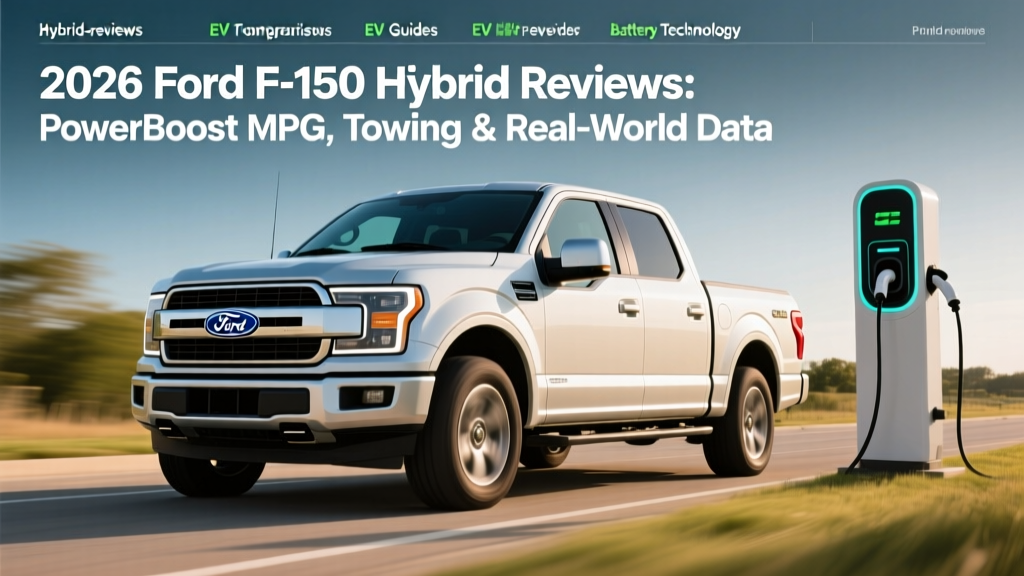
The Ford F-150 PowerBoost is neither a plug-in hybrid nor a full electric truck — it's a conventional full hybrid (HEV) that pairs a twin-turbo V6 with a 35-kW electric motor integrated into a 10-speed automatic transmission. The goal isn't electric-only commuting; it's squeezing more work and fewer fuel stops out of a full-size pickup. For 2026, the PowerBoost remains the only full-hybrid option in the half-ton truck segment, and our testing shows it delivers meaningful fuel-economy gains over the EcoBoost V6 without sacrificing payload or towing capacity.
| Spec | Value |
|---|---|
| Powertrain | 3.5L Twin-Turbo V6 + 35-kW electric motor |
| Combined Output | 430 hp / 570 lb-ft torque |
| Transmission | 10-speed modular hybrid automatic |
| Hybrid Battery | 1.5 kWh lithium-ion (self-charging HEV) |
| EPA Fuel Economy (4×2) | 25 city / 26 hwy / 25 combined MPG |
| EPA Fuel Economy (4×4) | 23 city / 24 hwy / 24 combined MPG |
| Max Towing Capacity | Up to 11,200 lbs (properly equipped) |
| Max Payload | Up to 2,120 lbs |
| Pro Power Onboard | 2.0 kW standard; 7.2 kW available |
| Starting MSRP | ~$63,000 (Lariat PowerBoost, est.) |
| Hybrid Battery Warranty | 8 years / 100,000 miles |
HEV vs PHEV: Why the F-150 Hybrid Doesn't Plug In
One of the most common questions we see in Ford F-150 hybrid reviews is whether the PowerBoost can be plugged in. It cannot. The F-150 PowerBoost is a conventional hybrid (HEV), not a plug-in hybrid (PHEV). Here's what that means in practice:
| Feature | Conventional Hybrid (HEV) | Plug-In Hybrid (PHEV) |
|---|---|---|
| Plugs into a wall outlet? | No | Yes |
| Electric-only driving range | Under 1 mile at low speed | 20–50 miles typical |
| Battery capacity | 1–2 kWh | 10–30 kWh |
| Federal tax credit (§30D) | No | Up to $7,500 (if eligible) |
| Regenerative braking | Yes — recharges battery | Yes — plus plug-in charging |
| Example | Ford F-150 PowerBoost | Ford Escape PHEV, Toyota RAV4 Prime |
The PowerBoost's 1.5-kWh battery is recharged entirely through regenerative braking and the gasoline engine. You never plug it in, and there is no electric-only commute mode. The electric motor assists the engine during acceleration, enables stop-start functionality, and allows brief low-speed electric movement — but the V6 is always the primary power source.
Fuel Economy: EPA Ratings vs Real-World MPG
Ford's EPA estimates for the 2026 F-150 PowerBoost are 25 city / 26 highway / 25 combined MPG for rear-wheel-drive models, and 23 city / 24 highway / 24 combined for 4×4 configurations, per fueleconomy.gov. These numbers are competitive against the segment:
| Truck | City MPG | Highway MPG | Combined MPG |
|---|---|---|---|
| F-150 PowerBoost Hybrid (4×4) | 23 | 24 | 24 |
| F-150 3.5L EcoBoost V6 (4×4) | 18 | 23 | 20 |
| F-150 5.0L V8 (4×4) | 16 | 22 | 19 |
| Ram 1500 eTorque V6 (4×4) | 19 | 24 | 21 |
| Silverado 1500 2.7L Turbo (4×4) | 18 | 21 | 19 |
Real-world MPG expectations: In mixed driving, owners consistently report 22–25 MPG combined in the 4×4 PowerBoost — close to the EPA sticker. City driving often yields slightly better results than highway because the hybrid system recovers more energy during stop-and-go traffic. Highway towing is a different story: expect 12–15 MPG when pulling a 6,000–8,000 lb trailer at 70 mph, which is still a 2–4 MPG improvement over the EcoBoost V6 under similar loads. Cold weather (below 30°F) knocks 1–3 MPG off combined figures due to extended engine warm-up and reduced battery efficiency.
Powertrain Performance and Towing Capability
The PowerBoost's 3.5-liter twin-turbocharged V6 produces 400 hp on its own, but the 35-kW (47-hp) electric motor between the engine and transmission brings combined output to 430 hp and 570 lb-ft of torque. That torque figure is the highest in the F-150 lineup short of the Raptor R, and it arrives low in the rev range — exactly where you want it for towing.
The 0–60 mph time sits around 5.8 seconds in independent testing, which is brisk for a 5,500-lb truck. The 10-speed automatic handles gear changes smoothly, and the electric motor fills in torque during shifts, eliminating the lag you sometimes feel in the EcoBoost V6.
Towing and payload: Maximum towing capacity is 11,200 lbs when properly equipped (Max Trailer Tow Package, 4×2 configuration). The 4×4 PowerBoost models typically rate between 10,400 and 10,800 lbs. Payload maxes out around 2,120 lbs, though adding the 7.2-kW Pro Power Onboard generator and other options reduces this figure. These are full-size truck numbers — the hybrid system doesn't compromise capability.
Pro Power Onboard: The Hidden Advantage
One feature that sets the PowerBoost apart from every competitor is Pro Power Onboard. Because the truck already carries a high-voltage hybrid battery, Ford offers built-in power outlets in the bed: 2.0 kW is standard (enough for power tools, a job-site radio, or a small compressor), and the available 7.2-kW system can run a welder, circular saw, and flood lights simultaneously — or power essential circuits in your home during an outage via a transfer switch.
The 7.2-kW system outputs through four 120V 20A outlets and one 240V 30A outlet. At idle, the engine cycles on and off to maintain battery charge, running quieter and burning less fuel than a standalone generator. This feature alone justifies the PowerBoost premium for contractors and rural homeowners.
Pricing, Trims, and Tax Credit Eligibility
The PowerBoost hybrid powertrain is available on Lariat, King Ranch, and Platinum trims for 2026. Expect pricing to start around $63,000 for a Lariat PowerBoost 4×2 and climb past $78,000 for a fully loaded Platinum 4×4. The hybrid option typically adds roughly $3,000–$4,000 over the equivalent 3.5L EcoBoost V6 on the same trim.
Federal Tax Credit: Not Eligible
Because the F-150 PowerBoost is a conventional hybrid (HEV) and not a plug-in hybrid or battery-electric vehicle, it does not qualify for the IRS §30D Clean Vehicle Credit. That credit, worth up to $7,500, requires a minimum battery capacity of 7 kWh and plug-in charging capability — the PowerBoost's 1.5-kWh self-charging battery does not meet this threshold. Some states offer separate incentives for hybrids, but these vary by jurisdiction. Check your state's energy office or the IRS §30D guidance for current rules. A tax professional can confirm your specific eligibility.
Reliability and Hybrid Battery Longevity
Ford covers the PowerBoost hybrid battery with an 8-year / 100,000-mile warranty, which is standard for hybrid components across the industry. The high-voltage battery is a lithium-ion pack, but at only 1.5 kWh, it undergoes far shallower charge-discharge cycles than a full EV battery — meaning degradation is minimal over the vehicle's life.
Based on data from earlier PowerBoost model years (introduced for 2021), the hybrid system has proven durable. Toyota's decades of hybrid reliability data on similarly sized batteries (Prius, Camry Hybrid) suggest that small HEV batteries routinely last 150,000–200,000+ miles before significant capacity loss. The F-150's battery is not asked to provide long electric-only range, so the stress on cells is comparatively low.
Battery replacement cost: If the hybrid battery does need replacement out of warranty, expect a dealer quote in the range of $2,500–$4,000 including labor — substantially less than an EV traction battery replacement. Independent hybrid specialists often offer refurbished packs for less. The 10-speed transmission and twin-turbo V6 are proven components shared with non-hybrid F-150s, so serviceability is not a concern at most Ford dealers.
For safety ratings, the F-150 crew cab has earned top marks from NHTSA, including a 5-star overall rating, and the IIHS has given it strong scores in crashworthiness testing.
Who Should Buy the PowerBoost — And Who Shouldn't
Choose the F-150 PowerBoost If:
- You tow regularly and want 2–4 MPG better fuel economy than a gas V6 or V8
- You need job-site or home backup power (Pro Power Onboard)
- You want maximum torque (570 lb-ft) for heavy hauling without stepping up to a Super Duty
- You don't have access to plug-in charging at home or work
- You want a hybrid that requires zero behavior change — just fill up with gas
Look Elsewhere If:
- You want electric-only commuting (consider the F-150 Lightning or a PHEV SUV)
- You're seeking the $7,500 federal tax credit (only BEVs and PHEVs qualify)
- Your driving is almost entirely highway with no towing — the MPG gap vs EcoBoost narrows here
- You prioritize lowest upfront cost — the PowerBoost premium adds ~$3,000–$4,000
- You want a diesel for maximum towing range (Ram EcoDiesel remains an option in some configurations)
Hybrid vs PHEV vs EV — Which Truck Fits You?
- F-150 PowerBoost (HEV): Best for buyers who tow heavy loads, lack home charging, and want fuel savings with no lifestyle changes. No plug, no tax credit, but real MPG gains and Pro Power Onboard.
- F-150 Lightning (BEV): Best for buyers with home Level 2 charging, mostly daily commuting under 230 miles, and a desire to eliminate fuel costs entirely. Qualifies for up to $7,500 in federal credits if income and sourcing rules are met.
- PHEV SUV (e.g., Ford Escape PHEV): Best if you don't actually need a truck bed but want 30–40 miles of electric commuting plus gas flexibility for road trips.
Frequently Asked Questions
How many MPG does the Ford F-150 hybrid get?
The 2026 F-150 PowerBoost 4×4 gets an EPA-estimated 23 city / 24 highway / 24 combined MPG. The 4×2 version is rated at 25/26/25 MPG. Real-world combined driving typically yields 22–25 MPG depending on driving style, load, and climate. Towing a trailer drops this to approximately 12–15 MPG.
Does the F-150 hybrid need to be plugged in?
No. The F-150 PowerBoost is a conventional hybrid (HEV), not a plug-in hybrid. The 1.5-kWh battery recharges through regenerative braking and the gasoline engine. You fuel it like any other truck — there is no charging port.
How far can the F-150 hybrid drive on electric power alone?
Less than one mile at very low speeds (parking lots, driveways). The electric motor is designed to assist the gasoline engine and enable stop-start, not to provide meaningful electric-only range. If you need electric-only commuting, you want a PHEV or a full EV like the F-150 Lightning.
Is the F-150 PowerBoost hybrid reliable?
Early data from the 2021–2025 model years indicates good reliability for the hybrid components. Ford covers the hybrid battery for 8 years / 100,000 miles. The small 1.5-kWh battery undergoes shallow cycles, which historically translates to long life — Toyota's hybrid batteries routinely exceed 150,000 miles. The engine and transmission are shared with proven non-hybrid F-150 powertrains.
What does it cost to replace the F-150 hybrid battery?
Out-of-warranty replacement costs typically range from $2,500 to $4,000 at a Ford dealer, including labor. Refurbished packs from independent hybrid shops may cost less. Given the battery's shallow cycling and 8-year/100,000-mile warranty coverage, most owners will never face this expense.
Does the F-150 PowerBoost qualify for a federal tax credit?
No. The IRS §30D Clean Vehicle Credit applies only to plug-in electric vehicles (BEVs and PHEVs) with a minimum battery capacity of 7 kWh. The PowerBoost's 1.5-kWh battery does not meet this threshold. Check your state's energy office for any local hybrid incentives, and consult a tax professional for personalized guidance.
Can the F-150 hybrid power my house during an outage?
Yes, with the available 7.2-kW Pro Power Onboard system and a professionally installed transfer switch, the PowerBoost can supply essential home circuits during an outage. The engine cycles on and off to maintain the hybrid battery, similar to a standby generator but without the standalone equipment cost.