Quick Verdict: The PowerBoost F-150 Earns Its Keep
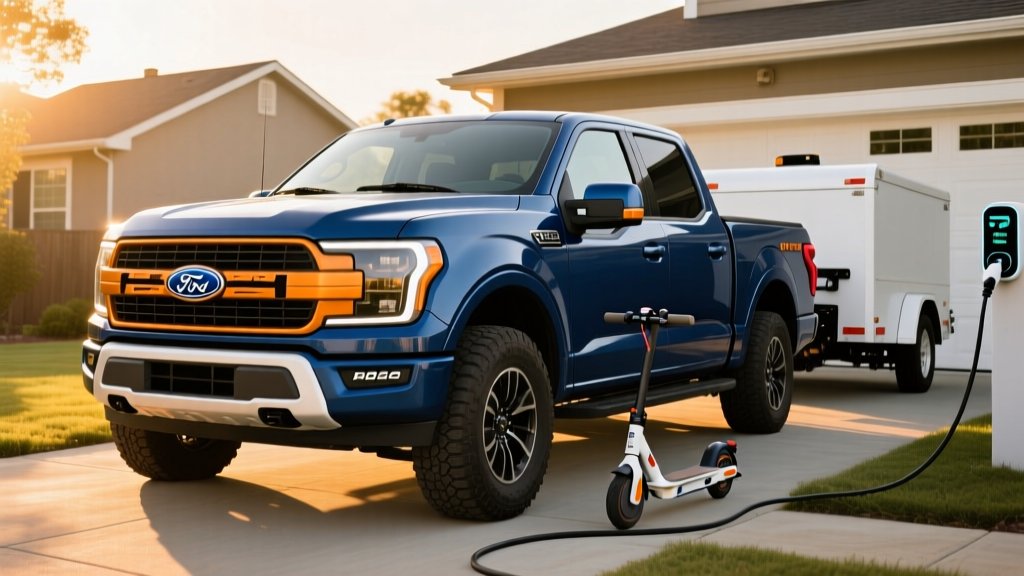
The Ford F-150 PowerBoost isn't trying to be a plug-in or a pure electric truck. It's a conventional hybrid (HEV) that pairs a twin-turbo V6 with a 47-horsepower electric motor sandwiched into the 10-speed automatic transmission. The result is 430 combined horsepower, 570 lb-ft of torque, and an EPA-estimated 24 MPG combined — meaningful gains over the standard 3.5L EcoBoost without requiring a plug, a charging routine, or any behavioral change from the driver.
After spending time with the PowerBoost across mixed highway, city, and towing duty, the value proposition is clear: you get a full-size truck that sips fuel in stop-and-go work traffic, powers job-site tools via Pro Power Onboard, and still tows up to 7,200 pounds (properly equipped). The trade-off is a premium over the non-hybrid EcoBoost and slightly less maximum tow rating than the heavy-duty payload package allows.
The 2024 Ford F-150 PowerBoost is a conventional hybrid (HEV). It does not plug in. It does not have a dedicated electric-only driving range. The 1.5 kWh lithium-ion battery recharges exclusively through regenerative braking and the gasoline engine. If you're looking for a plug-in F-150, you're thinking of the F-150 Lightning (full EV) or waiting for Ford's future PHEV plans. This review covers the HEV only.
Specs at a Glance: F-150 PowerBoost Hybrid
| Specification | 2024 F-150 PowerBoost |
|---|---|
| Powertrain | 3.5L twin-turbo V6 + 35 kW (47 HP) electric motor |
| Combined Output | 430 HP / 570 lb-ft torque |
| Transmission | 10-speed automatic (modular hybrid) |
| Battery | 1.5 kWh lithium-ion (HEV — no plug) |
| Drivetrain | RWD or 4WD (4WD standard on most trims) |
| EPA Fuel Economy (4WD) | 24 city / 24 hwy / 24 combined MPG |
| Max Towing | 7,200 lbs (with Max Trailer Tow Pkg) |
| 0-60 mph | ~5.8 seconds (4WD, independent testing) |
| Pro Power Onboard | 7.2 kW (240V/30A outlet in bed) |
| Hybrid Battery Warranty | 8 years / 100,000 miles |
| Base MSRP | From ~$54,795 (XLT 4WD SuperCrew) |
Fuel Economy: EPA Numbers vs. Real-World Results
The 2024 F-150 PowerBoost with 4WD carries EPA ratings of 24 city / 24 highway / 24 combined MPG according to fueleconomy.gov. The 2WD variant bumps highway slightly to 25 MPG for a 25 combined rating.
| Configuration | City | Highway | Combined |
|---|---|---|---|
| PowerBoost 4WD | 24 | 24 | 24 |
| PowerBoost 2WD | 25 | 26 | 25 |
| 3.5L EcoBoost V6 4WD (non-hybrid) | 17 | 23 | 19 |
| 5.0L V8 4WD | 16 | 22 | 18 |
Real-World MPG: What Owners Actually See
The PowerBoost's hybrid system shines in low-speed and stop-and-go driving, where the electric motor handles initial acceleration and the engine shuts off at stops. In mixed suburban and city driving, many owners report 23–26 MPG — often meeting or slightly exceeding the EPA sticker. This is typical of conventional hybrids: EPA city numbers tend to be conservative.
On sustained highway cruising at 75+ mph, expect fuel economy to dip to roughly 20–22 MPG. Aerodynamics work against every full-size truck at speed, and the hybrid system's regenerative advantage diminishes when there's no braking to recapture energy. When towing a 5,000-pound trailer on flat interstate, plan for 12–14 MPG — still better than the non-hybrid EcoBoost under the same load, but not a dramatic improvement.
Cold weather (below 30°F) reduces fuel economy by roughly 10–15% as the engine runs more frequently to maintain cabin heat and battery temperature. This is consistent across all hybrids, not unique to Ford.
Powertrain Deep Dive: How the PowerBoost System Works
The PowerBoost system integrates a 35 kW (47 HP) electric motor directly into the housing of Ford's 10-speed automatic transmission. It sits between the 3.5L twin-turbocharged V6 and the gearbox — what engineers call a P2 hybrid architecture. This means the motor can assist the engine, operate the truck at very low speeds on electric power alone (briefly, not as a sustained EV mode), and recapture energy during braking.
The combined system output of 430 horsepower and 570 lb-ft of torque makes the PowerBoost the most powerful engine in the F-150 lineup short of the Raptor and Lightning. Torque delivery is notably smooth because the electric motor fills the gap during turbo spool-up, eliminating the lag you'd feel in the standard EcoBoost. The result is confident passing and merging without the lurchy power band of a turbo-only setup.
The 1.5 kWh battery pack is mounted under the rear seat of SuperCrew models. It's small by EV standards — roughly 1/50th the size of an F-150 Lightning battery — but perfectly sized for an HEV. It doesn't need to store miles of electric range; it just needs to buffer energy for acceleration assist and regenerative capture. The pack adds roughly 200 pounds to the truck, a negligible penalty relative to the F-150's 5,000+ pound curb weight.
Pro Power Onboard: The Killer Feature for Work Trucks
The 7.2 kW Pro Power Onboard system is available exclusively with the PowerBoost hybrid (a 2.0 kW version is available on some non-hybrid trims). It provides a 240V/30A outlet in the truck bed capable of running:
- MIG welders and plasma cutters
- Circular saws, compressors, and chop saws simultaneously
- Job-site lighting arrays
- Small RV or tailgate appliances
The hybrid battery and engine work together to supply continuous power without the engine needing to idle constantly. For contractors, this eliminates the need for a separate generator — the truck is the generator. This feature alone justifies the PowerBoost premium for many commercial buyers.
Pricing, Trims, and Tax Credit Eligibility
The PowerBoost hybrid is available on F-150 XLT, Lariat, King Ranch, and Platinum trims with the SuperCrew body style. Pricing for the 2024 model year (as originally listed by Ford) starts around $54,795 for an XLT 4WD SuperCrew with the PowerBoost option, climbing past $78,000 for a fully loaded Platinum.
The PowerBoost option itself typically adds $2,500–$3,500 over the equivalent 3.5L EcoBoost depending on trim and package bundling. For buyers comparing trims:
- XLT PowerBoost: ~$54,795–$60,000 — work-fleet and value buyers
- Lariat PowerBoost: ~$62,000–$68,000 — the volume trim, leather + tech
- King Ranch / Platinum: ~$70,000–$78,000+ — premium luxury truck
Does the F-150 Hybrid Qualify for a Federal Tax Credit?
No. The F-150 PowerBoost is a conventional hybrid (HEV), not a plug-in hybrid (PHEV) or battery electric vehicle (BEV). Under current IRS §30D Clean Vehicle Credit rules, only vehicles with a battery capacity of at least 7 kWh that can be recharged from an external source qualify. The PowerBoost's 1.5 kWh battery charges only from the engine and regenerative braking, so it does not meet the threshold.
There is no federal purchase incentive for conventional hybrids as of 2024–2026. Some states may offer minor rebates or HOV lane access for hybrids, but these vary widely by jurisdiction — check your state's energy office or DMV for specifics.
The economic case for the PowerBoost rests entirely on fuel savings. At 24 MPG combined versus 19 MPG for the EcoBoost 4WD, driving 15,000 miles per year at $3.50/gallon saves roughly $970 annually in fuel. Over a 5-year ownership period, that's approximately $4,850 in savings — enough to offset most of the hybrid premium, before factoring in Pro Power Onboard value or reduced generator costs for commercial users.
Reliability, Battery Warranty, and Replacement Cost
Ford covers the PowerBoost hybrid battery for 8 years or 100,000 miles (whichever comes first), consistent with federal emissions component warranty requirements. The coverage includes defects and capacity loss below a functional threshold. Ford's hybrid battery warranty also extends to the electric motor and power inverter.
How Long Will the PowerBoost Battery Last?
Conventional hybrid batteries are engineered for longevity, not energy density. The 1.5 kWh pack uses conservative charge/discharge windows — it never fully charges or fully depletes — which dramatically reduces degradation stress. Toyota's Prius batteries routinely exceed 150,000 miles; Ford's hybrid systems in the Escape and Fusion (now discontinued) have shown similar durability in fleet data.
For the F-150 PowerBoost specifically, introduced for the 2021 model year, long-term fleet data is still maturing. However, the architecture is proven and the battery is small enough that replacement cost is manageable.
Hybrid Battery Replacement Cost
If the hybrid battery requires replacement outside warranty, expect a cost of approximately $2,500–$4,000 for the battery pack plus labor. This is dramatically less than an EV battery replacement ($10,000–$20,000+) because the pack is small and accessible under the rear seat. Independent hybrid repair shops are increasingly able to replace individual cells or modules for even less.
Overall PowerBoost reliability has been generally strong, though early 2021–2022 models had some software-related complaints around transmission shift quality and hybrid system fault codes. Ford issued several technical service bulletins (TSBs) addressing these issues. The 2024 model year benefits from these refinements. Check NHTSA's recall database for any open recalls on specific VINs before purchasing used.
HEV vs. PHEV vs. EV: Which F-150 Fits Your Life?
| Factor | F-150 PowerBoost (HEV) | F-150 Lightning (BEV) | Gas F-150 EcoBoost |
|---|---|---|---|
| Plug-in Required? | No | Yes | No |
| Combined MPG / MPGe | 24 MPG | ~70 MPGe | 19 MPG |
| Range | ~660 mi (36-gal tank) | 230–320 mi (EPA) | ~550 mi |
| Max Towing | 7,200 lbs | 10,000 lbs | 13,000 lbs |
| Federal Tax Credit | None | Up to $7,500* | None |
| Home Charging Needed | No | Yes (Level 2 ideal) | No |
| Pro Power Onboard | 7.2 kW | 9.6 kW (Pro) | 2.0 kW (optional) |
| Starting Price (4WD) | ~$54,795 | ~$54,995 | ~$48,000 |
*Lightning tax credit eligibility depends on MSRP caps, buyer income limits, and battery component sourcing requirements under §30D. Verify current rules at irs.gov.
Choose the PowerBoost HEV If:
- You can't charge at home (apartment, street parking, no garage)
- You regularly tow 5,000–7,000 lbs and don't want EV range loss while towing
- You need 600+ miles of range for remote work sites or rural routes
- You want Pro Power Onboard without paying the Lightning premium
- You want hybrid fuel savings with zero change to your refueling habits
Choose the Lightning EV If:
- You have reliable Level 2 home charging
- Your daily driving is under 200 miles with predictable routes
- You want the lowest per-mile fuel cost (~$0.04–$0.08/mi vs. ~$0.15/mi for hybrid)
- You qualify for the $7,500 federal tax credit
- You rarely tow heavy loads long-distance
Choose the Gas EcoBoost If:
- Upfront purchase price is the primary concern
- You need maximum towing (13,000 lbs with HD payload package)
- You drive low annual miles where fuel savings won't offset the hybrid premium
Towing and Payload: What the Hybrid Changes
The PowerBoost's maximum tow rating of 7,200 pounds (with Max Trailer Tow Package, 4WD SuperCrew) is lower than the gas EcoBoost's 13,000-pound maximum. This isn't because the hybrid lacks power — 570 lb-ft of torque is more than adequate — but because the hybrid system adds weight and Ford rates the platform conservatively given thermal management requirements for the battery and motor under sustained heavy load.
For the vast majority of truck owners towing boat trailers, campers, or utility trailers in the 4,000–6,500 pound range, the PowerBoost is more than capable. The electric motor's instant torque actually makes low-speed trailer maneuvering smoother than the gas-only truck. Fuel economy while towing drops to the 12–14 MPG range, but this still represents a 15–20% improvement over the EcoBoost under the same load.
Payload capacity is similarly affected: the PowerBoost's maximum payload sits around 1,700–2,100 pounds depending on trim and configuration, compared to 3,325 pounds for the gas model with the Heavy-Duty Payload Package. If you regularly max out a truck bed with gravel, lumber, or equipment, the gas model remains the better tool.
Frequently Asked Questions
How many MPG does the 2024 F-150 Hybrid get?
The EPA rates the 2024 F-150 PowerBoost 4WD at 24 city / 24 highway / 24 combined MPG. The 2WD variant achieves 25/26/25. Real-world results typically range from 20–26 MPG depending on driving mix, speed, temperature, and load. City-heavy driving often yields results at or slightly above the EPA number, while sustained highway cruising above 75 mph and towing reduce fuel economy.
Does the F-150 Hybrid need to be plugged in?
No. The F-150 PowerBoost is a conventional hybrid (HEV). The battery charges exclusively through regenerative braking and the gasoline engine. There is no plug, no charging port, and no electric-only driving mode. You fuel it exactly like a standard gas truck.
Is the PowerBoost hybrid reliable?
The PowerBoost system uses proven hybrid architecture (P2 motor-in-transmission) that Ford has deployed across its lineup. Early 2021–2022 models had some software-related issues addressed by TSBs, but the 2024 model year is more refined. The hybrid battery carries an 8-year/100,000-mile warranty. Replacement cost out of warranty is approximately $2,500–$4,000 — far less than an EV battery.
Does the F-150 Hybrid qualify for a tax credit?
No. The federal §30D Clean Vehicle Credit requires a minimum 7 kWh battery that charges from an external power source. The PowerBoost's 1.5 kWh battery charges only internally, making it ineligible for the federal credit or most state EV incentives. The economic benefit comes from fuel savings (~$970/year vs. the EcoBoost) and Pro Power Onboard utility.
How does the PowerBoost compare to the F-150 Lightning?
The Lightning is a full battery-electric truck with 230–320 miles of EPA range, up to $7,500 in potential federal tax credits, and dramatically lower per-mile fuel costs — but it requires home charging, loses significant range when towing, and has a shorter total range than the PowerBoost's 660-mile gas tank. The PowerBoost is the pragmatic choice for buyers who need unlimited range, tow regularly, or lack home charging. The Lightning is the better choice for daily commuters with predictable routes and charging access.
What is the real-world fuel cost difference?
At 15,000 miles/year and $3.50/gallon, the PowerBoost (24 MPG) costs roughly $2,188/year in fuel. The gas EcoBoost 4WD (19 MPG) costs about $2,763/year. The Lightning (at $0.15/kWh national average and 2.0 mi/kWh efficiency) costs approximately $1,125/year. The hybrid saves $575/year over gas; the EV saves $1,063/year over gas and $1,063 over the hybrid.