Quick Verdict: The Hybrid F-150 PowerBoost at a Glance
The Ford F-150 PowerBoost remains the only full-hybrid pickup in the half-ton segment that pairs a twin-turbo V6 with an electric motor and a modest battery — no plug required. For 2026, Ford continues the 3.5L PowerBoost Full Hybrid powertrain across XLT, Lariat, King Ranch, Platinum, and Limited trims, delivering 430 horsepower and 570 lb-ft of torque with an EPA-estimated 25 MPG combined. That is roughly 25–30% better fuel economy than the non-hybrid 3.5L EcoBoost V6 in mixed driving, while retaining up to 7,800 pounds of towing capacity.
If you need a full-size truck for work or family hauling but want to cut fuel costs without changing your refueling habits — no charging cables, no range math — the PowerBoost is the pragmatic middle ground between a gas-only F-150 and a fully electric pickup like the Ford F-150 Lightning or Rivian R1T.
Powertrain Specs: What's Under the Hood
The 2026 F-150 PowerBoost pairs a 3.5-liter twin-turbocharged V6 engine with a 35 kW (47 hp) electric motor integrated into the 10-speed automatic transmission. The combined system output is 430 horsepower and 570 lb-ft of torque — more torque than the standard 3.5L EcoBoost (470 lb-ft) and competitive with Ford's 5.0L V8 (525 lb-ft in the 2026 lineup).
| Spec | Value |
|---|---|
| Engine | 3.5L Twin-Turbo V6 + 35 kW electric motor |
| Combined Output | 430 hp / 570 lb-ft torque |
| Transmission | 10-speed automatic (modular hybrid) |
| Battery | 1.5 kWh lithium-ion (HEV, no plug) |
| Drivetrain | 4WD standard with PowerBoost |
| Max Towing | 7,800 lbs (properly equipped) |
| Max Payload | ~1,840 lbs |
| 0–60 mph | ~5.8 seconds (est.) |
| Pro Power Onboard | 7.2 kW (optional, 240V/120V outlets) |
The 1.5 kWh battery is small by EV standards — it exists to buffer energy from regenerative braking and assist the engine during acceleration, not to drive the truck on electric power alone. You will notice the electric motor filling torque gaps during low-speed maneuvers and providing seamless stop-start operation, but the gasoline engine is always the primary propulsion source.
Fuel Economy: EPA Numbers and Real-World MPG
The EPA rates the 2026 F-150 PowerBoost 4WD at 25 MPG combined (24 city / 26 highway) per fueleconomy.gov. For comparison, the non-hybrid 3.5L EcoBoost 4WD returns 20 MPG combined (18 city / 23 highway).
| Powertrain | City | Highway | Combined |
|---|---|---|---|
| 3.5L PowerBoost Hybrid 4WD | 24 | 26 | 25 |
| 3.5L EcoBoost V6 4WD | 18 | 23 | 20 |
| 5.0L V8 4WD | 16 | 22 | 18 |
| 2.7L EcoBoost V6 4WD | 19 | 24 | 21 |
Real-World MPG: What Owners Actually See
Hybrid trucks tend to exceed their EPA city rating in stop-and-go driving because regenerative braking recaptures energy that a gas truck wastes as heat. On Fuelly, F-150 PowerBoost owners report averages between 22 and 27 MPG depending on driving mix:
- City-heavy commuting: 25–28 MPG (regen braking maximizes electric assist)
- Highway cruising (70–80 mph): 21–24 MPG (hybrid advantage diminishes at sustained speed)
- Towing a 5,000-lb trailer: 12–15 MPG (hybrid system helps less under heavy load)
- Cold weather (below 30°F): Expect a 2–4 MPG drop due to engine warm-up cycles and reduced battery efficiency
The PowerBoost's biggest fuel economy advantage over the EcoBoost shows up in city and suburban driving. If your daily routine involves frequent stops — school runs, job-site hops, errand chains — the hybrid system works hardest where a gas truck is least efficient.
Pricing, Trims, and Tax Credit Eligibility
The PowerBoost hybrid powertrain is a $3,300–$4,475 option depending on trim (pricing varies by model year and package bundling). Here is the approximate 2026 MSRP landscape:
| Trim | Starting MSRP (with PowerBoost) |
|---|---|
| XLT | ~$52,500 |
| Lariat | ~$59,800 |
| King Ranch | ~$68,200 |
| Platinum | ~$70,500 |
| Limited | ~$84,000 |
Does the F-150 PowerBoost Qualify for a Federal Tax Credit?
No. Under current IRS §30D Clean Vehicle Credit rules, only battery electric vehicles (BEVs) and plug-in hybrids (PHEVs) with a minimum battery capacity of 7 kWh qualify. The PowerBoost's 1.5 kWh battery does not meet this threshold. There is no federal tax credit for conventional hybrids.
Some states offer rebates or reduced registration fees for hybrid vehicles, but these vary by jurisdiction. Check your state's energy or environmental agency website for current programs.
Pro Power Onboard: The Hidden Hybrid Advantage
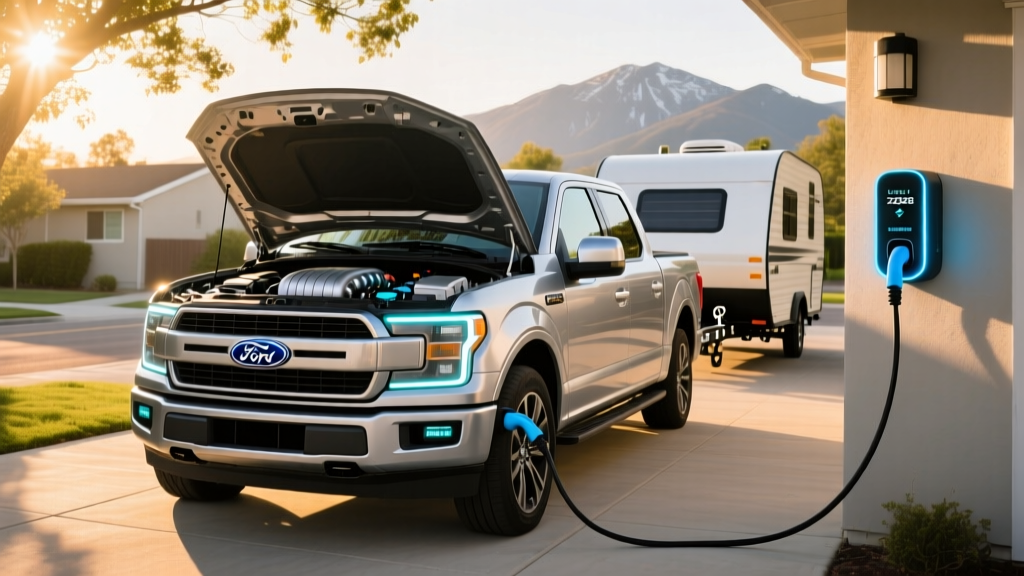
One feature unique to the PowerBoost is Ford's available 7.2 kW Pro Power Onboard system — a mobile generator that uses the hybrid battery and gasoline engine to supply 240V and 120V AC power through bed-mounted outlets. At 7.2 kW, it can run:
- A full-size welder or air compressor on a job site
- A 240V well pump or sump pump during a home outage
- Power tools, lights, and a refrigerator simultaneously at a campsite
The non-hybrid F-150 offers a 2.0 kW Pro Power Onboard option, but the 7.2 kW version is exclusive to the PowerBoost. The hybrid battery acts as a buffer, so the engine doesn't need to run constantly — it kicks on only when the battery depletes to a set threshold, then recharges it. On a full tank, Ford estimates the system can provide up to 32 hours of continuous 7.2 kW output at partial load.
Battery Warranty, Reliability, and Replacement Cost
How Long Will the Hybrid Battery Last?
The 1.5 kWh lithium-ion pack in the PowerBoost is small and operates in a narrow state-of-charge window — typically between 40% and 80% — which significantly reduces degradation stress. Toyota's hybrid systems (which use similar shallow-cycle strategies) have demonstrated 200,000+ mile battery longevity across millions of vehicles. Ford's hybrid technology, now in its second decade across the Escape Hybrid and F-150 PowerBoost, follows the same engineering principles.
Based on owner reports and Ford's track record with the Escape Hybrid (which has been in production since 2005), the F-150 PowerBoost battery should reliably last 150,000–200,000+ miles under normal use before capacity loss becomes noticeable. Unlike an EV battery, a modest degradation in a 1.5 kWh HEV pack primarily reduces the duration of electric assist — it doesn't strand you. The gasoline engine continues to operate normally.
Hybrid Battery Replacement Cost
If the hybrid battery does fail outside of warranty, replacement costs for the F-150 PowerBoost battery pack currently range from $3,000 to $5,000 including parts and labor at a Ford dealership. Third-party hybrid battery rebuilders offer refurbished packs for $2,000–$3,500. This is dramatically less than an EV traction battery replacement ($10,000–$20,000+) because the pack is small and uses proven cylindrical cell chemistry.
Hybrid F-150 vs. Gas F-150 vs. F-150 Lightning: Which Fits You?
| Factor | PowerBoost Hybrid | 3.5L EcoBoost Gas | F-150 Lightning (EV) |
|---|---|---|---|
| Combined MPG / MPGe | 25 MPG | 20 MPG | ~70 MPGe |
| Total Range | ~700 miles | ~550 miles | 230–320 miles |
| Max Towing | 7,800 lbs | 11,300 lbs | 10,000 lbs |
| Refueling / Recharge | 5 min (gas) | 5 min (gas) | 30–80 min (DC) |
| Federal Tax Credit | None | None | Up to $7,500* |
| Onboard Power | 7.2 kW | 2.0 kW | 9.6 kW (V2H capable) |
| Starting Price (approx.) | ~$52,500 | ~$44,000 | ~$55,000 |
*F-150 Lightning tax credit eligibility depends on MSRP caps, buyer income limits, and battery sourcing requirements per IRS §30D. Verify at irs.gov before purchase.
Choose the PowerBoost Hybrid If:
- You tow regularly but want better daily fuel economy than a gas truck
- You need 7.2 kW onboard power for job-site tools or home backup
- You don't have access to home EV charging
- You want 700+ mile range without refueling stops
- Your driving is a mix of city stops and highway hauling
Choose the F-150 Lightning (EV) If:
- You can install a Level 2 home charger
- Your daily driving is under 200 miles and you rarely tow heavy
- You want the lowest per-mile fuel cost and zero tailpipe emissions
- You value the $7,500 federal tax credit (if eligible)
- You want V2H (vehicle-to-home) backup power capability
Pros and Cons
✓ Pros
- 25 MPG combined — best in the full-size truck segment
- 570 lb-ft torque beats the 5.0L V8
- 7.2 kW Pro Power Onboard (exclusive to hybrid)
- No plug-in charging required — zero lifestyle change
- ~700-mile total range on a full tank
- Proven hybrid battery reliability with 8yr/100k-mi warranty
✗ Cons
- $3,300–$4,475 premium over equivalent gas powertrain
- Towing capacity 7,800 lbs — less than the EcoBoost's 11,300 lbs
- No federal tax credit to offset the hybrid upcharge
- Highway MPG advantage is modest (26 vs 23 for EcoBoost)
- Not available in base XL trim (XLT minimum)
- Hybrid system adds ~200 lbs vs non-hybrid powertrain
Frequently Asked Questions
How many MPG does the hybrid F-150 get?
The EPA rates the 2026 F-150 PowerBoost 4WD at 24 city / 26 highway / 25 combined MPG. In real-world city-heavy driving, owners commonly see 25–28 MPG thanks to regenerative braking. Highway-only driving at 75+ mph typically yields 21–24 MPG. Towing drops economy to 12–15 MPG depending on trailer weight and terrain.
Is the F-150 hybrid a plug-in? Do I need to charge it?
No. The F-150 PowerBoost is a conventional self-charging hybrid (HEV). The 1.5 kWh battery charges automatically through regenerative braking and the gasoline engine. You never plug it in, and there is no electric-only driving range. Ford does not offer a plug-in hybrid (PHEV) version of the F-150.
Is the F-150 PowerBoost reliable? What about battery replacement?
Ford's hybrid system has been proven across the Escape Hybrid since 2005 with strong reliability records. The PowerBoost battery carries an 8-year/100,000-mile warranty (10 years/150,000 miles in CARB states). The battery should last 150,000–200,000+ miles. If replacement is needed out of warranty, expect $3,000–$5,000 at a dealer — far less than an EV battery replacement.
Can the hybrid F-150 tow as much as the gas version?
No. The PowerBoost is rated for up to 7,800 lbs of towing (properly equipped), while the 3.5L EcoBoost can tow up to 11,300 lbs. The hybrid's lower tow rating is due to the added weight of the hybrid system and different axle ratio calibration. If you regularly tow over 7,500 lbs, the EcoBoost or 5.0L V8 is the better choice.
How much does the hybrid option cost over the gas F-150?
The PowerBoost adds approximately $3,300–$4,475 depending on trim and model year. At current fuel prices (~$3.40/gallon), driving 15,000 miles per year, the 5 MPG improvement over the EcoBoost saves roughly $500–$650 annually in fuel. The hybrid premium pays for itself in about 5–7 years for average drivers — sooner if gas prices rise or your driving is city-heavy.
Does the F-150 hybrid qualify for any tax credit?
The PowerBoost does not qualify for the federal §30D Clean Vehicle Credit because it is a conventional hybrid with a 1.5 kWh battery — well below the 7 kWh minimum. No current federal incentive exists for HEVs. Check your state energy office for any local hybrid rebates or incentives, which vary significantly by jurisdiction.