Quick Verdict: The F-150 PowerBoost Is a Hybrid, Not a Plug-In
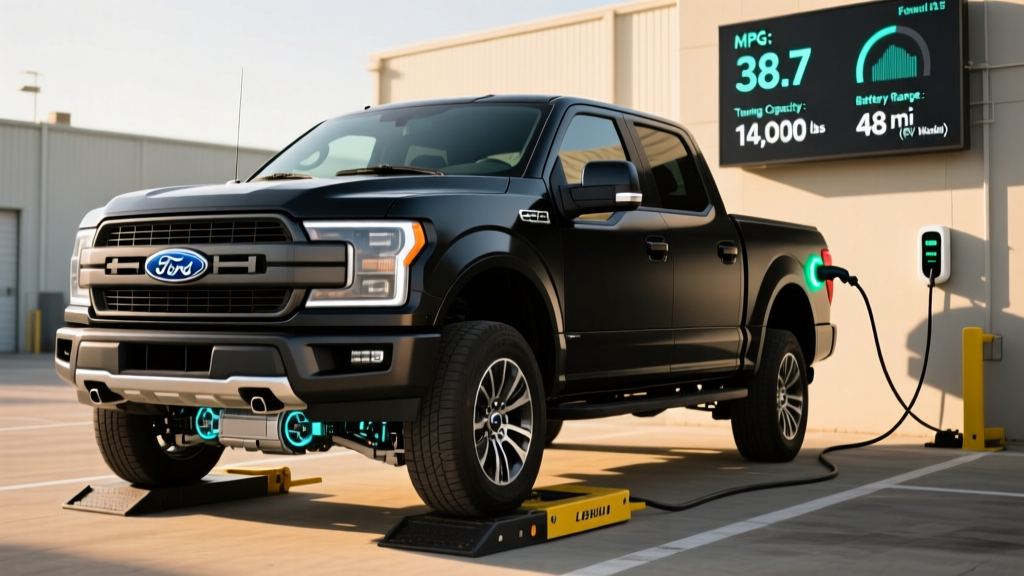
If you've been searching for an F-150 hybrid, what you'll find is Ford's PowerBoost system — a conventional full hybrid (HEV) that pairs a 3.5-liter twin-turbo V6 with a 47-horsepower electric motor integrated into the 10-speed automatic transmission. This is not a plug-in hybrid (PHEV). You never plug it in. The 1.5 kWh lithium-ion battery recharges through regenerative braking and engine operation, and the truck drives, refuels, and feels almost identical to a standard F-150 — just with noticeably better fuel economy, especially in city driving and stop-start conditions.
For the 2026 model year, the PowerBoost remains the only hybrid option in the F-150 lineup. Ford does not offer a plug-in variant of the F-150, and the fully electric F-150 Lightning serves buyers who want zero tailpipe emissions. The PowerBoost occupies a practical middle ground: genuine fuel savings without range anxiety, charging infrastructure dependence, or a price premium that stretches into Lightning territory.
HEV vs. PHEV — What's the Difference for Truck Buyers?
Conventional Hybrid (HEV) — F-150 PowerBoost: Small battery (~1.5 kWh), self-charging via regen and engine, no plug required, modest electric-only assist at low speeds, EPA 25 MPG combined.
Plug-In Hybrid (PHEV) — e.g., Ford Escape PHEV: Larger battery (14+ kWh), plug-in charging required for full benefit, 30+ miles electric-only range, higher MSRP, eligible for §30D federal tax credit if criteria are met.
The F-150 PowerBoost is strictly HEV. If you need plug-in electric range in a Ford truck, that option doesn't currently exist in the F-150 lineup.
Fuel Economy: EPA Numbers and Real-World MPG
The headline number for the 2026 F-150 PowerBoost is its EPA-estimated fuel economy. Here's the official breakdown from fueleconomy.gov:
| Configuration | City MPG | Highway MPG | Combined MPG |
|---|---|---|---|
| 4×2 (Rear-Wheel Drive) | 25 | 26 | 25 |
| 4×4 (Four-Wheel Drive) | 23 | 24 | 24 |
| Gas 3.5L V6 (4×4, non-hybrid) | 18 | 23 | 20 |
The 4×4 PowerBoost returns a 4-MPG combined improvement over the equivalent non-hybrid 3.5L EcoBoost — a 20% gain. That gap widens in city driving, where the hybrid system's regenerative braking and electric motor assist shine. The EPA city figure of 23 MPG for the 4×4 hybrid versus 18 MPG for the gas version represents a 28% improvement in stop-and-go conditions.
Real-World MPG: What Owners Actually Report
EPA estimates are tested on controlled cycles, and real-world results depend heavily on driving style, payload, and terrain. Based on owner-reported data and independent testing:
- City/suburban driving (under 45 mph): 22–26 MPG — the hybrid system delivers its strongest gains here, with frequent regen-braking opportunities and electric motor assist from stops.
- Highway cruising (70–80 mph, unloaded): 21–24 MPG — at sustained speed, the gasoline engine does most of the work, and the hybrid advantage narrows to roughly 2–3 MPG over the gas-only 3.5L.
- Towing (5,000+ lb trailer): 12–15 MPG — towing erases nearly all hybrid advantage. Expect fuel consumption similar to the non-hybrid V6 under heavy load.
- Cold weather (below 30°F): Subtract 1–3 MPG. The engine runs more frequently to provide cabin heat and maintain operating temperature, reducing electric motor contribution.
For a daily driver who commutes in mixed suburban traffic, the PowerBoost consistently delivers 23–25 MPG — closely matching the EPA sticker. Highway-heavy commuters will see less benefit.
Powertrain Specs: Power Meets Efficiency
| Specification | 2026 F-150 PowerBoost |
|---|---|
| Engine | 3.5L Twin-Turbo V6 + 47-hp electric motor |
| Combined Horsepower | 430 hp |
| Combined Torque | 570 lb-ft |
| Transmission | 10-speed automatic (modular hybrid) |
| Battery Capacity | 1.5 kWh (lithium-ion) |
| Electric-Only Driving | Limited low-speed assist (~1–2 mi at low speed) |
| 0–60 mph | ~5.8 seconds (4×2, estimated) |
| Max Towing Capacity | Up to 12,700 lb (properly equipped) |
| Max Payload | Up to 2,120 lb |
| Pro Power Onboard | Up to 7.2 kW generator output |
| Fuel Tank | 30.6 gallons |
| Total Range | ~730–760 miles |
The 430-horsepower combined output actually exceeds the standard 3.5L EcoBoost (400 hp), and peak torque of 570 lb-ft arrives low in the rev range thanks to electric motor fill. This makes the PowerBoost feel punchy from a stoplight and responsive during highway merging — not a characteristic you typically associate with "hybrid."
Pro Power Onboard: The Hidden Hybrid Advantage
One feature unique to the PowerBoost is the available 7.2-kilowatt Pro Power Onboard system. Because the hybrid battery and motor can run the engine as a generator, the PowerBoost can output 240-volt AC power through bed-mounted outlets — enough to run power tools at a job site, a campsite setup, or even essential home circuits during an outage. The 7.2 kW output rivals a small home standby generator and runs for up to 85 hours on a full tank at half load. The non-hybrid F-150 offers a 2.0 kW version, but the 7.2 kW system is exclusive to the PowerBoost.
Pricing, Trims, and Tax Credit Eligibility
The PowerBoost is available across multiple F-150 trims for 2026, though not every trim offers it. Here's the approximate pricing structure:
| Trim | PowerBoost MSRP (4×4, est.) | PowerBoost Premium Over Gas |
|---|---|---|
| XLT | ~$58,500 | ~$3,300 |
| Lariat | ~$66,000 | ~$3,300 |
| King Ranch | ~$73,000 | Included |
| Platinum | ~$76,500 | Included |
| Limited | ~$85,000 | Included |
The PowerBoost option typically adds $3,300 to lower trims (XLT, Lariat) and comes standard on higher luxury trims. Compared to the F-150 Lightning (starting ~$55,000 for the base Flash trim), the PowerBoost is similarly priced in mid-trims but doesn't require home charging infrastructure.
Does the F-150 PowerBoost Qualify for a Federal Tax Credit?
No. The F-150 PowerBoost is a conventional hybrid (HEV), not a plug-in electric vehicle. The IRS §30D Clean Vehicle Credit applies only to plug-in electric vehicles (BEVs and PHEVs) with a battery capacity of at least 7 kWh. The PowerBoost's 1.5 kWh battery falls far short of this threshold. There is no federal tax credit for conventional hybrids as of the 2026 tax year.
Some states offer separate incentives for hybrid vehicles, but these vary by jurisdiction and change frequently. Check your state's energy office or department of revenue for current programs. For federal credit rules, see IRS.gov Clean Vehicle Tax Credits.
Battery Warranty and Longevity
Hybrid Battery Warranty: Ford covers the PowerBoost hybrid battery for 8 years or 100,000 miles (whichever comes first) in all 50 states, with a capacity retention threshold. In states that follow California Air Resources Board (CARB) emissions standards, hybrid battery coverage extends to 10 years or 150,000 miles.
Powertrain Warranty: The engine, transmission, and hybrid motor are covered under the 5-year/60,000-mile powertrain warranty.
Replacement Cost: If the hybrid battery fails outside warranty, replacement typically costs $3,000–$5,000 including labor at a Ford dealership. However, the 1.5 kWh battery in the PowerBoost is significantly smaller than a PHEV or BEV pack, and its smaller size and moderate charge/discharge cycles contribute to slower degradation. Most hybrid batteries in modern Ford systems last well beyond the warranty period — often 150,000–200,000+ miles before meaningful capacity loss.
Reliability and Long-Term Ownership
The PowerBoost system uses Ford's well-established 3.5L EcoBoost V6 as its foundation — an engine with over a decade of real-world service in the F-150, Explorer, and other models. The hybrid motor is integrated into the 10-speed transmission housing (a modular hybrid design), eliminating the need for a separate drive unit and reducing mechanical complexity.
Key reliability considerations:
- Hybrid system complexity: The addition of the electric motor, inverter, and battery adds components that can fail, but Ford's hybrid systems in the Escape and Maverick have shown strong reliability records. The PowerBoost has been in production since the 2021 model year, giving it a multi-year track record.
- Brake longevity: Regenerative braking reduces wear on the friction brake pads and rotors. Many hybrid truck owners report brake pad life extending to 70,000–100,000 miles — significantly longer than the 30,000–50,000 miles typical of gas-only trucks.
- No plug-in maintenance: Because the PowerBoost is an HEV, there's no charging cable, charge port mechanism, or onboard charger to maintain. The maintenance schedule is nearly identical to the gas F-150.
- Known concerns: Early 2021–2022 PowerBoost models had some reported transmission shudder and hybrid system software glitches. Ford addressed most of these through technical service bulletins and software updates. The 2026 model benefits from these refinements.
F-150 Hybrid vs. F-150 Lightning vs. Gas F-150: Which Fits You?
| Factor | PowerBoost HEV | F-150 Lightning (BEV) | Gas 3.5L EcoBoost |
|---|---|---|---|
| Combined MPG / MPGe | 24 MPG (4×4) | 70 MPGe combined | 20 MPG (4×4) |
| Range | ~730 miles | 240–320 miles (EPA) | ~610 miles |
| Max Towing | 12,700 lb | 10,000 lb | 13,000 lb |
| Home Charging Needed? | No | Yes (Level 2 recommended) | No |
| Federal Tax Credit | None | Up to $7,500 (if eligible) | None |
| Fuel Cost per Mile* | ~$0.14 | ~$0.04–$0.06 | ~$0.17 |
| Starting MSRP (4×4) | ~$58,500 | ~$55,000 | ~$55,200 |
| Pro Power Onboard | Up to 7.2 kW | Up to 9.6 kW | Up to 2.0 kW |
*Fuel cost per mile assumes $3.40/gal gasoline and $0.16/kWh home electricity. Source: fueleconomy.gov and EIA average electricity rates.
Choose the F-150 PowerBoost Hybrid If:
- You drive 15,000+ miles per year in mixed city/suburban conditions and want meaningful fuel savings without changing your refueling habits.
- You tow regularly and need the full 12,700-lb capacity that the Lightning can't match.
- You don't have access to home Level 2 charging (apartment, street parking, no garage).
- You want the 7.2 kW Pro Power Onboard for job-site or emergency generator use.
- You plan to keep the truck 8–12 years and value the hybrid battery warranty as a long-term safeguard.
Choose the F-150 Lightning (BEV) If:
- You have reliable home Level 2 charging and most daily drives are under 200 miles.
- You want the lowest per-mile operating cost and qualify for the §30D federal tax credit.
- You value instant torque, a front trunk (frunk), and near-silent operation.
- You rarely tow over 8,000 lb and don't drive in extreme cold where range loss is a concern.
Stick With the Gas 3.5L EcoBoost If:
- You tow maximum loads frequently (the gas V6 edges out the hybrid at 13,000 lb).
- Your driving is almost entirely highway at sustained speeds, where the hybrid advantage is smallest.
- You want the lowest possible purchase price and plan to sell or trade within 3–4 years.
5-Year Cost of Ownership Snapshot
| Cost Category | PowerBoost HEV (4×4) | Gas 3.5L (4×4) | Lightning (AWD) |
|---|---|---|---|
| MSRP (mid-trim Lariat/Flash) | $66,000 | $62,700 | $65,000 |
| Federal Tax Credit | $0 | $0 | Up to $7,500* |
| Fuel/Energy (5 yr, 75K mi) | $10,500 | $12,750 | $3,000–$4,500 |
| Maintenance (5 yr est.) | $3,200 | $3,800 | $2,100 |
| Insurance (5 yr est.) | $9,500 | $9,000 | $10,200 |
| Est. 5-Year Total | ~$89,200 | ~$88,250 | ~$77,300–$81,800 |
*Lightning tax credit eligibility depends on MSRP cap ($80,000 for trucks), buyer income limits, and battery component/critical mineral sourcing requirements per IRS §30D. Verify at IRS.gov. Estimates are approximate and vary by region, driving habits, and electricity rates.
The PowerBoost's 5-year cost sits between the gas model and the Lightning. Its fuel savings over the gas truck (~$2,250 over 5 years) roughly offset the hybrid premium, but it can't match the Lightning's dramatically lower energy costs — especially after the federal credit.
Pros and Cons at a Glance
Pros
- 24 MPG combined (4×4) — best-in-class for a full-size truck hybrid
- 430 hp / 570 lb-ft — more power than the standard 3.5L EcoBoost
- 12,700-lb max towing — no compromise vs. gas models
- 7.2 kW Pro Power Onboard — job-site and emergency generator capability
- No plug-in charging required — zero infrastructure change
- ~730-mile total range — fewer fuel stops on long trips
- 8-year/100,000-mile hybrid battery warranty (10 yr/150K in CARB states)
Cons
- No federal tax credit — HEVs don't qualify for §30D
- Hybrid premium adds ~$3,300 to XLT/Lariat trims
- Highway MPG advantage is modest (~2 MPG over gas)
- Towing fuel economy drops to 12–15 MPG, negating hybrid benefit
- Electric-only driving is negligible (low-speed assist only, ~1 mi)
- Not available on base XL trim — limited entry-level access
Frequently Asked Questions
How many MPG does the F-150 hybrid get?
The 2026 F-150 PowerBoost 4×4 returns an EPA-estimated 23 city / 24 highway / 24 combined MPG. The 4×2 version achieves 25 city / 26 highway / 25 combined. Real-world results typically match the EPA sticker in mixed driving (23–25 MPG), but highway-only commuters should expect 21–23 MPG, and towing drops economy to 12–15 MPG.
Does the F-150 hybrid need to be plugged in?
No. The F-150 PowerBoost is a conventional hybrid (HEV). Its 1.5 kWh battery charges automatically through regenerative braking and engine operation. There is no charge port and no plug-in capability. Ford does not currently offer a plug-in hybrid (PHEV) version of the F-150.
How far can the F-150 hybrid drive on electric power alone?
The PowerBoost can creep at very low speeds (under 25 mph) on electric power for roughly 1–2 miles in ideal conditions — for example, in a parking lot or heavy traffic. It is not designed for meaningful electric-only driving. The electric motor primarily assists the gasoline engine during acceleration and fills torque gaps during gear shifts.
Is the F-150 PowerBoost hybrid reliable?
The PowerBoost has been in production since the 2021 model year, and its underlying 3.5L EcoBoost V6 is one of Ford's most widely used engines. Early models had some transmission software issues that Ford addressed through updates. The hybrid-specific components (motor, inverter, battery) are covered by an 8-year/100,000-mile warranty (10 yr/150,000 mi in CARB states). Owner-reported reliability is generally favorable, with the hybrid system adding minimal maintenance burden compared to the gas model.
What does it cost to replace the F-150 hybrid battery?
Out-of-warranty hybrid battery replacement for the F-150 PowerBoost typically costs $3,000–$5,000 including labor. This is substantially less than a PHEV or BEV battery replacement because the pack is only 1.5 kWh. Most modern hybrid batteries last 150,000–200,000+ miles before significant degradation, and many will outlast the vehicle itself.
Does the F-150 hybrid qualify for any tax credit?
The F-150 PowerBoost does not qualify for the federal §30D Clean Vehicle Credit because it is a conventional hybrid (HEV), not a plug-in vehicle. The credit requires a minimum 7 kWh battery and plug-in charging capability. Some states may offer their own hybrid incentives — check your state energy office for current programs. The fully electric F-150 Lightning may qualify for up to $7,500 in federal credits, subject to income, MSRP, and battery-sourcing requirements.
Can the F-150 hybrid power my house?
The available 7.2 kW Pro Power Onboard system can power essential home circuits during an outage through the bed-mounted 240V outlets. However, unlike the F-150 Lightning (which offers vehicle-to-home/V2H capability with the Ford Charge Station Pro and Home Integration System), the PowerBoost does not have bidirectional power transfer to a home electrical panel. You would need to manually connect appliances or use a transfer switch with the bed outlets.