Quick Verdict: The F-150 PowerBoost Hybrid Earns Its Keep
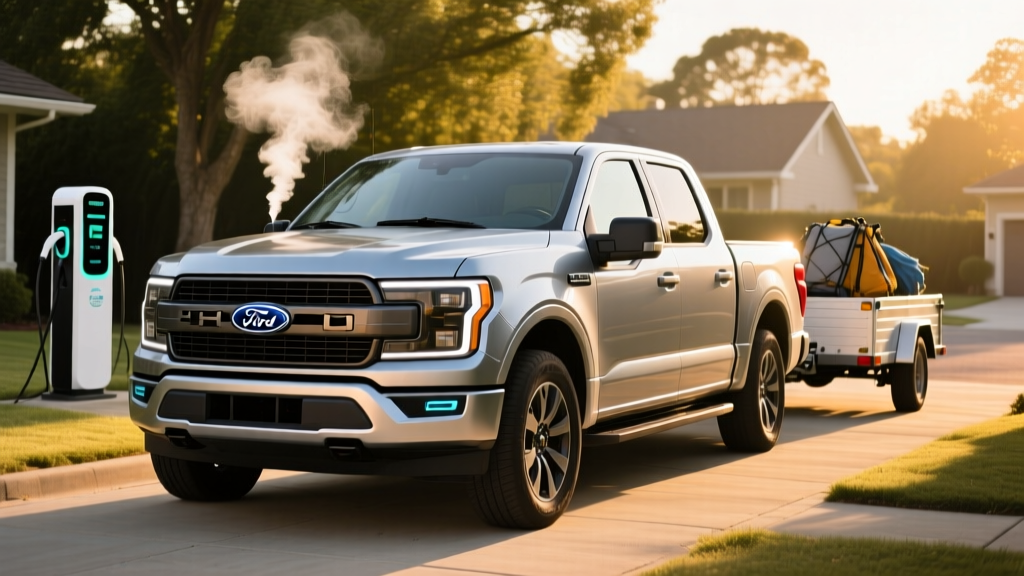
The Ford F-150 PowerBoost hybrid doesn't try to be an EV. It's a full-size, body-on-frame pickup that uses a 1.5 kWh lithium-ion battery and a 47-hp electric motor sandwiched into a 10-speed automatic to deliver meaningful fuel savings without sacrificing the towing, payload, and off-road capability truck buyers demand. For the 2025 model year, the PowerBoost remains the only full-hybrid option in the F-150 lineup — and notably, Ford does not offer a plug-in hybrid (PHEV) F-150. If you want electric-only driving from a Blue Oval truck, you're looking at the F-150 Lightning EV instead.
The 2025 F-150 PowerBoost pairs a 3.5-liter twin-turbo V6 with that integrated electric motor for a combined output of 430 horsepower and 570 lb-ft of torque. EPA-rated at 25 MPG combined, it delivers roughly 20–30% better fuel economy than the non-hybrid 3.5L EcoBoost while maintaining a maximum towing capacity of 11,200 pounds when properly equipped. Starting around $56,000 (before destination), it's a premium powertrain option — but one that can pay for itself over a high-mileage ownership cycle.
| Spec | Value |
|---|---|
| Powertrain | 3.5L Twin-Turbo V6 + 47-hp electric motor (PowerBoost) |
| Combined Output | 430 hp / 570 lb-ft torque |
| Transmission | 10-speed automatic with integrated motor |
| Battery | 1.5 kWh lithium-ion (self-charging HEV — no plug) |
| EPA Fuel Economy (4x2) | 25 city / 26 highway / 25 combined MPG |
| EPA Fuel Economy (4x4) | 23 city / 24 highway / 24 combined MPG |
| Max Towing (properly equipped) | 11,200 lbs |
| Max Payload | ~2,120 lbs |
| Pro Power Onboard | Up to 7.2 kW (bed outlets) |
| 0–60 mph | ~5.8 seconds (est.) |
| Starting MSRP (SuperCrew, 4x2) | ~$56,000 (before destination) |
| Hybrid Battery Warranty | 8 years / 100,000 miles |
HEV vs PHEV: Why the F-150 PowerBoost Is a Conventional Hybrid
A common point of confusion among truck shoppers is whether the F-150 hybrid needs to be plugged in. It does not. The PowerBoost is a conventional hybrid electric vehicle (HEV) — sometimes called a "self-charging" hybrid. Its 1.5 kWh battery is charged entirely through regenerative braking and the gasoline engine. There is no plug, no charging port, and no electric-only driving range to speak of (the motor assists at low speeds but cannot propel the truck on battery alone for meaningful distances).
| Feature | F-150 PowerBoost (HEV) | F-150 Lightning (BEV) | Hypothetical PHEV F-150* |
|---|---|---|---|
| Plug-in Required? | No | Yes (Level 2 / DC fast) | Yes (for EV range) |
| Electric-Only Range | None (motor assist only) | 230–320 mi (EPA) | N/A — not offered |
| Battery Size | 1.5 kWh | 98–131 kWh usable | Typically 15–25 kWh |
| Fuel Economy | 24–25 MPG combined | ~66–70 MPGe | N/A |
| Max Towing | 11,200 lbs | 10,000 lbs | N/A |
| Federal Tax Credit (§30D) | Not eligible | Up to $7,500 (eligibility varies) | Would require §30D compliance |
*Ford does not currently produce a plug-in hybrid F-150. This column is for educational comparison only.
This distinction matters for your wallet and your routine. An HEV like the PowerBoost requires zero behavioral change — you fuel it like any other truck and the hybrid system works invisibly in the background. A PHEV, by contrast, gives you 25–40 miles of electric-only range but demands access to a plug (ideally a home Level 2 charger) to realize its efficiency advantage. And a full BEV like the F-150 Lightning eliminates gas entirely but introduces charging logistics, range planning for towing, and higher upfront cost.
Fuel Economy: EPA Ratings and Real-World MPG
The EPA rates the 2025 F-150 PowerBoost 4x2 at 25 city / 26 highway / 25 combined MPG, while the 4x4 drops slightly to 23 city / 24 highway / 24 combined. These figures come from fueleconomy.gov and represent the official federal testing cycle.
| Drivetrain | City MPG | Highway MPG | Combined MPG |
|---|---|---|---|
| 4x2 (RWD) | 25 | 26 | 25 |
| 4x4 (AWD) | 23 | 24 | 24 |
Real-world expectations: Hybrid trucks, like most hybrids, tend to perform better in stop-and-go city driving where regenerative braking recaptures energy frequently. In mixed suburban and city driving, owners commonly report matching or slightly exceeding the EPA combined number — 25–27 MPG is achievable. On sustained highway trips at 75+ mph, expect the hybrid advantage to narrow, with fuel economy settling closer to 22–24 MPG for the 4x4. Towing a trailer will drop economy significantly — figure 12–16 MPG depending on weight and aerodynamics, which is comparable to the non-hybrid EcoBoost under load.
Compared to the conventional 3.5L EcoBoost V6 (rated around 20 combined MPG in 4x4 form), the PowerBoost's 4 MPG combined advantage translates to roughly 60–80 fewer gallons of fuel per year at 15,000 miles driven — a savings of approximately $200–$300 annually at $3.50/gallon.
Powertrain Deep Dive: What Makes PowerBoost Tick
The PowerBoost system is more than a bolted-on electric motor. Ford integrates a 47-horsepower (35 kW) electric motor directly into the housing of the 10-speed automatic transmission. This motor draws from a 1.5 kWh lithium-ion battery pack mounted under the rear seat of the SuperCrew cab — preserving bed space and interior volume.
The combined system output of 430 hp and 570 lb-ft of torque actually exceeds the standard 3.5L EcoBoost (400 hp / 500 lb-ft) and approaches the high-output variant. The electric motor fills in torque at low RPMs before the turbos fully spool, giving the PowerBoost a noticeably responsive launch from a stop and smooth, linear acceleration through the midrange.
A standout feature is Pro Power Onboard, available in 2.4 kW and 7.2 kW configurations. The 7.2 kW system provides up to six 120V outlets and a 240V outlet in the bed, effectively turning the F-150 into a mobile generator. This is powered by the hybrid battery and engine — it can run tools, appliances, or even provide emergency home power during an outage, with the engine cycling on and off as needed to maintain battery charge. Ford estimates the 7.2 kW system can power an average home's essential circuits for up to three days on a full tank.
Pricing, Trims, and Tax Credit Eligibility
The PowerBoost hybrid is available across multiple F-150 trims for 2025, including XLT, Lariat, King Ranch, Platinum, and Limited. It requires the SuperCrew cab configuration. Pricing varies significantly by trim and options:
- XLT PowerBoost (4x2): Starting ~$56,000
- Lariat PowerBoost (4x4): Starting ~$63,000
- King Ranch / Platinum: $68,000–$78,000
- Limited: $82,000+
Federal tax credit status: The F-150 PowerBoost is a conventional hybrid (HEV), and as such it does not qualify for the §30D federal clean vehicle tax credit. That credit — up to $7,500 for new vehicles — applies only to plug-in electric vehicles (BEVs and PHEVs) that meet battery sourcing, critical mineral, MSRP cap, and buyer income requirements per IRS guidelines. Some states may offer their own incentives for hybrid vehicles, but these vary by jurisdiction — check your state's energy or environmental agency for current programs.
For buyers specifically seeking a tax-credit-eligible Ford truck, the F-150 Lightning BEV may qualify depending on your income, the vehicle's MSRP, and current battery-component sourcing rules. Always verify eligibility with a tax professional before purchasing.
Reliability, Battery Warranty, and Long-Term Costs
Hybrid Battery Warranty
Ford covers the PowerBoost hybrid battery for 8 years or 100,000 miles (whichever comes first), in compliance with federal emissions warranty requirements for hybrid components. This warranty covers defects and capacity loss below a functional threshold — though with a 1.5 kWh pack that cycles shallowly (it never fully depletes or fully charges), degradation is minimal in practice.
The PowerBoost system has been in production since the 2021 model year, giving it several years of real-world service history. The 3.5L EcoBoost V6 itself is one of Ford's most widely deployed engines, with millions on the road. Common owner-reported concerns in early model years (2021–2022) included minor software glitches related to the hybrid control module and occasional rough engine stop/start transitions, most of which were addressed through over-the-air updates and dealer service bulletins.
Battery replacement cost: Should the hybrid battery fail outside warranty, replacement is estimated between $2,500 and $4,500 including labor — substantially less than a full EV battery replacement because the pack is small (1.5 kWh vs. 100+ kWh in a BEV). The electric motor within the transmission is covered under the powertrain warranty (5 years / 60,000 miles) and is generally considered a low-wear component.
Long-term maintenance for the PowerBoost is similar to the conventional EcoBoost: same oil change intervals, same transmission fluid, same brake service (though regenerative braking can extend pad life by 20–40% based on driving patterns). There's no additional scheduled maintenance specific to the hybrid system.
Towing, Payload, and Practical Capability
The hybrid system does not compromise the F-150's core truck functions. When properly equipped with the Max Trailer Tow Package, the 2025 PowerBoost 4x2 achieves a maximum towing capacity of 11,200 pounds. The 4x4 variant rates slightly lower, typically around 10,800 pounds. Payload capacity tops out at approximately 2,120 pounds for the 4x2 — competitive with the non-hybrid 3.5L EcoBoost.
One practical advantage of the PowerBoost for towing: the electric motor's instant low-RPM torque smooths out initial acceleration with a heavy trailer, reducing the transmission hunting and turbo lag you might feel with the conventional EcoBoost. The integrated trailer brake controller and Ford's Pro Trailer Backup Assist are available with the PowerBoost as they are on other trims.
The 7.2 kW Pro Power Onboard system deserves special mention for worksite and recreational use. With a 240V NEMA L14-30 outlet in the bed, you can run welders, compressors, or circular saws directly from the truck without a separate generator. For camping, it powers microwaves, portable A/C units, and lighting effortlessly — and the hybrid system's ability to silently run the battery for short periods (engine off) means quiet nighttime power without idling.
Pros
- 24–25 MPG combined — best-in-class for a full-size truck with this towing capacity
- 430 hp / 570 lb-ft exceeds the standard EcoBoost output
- 7.2 kW Pro Power Onboard turns the truck into a mobile generator
- No plug-in required — zero behavioral change from a gas truck
- Regenerative braking extends brake pad life
- Full towing/payload capability retained vs. non-hybrid
Cons
- ~$4,000–$5,000 premium over the equivalent 3.5L EcoBoost
- No federal tax credit to offset the hybrid premium
- Highway MPG advantage narrows at sustained high speeds
- Requires SuperCrew cab — not available in Regular or SuperCab
- Fuel savings take 3–5 years to recoup the powertrain premium at average mileage
- Some early-model-year software refinement issues (mostly resolved)
Who Should Choose the F-150 PowerBoost Hybrid?
The 2025 F-150 PowerBoost is best suited for buyers who:
- Drive 15,000+ miles per year and want to reduce fuel costs without altering their refueling routine — the hybrid premium pays back faster at high mileage.
- Need full truck capability — towing, payload, off-road clearance — and aren't willing to compromise for efficiency.
- Want Pro Power Onboard for jobsite or recreational use; the hybrid system is what makes the 7.2 kW output possible.
- Lack home charging access — apartment dwellers, street parkers, or those without a garage who can't install a Level 2 charger but still want better fuel economy.
- Want a bridge technology — better efficiency today without committing to full EV charging infrastructure or accepting the range limitations of a BEV when towing.
Consider the F-150 Lightning (BEV) instead if: you have home charging, mostly drive under 250 miles per day, want to eliminate fuel costs entirely, qualify for the §30D tax credit, and don't regularly tow heavy trailers over long distances (where BEV range drops significantly).
Stick with the conventional 3.5L EcoBoost if: your annual mileage is under 10,000 miles (the hybrid premium won't pay back in fuel savings), you want the lowest upfront price, or you prefer a simpler powertrain with fewer unique components.
Frequently Asked Questions
How many MPG does the 2025 Ford F-150 hybrid get?
The EPA rates the 2025 F-150 PowerBoost at 25 city / 26 highway / 25 combined MPG for the 4x2, and 23 city / 24 highway / 24 combined for the 4x4. In real-world mixed driving, many owners report matching or slightly exceeding the combined figure, particularly in suburban and city conditions where regenerative braking is most active.
Does the F-150 hybrid need to be plugged in?
No. The F-150 PowerBoost is a conventional hybrid (HEV). Its 1.5 kWh battery charges through regenerative braking and the gasoline engine. There is no plug and no charging port. You fuel it exactly like a standard F-150.
Does the F-150 hybrid qualify for any tax credit?
The F-150 PowerBoost does not qualify for the federal §30D clean vehicle tax credit because it is not a plug-in vehicle. That credit applies only to BEVs and PHEVs meeting specific battery sourcing, MSRP, and buyer income requirements. Some states may offer separate incentives for hybrids — check your state's energy office for details.
Is the F-150 PowerBoost hybrid reliable?
The PowerBoost system has been in production since 2021 and uses Ford's widely deployed 3.5L EcoBoost V6 as its foundation. The hybrid battery is warrantied for 8 years / 100,000 miles. Early model-year reports noted minor software issues, largely addressed through updates. The small 1.5 kWh battery experiences shallow cycling, which minimizes long-term degradation. Overall, it carries similar reliability expectations to the conventional EcoBoost powertrain.
How much does it cost to replace the F-150 hybrid battery?
Outside of warranty, a PowerBoost hybrid battery replacement is estimated at $2,500–$4,500 including labor. This is significantly less than a full EV battery replacement due to the small 1.5 kWh pack size. The battery is covered under Ford's 8-year / 100,000-mile hybrid component warranty.
Can the F-150 hybrid tow as much as the gas version?
Yes. When properly equipped, the 2025 PowerBoost 4x2 tows up to 11,200 pounds — matching or exceeding many conventional F-150 configurations. Payload capacity reaches approximately 2,120 pounds. The hybrid system does not reduce the truck's core work capabilities.
What is Pro Power Onboard and how does it work?
Pro Power Onboard is Ford's integrated mobile generator system, available in 2.4 kW and 7.2 kW versions on the PowerBoost. It uses the hybrid battery and engine to supply 120V and (on the 7.2 kW system) 240V power through outlets in the truck bed. The engine cycles on and off as needed to maintain battery charge, providing up to several days of continuous power for tools, appliances, or emergency home backup.
Hybrid vs PHEV vs EV — which F-150 should I buy?
Choose the PowerBoost (HEV) if you want better fuel economy with zero lifestyle changes — no plug, no range planning, full towing capability. Choose the F-150 Lightning (BEV) if you have home charging, drive under ~250 miles daily, want to eliminate gasoline costs, and can benefit from the federal tax credit. Ford does not currently offer a PHEV F-150, so there is no middle-ground plug-in option in this lineup.