Quick Verdict: The Ford F-150 PowerBoost Hybrid at a Glance
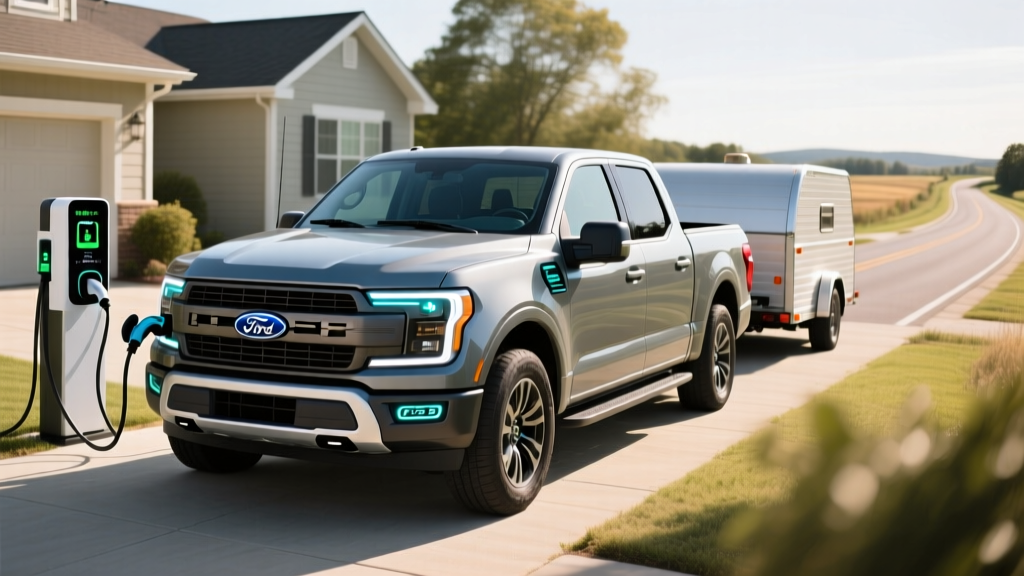
The Ford F-150 PowerBoost Hybrid occupies a pragmatic middle ground in the full-size truck segment. It pairs a 3.5-liter twin-turbo V6 with a 35-kW electric motor integrated into the 10-speed automatic transmission, producing a combined 430 horsepower and 570 lb-ft of torque. Unlike a plug-in hybrid (PHEV), the PowerBoost is a conventional hybrid (HEV) — it never needs to be plugged in. The battery recharges through regenerative braking and the gasoline engine, making it a drop-in efficiency upgrade for truck buyers who tow, haul, and drive long distances without access to reliable charging infrastructure.
For 2026, the PowerBoost remains available across multiple F-150 trims, from the XLT up through the Platinum and King Ranch, starting around $55,000 before options and destination charges. Its EPA rating of 25 MPG combined is a meaningful improvement over the non-hybrid 3.5L EcoBoost (roughly 20-21 MPG combined), translating to 50-70 fewer gallons of fuel per year at 15,000 miles.
| Spec | Value |
|---|---|
| Powertrain | 3.5L twin-turbo V6 + 35-kW electric motor |
| Combined Output | 430 hp / 570 lb-ft |
| Transmission | 10-speed automatic (modular hybrid) |
| Drivetrain | RWD or 4WD |
| EPA Fuel Economy (4WD) | 23 city / 24 hwy / 24 combined MPG |
| EPA Fuel Economy (RWD) | 25 city / 26 hwy / 25 combined MPG |
| Hybrid Battery | 1.5 kWh lithium-ion (non-plug-in HEV) |
| Max Towing Capacity | 12,700 lbs (properly equipped) |
| 0-60 mph | ~5.4 seconds |
| Pro Power Onboard | Up to 7.2 kW (standard on PowerBoost) |
| Base MSRP (XLT 4x2) | ~$55,000 |
| Battery Warranty | 8 years / 100,000 miles |
Hybrid (HEV) vs. Plug-In Hybrid (PHEV): What F-150 Buyers Need to Know
Ford currently offers the F-150 in three electrified-adjacent configurations, and the distinction matters for your wallet and daily routine:
| Type | F-150 Example | Needs Plug-In? | Electric-Only Range | How It Works |
|---|---|---|---|---|
| Conventional Hybrid (HEV) | PowerBoost | No | ~1-2 miles at low speed | Gas engine + small motor; battery recharges via regen and engine |
| Plug-In Hybrid (PHEV) | Not currently offered | Yes | 20-40 miles typical | Larger battery charged from grid; gas engine kicks in after battery depletes |
| Battery Electric (BEV) | F-150 Lightning | Yes (required) | 240-320 miles (EPA) | No gas engine; 100% electric drivetrain |
The PowerBoost is strictly a conventional hybrid. You fuel it at a gas station like any other truck. The 1.5 kWh battery is small by EV standards — it exists to assist the engine during acceleration, enable regenerative braking, and support idle stop-start. It cannot be plugged in, and it does not offer meaningful electric-only driving range.
If you're looking for a plug-in F-150 that can commute 30 miles on electricity before the gas engine activates, Ford does not currently offer one. Your closest alternatives are the F-150 Lightning (full EV) or waiting for potential future PHEV variants Ford has hinted at but not announced.
Fuel Economy: EPA Numbers vs. Real-World MPG
The EPA rates the 2026 F-150 PowerBoost at 25 MPG city / 26 MPG highway / 25 MPG combined in rear-wheel-drive form, and 23 city / 24 highway / 24 combined with four-wheel drive, according to fueleconomy.gov. These figures represent a roughly 20-25% improvement over the non-hybrid 3.5L EcoBoost V6, which lands around 19-20 MPG combined with 4WD.
| Powertrain | City MPG | Highway MPG | Combined MPG |
|---|---|---|---|
| 3.5L PowerBoost Hybrid (RWD) | 25 | 26 | 25 |
| 3.5L PowerBoost Hybrid (4WD) | 23 | 24 | 24 |
| 3.5L EcoBoost V6 (4WD) | 18 | 23 | 20 |
| 5.0L V8 (4WD) | 16 | 22 | 18 |
| F-150 Lightning (BEV) | — | — | ~70 MPGe combined |
Real-World MPG: What to Actually Expect
The PowerBoost's hybrid system shines in stop-and-go driving, where regenerative braking recovers energy and the electric motor handles low-speed movement. Owners frequently report exceeding EPA city estimates by 1-2 MPG in urban and suburban driving. Highway fuel economy, however, tends to land at or slightly below the EPA sticker, especially at sustained speeds above 70 mph or with a loaded bed.
In real-world mixed driving (roughly 60% highway, 40% city), expect 22-24 MPG with 4WD and 24-26 MPG with RWD. Towing a 6,000-pound trailer drops economy to roughly 11-13 MPG — comparable to the EcoBoost under load but still marginally better due to the hybrid system smoothing out engine load.
Cold weather reduces fuel economy by 5-10% in any internal-combustion vehicle. The hybrid system is less affected than a pure gas engine because it recaptures braking energy regardless of temperature, but expect winter combined figures closer to 21-22 MPG with 4WD.
Powertrain and Performance: 430 HP with Hybrid Efficiency
The PowerBoost pairs Ford's 3.5-liter twin-turbocharged V6 with a 35-kW (approximately 47-hp) electric motor sandwiched between the engine and the 10-speed automatic transmission. Combined system output is 430 horsepower and 570 lb-ft of torque, with peak torque arriving low in the rev range thanks to the electric motor's instant response.
This makes the PowerBoost one of the most powerful F-150 engines short of the high-output variants in the Raptor and Tremor. The 0-60 mph sprint takes approximately 5.4 seconds — competitive with the 5.0L V8 and noticeably quicker than the base 2.7L EcoBoost.
The electric motor also enables Ford's Pro Power Onboard system, which comes standard on all PowerBoost trims. The 7.2-kW option can power job-site tools, tailgate appliances, or serve as emergency home backup power through a 240-volt outlet in the bed. This is a genuine functional advantage the hybrid holds over the conventional EcoBoost and V8 powertrains, which offer a lower-output 2.0-kW Pro Power option at best.
Towing and Payload
The PowerBoost is rated to tow up to 12,700 pounds when properly equipped with the Max Trailer Tow Package. This falls slightly short of the maximum 14,000-pound rating available with the 3.5L EcoBoost and specific axle ratios, but it covers the vast majority of truck-towing scenarios — boat trailers, horse trailers, and most travel trailers under 30 feet.
Maximum payload sits around 2,120 pounds depending on trim and configuration. The hybrid battery pack adds roughly 200 pounds of curb weight compared to the EcoBoost, a minor trade-off that the system's torque output more than compensates for in daily driving.
Pricing, Trims, and Tax Credit Eligibility
The PowerBoost hybrid is available as an engine option across several F-150 trims for 2026. Here's a general pricing overview (MSRP before destination, options, or dealer adjustments):
- XLT (base PowerBoost trim): ~$55,000 (4x2) / ~$58,500 (4x4)
- Lariat: ~$62,000-$65,000
- King Ranch: ~$70,000-$73,000
- Platinum: ~$72,000-$76,000
- Tremor (PowerBoost option): ~$72,000+
The PowerBoost engine option typically adds $2,500-$3,500 over the equivalent 3.5L EcoBoost on the same trim. Ford includes Pro Power Onboard 7.2 kW as standard equipment with the PowerBoost, which partially offsets the upcharge compared to adding the feature separately on an EcoBoost model.
Federal Tax Credit: Does the F-150 Hybrid Qualify?
The F-150 PowerBoost is a conventional hybrid (HEV), not a plug-in vehicle. Under current IRS §30D Clean Vehicle Credit rules, the federal tax credit of up to $7,500 applies only to new plug-in electric vehicles (BEVs and PHEVs) that meet battery-sourcing and critical-mineral requirements. The PowerBoost does not qualify for the §30D federal EV tax credit.
There is a separate, smaller federal credit for certain qualified hybrid vehicles under the Energy Policy Act, but this credit has been largely phased out for major manufacturers like Ford. Some states offer their own incentives for hybrid vehicles — check your state's energy office or DMV for current programs, as these vary significantly by jurisdiction.
The F-150 Lightning (full EV), by contrast, may qualify for up to $7,500 under §30D depending on your income, the vehicle's MSRP, and battery component sourcing — though eligibility rules tighten annually. Consult a tax professional for your specific situation.
Battery Warranty, Reliability, and Replacement Cost
Ford Hybrid Battery Warranty: 8 years or 100,000 miles (whichever comes first), covering defects and capacity loss below a defined threshold. In states that follow California Air Resources Board (CARB) standards, hybrid battery warranty extends to 10 years or 150,000 miles.
The PowerBoost uses a 1.5 kWh lithium-ion battery pack — far smaller and less stressed than the battery in a full EV. Ford's hybrid battery technology traces back to the Escape Hybrid in 2005, and real-world data from millions of Ford hybrid vehicles (including the F-150 PowerBoost since 2021 and decades of Fusion/C-Max/Escape hybrids) shows excellent longevity. Most hybrid batteries outlast their warranty period without issue.
What If the Battery Fails?
Out-of-warranty hybrid battery replacement for the F-150 PowerBoost runs approximately $2,500-$4,000 including parts and labor at a Ford dealership. This is significantly less than a full EV battery replacement ($10,000-$20,000+) because the pack is small and the system is less complex. Independent hybrid-battery specialists can sometimes refurbish or replace individual cells for $1,500-$2,500.
The broader powertrain — the 3.5L V6, 10-speed transmission, and electric motor — is covered under Ford's 5-year/60,000-mile powertrain warranty. The 3.5L EcoBoost architecture is well-proven in millions of vehicles, and the hybrid system adds relatively few failure points. The electric motor, in particular, has far fewer moving parts than a traditional alternator or starter motor.
For reliability data, consult NHTSA for safety recalls and IIHS for crash-test ratings on the F-150 platform. Consumer Reports and J.D. Power also track owner-reported reliability by model year.
Who Should Buy the F-150 PowerBoost Hybrid?
Pros
- 4-5 MPG improvement over EcoBoost/V8 with no change in driving habits
- 570 lb-ft of torque with strong low-end electric assist
- Pro Power Onboard 7.2 kW standard — best-in-class onboard power
- No plug-in charging required; works at any gas station
- Full towing capability (12,700 lbs) with minimal efficiency penalty
- Proven hybrid reliability with 8yr/100k-mile battery warranty
Cons
- $2,500-$3,500 premium over equivalent EcoBoost
- No federal EV tax credit eligibility
- No electric-only driving range (not a PHEV)
- Highway MPG gains modest — benefits are city-centric
- Heavier than EcoBoost by ~200 lbs (minor payload reduction)
- Still burns gasoline — not a path to zero tailpipe emissions
The Decision Framework: Hybrid vs. EV vs. Gas
Choose the F-150 PowerBoost Hybrid if: You drive 12,000-20,000+ miles per year in mixed city/highway conditions, want better fuel economy without changing your fueling routine, need full towing capability, and value Pro Power Onboard for work or recreation. It's ideal for truck buyers who can't reliably charge at home or who regularly exceed 300 miles between stops.
Choose the F-150 Lightning (EV) if: You have home Level 2 charging, drive under 250 miles daily, want the lowest per-mile fuel cost (roughly $0.04-$0.08/mile on electricity vs. $0.18-$0.24/mile on gas), and qualify for the §30D tax credit. The Lightning offers 240-320 miles of EPA range, instant torque, and a front trunk (frunk) — but towing cuts range by 40-50%.
Choose the conventional EcoBoost (gas) if: Your budget is tight, you drive fewer than 10,000 miles per year (making the hybrid premium hard to recoup), or you prioritize maximum towing capacity (14,000 lbs) over fuel economy.
Frequently Asked Questions
How many MPG does the Ford F-150 PowerBoost Hybrid get?
The EPA rates the 2026 F-150 PowerBoost at 25 city / 26 highway / 25 combined MPG (RWD) or 23 city / 24 highway / 24 combined MPG (4WD). Real-world mixed driving typically yields 22-26 MPG depending on driving style, terrain, and weather.
Does the F-150 hybrid need to be plugged in?
No. The PowerBoost is a conventional hybrid (HEV), not a plug-in hybrid. The small 1.5 kWh battery recharges through regenerative braking and the gasoline engine. You fuel it at a gas station like any other truck.
How far can the F-150 PowerBoost drive on electric only?
Effectively zero miles in normal driving. The hybrid system can move the truck at very low speeds (parking lots, traffic crawls) for brief distances, but it is not designed for electric-only commuting. If you want electric-only range, you need a PHEV or a full EV like the F-150 Lightning.
Does the F-150 hybrid qualify for a federal tax credit?
No. The IRS §30D Clean Vehicle Credit applies only to plug-in electric vehicles (BEVs and PHEVs). The PowerBoost is a conventional hybrid and does not qualify. The F-150 Lightning (full EV) may qualify for up to $7,500 depending on buyer income, MSRP caps, and battery-sourcing requirements. Check IRS guidelines and consult a tax professional.
Is the F-150 PowerBoost hybrid reliable?
Ford's hybrid technology has been in production since 2005 (Escape Hybrid), and the PowerBoost system has been in the F-150 since the 2021 model year. The 1.5 kWh battery is small and lightly stressed compared to EV batteries. The hybrid battery is covered by an 8-year/100,000-mile warranty (10yr/150k in CARB states). Out-of-warranty replacement costs approximately $2,500-$4,000.
What is the F-150 hybrid's towing capacity?
The PowerBoost is rated to tow up to 12,700 pounds when properly equipped with the Max Trailer Tow Package. This covers most boat, horse, and travel trailer applications. The conventional 3.5L EcoBoost can tow up to 14,000 lbs with specific configurations.
How much does the PowerBoost hybrid cost over the EcoBoost?
The PowerBoost engine option typically adds $2,500-$3,500 to the MSRP of an equivalent EcoBoost trim. However, Ford includes the 7.2-kW Pro Power Onboard system as standard with the PowerBoost, which is a $1,000-$1,500 standalone option on EcoBoost models. At 15,000 miles per year and $3.50/gallon fuel, the 4-5 MPG improvement saves roughly $500-$700 annually, paying back the premium in 3-5 years for many drivers.