Quick Verdict: A Three-Row Hybrid That Delivers Where It Counts
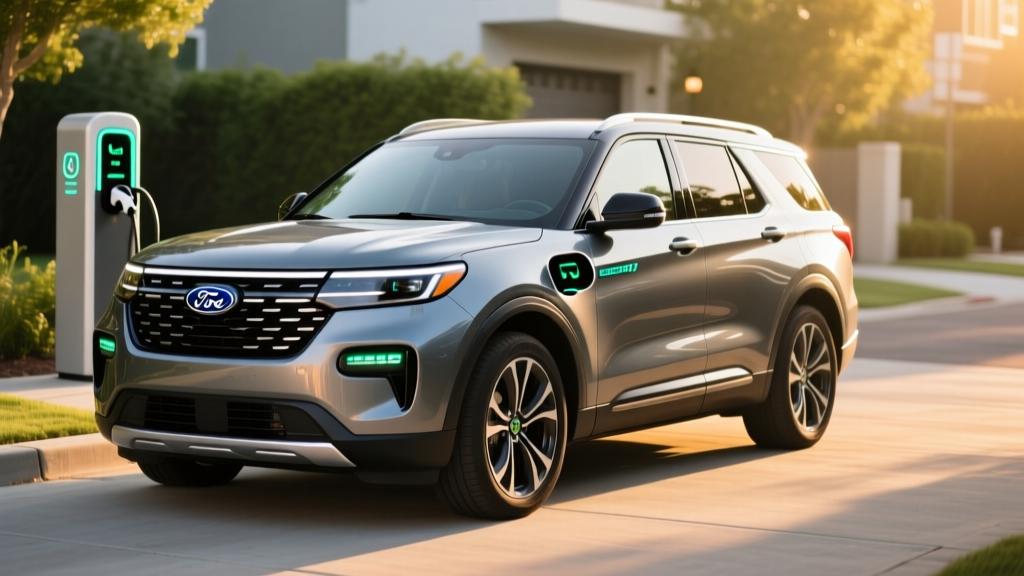
The 2026 Ford Explorer Hybrid threads a specific needle: three-row SUV practicality with meaningful fuel savings over its gas-only counterpart, without requiring you to plug in or change your driving habits. Ford's 3.3L V6 hybrid powertrain returns an EPA-estimated 28 MPG combined — a roughly 25% improvement over the standard Explorer's 22 MPG — while retaining the towing capacity and cargo volume that make the Explorer a segment staple.
This is a conventional hybrid (HEV), not a plug-in. You fuel it like any other vehicle. The hybrid system recovers energy during braking and low-speed driving to supplement the gasoline engine, reducing fuel consumption without any change to your refueling routine. If you need electric-only commuting capability, you'll want to look at the Explorer's PHEV variant or a full EV alternative — we break down those options below.
| Specification | 2026 Ford Explorer Hybrid |
|---|---|
| Powertrain | 3.3L V6 + electric motor |
| Combined Horsepower | 318 HP |
| Combined Torque | 322 lb-ft |
| EPA MPG (City / Highway / Combined) | 29 / 27 / 28 |
| Drivetrain | RWD standard, AWD available |
| Towing Capacity | 5,000 lbs (with tow package) |
| Cargo Volume (behind 3rd / 2nd / 1st row) | 18.2 / 47.9 / 87.8 cu ft |
| Hybrid Battery Warranty | 8 years / 100,000 miles |
| Base MSRP (Limited Hybrid trim) | $55,195 |
Fuel Economy: EPA Numbers and Real-World MPG
The EPA rates the 2026 Explorer Hybrid at 29 MPG city, 27 MPG highway, and 28 MPG combined for rear-wheel-drive models. AWD-equipped versions see a slight reduction to approximately 27 MPG combined. These figures come from fueleconomy.gov, the official EPA testing database.
| Configuration | City | Highway | Combined |
|---|---|---|---|
| RWD Hybrid | 29 MPG | 27 MPG | 28 MPG |
| AWD Hybrid | 28 MPG | 26 MPG | 27 MPG |
| Gas-Only Explorer (2.3L EcoBoost AWD) | 21 MPG | 28 MPG | 24 MPG |
Real-world expectations: Hybrid SUVs like the Explorer tend to exceed their EPA city estimates in stop-and-go driving because regenerative braking recovers energy that a gas-only vehicle wastes as heat. In mixed suburban driving with frequent stops, owners commonly report 29–31 MPG. Highway-only driving at 75+ MPH, however, typically yields 25–26 MPG — the electric motor provides less assistance at sustained high speeds, and aerodynamic drag dominates. In cold weather (below 30°F), expect a 1–2 MPG reduction as the engine runs more frequently to provide cabin heat and maintain battery temperature.
For a driver covering 15,000 miles annually, the hybrid saves approximately 100–120 gallons per year versus the gas-only EcoBoost model, translating to roughly $350–$450 in annual fuel savings at $3.50/gallon. Over a five-year ownership period, that's $1,750–$2,250 in fuel savings — meaningful, though not enough to fully offset the hybrid's higher purchase price without additional incentives.
HEV vs. PHEV: Understanding What You're Buying
The 2026 Explorer lineup includes a conventional hybrid (HEV). Ford has offered a plug-in hybrid (PHEV) Explorer in select markets and model years, so it's critical to understand the distinction before shopping.
| Feature | HEV (Conventional Hybrid) | PHEV (Plug-In Hybrid) |
|---|---|---|
| Plug-in charging required? | No — gas station only | Yes, for electric-only range |
| Electric-only driving | Minimal (low-speed, short distances) | 20–40 miles typical |
| Battery size | ~1.5 kWh | 13–20 kWh typical |
| Fuel economy advantage | 20–30% over gas-only | 50–80% if charged daily |
| Federal tax credit (§30D) | Not eligible | May qualify ($3,750–$7,500) |
| Home charging needed | No | Level 2 recommended |
| Complexity | Simple — no behavior change | Requires charging routine for max benefit |
The Explorer HEV is the right choice if you want fuel savings without altering your routine. You'll never need to find a charger, install home charging equipment, or plan around electric-only range. The PHEV path makes sense only if you have reliable home or workplace charging and a commute under 35 miles — conditions that let you drive predominantly on electricity and use gasoline only for longer trips.
Powertrain Deep Dive: 318 HP Without Sacrifice
Ford pairs a naturally aspirated 3.3L V6 engine with an electric motor integrated into the transmission housing. Combined output is 318 horsepower and 322 lb-ft of torque, routed through a 10-speed automatic transmission. The electric motor fills in torque at low RPM where the V6 is weakest, resulting in confident acceleration from stops and during highway merging — areas where the base 2.3L EcoBoost can feel strained under load.
The hybrid battery pack is a lithium-ion unit mounted beneath the cargo floor. It does not meaningfully reduce cargo volume compared to the gas-only Explorer — you retain 18.2 cubic feet behind the third row and 87.8 cubic feet with both rear rows folded. Towing capacity with the Class III tow package remains 5,000 pounds, identical to the gas model.
One notable detail: the hybrid uses a conventional hydraulic braking system blended with regenerative braking. Ford has refined this integration over successive model years, and brake pedal feel in the current-generation Explorer Hybrid is linear and predictable — a common weak point in earlier hybrid SUVs from other manufacturers.
Pricing, Trims, and Tax Credit Eligibility
The 2026 Explorer Hybrid is offered exclusively in the Limited trim, starting at an MSRP of $55,195 for RWD. Adding Intelligent AWD raises the price to approximately $57,395. The Limited trim includes leather upholstery, a 10.1-inch touchscreen with SYNC 4, a 12-speaker B&O audio system, hands-free liftgate, and Ford's Co-Pilot360 Assist+ suite (adaptive cruise with stop-and-go, lane centering, evasive steering assist).
Federal tax credit status: The conventional Explorer Hybrid (HEV) does not qualify for the IRS §30D Clean Vehicle Credit. That credit applies only to plug-in electric vehicles (BEVs and PHEVs) meeting battery sourcing, MSRP cap, and buyer income requirements. The HEV's fuel savings come entirely from reduced gasoline consumption, not from purchase incentives.
Battery Warranty & Longevity
Ford covers the Explorer Hybrid's battery pack for 8 years or 100,000 miles (whichever comes first), with a capacity retention threshold of approximately 70%. This is the industry-standard hybrid battery warranty, matching Toyota and Hyundai's coverage.
Replacement cost if out of warranty: A hybrid battery replacement for the Explorer runs approximately $3,000–$5,000 including labor at a Ford dealer. However, hybrid battery failure before 150,000 miles is uncommon in modern lithium-ion packs. Many first-generation Ford Fusion Hybrid taxis exceeded 300,000 miles on original battery packs.
Reliability: What the Data Shows
Ford's 3.3L V6 hybrid powertrain has been in production since the 2020 model year, giving it a six-year track record across the Explorer and Police Interceptor Utility fleets. The police variant, which uses an identical hybrid system under far more demanding duty cycles, has demonstrated strong durability — a meaningful signal for civilian use.
Common reported issues are minor and non-powertrain-related: SYNC 4 infotainment glitches (addressed via over-the-air updates), occasional 12V auxiliary battery drain in vehicles left parked for extended periods, and wind noise from the panoramic sunroof option. The hybrid system itself — motor, inverter, and battery — has not been a significant source of warranty claims according to available NHTSA complaint data.
For reliability benchmarking, the Explorer Hybrid trails the Toyota Highlander Hybrid slightly in long-term predicted reliability scores from major evaluators, but exceeds most domestic three-row competitors. The hybrid powertrain adds minimal maintenance versus the gas model — there is no hybrid-specific fluid service interval, and brake pad life typically increases due to regenerative braking reducing friction brake usage.
Who Should Choose the Explorer Hybrid — and Who Shouldn't
Choose the Explorer Hybrid If:
- You drive 15,000+ miles per year and want fuel savings without plug-in infrastructure
- You need three rows and 5,000-lb towing — the hybrid preserves both
- Your driving is predominantly city/suburban where regenerative braking maximizes efficiency
- You plan to own the vehicle 8+ years and want the security of the hybrid battery warranty
- You prefer a proven V6 over turbocharged four-cylinder powertrains
Look Elsewhere If:
- You have home charging and a short commute — a PHEV or BEV will save far more fuel
- Your budget is under $50,000 — the Hybrid trim premium is substantial
- You drive primarily highway miles at 75+ MPH — the hybrid advantage narrows to 2–3 MPG
- You want a federal tax credit — only plug-in vehicles qualify under current §30D rules
- You prioritize maximum acceleration — the Explorer ST (400 HP) fills that role
The decision framework: At $55,195 base, the Explorer Hybrid carries a roughly $5,000 premium over an equivalently equipped gas-only Explorer Limited. At 15,000 miles per year and $3.50/gallon, you'll recover that premium through fuel savings in approximately 11–13 years. The math improves if gas prices rise, if you drive more than average, or if resale values favor the hybrid. The purchase makes the most sense for high-mileage drivers who value the powertrain's smoothness and low-speed torque as much as the fuel savings.
Explorer Hybrid vs. Full EV vs. PHEV: The Three-Row Family SUV Decision
If you're cross-shopping the Explorer Hybrid, you're likely also considering full EVs like the Kia EV9 or Rivian R1S, or waiting for a potential Explorer PHEV. Here's how the options stack up for a typical family SUV buyer:
| Factor | Explorer Hybrid (HEV) | Kia EV9 (BEV) | Rivian R1S (BEV) |
|---|---|---|---|
| Base Price | $55,195 | $54,900 | $75,900 |
| Fuel/Energy Cost (15K mi/yr) | ~$1,875 | ~$540 (home charging) | ~$540 |
| Annual Maintenance | ~$600 | ~$200 | ~$250 |
| Federal Tax Credit | $0 | Up to $7,500* | Up to $7,500* |
| Home Charging Required | No | Yes (strongly recommended) | Yes (strongly recommended) |
| Towing Capacity | 5,000 lbs | 5,000 lbs | 7,700 lbs |
| Range/Total Range | ~490 mi (18 gal tank) | ~270–310 mi EPA | ~330–410 mi EPA |
*Tax credit eligibility depends on MSRP caps, buyer income limits, and battery sourcing requirements under current IRS §30D rules. Verify eligibility with a tax professional before purchase.
The Explorer Hybrid wins on simplicity and familiarity — no charging infrastructure, no range planning for road trips, and a dealer network accustomed to servicing the powertrain. Full EVs win decisively on operating cost and qualify for federal incentives that can narrow or eliminate the price gap. The right choice depends entirely on your home charging access, annual mileage, and willingness to adapt to EV ownership.
FAQ: 2026 Ford Explorer Hybrid
How many MPG does the 2026 Ford Explorer Hybrid get?
The EPA rates the RWD Explorer Hybrid at 29 city / 27 highway / 28 combined MPG. AWD models drop to approximately 27 combined. In real-world city and suburban driving, expect 29–31 MPG thanks to regenerative braking; highway-only driving at higher speeds typically yields 25–26 MPG.
Does the Explorer Hybrid need to be plugged in?
No. The Explorer Hybrid is a conventional HEV — it charges its battery through regenerative braking and the gasoline engine. You refuel it at a gas station exactly like a non-hybrid vehicle.
Is there a plug-in hybrid (PHEV) Ford Explorer?
Ford has offered PHEV Explorer variants in certain markets and model years. For the 2026 model year in the US, the Explorer is available as a conventional hybrid (HEV). If plug-in capability is essential, consider the Lincoln Corsair Grand Touring PHEV (Ford's luxury-division plug-in) or wait for Ford to expand PHEV availability.
Does the Explorer Hybrid qualify for a federal tax credit?
No. The IRS §30D Clean Vehicle Credit applies only to plug-in electric vehicles (BEVs and PHEVs) that meet battery sourcing, MSRP, and income requirements. The conventional hybrid Explorer does not qualify. Check the IRS clean vehicle credit page for current eligibility rules.
How long will the hybrid battery last and what does replacement cost?
Ford warranties the hybrid battery for 8 years / 100,000 miles. Modern lithium-ion hybrid packs routinely last 150,000–200,000+ miles before significant degradation. Out-of-warranty replacement costs approximately $3,000–$5,000 at a Ford dealer, though full replacement is rarely needed within typical ownership periods.
Can the Explorer Hybrid tow as much as the gas model?
Yes. With the Class III tow package, the Explorer Hybrid retains the same 5,000-pound towing capacity as the gas-only model. The hybrid's low-end electric torque actually improves towing feel from a standstill.
Is the Explorer Hybrid reliable?
The 3.3L V6 hybrid powertrain has been in production since 2020 and has demonstrated strong durability, including in the demanding Police Interceptor Utility fleet. NHTSA complaint data does not show significant hybrid-system-related issues. Overall reliability is competitive within the three-row hybrid SUV segment.