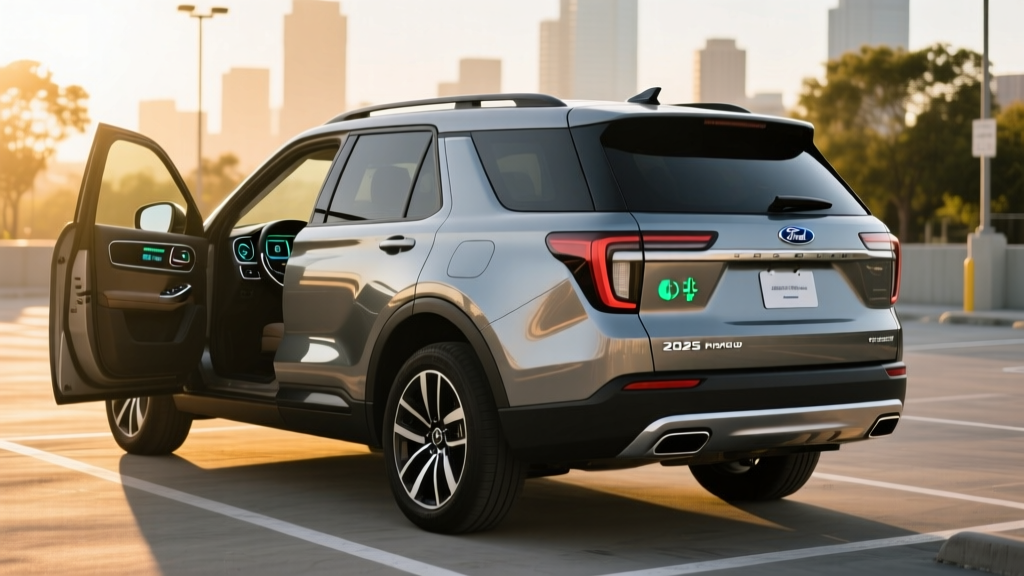
The three-row midsize SUV segment is crowded, but buyers who want electrified efficiency without committing to a plug keep circling back to one question: does the Ford Explorer 2025 SUV hybrid actually deliver on fuel savings, or is it just a marketing badge on a heavy family hauler? After digging into EPA data, real-world driving reports, and Ford's powertrain specs, we have a clear picture of what this hybrid can — and can't — do for your wallet and your daily commute.
2025 Ford Explorer Hybrid: Powertrain and Performance Specs
The 2025 Explorer Hybrid pairs a naturally aspirated 3.3-liter V6 engine with an electric motor integrated into a 10-speed automatic transmission. This isn't a performance-tuned setup — it's engineered for low-end torque fill and stoplight efficiency. Combined output lands at 318 horsepower and 322 lb-ft of torque, which is adequate for a 4,700-pound SUV but won't win drag races against the turbocharged 2.3L EcoBoost or the 3.0L EcoBoost V6 found in the ST.
| Attribute | Specification |
|---|---|
| Powertrain Type | Conventional Hybrid (HEV) — no plug |
| Engine | 3.3L V6 Atkinson-cycle + electric motor |
| Combined Horsepower | 318 HP |
| Combined Torque | 322 lb-ft |
| Transmission | 10-speed automatic |
| Drivetrain | RWD standard; Intelligent 4WD available |
| 0–60 mph (est.) | ~7.8 seconds |
| Towing Capacity | 5,300 lbs (with Class IV tow package) |
| Hybrid Battery | ~1.5 kWh lithium-ion (self-charging) |
| Seating | 6 or 7 passengers (trim dependent) |
The hybrid battery pack is small — approximately 1.5 kWh usable — because this is a conventional HEV, not a plug-in. The battery acts as a buffer: it captures energy from regenerative braking and deceleration, then deploys it to assist the gas engine during acceleration or to power low-speed electric-only crawling in stop-and-go traffic. You will never plug this vehicle in. There is no EV-only range to manage, no charging cable to deploy, and no home charger to install.
Fuel Economy: EPA Ratings vs. Real-World MPG
This is where hybrid buyers focus, and the 2025 Explorer Hybrid tells a nuanced story. According to EPA data on fueleconomy.gov, the rear-wheel-drive Explorer Hybrid achieves the following ratings:
| Drivetrain | City MPG | Highway MPG | Combined MPG |
|---|---|---|---|
| RWD Hybrid | 24 | 28 | 25 |
| 4WD Hybrid | 23 | 26 | 24 |
For context, the non-hybrid 2025 Explorer with the 2.3L EcoBoost I4 and 4WD is EPA-rated at 21 city / 27 highway / 23 combined. The hybrid's advantage is most pronounced in city traffic — about 2–3 MPG better — while highway numbers are nearly identical. If you drive predominantly on interstates, the fuel savings shrink significantly.
HEV vs. PHEV vs. Full EV: Which Electrified Explorer Fits You?
A common point of confusion among shoppers researching the 2025 Explorer lineup is whether a plug-in hybrid (PHEV) version exists. Let's clear this up immediately and compare the three electrified pathways:
| Feature | HEV (Explorer Hybrid) | PHEV | Full EV (BEV) |
|---|---|---|---|
| Plugs in? | No | Yes | Yes |
| Electric-only range | < 1 mile (low-speed creep) | 20–40 miles typical | 250–350+ miles |
| Battery size | ~1–2 kWh | 13–25 kWh | 60–100+ kWh |
| Gas engine? | Yes (primary) | Yes (backup) | No |
| Home charger needed? | No | Recommended (Level 2) | Yes (Level 2) |
| Federal tax credit (§30D)? | No | Up to $7,500 (if eligible) | Up to $7,500 (if eligible) |
| Range anxiety? | None | Minimal | Requires planning |
Ford does not currently offer a PHEV version of the 2025 Explorer in the U.S. market. The only electrified Explorer available stateside is this conventional HEV. If you specifically want a plug-in hybrid three-row SUV from Ford, you'd need to look at the Ford Escape PHEV (smaller, two-row) or cross-shop competitors like the Toyota Grand Highlander Hybrid, Hyundai Santa Fe PHEV, or the Kia Sorento PHEV.
- You want three rows and don't want to think about charging.
- Your commute includes significant city/stop-and-go driving where regenerative braking pays off.
- You tow occasionally (5,300-lb capacity is competitive).
- You live in an apartment or lack access to home/workplace charging.
- You want a modest fuel-cost reduction without the premium price of a PHEV or EV.
Pricing, Trims, and Tax Credit Eligibility
The 2025 Ford Explorer Hybrid is available in select trims, most commonly the Limited and Platinum. Here's the approximate MSRP breakdown:
- Explorer Limited Hybrid (RWD): ~$54,550
- Explorer Limited Hybrid (4WD): ~$56,550
- Explorer Platinum Hybrid (4WD): ~$59,000
Destination charges add approximately $1,595. These prices position the hybrid roughly $2,000–$3,000 above the equivalent gas-only Limited trim.
Does the 2025 Explorer Hybrid Qualify for a Federal Tax Credit?
No. The IRS §30D Clean Vehicle Credit applies only to plug-in electric vehicles (PHEVs and BEVs) with a battery capacity of at least 7 kWh and the ability to charge from an external source. The Explorer Hybrid's ~1.5 kWh self-charging battery does not meet these requirements. There is no federal tax credit for conventional HEVs under current law. You can review the full eligibility criteria on IRS.gov's Clean Vehicle Tax Credits page.
Some states offer their own incentives for hybrid purchases, though these are increasingly rare and typically modest ($250–$1,000). Check your state's energy or environmental agency website for current programs. A few states also offer HOV lane access for hybrids, though many have phased this out or restricted it to PHEVs and EVs.
Hybrid Battery Warranty, Reliability, and Replacement Costs
Hybrid battery longevity is the number-one concern for used-hybrid buyers and new-hybrid skeptics alike. Here's what Ford provides:
- Hybrid Battery: 8 years / 100,000 miles (whichever comes first). In CARB states (CA, NY, MA, and others adopting California emissions standards), coverage extends to 10 years / 150,000 miles.
- Hybrid System Components (inverter, electric motor, control modules): 8 years / 100,000 miles.
- Powertrain (engine + transmission): 5 years / 60,000 miles.
- Bumper-to-bumper: 3 years / 36,000 miles.
How Reliable Is the Explorer Hybrid?
Ford's 3.3L hybrid powertrain has been in use since the 2020 model year in the Explorer and the Police Interceptor Utility. The naturally aspirated V6 avoids the complexity of turbochargers, which reduces one common failure point. Early 2020–2021 models had some software-related complaints around hybrid-system shudder and transmission calibration, but Ford issued technical service bulletins (TSBs) to address these. The 2025 model benefits from five years of calibration refinement.
According to NHTSA recall data, the Explorer Hybrid has not had major battery-related recalls. The lithium-ion pack is air-cooled (not liquid-cooled like larger EV batteries), which simplifies the thermal management system but means it's more sensitive to extreme ambient heat during sustained heavy loads.
What Does a Hybrid Battery Replacement Cost?
If the hybrid battery fails outside of warranty, expect a replacement cost between $2,500 and $4,500 for the battery pack itself, plus $500–$1,000 in labor. This is significantly less than a full EV battery replacement ($8,000–$20,000+) because the pack is small. Independent hybrid-battery shops can often recondition or replace individual cells within the pack for $1,200–$2,000, extending the battery's life without a full swap. Most hybrid batteries in real-world use last 150,000–200,000+ miles before significant degradation, making out-of-warranty failure uncommon for typical ownership cycles.
Driving Impressions: What the Hybrid Does Well (and Where It Falls Short)
| ✓ Pros | ✗ Cons |
|---|---|
|
|
On the road, the Explorer Hybrid is at its best in urban and suburban environments. The electric motor fills in the torque gap while the V6 spools up, giving confident launches from stoplights. The transition between electric-only creeping and engine engagement is generally seamless, though you'll notice a subtle vibration when the engine fires up after an extended idle stop. At highway speeds, the hybrid system contributes less — this is a 4,700-lb SUV pushing through aerodynamic drag, and the small battery/motor combo can't meaningfully offset the energy demand.
The regenerative braking system has two modes: standard (feels like normal brake pedal feel) and enhanced (stronger regen, approaching one-pedal driving at low speeds but not a true one-pedal system). In enhanced mode, you can recover more energy in city driving, which directly translates to the city-MPG advantage over the gas-only model.
Ownership Costs: 5-Year Fuel Savings vs. the Gas Explorer
Let's run the numbers. Assuming 15,000 miles per year, $3.50/gallon regular unleaded, and a 55% city / 45% highway driving mix:
| Metric | Hybrid (4WD) | Gas 2.3L (4WD) |
|---|---|---|
| Real-world combined MPG (est.) | 23 | 21 |
| Gallons per year | 652 | 714 |
| Annual fuel cost | $2,282 | $2,499 |
| 5-year fuel cost | $11,410 | $12,495 |
| 5-year savings (hybrid) | ~$1,085 | |
Over five years, the hybrid saves approximately $1,085 in fuel. With a $2,000–$3,000 purchase premium, the break-even point on fuel alone is roughly 9–14 years. The hybrid makes financial sense if you plan to keep the vehicle long-term, value the smoother low-speed driving experience, or live in a state where hybrids hold resale value better. It does not make sense purely as a short-term cost-saving measure unless gas prices spike significantly above $4.50/gallon in your area.
Frequently Asked Questions
How many MPG does the 2025 Ford Explorer Hybrid get?
The EPA rates the RWD Explorer Hybrid at 24 city / 28 highway / 25 combined. The 4WD version is rated at 23 city / 26 highway / 24 combined. In real-world city-heavy driving, owners commonly report 25–27 MPG, while highway-dominant driving may yield 22–23 MPG.
Does the 2025 Explorer Hybrid plug in or have electric-only range?
No. The 2025 Explorer Hybrid is a conventional HEV. It charges its small (~1.5 kWh) battery through regenerative braking and the gas engine. There is no plug, no charging port, and no meaningful electric-only range (less than 1 mile at very low speeds). Ford does not offer a PHEV Explorer in the U.S. market.
Hybrid vs. PHEV vs. EV — which is right for me?
Choose the HEV (Explorer Hybrid) if you lack home charging access, want zero lifestyle change, and drive a mix of city and highway. Choose a PHEV if you have home charging and a short commute (20–40 miles) you want to complete on electricity, with a gas engine for longer trips. Choose a full EV if you have reliable home/workplace charging, want the lowest per-mile energy cost, and are comfortable with charging planning on road trips.
Is the Explorer Hybrid reliable, and what does battery replacement cost?
The 3.3L hybrid powertrain has been in production since 2020 with generally positive reliability. Ford covers the hybrid battery for 8 years/100,000 miles (10 years/150,000 miles in CARB states). Out-of-warranty battery replacement runs $2,500–$4,500, though reconditioning options exist for $1,200–$2,000. Most hybrid batteries last well beyond 150,000 miles.
Does the 2025 Ford Explorer Hybrid qualify for any tax credit?
No. The federal §30D Clean Vehicle Credit requires a plug-in vehicle with at least 7 kWh of battery capacity. The Explorer Hybrid's ~1.5 kWh self-charging system does not qualify. No current federal incentive exists for conventional HEVs. Check your state's energy agency for any local hybrid incentives, though these are increasingly rare.
Can I tow with the Explorer Hybrid?
Yes. When properly equipped with the Class IV Trailer Tow Package, the 2025 Explorer Hybrid can tow up to 5,300 pounds — matching the gas-only Explorer's capacity. The hybrid system's low-end torque assist can actually make initial trailer acceleration feel smoother.