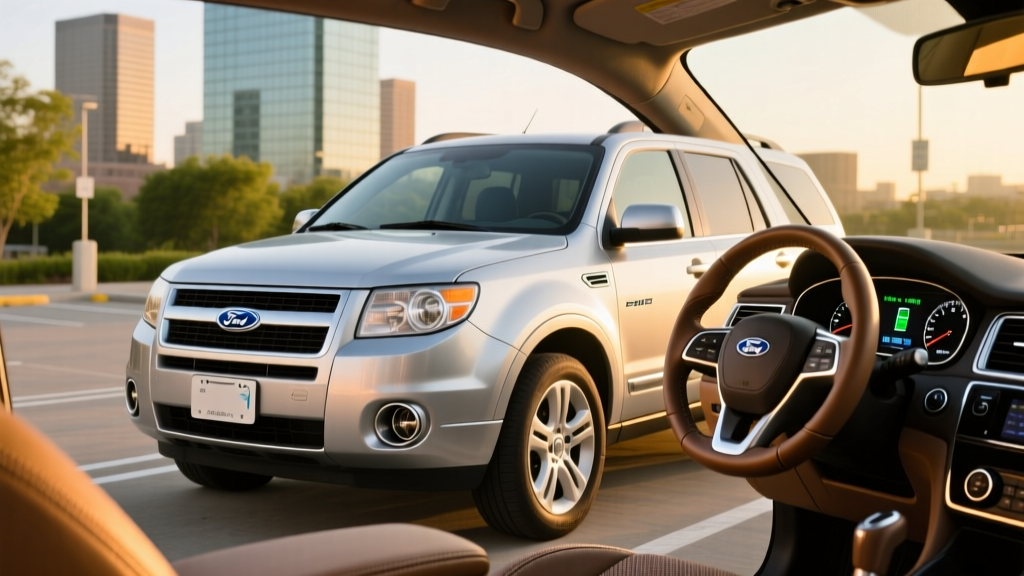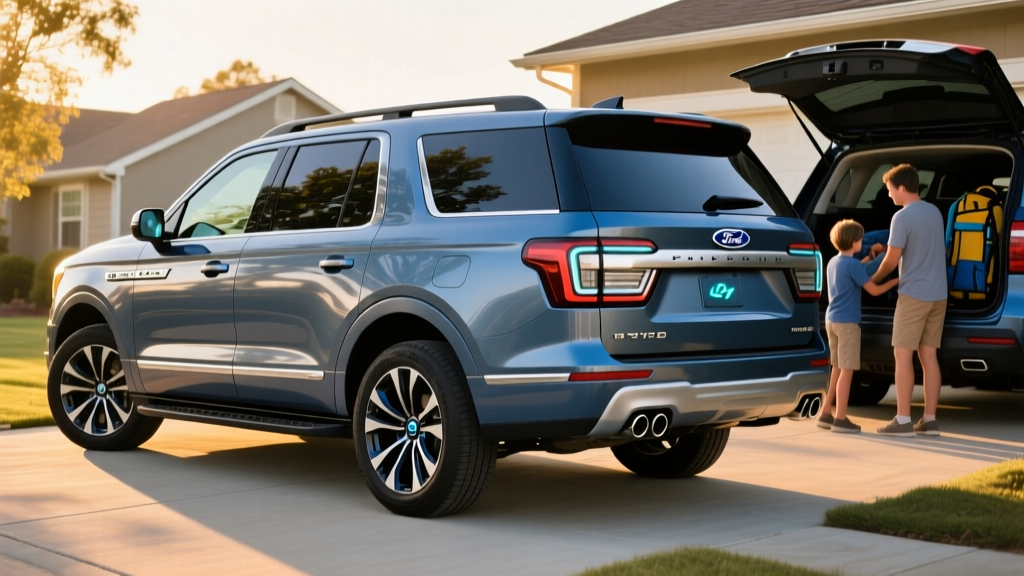
The full-size SUV segment has been slow to embrace electrification, but the 2026 Ford Expedition Hybrid (officially the Expedition PowerBoost) proves that a three-row, body-on-frame hauler doesn't have to guzzle fuel to deliver serious capability. By pairing Ford's twin-turbo 3.5-liter V6 with a hybrid electric motor system, the Expedition Hybrid targets families and tow-rig owners who need maximum space and towing muscle but want to cut fuel costs without plugging in.
Unlike a plug-in hybrid (PHEV) or a battery-electric vehicle (BEV), the Expedition Hybrid is a conventional hybrid (HEV). It charges its own battery through regenerative braking and the gasoline engine — no charging cord required. That distinction matters enormously for buyers who lack home charging access or who regularly drive in areas with sparse public charging infrastructure.
HEV vs PHEV: Why the Expedition Is a Conventional Hybrid
Ford's decision to make the Expedition a conventional hybrid rather than a plug-in reflects the vehicle's mission: maximum range, maximum towing, and zero lifestyle compromise for buyers who can't charge at home. Here's how the two hybrid architectures differ in practice:
| Feature | HEV (Expedition PowerBoost) | PHEV (e.g., Chrysler Pacifica Hybrid) |
|---|---|---|
| Plug-in charging required? | No — self-charging | Yes — plug in for EV range |
| Electric-only driving | Limited (low-speed, short bursts) | 20–40 miles typical |
| Battery size | ~1.5 kWh (small buffer) | 12–20 kWh typical |
| Fuel economy advantage | 20–35% over gas equivalent | 50–100+ MPGe on short trips |
| Best for | No home charger, long trips, towing | Home charger, short commutes |
The Expedition's hybrid system uses a compact lithium-ion battery pack (approximately 1.5 kWh) integrated into the powertrain. It's large enough to assist the gas engine during acceleration and enable brief electric-only motoring at parking-lot speeds, but small enough to avoid the weight penalty, packaging compromises, and cost of a full PHEV system. For a 5,500+ pound SUV designed to tow up to 9,300 pounds, this is a pragmatic engineering choice.
Fuel Economy: EPA Estimates and Real-World MPG
The headline number for any hybrid buyer is fuel economy, and the 2026 Expedition PowerBoost delivers meaningful gains over its gasoline-only sibling. Here's what the EPA rates and what you can expect in real driving:
| Configuration | City MPG | Highway MPG | Combined MPG |
|---|---|---|---|
| 4x2 (Rear-Wheel Drive) | 25 | 23 | 24 |
| 4x4 (Four-Wheel Drive) | 23 | 22 | 23 |
For context, the non-hybrid 2026 Expedition with the standard 3.5L EcoBoost V6 is rated at approximately 17 city / 23 highway / 19 combined (4x2). The hybrid system delivers its biggest advantage in city and stop-and-go driving, where regenerative braking and electric assist do the most work — a 47% improvement in city MPG for the 4x2 model.
Powertrain: Twin-Turbo V6 Meets Electric Motor
The 2026 Expedition PowerBoost uses Ford's 3.5-liter PowerBoost twin-turbo V6 hybrid powertrain, the same architecture proven in the F-150 PowerBoost. The system combines:
- Gasoline engine: 3.5L twin-turbo V6 producing approximately 400 horsepower and 500 lb-ft of torque
- Electric motor: Integrated between the engine and transmission, contributing additional torque fill and enabling regenerative braking
- Combined system output: 430 horsepower and 570 lb-ft of torque
- Transmission: 10-speed modular hybrid automatic (replaces the standard 10-speed)
- 0–60 mph: Approximately 5.9 seconds (4x2)
The electric motor's primary contribution isn't peak power — it's torque fill. Turbocharged engines have inherent lag at low RPM, and the electric motor bridges that gap instantly. The result is a full-size SUV that pulls away from stoplights with the urgency of a much smaller vehicle, while the turbo V6 delivers relentless highway passing power.
| Specification | Detail |
|---|---|
| Engine | 3.5L Twin-Turbo V6 Hybrid (PowerBoost) |
| Combined Horsepower | 430 HP |
| Combined Torque | 570 lb-ft |
| Transmission | 10-speed modular hybrid automatic |
| Drivetrain | RWD or 4WD |
| EPA MPG (4x2 combined) | 24 MPG |
| EPA MPG (4x4 combined) | 23 MPG |
| Max Towing Capacity | 9,300 lbs (properly equipped) |
| Seating Capacity | Up to 8 passengers |
| Cargo Volume (behind 3rd row) | ~20.9 cu ft |
| Fuel Tank | 28.0 gallons |
| Total Driving Range (est.) | ~644–672 miles |
Pricing, Trims, and Tax Credit Eligibility
The 2026 Ford Expedition Hybrid is available across multiple trim levels, with the PowerBoost hybrid powertrain offered as an upgrade on mid-to-upper trims. Pricing reflects the hybrid system premium over the standard EcoBoost V6:
| Trim | Approx. MSRP (4x2) | Approx. MSRP (4x4) |
|---|---|---|
| XLT (with PowerBoost option) | ~$66,000 | ~$69,000 |
| Limited | ~$73,500 | ~$76,500 |
| King Ranch | ~$79,000 | ~$82,000 |
| Platinum | ~$82,500 | ~$85,500 |
Note: Pricing is approximate based on Ford's announced MSRP structure and may vary by dealer. Destination charges (~$1,995) apply to all trims.
Reliability, Battery Warranty, and Long-Term Costs
Hybrid reliability is one of the most common buyer concerns, particularly around battery longevity and replacement cost. Ford's hybrid system in the Expedition benefits from years of real-world validation in the F-150 PowerBoost, which has been on the road since the 2021 model year.
- Hybrid battery: 8 years / 100,000 miles (10 years / 150,000 miles in CARB states including CA, NY, MA, and others)
- Hybrid-specific components (electric motor, power inverter, DC-DC converter): 8 years / 100,000 miles
- Powertrain warranty: 5 years / 60,000 miles
- Bumper-to-bumper: 3 years / 36,000 miles
Battery replacement cost: If the Expedition's hybrid battery requires replacement out of warranty (rare before 150,000+ miles based on F-150 PowerBoost data), expect a cost in the range of $2,500–$4,500 including parts and labor. This is substantially lower than BEV battery replacements ($10,000–$25,000+) because the Expedition's hybrid battery is small (~1.5 kWh vs. 75–130+ kWh in a BEV). The compact battery is also easier to access and replace.
Overall reliability: Ford's 3.5L EcoBoost V6 is one of the most widely deployed turbocharged engines in the American market, with millions of units in service. The hybrid variant adds an electric motor but removes the traditional starter motor and alternator (the hybrid motor handles both functions), actually reducing the number of failure-prone accessory components. NHTSA complaint data for the F-150 PowerBoost has shown no systemic hybrid-system failures. The Expedition's hybrid system carries over this proven architecture.
Expedition Hybrid vs. Full EV vs. Gas: Which Fits You?
Choosing between the Expedition Hybrid, a gas-only full-size SUV, and a fully electric alternative (like the Rivian R1S or upcoming electric competitors) depends on your driving patterns, charging access, and priorities:
✓ Choose the Expedition Hybrid if:
- You need 3-row seating and 9,000+ lb towing
- You lack reliable home charging access
- You take frequent long road trips (600+ mile range)
- You want better city MPG without plugging in
- You need a proven body-on-frame platform
✓ Choose a Full EV (BEV) if:
- You have Level 2 home charging
- Most trips are under 250 miles
- You want the lowest per-mile fuel cost
- You want the $7,500 federal tax credit
- You prioritize instant torque and quiet operation
✓ Choose Gas-Only if:
- Upfront cost is your top priority
- You drive very few miles annually
- You want the widest trim/accessory selection
- You don't mind 17–19 MPG combined
The Expedition Hybrid occupies a clear middle ground: it delivers 20–35% better fuel economy than the gas version in real-world driving, requires zero behavioral change (no plugging in, no range planning), and maintains the full towing and passenger capability of the standard Expedition. For families covering 15,000+ miles per year in mixed driving, the hybrid premium pays for itself in fuel savings while delivering noticeably better around-town drivability.
Pros and Cons at a Glance
Pros
- 24 MPG combined — best in full-size SUV class
- 430 HP / 570 lb-ft — strong acceleration and towing
- No plug-in charging required
- 640+ mile total range per tank
- 9,300 lb towing capacity maintained
- Proven PowerBoost architecture from F-150
- 8-year/100,000-mile hybrid battery warranty
Cons
- No federal tax credit (HEV, not PHEV/BEV)
- Hybrid premium adds ~$3,000–$4,000 over gas model
- Highway MPG advantage is modest vs. gas
- Small hybrid battery limits electric-only driving to low speeds
- MSRP starts above $65K; fully loaded exceeds $85K
- Towing fuel economy drops significantly (expect 12–15 MPG with heavy trailer)
Frequently Asked Questions
How many MPG does the 2026 Ford Expedition Hybrid get?
The EPA rates the Expedition PowerBoost at 25 city / 23 highway / 24 combined (4x2) and 23 city / 22 highway / 23 combined (4x4). In real-world suburban driving, owners commonly report 23–26 MPG combined. Highway-only driving at 75+ mph typically returns 20–22 MPG. Towing a trailer reduces economy to approximately 12–15 MPG depending on weight and aerodynamics.
Does the Expedition Hybrid need to be plugged in?
No. The Expedition PowerBoost is a conventional hybrid (HEV). Its small battery recharges through regenerative braking and the gasoline engine. You simply fill up at the gas station as you would with any other vehicle — there is no charging port and no electric-only range to manage.
How far can the Expedition Hybrid drive on electric power alone?
As a conventional hybrid, the Expedition can only travel very short distances (a few hundred yards) at low speeds (under 25 mph) on electric power alone. This is by design — the system uses electric assist to smooth stop-and-go driving and reduce engine load, not to replace the gas engine. If you want 20–40 miles of electric-only driving, you'd need a PHEV, which is not currently offered in the Expedition lineup.
Does the Expedition Hybrid qualify for any tax credits?
The Expedition PowerBoost does not qualify for the federal IRS §30D Clean Vehicle Credit because it is a conventional hybrid, not a plug-in hybrid or battery-electric vehicle. Some states offer smaller incentives for hybrid vehicles — check your state's energy office or IRS clean vehicle credit page for current rules. The hybrid's fuel savings (approximately $400–$700 per year vs. the gas model at 15,000 miles/year) offset the powertrain premium over time.
Is the Expedition Hybrid battery reliable, and what does replacement cost?
Ford covers the hybrid battery for 8 years/100,000 miles (10 years/150,000 miles in CARB states). The PowerBoost system has been in production since 2021 in the F-150 with no widespread battery failure reports. Out-of-warranty replacement, while unlikely to be needed before 150,000+ miles, is estimated at $2,500–$4,500 — far less than a BEV battery replacement due to the small (~1.5 kWh) pack size.
How does towing affect the Expedition Hybrid's fuel economy?
Towing is where the hybrid advantage diminishes. Expect 14–17 MPG when towing a 5,000-pound camper and 12–14 MPG with a max-load 9,000-pound trailer. The hybrid system still provides low-RPM torque assist that reduces transmission hunting on grades, but the aerodynamic drag and weight of a trailer dominate fuel consumption. The Expedition Hybrid still matches or slightly beats comparable gas-only full-size SUVs while towing, but the gap narrows significantly.
Sources: EPA fuel economy data via fueleconomy.gov, Ford Motor Company official specifications, IRS §30D Clean Vehicle Credit guidelines.