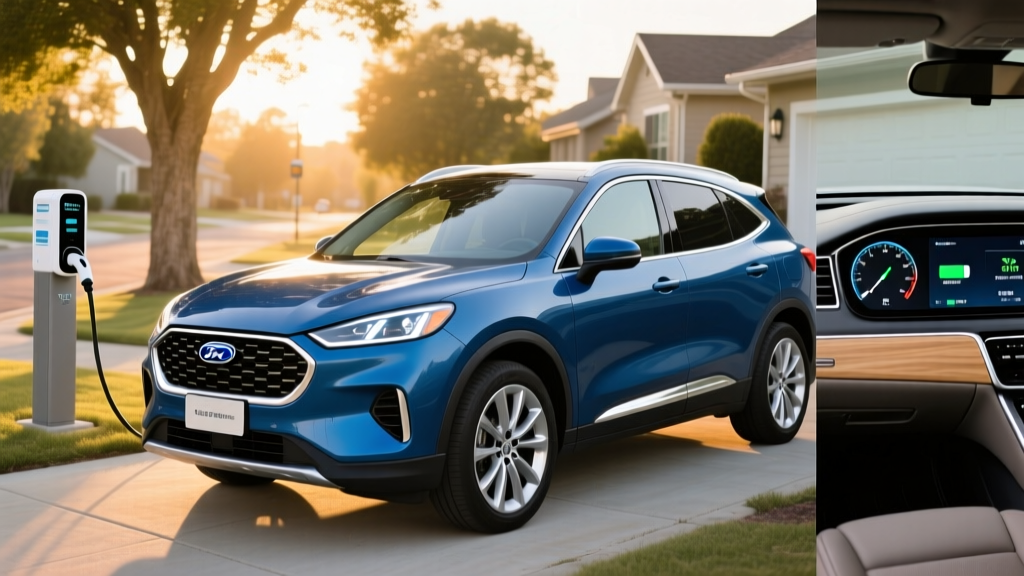
The Ford Escape Plug-In Hybrid occupies a narrow but valuable lane: it gives you genuine electric-only commuting capability without requiring a second car for road trips. For the 2026 model year, Ford continues the formula that has made this compact PHEV a pragmatic bridge for buyers who want electrified daily driving but aren't ready to commit to a full battery-electric vehicle. With 37 miles of EPA-rated electric range, 210 combined horsepower, and a starting price near $40,000, it competes directly with the Toyota RAV4 Prime and Hyundai Tucson PHEV. Here's exactly what you get, what it costs, and whether it fits your life.
HEV vs PHEV: Which Escape Is Which?
Ford sells the Escape in two electrified flavors, and the distinction matters for your wallet and your daily routine.
| Feature | Escape Hybrid (HEV) | Escape Plug-In Hybrid (PHEV) |
|---|---|---|
| Battery | 1.1 kWh (small, self-charging) | 14.4 kWh usable (plug-in) |
| Electric-only driving | Brief low-speed assist only | 37 miles EPA-rated |
| Plug-in charging | No — regenerative braking only | Yes — Level 1 and Level 2 |
| Combined horsepower | 198 hp | 210 hp |
| EPA combined (gas) | 39 MPG | 40 MPG (hybrid mode) |
| MPGe (electric + gas) | N/A | 105 MPGe |
| Drivetrain | AWD available | FWD only |
| Starting MSRP (2026) | ~$34,000 | ~$39,995 |
The conventional HEV never plugs in. Its small battery charges through regenerative braking and the engine, delivering fuel savings passively. The PHEV has a much larger battery that you charge from a wall outlet or public charger, enabling genuine zero-tailpipe-emission commuting within its electric range. Once the battery depletes, it operates as a regular hybrid. If your commute is under 37 miles round-trip and you can charge at home, the PHEV will use almost no gasoline on weekdays.
Electric Range, MPGe, and Fuel Economy Breakdown
The headline number for the 2026 Escape PHEV is its 37-mile EPA-rated electric-only range. That figure comes from a 14.4 kWh usable lithium-ion battery pack paired with a permanent-magnet electric motor producing 131 hp on its own. Combined with the 2.5-liter Atkinson-cycle four-cylinder engine, total system output is 210 horsepower.
| Specification | 2026 Ford Escape PHEV |
|---|---|
| Battery (usable) | 14.4 kWh, lithium-ion |
| Electric-only range | 37 miles (EPA) |
| Total range (EV + gas) | ~520 miles |
| MPGe (combined) | 105 MPGe |
| MPG (hybrid mode, combined) | 40 MPG |
| MPG city / highway (hybrid) | 42 city / 36 highway |
| Combined horsepower | 210 hp |
| Engine | 2.5L Atkinson-cycle I-4 |
| Electric motor | 131 hp permanent-magnet |
| Transmission | eCVT |
| Drivetrain | FWD |
| Fuel tank | 11.1 gallons |
Real-World MPG vs EPA Estimates
The EPA rates the Escape PHEV at 42 city / 36 highway / 40 combined MPG once the battery is depleted. In practice, PHEVs tend to outperform their EPA city numbers because regenerative braking recaptures energy in stop-and-go traffic. Owners who drive primarily in urban conditions regularly report 43–46 MPG in hybrid mode. Highway driving at 75+ mph pushes the figure closer to 33–35 MPG — the Atkinson-cycle engine is optimized for efficiency, not high-speed power.
Electric-only range also varies. The 37-mile EPA figure assumes moderate temperatures and mixed driving. In cold weather (below 40°F), expect 25–30 miles of electric range due to cabin heating demands and reduced battery efficiency. In warm weather with gentle driving, 40+ miles is achievable.
EPA electric-only: 37 miles
Warm-weather mixed driving: 35–42 miles
Cold-weather (below 40°F): 25–30 miles
Highway at 75 mph (hybrid mode): ~33–35 MPG
City stop-and-go (hybrid mode): ~43–46 MPG
Charging: What You Need to Know
The Escape PHEV uses a standard J1772 connector for AC charging. Here is the critical limitation: it does not support DC fast charging. This is typical for PHEVs in this class — the battery is small enough that Level 2 charging fills it quickly, and adding DC fast-charge hardware would increase cost and weight for marginal benefit.
| Charging Level | Power | 0–100% Time | Where |
|---|---|---|---|
| Level 1 (120V household) | ~1.4 kW | ~10–11 hours | Standard outlet |
| Level 2 (240V) | ~3.6 kW (onboard charger max) | ~3.5 hours | Home wallbox, public AC |
| DC Fast Charge | Not supported | N/A | N/A |
A full Level 2 charge in roughly 3.5 hours means you can easily recharge during the workday or overnight. Most PHEV owners find that a dedicated Level 2 home charger — typically a $500–$700 unit plus installation — transforms the ownership experience, ensuring a full battery every morning. The onboard charger is limited to 3.6 kW, so even if you plug into a 7.2 kW or 11.5 kW Level 2 station, the Escape will only draw 3.6 kW. This is worth understanding: you don't need an expensive high-power home charger for this vehicle.
According to fueleconomy.gov, charging costs vary dramatically by local electricity rates. At the US average of ~$0.16/kWh, a full 14.4 kWh charge costs roughly $2.30 — about $0.06 per electric mile. Compare that to gasoline at $3.40/gallon and 40 MPG: $0.085 per mile in hybrid mode. The electric miles are meaningfully cheaper, though the gap narrows compared to a 50+ MPG conventional hybrid.
Pricing, Trims, and Tax Credit Eligibility
The 2026 Ford Escape Plug-In Hybrid starts at approximately $39,995 (including destination) for the base Select trim. A Premium trim adds features like a panoramic sunroof, upgraded audio, and additional driver-assist technology, pushing the price to roughly $44,000–$46,000 depending on options.
Federal Tax Credit: Does the Escape PHEV Qualify?
Under current IRS §30D rules, the Escape PHEV's eligibility for the federal plug-in vehicle tax credit depends on several factors that change periodically:
- Battery sourcing and critical minerals: The vehicle must meet progressively stricter battery-component and critical-mineral sourcing requirements. As of 2026, these rules are stringent and have disqualified several previously eligible PHEVs.
- MSRP cap: SUVs must have an MSRP at or below $80,000. The Escape PHEV clears this easily.
- Buyer income cap: Modified adjusted gross income must not exceed $150,000 (single), $225,000 (head of household), or $300,000 (joint filers).
- Point-of-sale transfer: If eligible, the credit can be transferred to the dealer at purchase, reducing your out-of-pocket cost immediately rather than waiting for tax filing.
Check the latest eligibility on IRS.gov's qualified vehicles list before purchasing — the list updates regularly as manufacturers adjust supply chains. Some buyers may also qualify for state-level PHEV incentives (California, Colorado, and several Northeast states offer additional rebates), but these vary by jurisdiction and income. Consult your state's energy office or a tax professional for specifics.
Powertrain and Driving Impressions
The 2.5-liter Atkinson-cycle inline-four produces 163 horsepower on its own. Combined with the 131-hp electric motor through Ford's eCVT (electronically controlled continuously variable transmission), total system output is 210 hp. That's competitive with the RAV4 Prime's 302 hp? No — the Toyota has a significant power advantage. But 210 hp in a compact crossover is adequate for confident highway merging and passing.
The eCVT operates differently from a traditional belt-driven CVT. It uses a planetary gearset to blend engine and motor power seamlessly, with no rubber-band revving sensation. Acceleration from 0–60 mph takes approximately 7.5 seconds — brisk enough for daily driving, though not sporty.
One trade-off: the Escape PHEV is front-wheel drive only. Ford does not offer AWD on the plug-in variant because the rear axle lacks a dedicated motor (unlike the RAV4 Prime, which uses a rear motor for electronic AWD). If you live in a region with heavy snow and need AWD, you'll have to choose the conventional Escape Hybrid (AWD available) or look at the RAV4 Prime or Tucson PHEV.
Battery Warranty, Reliability, and Replacement Cost
Ford covers the Escape PHEV's high-voltage battery with an 8-year/100,000-mile warranty (10 years/150,000 miles in California and states that follow CARB emissions standards). The warranty guarantees the battery will retain a minimum capacity threshold — typically 70% of original capacity — during the coverage period. If degradation exceeds that threshold, Ford will repair or replace the battery at no cost.
Federal mandate: 8 years / 100,000 miles
CARB states (CA, NY, MA, and others): 10 years / 150,000 miles
Capacity retention guarantee: ~70% minimum
Estimated out-of-warranty replacement: $6,000–$9,000 (parts + labor)
Ford's hybrid and PHEV powertrains have demonstrated solid reliability over multiple generations. The Escape Hybrid has been in production since 2020 (with a refresh for 2023), and the eCVT design — shared with Toyota's hybrid system architecture — has proven durable. The IIHS has tested the Escape line favorably for crashworthiness. Out-of-warranty battery replacement is rare before 150,000+ miles, but if needed, expect a cost in the $6,000–$9,000 range including labor. This is less than a full BEV battery replacement but still a meaningful expense to budget for in long-term ownership.
Who Should Choose the Escape PHEV — And Who Shouldn't?
- 37-mile EV range covers most commutes gas-free
- 520+ mile total range eliminates road-trip anxiety
- No range anxiety — gas engine as backup
- Strong city MPG (42+) in hybrid mode
- Comfortable, quiet cabin with modern tech
- Qualifies for HOV lane access in several states
- FWD only — no AWD option
- No DC fast charging
- Less powerful than RAV4 Prime (210 vs 302 hp)
- Cargo space reduced vs gas Escape (~34 vs 37.5 cu ft)
- Electric range drops significantly in cold weather
- Federal tax credit eligibility uncertain for 2026
Escape PHEV vs Full EV vs Gas: Decision Framework
Choose the Escape PHEV if: Your daily commute is under 35 miles round-trip, you can charge at home (even on a 120V outlet overnight), you take road trips several times a year and don't want to plan around charging infrastructure, and you want to reduce fuel consumption without going fully electric.
Choose a full EV (like the Ford Mustang Mach-E or Hyundai Ioniq 5) if: You have reliable home Level 2 charging, your daily driving is under 250 miles, you want zero tailpipe emissions and minimal maintenance, and you're comfortable with public DC fast charging on road trips.
Choose the conventional Escape Hybrid (HEV) if: You cannot charge at home, you want maximum simplicity with no plug-in routine, you need AWD, or your budget is closer to $34,000. You'll still get 39 MPG combined without any behavior change.
Choose a gas-only compact SUV if: Your annual mileage is very low (under 8,000 miles), the upfront price premium of any hybrid doesn't pencil out in fuel savings over your ownership timeline, or you plan to keep the vehicle for only 2–3 years.
Ownership Costs Over 5 Years
The Escape PHEV's total cost of ownership depends heavily on how much you drive in electric mode. A driver who charges nightly and commutes 30 miles round-trip could use fewer than 15 gallons of gasoline per month. A driver who never plugs in will see 40 MPG — still excellent, but no better than the cheaper conventional hybrid.
Insurance premiums for PHEVs tend to run 5–12% higher than their gas counterparts due to higher repair costs for high-voltage components. Maintenance is lower than a gas car (no oil changes needed when running on electricity, regenerative braking extends brake pad life), but the eCVT and hybrid system add complexity that independent shops may not service as easily.
Frequently Asked Questions
How many MPG does the Ford Escape Plug-In Hybrid get?
The EPA rates the 2026 Escape PHEV at 42 city / 36 highway / 40 combined MPG in hybrid mode (after the battery is depleted). In real-world city driving, many owners see 43–46 MPG thanks to regenerative braking. Highway driving at sustained high speeds yields closer to 33–35 MPG. When operating on electricity, it achieves 105 MPGe combined.
How far can the Escape PHEV go on electric only?
The EPA rates it at 37 miles of electric-only range. In warm weather with moderate driving, you may see 40+ miles. In cold weather (below 40°F), expect 25–30 miles due to cabin heating demands and reduced battery efficiency. The gasoline engine seamlessly takes over once the battery is depleted, providing a total range of approximately 520 miles.
Does the Escape Plug-In Hybrid qualify for a federal tax credit?
Eligibility depends on current IRS §30D rules, including battery sourcing requirements, buyer income limits, and MSRP caps. The Escape PHEV's MSRP is well under the $80,000 SUV cap. However, battery-component and critical-mineral sourcing rules may affect eligibility in 2026. Always verify on the IRS qualified vehicles list before purchasing. If eligible, the credit can be transferred at point of sale to reduce your purchase price directly.
Is the Escape PHEV reliable, and what does battery replacement cost?
Ford's hybrid powertrain has a solid reliability track record. The high-voltage battery is warrantied for 8 years/100,000 miles (10 years/150,000 miles in CARB states) against excessive degradation. Out-of-warranty battery replacement is estimated at $6,000–$9,000, though most PHEV batteries last well beyond 150,000 miles with gradual capacity loss rather than sudden failure.
Do I need a special charger at home for the Escape PHEV?
You can charge on a standard 120V household outlet (Level 1), which takes about 10–11 hours for a full charge — adequate if you park overnight. A 240V Level 2 home charger reduces that to about 3.5 hours and is recommended for convenience. The onboard charger maxes out at 3.6 kW, so a basic 16-amp Level 2 unit ($400–$600 for equipment) is sufficient. Professional installation typically adds $500–$1,500 depending on your electrical panel's capacity and the run distance.
Can the Escape PHEV tow or go off-road?
The Escape PHEV has a maximum towing capacity of approximately 1,500 pounds — enough for a small utility trailer or a couple of dirt bikes, but not a boat or camper. It is FWD only with no AWD option, so it's not suited for serious off-road use or regions with heavy snowfall where AWD is essential. If you need AWD, consider the conventional Escape Hybrid or the Toyota RAV4 Prime.
The 2026 Ford Escape Plug-In Hybrid is a sensible, data-backed choice for a specific buyer: someone with a sub-35-mile commute, home charging access, and a desire to reduce gasoline consumption without surrendering the flexibility of a gas engine for longer trips. It isn't the most powerful PHEV in its class, and the lack of AWD is a genuine limitation for some climates. But for the majority of American commuters who drive 30–40 miles per day and want to electrify without overhauling their lifestyle, the Escape PHEV delivers measurable fuel savings, reasonable pricing, and the security of a 520-mile total range.