There Is No Ford Prius — But There Is a Ford Hybrid That Rivals It
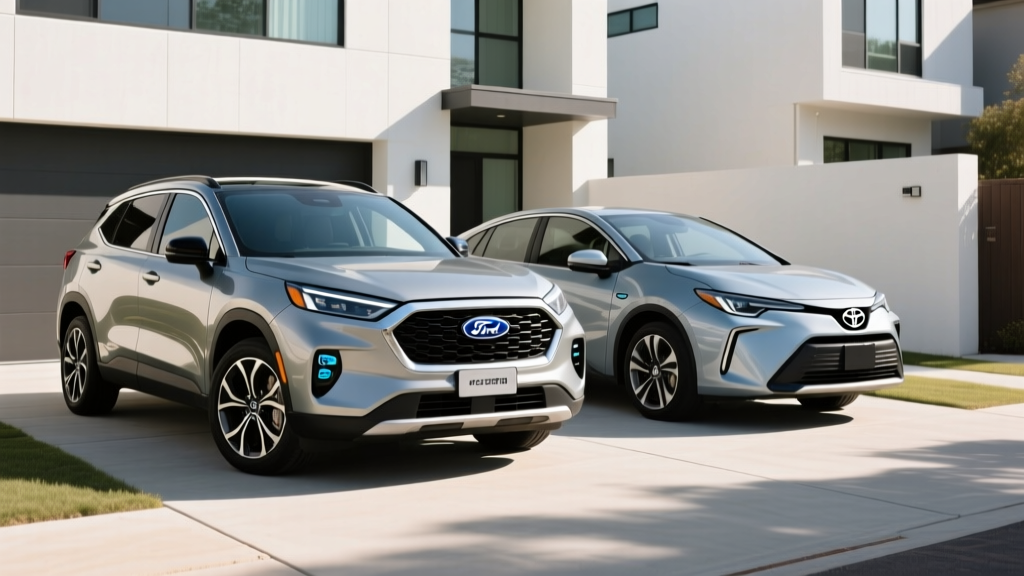
If you've been searching for a "Ford Prius hybrid," you're not alone — the term pulls consistent interest from shoppers who know they want a fuel-sipping hybrid but aren't sure which badge builds it. Here's the quick clarification: the Prius is a Toyota product, not a Ford. Ford's direct competitor in the hybrid space is the Ford Escape Hybrid, a compact crossover that trades the Prius's hatchback silhouette for SUV utility.
Both vehicles are conventional hybrids (HEVs) — meaning no plug, no charging cable, just regenerative braking and a small battery that assists the gasoline engine. For 2026, the Escape Hybrid and the Prius represent two different philosophies: maximum efficiency in a low-slung package (Prius) versus practicality and all-wheel-drive availability in a crossover (Escape Hybrid). Let's break down exactly how they compare on the numbers that matter.
HEV vs PHEV vs EV: Which Powertrain Fits You?
Before diving into specs, let's establish the powertrain landscape. Both the Escape Hybrid and Prius are available as conventional hybrids (HEVs), and each also has a plug-in hybrid variant (the Escape PHEV and the Prius Prime). Understanding the difference is critical before you buy.
| Feature | Conventional Hybrid (HEV) | Plug-In Hybrid (PHEV) | Battery Electric (BEV) |
|---|---|---|---|
| Plug in to charge? | No — self-charging via regen | Yes — has a larger battery you charge externally | Yes — only power source |
| Electric-only driving | Brief, low-speed EV assist | 25–44 miles typical | 250–400+ miles |
| Gas engine | Always available | Engages after EV range depletes | None |
| Federal tax credit | Generally not eligible | Up to $3,750–$7,500 (§30D, varies) | Up to $7,500 (§30D, varies) |
| Best for | No home charging access, want simplicity | Short commutes + road trip flexibility | Home charging + daily driving under 300 mi |
If you don't have access to a plug at home or work, a conventional HEV like the base Escape Hybrid or standard Prius is the right call. If you can charge overnight and your commute is under 40 miles round-trip, the PHEV variants let you drive mostly on electricity while keeping a gas tank for longer trips.
Fuel Economy: EPA MPG Breakdown
Fuel economy is the headline metric for hybrid shoppers. Here's how the 2026 model-year lineup stacks up according to EPA estimates on fueleconomy.gov:
| Model | City MPG | Highway MPG | Combined MPG | Drivetrain |
|---|---|---|---|---|
| 2026 Toyota Prius (FWD) | 57 | 56 | 57 | FWD |
| 2026 Toyota Prius (AWD-e) | 53 | 54 | 54 | AWD |
| 2026 Toyota Prius Prime (PHEV) | 52 (hybrid mode) / 127 MPGe | 48 / — | 50 / 127 MPGe | FWD |
| 2026 Ford Escape Hybrid (FWD) | 42 | 36 | 39 | FWD |
| 2026 Ford Escape Hybrid (AWD) | 42 | 36 | 39 | AWD |
| 2026 Ford Escape PHEV | 42 (hybrid) / 105 MPGe | 38 / — | 40 / 105 MPGe | FWD |
Real-world MPG note: Hybrids typically exceed their EPA city estimates in stop-and-go traffic because regenerative braking recovers energy that a gas-only car wastes as heat. In our experience, the Prius FWD easily returns 55–60 MPG in urban driving. Highway driving is where hybrids lose their advantage — at sustained 75+ mph speeds, the electric motor contributes less, and aerodynamic drag dominates. Expect the Escape Hybrid AWD to deliver 33–35 MPG on the highway in real-world conditions, slightly below its EPA sticker.
Powertrain Specs: What's Under the Hood
| Spec | 2026 Toyota Prius | 2026 Ford Escape Hybrid |
|---|---|---|
| Engine | 2.0L 4-cyl Atkinson | 2.5L 4-cyl Atkinson |
| Combined system HP | 194 hp (FWD) / 196 hp (AWD) | 198 hp (FWD) / 198 hp (AWD) |
| Transmission | eCVT (planetary gearset) | eCVT (planetary gearset) |
| Hybrid battery | ~1.0 kWh lithium-ion (HEV) | ~1.1 kWh lithium-ion (HEV) |
| PHEV battery (if equipped) | 13.6 kWh (Prius Prime) | 14.4 kWh (Escape PHEV) |
| PHEV electric-only range | 44 miles (Prime) | 37 miles (Escape PHEV) |
| PHEV total combined range | ~480 miles | ~430 miles |
| 0-60 mph (HEV) | 7.2 sec (FWD) | 7.8 sec (FWD) |
| DC fast charge (PHEV) | No (Level 2 AC only) | No (Level 2 AC only) |
| Level 2 charge time (PHEV) | ~4 hours (0–100%) | ~3.5 hours (0–100%) |
A critical point for PHEV shoppers: neither the Prius Prime nor the Escape PHEV supports DC fast charging. Both charge exclusively via Level 1 (120V household outlet) or Level 2 (240V). On a standard 120V outlet, expect 10–12 hours for a full charge — fine for overnight, but you'll want a Level 2 home charger if you plan to rely on electric-only driving daily. A 240V Level 2 station at 3.3–6.6 kW replenishes the battery in 3.5–4 hours.
Pricing and Tax Credit Eligibility
Here's where the "Ford Prius hybrid" search gets financially interesting. Base MSRPs for 2026 models:
- Toyota Prius LE (FWD): ~$29,450
- Toyota Prius Prime SE (PHEV): ~$34,100
- Ford Escape Hybrid (base): ~$34,500
- Ford Escape PHEV: ~$40,500
Federal tax credit (§30D) eligibility for 2026: Conventional hybrids (the standard Prius and standard Escape Hybrid) do not qualify for the federal clean vehicle credit. That credit applies to BEVs and PHEVs only, and only those meeting IRS battery-sourcing and critical-minerals requirements under current IRS §30D rules.
PHEV tax credit reality check: The Prius Prime and Escape PHEV may qualify for a partial or full §30D credit (up to $7,500), but eligibility depends on battery component sourcing, your adjusted gross income (caps: $150K single / $300K joint), and MSRP limits ($55K for sedans, $80K for SUVs/vans). The point-of-sale transfer option lets you apply the credit as a down payment reduction at the dealer. Always verify current eligibility on irs.gov before purchasing — sourcing rules tighten annually.
Neither conventional hybrid qualifies for §30D. However, some states offer separate rebates for HEVs — check your state's energy office or AFDC state incentive database for local programs.
Battery Warranty, Lifespan, and Replacement Cost
Hybrid battery longevity is the number-one concern we hear from buyers. Here's the data:
| Item | Toyota Prius | Ford Escape Hybrid |
|---|---|---|
| Hybrid battery warranty | 10 years / 150,000 miles | 8 years / 100,000 miles |
| Powertrain warranty | 5 years / 60,000 miles | 5 years / 60,000 miles |
| Battery chemistry | Lithium-ion (bipolar NiMH on some trims) | Lithium-ion |
| Estimated replacement cost (out of warranty) | $2,500–$4,500 | $3,000–$5,000 |
| Real-world degradation data | Minimal — many Prius taxis exceed 300K mi on original battery | Good — fewer long-term data points than Toyota |
Toyota's hybrid battery track record is the strongest in the industry. The Prius has been in production since 1997 (globally), and fleet data consistently shows hybrid battery packs lasting well beyond the warranty period. Ford's hybrid system is newer to the market at scale, but the Escape Hybrid's lithium-ion pack uses proven cell chemistry and is managed conservatively — the system never fully charges or fully depletes the battery, which dramatically extends cycle life.
Practical takeaway: For most owners who sell or trade within 8–10 years, battery replacement is a non-issue. If you plan to keep either vehicle past 150,000 miles, budget $3,000–$5,000 as a contingency, but understand that many hybrid batteries outlast the vehicles they're installed in.
Who Should Choose Which — Decision Framework
Choose the Toyota Prius if:
- Maximum MPG is your top priority (57 combined is class-leading)
- You drive primarily in city/urban traffic where hybrids shine
- You want the lowest possible cost per mile on fuel
- You prefer a car with Toyota's long-proven hybrid reliability record
- You don't need SUV cargo space or towing capability
Choose the Ford Escape Hybrid if:
- You need crossover utility — higher seating position, more cargo room, available AWD
- You live in a region with harsh winters (AWD availability matters)
- You want a conventional hybrid without the Prius's low roofline and tight rear seats
- You're a Ford loyalist with existing dealer/service relationships
- You occasionally need to haul bulkier items (up to 60.8 cu ft cargo with rear seats folded)
Choose a PHEV variant (Prius Prime or Escape PHEV) if:
- You have Level 2 home charging and a commute under 40 miles
- You want to drive mostly on electricity without range anxiety on longer trips
- You may qualify for the §30D federal tax credit, narrowing the price gap
Choose a full BEV instead if:
- You have reliable home charging and drive under 300 miles daily
- You want zero tailpipe emissions and minimal maintenance (no oil changes, no exhaust system)
- Your budget can absorb a higher upfront price in exchange for lower per-mile energy cost
Pros and Cons at a Glance
Toyota Prius Pros & Cons
Pros:
- Best-in-class 57 MPG combined
- Proven hybrid system with 25+ year track record
- 10-year/150K-mile hybrid battery warranty
- Quick for a hybrid — 7.2 sec 0-60
- Low starting price (~$29,450)
Cons:
- Low roofline limits cargo versatility
- Rear seat space is tight for taller passengers
- No DC fast charging on Prime
- FWD-only on base trims (AWD-e costs more)
Ford Escape Hybrid Pros & Cons
Pros:
- SUV utility — 60.8 cu ft cargo, higher ride height
- AWD available on hybrid trims
- Comfortable ride quality for daily commuting
- 198 hp provides confident highway merging
- Competitive PHEV variant with 37 mi EV range
Cons:
- 39 MPG combined trails Prius by 18 MPG
- Higher starting price (~$34,500)
- Shorter hybrid battery warranty (8 yr / 100K mi)
- Real-world highway MPG often dips below EPA estimate
- Infotainment system can lag behind Toyota's updated interface
Frequently Asked Questions
Does Ford make a Prius?
No. The Prius is exclusively a Toyota model. Ford's hybrid competitor is the Escape Hybrid, a compact crossover SUV. Ford also offers the Maverick Hybrid (a compact pickup) and the F-150 PowerBoost Hybrid (full-size truck), but no Prius-equivalent hatchback.
How many MPG does the Ford Escape Hybrid get?
The 2026 Ford Escape Hybrid is EPA-rated at 42 city / 36 highway / 39 combined MPG for both FWD and AWD configurations. In real-world city driving, many owners report 40–44 MPG thanks to regenerative braking. Highway mileage at 75+ mph typically falls to 33–35 MPG.
How far can the Escape PHEV go on electric only?
The 2026 Ford Escape PHEV delivers an EPA-rated 37 miles of electric-only range on a full charge. That covers most daily commutes. Once the battery depletes, the 2.5L hybrid system takes over, delivering 42 combined MPG as a conventional hybrid for a total range of roughly 430 miles.
Is the Ford Escape Hybrid reliable?
The Escape Hybrid uses Ford's fourth-generation hybrid powertrain, which has shown solid reliability in fleet and consumer data. The hybrid battery carries an 8-year/100,000-mile warranty. Toyota's Prius has a longer track record and a 10-year/150,000-mile battery warranty, which gives it an edge in long-term confidence. NHTSA and IIHS crash-test ratings for both vehicles are strong — check current scores at nhtsa.gov and iihs.org.
Does the Ford Escape Hybrid qualify for a tax credit?
The conventional Escape Hybrid (HEV) does not qualify for the federal §30D clean vehicle credit — that credit applies only to plug-in vehicles (PHEVs and BEVs). The Escape PHEV may qualify for up to $7,500 depending on your income, the vehicle's MSRP, and battery-sourcing compliance. Rules change annually, so verify on irs.gov before purchase. Some states offer separate hybrid rebates that may apply to the HEV.
What does it cost to replace a hybrid battery?
Out-of-warranty hybrid battery replacement for the Escape Hybrid typically runs $3,000–$5,000 including labor. For the Prius, expect $2,500–$4,500. However, hybrid batteries rarely fail within the warranty period, and many last 200,000+ miles. Toyota's extensive fleet data (especially from Prius taxis) shows original batteries regularly exceeding 300,000 miles.
Hybrid vs PHEV vs EV — which should I buy?
If you can't charge at home: HEV (Prius or Escape Hybrid). If you can charge at home and commute under 40 miles: PHEV (Prius Prime or Escape PHEV) for near-EV daily driving with gas backup. If you have home charging, drive under 300 miles daily, and want the lowest running costs: BEV. The right answer depends entirely on your charging access and daily mileage pattern.