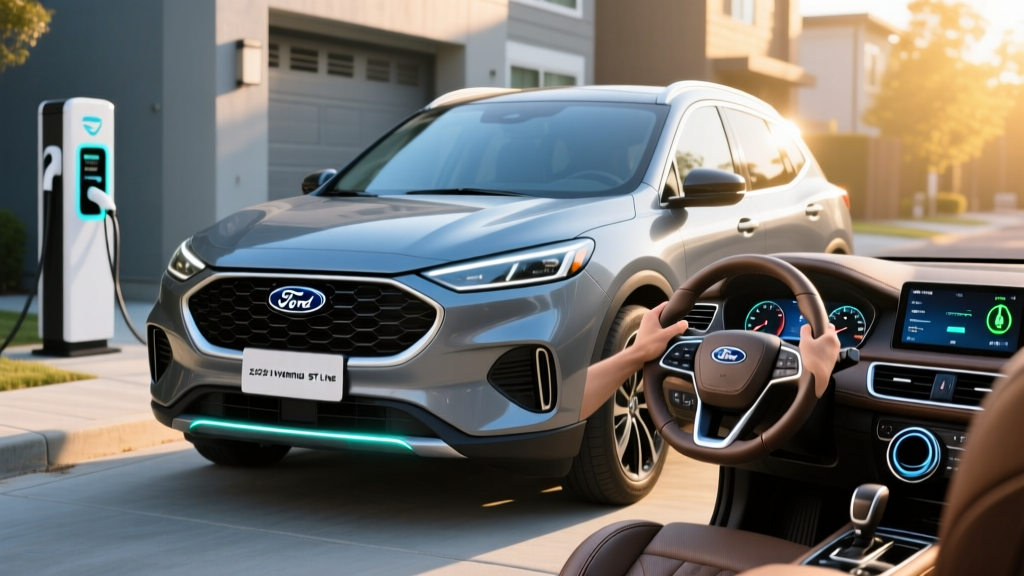
The Ford Escape Hybrid ST-Line occupies a specific niche in the compact crossover segment: sporty styling cues, genuine hybrid efficiency, and no plug required. For 2026, Ford continues the ST-Line trim as the appearance-and-handling upgrade over the base Hybrid, adding a flat-bottom steering wheel, unique 19-inch wheels, and a tuned suspension — all wrapped around the same proven 2.5-liter Atkinson-cycle hybrid powertrain. If you want the Escape's efficiency without the commitment of plugging in nightly, this is the trim to examine closely.
HEV vs. PHEV: Which Escape Hybrid Are We Talking About?
Before diving into specs, a critical distinction: Ford sells two electrified Escape variants, and they serve different buyers.
| Attribute | Escape Hybrid (HEV) | Escape Plug-In Hybrid (PHEV) |
|---|---|---|
| Needs to be plugged in? | No — self-charging via regen & engine | Yes — plug in to access EV range |
| Electric-only range | ~1-2 miles at low speed | 37 miles (EPA) |
| Battery size | 1.1 kWh (small buffer) | 14.4 kWh usable |
| Combined MPG / MPGe | 39 MPG combined | 105 MPGe (EV mode) / 40 MPG (hybrid) |
| DC fast charging | N/A | No — Level 2 AC only |
| Federal tax credit (§30D) | Not eligible | Not eligible (new units) |
| Starting MSRP (ST-Line) | ~$36,500 | ~$40,500 (Select/Premium trims) |
This review focuses on the Ford Escape Hybrid ST-Line, the conventional HEV variant. If you're interested in the PHEV, note that Ford discontinued the ST-Line trim for the plug-in model, reserving it for the Select and Premium trims. The HEV ST-Line is the sport-look, no-plug option.
Fuel Economy: EPA Ratings and Real-World MPG
The 2026 Ford Escape Hybrid ST-Line with front-wheel drive carries the following EPA-estimated fuel economy:
| Drivetrain | City MPG | Highway MPG | Combined MPG |
|---|---|---|---|
| FWD | 42 | 36 | 39 |
| AWD | 38 | 34 | 36 |
The city-highway split is typical of Toyota- and Ford-derived hybrid systems: the electric motor handles low-speed propulsion where internal combustion engines are least efficient, so city driving actually yields better numbers than highway cruising.
In mixed suburban driving with moderate climate control use, owners consistently report 38-43 MPG in the FWD Escape Hybrid — often meeting or slightly exceeding the EPA combined figure. Highway-only trips at 75+ mph tend to drop to 33-35 MPG. In cold weather (below 35°F), expect a 3-5 MPG reduction due to increased engine runtime for cabin heat and reduced battery efficiency. The AWD ST-Line typically delivers 34-38 MPG in real-world mixed use.
With a 14.2-gallon fuel tank, the FWD Hybrid ST-Line offers a theoretical range of approximately 554 miles per fill-up at the combined EPA rating — enough for most commuters to visit the gas station once every two weeks or less.
Powertrain: Engine, Motor, and Combined Output
The Escape Hybrid pairs Ford's 2.5-liter inline-four Atkinson-cycle engine with an electric motor integrated into the eCVT transaxle. Combined system output is 210 horsepower in the FWD configuration. The AWD variant adds a rear-mounted electric motor for all-wheel drive without a mechanical driveshaft, maintaining the same 210 hp figure.
| Specification | 2026 Escape Hybrid ST-Line |
|---|---|
| Engine | 2.5L iVCT Atkinson-cycle I-4 |
| Combined horsepower | 210 hp |
| Transmission | eCVT (planetary gearset) |
| 0-60 mph | ~7.6 seconds (FWD) |
| Drivetrain | FWD standard; AWD available |
| Towing capacity | 1,500 lbs (with Class II tow pkg) |
| Cargo volume (behind 2nd row) | 34.4 cu ft |
| Cargo volume (seats folded) | 60.8 cu ft |
| Curb weight | ~3,750 lbs (FWD) |
The eCVT isn't a traditional belt-and-cone CVT — it uses a planetary gearset to seamlessly blend engine and motor power. This means no rubber-band effect under acceleration and no shift shock. The result is smooth, linear power delivery that suits the ST-Line's sport-oriented positioning, though 210 hp in a 3,750-lb crossover won't produce enthusiast thrills. It's adequate for confident highway merging and passing.
ST-Line Trim: What You Get for the Price
The 2026 Ford Escape Hybrid ST-Line starts at approximately $36,495 MSRP (including destination). Key standard features over the base Hybrid trim include:
- Unique ST-Line front and rear fascias with gloss-black accents
- 19-inch aluminum wheels (Rock Metallic finish)
- Sport-tuned suspension with revised damper tuning
- Flat-bottom leather-wrapped steering wheel with red stitching
- Red brake calipers
- 13.2-inch SYNC 4 touchscreen with wireless Apple CarPlay and Android Auto
- Ford Co-Pilot360 suite (automatic emergency braking, lane-keeping, blind-spot monitoring)
- Wireless charging pad
The ST-Line Select hybrid (a step up) adds a panoramic sunroof, heated front seats, a 10-speaker B&O audio system, and Intelligent Adaptive Cruise Control, pushing MSRP to roughly $39,500. The ST-Line Elite hybrid tops the range near $43,000 with leather-trimmed seats, a head-up display, and additional driver-assistance features.
The conventional Escape Hybrid (HEV) does not qualify for the IRS §30D Clean Vehicle Credit. That credit applies only to plug-in electric vehicles (BEVs and PHEVs) meeting battery-sourcing and MSRP requirements. The Escape PHEV previously qualified but has been subject to evolving critical-mineral rules under current IRS guidance. Check IRS.gov for the latest eligibility before purchasing any plug-in variant. Some states offer separate hybrid rebates — consult your state energy office for local programs.
Battery Warranty, Lifespan, and Replacement Cost
The Escape Hybrid's 1.1 kWh lithium-ion traction battery is far smaller than a full EV's pack, and it operates within a narrow state-of-charge window managed by the vehicle's software. This conservative charge strategy — never fully charging or fully depleting the pack — is the primary reason hybrid batteries outlast their warranty periods in most cases.
- Hybrid/EV battery components: 8 years / 100,000 miles (whichever comes first)
- California and CARB-adopting states: 10 years / 150,000 miles for emissions-related hybrid components
- Powertrain warranty: 5 years / 60,000 miles
Based on long-term data from the Escape Hybrid platform (now in its second generation), battery degradation is minimal. Most owners report no measurable efficiency loss within the first 100,000 miles. The small battery size also means replacement costs are far lower than a full EV:
- Dealer replacement cost: Approximately $2,500–$4,000 for the hybrid battery pack
- Refurbished/aftermarket options: $1,500–$2,500 from independent hybrid specialists
- Individual cell/module repair: Some hybrid shops can replace degraded modules for $500–$1,200
For context, the Escape Hybrid battery is a fraction of the cost of a full EV pack replacement (which can exceed $10,000–$20,000). Combined with Ford's 8-year/100k-mile coverage, battery-related expense is a low-probability, low-severity risk for this vehicle.
Hybrid vs. PHEV vs. Full EV: Which Fits Your Life?
The Escape Hybrid ST-Line makes sense for a specific buyer profile. Here's a practical decision framework:
- You lack access to home or workplace charging (apartment, street parking, no garage outlet)
- You want 39 MPG combined without changing your fueling habits at all
- You take frequent road trips where charging infrastructure is sparse
- Your budget is under $40,000 and you don't want to manage plug-in logistics
- You can install a Level 2 charger at home and your daily commute is under 37 miles
- You want electric-only driving for errands but gas flexibility for road trips
- You can verify current §30D tax credit eligibility on IRS.gov before purchasing
- You have reliable home Level 2 charging
- Your daily driving is under 250 miles and you're comfortable planning DC fast-charge stops on road trips
- You want zero tailpipe emissions and the lowest per-mile fuel cost (~$0.04–$0.06/mi on residential electricity vs. ~$0.12–$0.14/mi for the Hybrid at 39 MPG)
The honest calculus: a conventional hybrid like the Escape ST-Line is the lowest-friction path to better fuel economy. You spend nothing on charging equipment, change nothing about how you refuel, and gain roughly 40% better city MPG over the gas-only Escape (27 MPG combined). The trade-off is that you'll always buy gasoline and never experience the silence, instant torque, or per-mile cost advantage of electric driving.
Reliability and Ownership Costs
The 2026 Escape Hybrid benefits from Ford's second-generation hybrid system, which has been in production since the 2020 model year. The eCVT planetary gearset has no belts, clutches, or friction bands to wear out — it's one of the most durable transmission designs in the industry. There are no spark-plug-like maintenance items unique to the hybrid system; the gasoline engine follows standard maintenance intervals.
According to IIHS testing, the Escape earns strong crashworthiness ratings, and the standard Co-Pilot360 suite provides comprehensive active-safety coverage. Long-term reliability data from Consumer Reports and J.D. Power places the Escape Hybrid in the average-to-above-average range for the compact SUV segment, with the hybrid powertrain itself generating fewer complaints than the turbocharged gas powertrain option.
- 42 MPG city in FWD — exceeds EPA in real-world suburban use
- No plug-in requirement — zero lifestyle change from gas car
- ST-Line styling and suspension add visual and dynamic appeal
- Proven eCVT with strong long-term reliability data
- 8-year/100k-mile hybrid battery warranty
- Affordable replacement cost if battery ever fails post-warranty
- No federal tax credit eligibility for HEV
- AWD drops combined MPG to 36
- 210 hp is adequate, not sporty — ST-Line is appearance, not performance
- Cabin noise under hard acceleration (Atkinson-cycle engine drone)
- 1,500-lb towing limit is below some competitors
- Small 1.1 kWh battery limits electric-only driving to low-speed creep
Frequently Asked Questions
How many MPG does the Ford Escape Hybrid ST-Line get?
The FWD Escape Hybrid ST-Line is EPA-rated at 42 city / 36 highway / 39 combined MPG. The AWD version is rated at 38/34/36. In real-world suburban driving, FWD owners commonly achieve 38-43 MPG combined, often meeting or slightly exceeding the EPA sticker.
Does the Ford Escape Hybrid need to be plugged in?
No. The Escape Hybrid (HEV) is a conventional, self-charging hybrid. It recovers energy through regenerative braking and uses the gasoline engine to maintain the small 1.1 kWh battery. You fuel it exclusively at gas stations, exactly like a conventional car. Only the Escape Plug-In Hybrid (PHEV) requires plugging in.
Does the Escape Hybrid ST-Line qualify for any tax credit?
The conventional Escape Hybrid does not qualify for the federal §30D Clean Vehicle Credit, which is reserved for plug-in vehicles (BEVs and PHEVs). Check your state's energy office for any local hybrid incentives, which vary by jurisdiction. The Escape PHEV may qualify depending on current IRS battery-sourcing rules — verify at irs.gov before purchase.
How long will the Escape Hybrid battery last?
Ford warranties the hybrid battery for 8 years/100,000 miles (10 years/150,000 miles in California and CARB states). Real-world data from the Escape Hybrid platform shows minimal degradation within the warranty period. Many first-generation Escape Hybrids (2005-2012) exceeded 150,000 miles on the original battery. If replacement is ever needed, expect $2,500-$4,000 at a dealer.
Is the ST-Line actually sporty to drive?
The ST-Line adds sport-tuned suspension, 19-inch wheels, and a flat-bottom steering wheel for sharper steering response and a firmer ride. It handles corners with less body roll than the base Hybrid. However, 210 hp in a 3,750-lb vehicle delivers adequate rather than thrilling acceleration (0-60 in ~7.6 seconds). Think of the ST-Line as a handling-and-appearance package, not a performance variant.
Should I buy the Hybrid or the PHEV Escape?
If you can charge at home and your daily commute is under 37 miles, the PHEV lets you drive on electricity most days while keeping gas-engine flexibility for longer trips. If you can't charge at home, drive long distances regularly, or want the lowest purchase price, the conventional Hybrid ST-Line at ~$36,500 is the more practical choice. The Hybrid also qualifies for the ST-Line sport appearance package, which the PHEV does not offer.