Quick Verdict: The Escape Hybrid and PHEV at a Glance
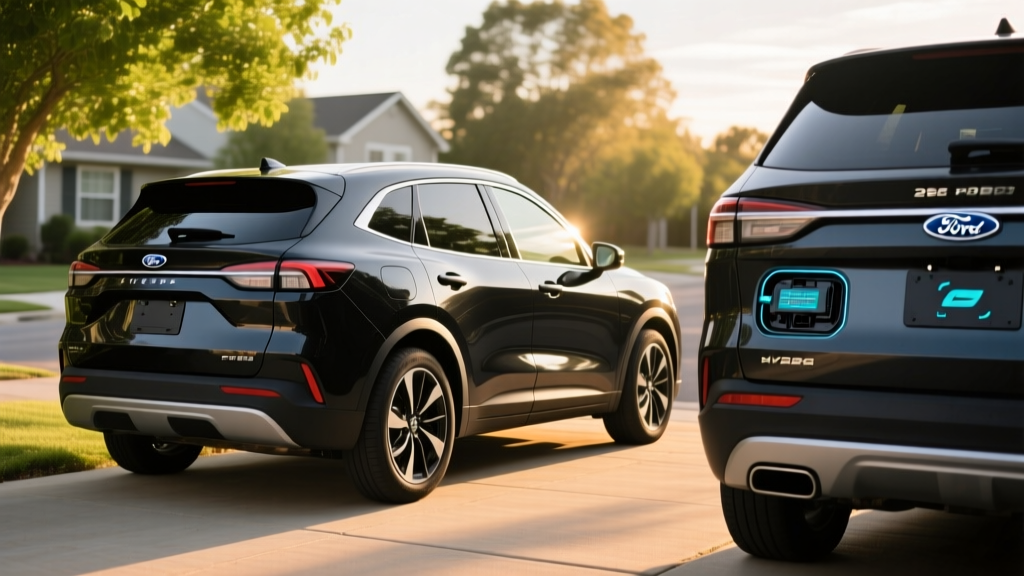
The Ford Escape Hybrid lineup gives compact-SUV shoppers two distinct electrified paths. The conventional hybrid (HEV) delivers an EPA-estimated 39 MPG combined without ever needing a plug, making it a drop-in replacement for a gas-only crossover. The Escape Plug-In Hybrid (PHEV) adds roughly 37 miles of electric-only driving and a combined 520+ miles of total range — ideal for commuters who can charge at home but still want gas-engine freedom for road trips. Neither requires lifestyle changes; both trim fuel costs significantly versus the turbocharged gas-only Escape.
| Specification | Escape Hybrid (HEV) | Escape Plug-In Hybrid (PHEV) |
|---|---|---|
| Powertrain | 2.5L 4-cyl + electric motor | 2.5L 4-cyl + electric motor |
| Combined Horsepower | 198 hp (FWD) / 210 hp (AWD) | 210 hp (FWD only) |
| EPA Combined MPG | 39 MPG (FWD) | 40 MPG (gas-only after battery) |
| Electric-Only Range | N/A (no plug) | 37 miles |
| Battery Capacity | ~1.1 kWh (self-charging) | 14.4 kWh usable |
| DC Fast Charging | N/A | No (Level 2 AC only) |
| Level 2 Charge Time | N/A | ~3.5 hours (240V) |
| Total Combined Range | ~520 miles | ~520 miles (gas + electric) |
| 0–60 mph | ~7.9 sec (FWD) | ~8.4 sec |
| Starting MSRP | ~$34,490 | ~$40,490 |
| Federal Tax Credit | Not eligible | Up to $3,750 (§30D) |
| Battery Warranty | 8 yr / 100,000 mi | 8 yr / 100,000 mi |
HEV vs. PHEV: Which Escape Hybrid Fits Your Driving?
Before comparing numbers, the distinction between the two Escape models matters because it changes how you fuel, what you pay, and whether you qualify for incentives.
| Factor | Escape Hybrid (HEV) | Escape PHEV |
|---|---|---|
| Plug Required? | No — charges via regen braking and engine | Yes — plug in for electric-only miles |
| Electric-Only Driving | Short bursts at low speed only | Up to 37 miles at highway speed |
| Home Charging Needed | No | Recommended (120V works, 240V preferred) |
| Federal Tax Credit | None | Up to $3,750 (income/MSRP rules apply) |
| Best For | Drivers without home charging access | Commuters with home/work charging |
| Premium Over Gas Model | ~$2,000 | ~$8,000 |
The HEV is the simpler choice: you drive it exactly like a gas car, and the hybrid system invisibly recovers energy during braking and coasting to boost efficiency. The PHEV demands one behavioral change — plugging in — but rewards you with zero-emission commuting for most daily round trips under 37 miles.
Fuel Economy Breakdown: EPA MPG and Real-World Numbers
The EPA rates the 2026 Escape Hybrid FWD at 42 city / 36 highway / 39 combined MPG. The AWD version drops slightly to 38 combined. The Escape PHEV is rated at 40 MPG combined once the battery is depleted, plus 37 miles of electric-only range measured at 105 MPGe.
| Model | City MPG | Highway MPG | Combined MPG | MPGe (PHEV Electric) |
|---|---|---|---|---|
| Escape Hybrid FWD | 42 | 36 | 39 | N/A |
| Escape Hybrid AWD | 40 | 34 | 38 | N/A |
| Escape PHEV FWD | 42 | 37 | 40 (gas) | 105 MPGe |
Real-World MPG: What Owners Actually See
Hybrids consistently outperform their EPA highway numbers in city driving because regenerative braking recovers energy at every stoplight. In mixed suburban commuting with frequent stops, expect the Escape Hybrid FWD to return 40–44 MPG. Sustained highway driving at 75+ mph is where hybrids lose their advantage — the engine runs continuously and aerodynamic drag dominates, so expect 33–36 MPG on long interstate trips. Cold weather (below 30°F) reduces fuel economy by roughly 8–12% because the engine runs more often for cabin heat and the battery is less efficient.
For the PHEV, if your commute is under 37 miles round-trip and you charge nightly, you may use almost zero gasoline during the workweek. On a road trip with a depleted battery, the PHEV operates as a conventional hybrid and delivers roughly the same 38–40 MPG as the HEV.
PHEV Electric-Only Range, Charging, and Battery Details
The Escape PHEV's 14.4 kWh lithium-ion battery delivers an EPA-rated 37 miles of electric-only range. That covers the average American one-way commute (roughly 16 miles each way per Census data) with margin to spare. Top speed in EV mode reaches 85 mph, so highway merging is not a concern.
Charging the Escape PHEV
The PHEV uses a standard J1772 connector and accepts Level 1 (120V) or Level 2 (240V) AC charging. There is no DC fast-charging capability — a common limitation among compact PHEVs because their smaller batteries don't justify the added cost and weight of DC hardware.
| Charging Level | Power | 0–100% Time | Where |
|---|---|---|---|
| Level 1 (120V household outlet) | ~1.4 kW | ~10–11 hours | Any standard outlet |
| Level 2 (240V home/public) | ~3.3 kW (vehicle-limited) | ~3.5 hours | Home wallbox, workplace, public L2 |
Because the onboard charger is limited to roughly 3.3 kW, upgrading to a 48-amp home Level 2 station won't speed things up — the car itself is the bottleneck. A basic 16-amp Level 2 unit is sufficient.
Can You Run the Escape PHEV Without Plugging In?
Yes. If you never plug in, the PHEV operates as a conventional hybrid and still delivers ~40 MPG combined. However, you're carrying roughly 260 extra pounds of battery you're not using, and you're leaving fuel savings on the table. The PHEV only makes financial sense if you plan to charge regularly.
Powertrain, Performance, and Drivetrain Options
Both Escape electrified models use Ford's 2.5-liter Atkinson-cycle four-cylinder engine paired with an electric motor and an electronically controlled continuously variable transmission (eCVT). This is a proven Toyota-derived hybrid architecture that Ford has refined over multiple generations.
The Escape Hybrid produces 198 hp in FWD form and 210 hp with AWD (the rear axle gets its own electric motor). The Escape PHEV makes 210 hp but is offered only in FWD — a trade-off for its larger battery pack. Acceleration is adequate for merging and passing (0–60 mph in roughly 8 seconds), but neither model is quick by EV standards. The eCVT keeps the engine in its most efficient RPM range, which means acceleration is smooth but not sporty.
One practical note: the AWD Escape Hybrid uses an electric rear axle rather than a mechanical driveshaft, so rear wheels engage only when slip is detected. This is efficient but means the AWD system has a slight engagement delay compared to full-time mechanical AWD.
Pricing, Tax Credits, and Total Cost of Ownership
The 2026 Escape Hybrid starts at approximately $34,490 (FWD base), with AWD adding ~$1,500 and higher trims (ST-Line, Platinum) pushing past $40,000. The Escape PHEV starts around $40,490 and is offered in select trims only.
Federal Tax Credit Eligibility
Under current IRS §30D rules, the Escape PHEV may qualify for a federal tax credit of up to $3,750 — not the full $7,500, because the battery's critical-mineral and component sourcing may only partially satisfy requirements. The conventional Escape Hybrid does not qualify for any federal clean-vehicle credit (those apply only to PHEVs and BEVs meeting battery-capacity thresholds).
Key §30D Tax Credit Requirements for the Escape PHEV (2026)
- MSRP cap: SUVs must be under $80,000 — the Escape PHEV qualifies at all trims.
- Buyer income cap: Modified AGI must not exceed $150,000 (single) / $300,000 (joint).
- Battery sourcing: Credit splits into two halves ($3,750 each) based on critical-mineral and battery-component requirements. Sourcing rules tighten annually — verify current-year status on IRS.gov.
- Point-of-sale transfer: You can transfer the credit to the dealer at purchase to reduce your out-of-pocket cost, rather than waiting for a tax refund.
- Final assembly: Must occur in North America (the Escape is built in Kentucky).
Consult a tax professional for your specific eligibility. Rules are subject to change.
Five-Year Cost Snapshot
Assuming 15,000 miles/year and $3.40/gallon regular fuel, the Escape Hybrid burns roughly 385 gallons/year (~$1,309). A comparable gas-only Escape at 28 MPG combined uses ~536 gallons (~$1,822). That's a ~$513/year fuel savings with the hybrid, or roughly $2,565 over five years — enough to recoup most of the hybrid premium. For the PHEV owner who charges at home ($0.14/kWh national average) and drives 30 electric miles daily, annual fuel costs can drop below $600, saving over $1,200/year versus the gas model.
Reliability, Battery Warranty, and Replacement Cost
Ford's hybrid system — derived from a long-licensed Toyota planetary-gear design — is among the most proven in the industry. There are no traditional transmission wear items (no clutch packs, no torque converter), and regenerative braking reduces wear on the friction brake pads, which routinely last 80,000+ miles on Escape Hybrids.
Hybrid Battery Warranty
Ford covers the high-voltage hybrid battery in both the HEV and PHEV for 8 years or 100,000 miles (whichever comes first). In California-emissions states, that extends to 10 years or 150,000 miles. The warranty guarantees the battery will retain sufficient capacity to function as designed — typically above 65–70% of original capacity.
Real-World Battery Longevity
Escape Hybrid batteries from earlier generations (2013–2019) have proven durable well past 150,000 miles with minimal degradation, largely because the hybrid system keeps the battery in a narrow state-of-charge window (roughly 40–60%), avoiding the deep cycles that accelerate wear. The PHEV battery sees wider charge swings but benefits from active thermal management.
Battery Replacement Cost
If a replacement is needed out of warranty, expect to pay $2,500–$4,000 for the Escape Hybrid's smaller battery pack and $6,000–$8,500 for the PHEV's larger pack, including labor. Independent hybrid shops and refurbished packs can reduce these figures. However, wholesale failures before 150,000 miles are uncommon based on fleet and owner data.
Who Should Buy the Escape Hybrid, the PHEV, or a Full EV?
Escape Hybrid (HEV) Pros
- No plug-in required — works with any lifestyle
- 39 MPG combined saves ~$500/year over gas
- AWD available
- Lower upfront cost than PHEV
- Proven, low-maintenance powertrain
Escape Hybrid (HEV) Cons
- No electric-only driving
- No federal tax credit
- eCVT drone under hard acceleration
- Less cargo space than gas model (battery under floor)
Escape PHEV Pros
- 37 miles electric-only covers most commutes
- Potential $3,750 federal tax credit
- 520+ total range eliminates range anxiety
- Gas-free weekday driving with road-trip flexibility
Escape PHEV Cons
- ~$6,000 premium over Hybrid HEV
- FWD only — no AWD option
- No DC fast charging
- Cargo space reduced by larger battery
- Requires home/work charging access for full value
The Decision Framework
- Choose the Escape Hybrid (HEV) if: You lack reliable home or workplace charging, you want AWD, or you want the simplest path to better fuel economy with zero behavior change.
- Choose the Escape PHEV if: Your daily round-trip is under 35 miles, you can charge at home overnight, you want to minimize gasoline use without committing to a full EV, and the ~$3,750 tax credit narrows the price gap.
- Choose a full BEV (e.g., Ford Mustang Mach-E, Tesla Model Y) if: Your daily driving exceeds 37 miles, you want zero tailpipe emissions, you have reliable home Level 2 charging, and you're comfortable with public DC fast charging on road trips.
Frequently Asked Questions
How many MPG does the Ford Escape Hybrid get?
The 2026 Escape Hybrid FWD is EPA-rated at 42 city / 36 highway / 39 combined MPG. AWD drops to 38 combined. Real-world city driving often exceeds the EPA city figure (40–44 MPG), while sustained highway driving at high speeds returns 33–36 MPG.
How far can the Escape PHEV go on electric only?
The EPA rates the Escape PHEV at 37 miles of electric-only range. Real-world results vary: expect 32–35 miles in cold weather (below 30°F) and up to 39–40 miles in mild conditions with gentle driving. Once the battery depletes, the gasoline engine engages seamlessly and the car operates as a conventional hybrid at ~40 MPG.
Does the Ford Escape Hybrid qualify for a tax credit?
The conventional Escape Hybrid (HEV) does not qualify for any federal clean-vehicle tax credit. The Escape PHEV may qualify for up to $3,750 under IRS §30D, subject to buyer income limits, battery-sourcing requirements, and MSRP caps. Check fueleconomy.gov for the latest eligibility status.
Is the Escape Hybrid reliable? What does a battery replacement cost?
The Escape Hybrid powertrain is based on a proven planetary-gear hybrid design with no traditional transmission wear components. Ford covers the hybrid battery for 8 years/100,000 miles (10 years/150,000 miles in CARB states). Out-of-warranty replacement costs range from $2,500–$4,000 (HEV) to $6,000–$8,500 (PHEV), though failures before 150,000 miles are uncommon.
Do I need to plug in the Escape Hybrid?
No. The conventional Escape Hybrid (HEV) charges its small battery entirely through regenerative braking and the gasoline engine. You never plug it in. Only the Escape PHEV requires plugging in to access its electric-only range — and even the PHEV can be driven without plugging in (at reduced efficiency benefit).
Hybrid vs. PHEV vs. full EV — which is right for me?
A conventional hybrid (HEV) suits anyone wanting better MPG with zero lifestyle change. A PHEV is ideal for drivers with short commutes and home charging who want electric daily driving plus gas-engine road-trip range. A full BEV (battery electric vehicle) makes sense if you want maximum fuel savings, have reliable home charging, and are comfortable planning DC fast-charging stops on longer trips. The Escape offers HEV and PHEV options; for a full BEV in Ford's lineup, look at the Mustang Mach-E.
Does the Escape Hybrid have AWD?
Yes — the conventional Escape Hybrid is available with AWD (an electric rear axle), rated at 38 MPG combined. The Escape PHEV is FWD only.