Ford Escape Hybrid MPG: The Numbers That Matter
The 2026 Ford Escape Hybrid remains one of the most fuel-efficient compact SUVs you can buy without plugging in. With an EPA-estimated 42 mpg city, 36 mpg highway, and 39 mpg combined for the front-wheel-drive hybrid (HEV), it sips fuel in a way that makes gas-only rivals look wasteful. For buyers who can charge at home, the Escape Plug-In Hybrid (PHEV) delivers 37 miles of electric-only driving before the gas engine kicks in, plus a total range exceeding 520 miles.
But EPA stickers don't always match what you'll see on your commute. Below, we break down the real-world fuel economy, powertrain specs, battery longevity, and tax credit eligibility for both versions of the 2026 Escape — so you can decide whether the HEV, the PHEV, or a full battery-electric vehicle (BEV) fits your life.
HEV vs PHEV: Which Escape Is Which?
Before diving into specs, let's clarify the fundamental difference between the two electrified Escape models, because confusing them is the most common mistake buyers make.
Escape Hybrid (HEV)
A conventional hybrid. It has a small battery (~1.1 kWh) that recharges through regenerative braking and the gas engine. You never plug it in. It simply uses less fuel than a gas-only car by blending electric motor assist with the 2.5-liter engine.
Escape Plug-In Hybrid (PHEV)
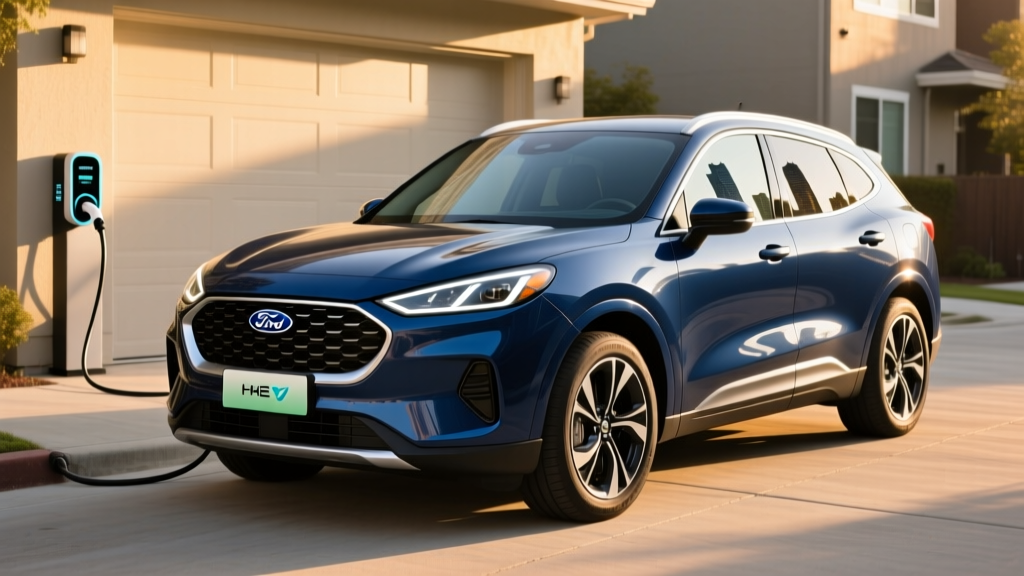
A plug-in hybrid with a larger 14.4 kWh battery. You can charge it from a wall outlet or Level 2 charger. It drives up to 37 miles on electricity alone, then operates as a conventional hybrid. You can plug it in, but you don't have to — it will still drive on gas if you never charge.
Fuel Economy: EPA Ratings and Real-World MPG
Ford offers the Escape Hybrid in front-wheel drive (FWD) and all-wheel drive (AWD). The PHEV is FWD only. Here's the complete fuel economy picture:
| Model | Drivetrain | EPA City | EPA Highway | EPA Combined | MPGe (PHEV EV Mode) |
|---|---|---|---|---|---|
| Escape Hybrid | FWD | 42 mpg | 36 mpg | 39 mpg | — |
| Escape Hybrid | AWD | 42 mpg | 36 mpg | 39 mpg | — |
| Escape PHEV | FWD | 40 mpg* | 37 mpg* | 39 mpg* | 105 MPGe |
*PHEV MPG figures reflect charge-sustaining (hybrid) mode after the battery is depleted. Source: fueleconomy.gov
Real-World MPG vs. EPA Sticker
Escape Hybrid (HEV): In mixed suburban and city driving, owners consistently report 38–43 mpg, often beating the EPA city estimate thanks to the hybrid system's regenerative braking at low speeds. Highway-only driving at 75+ mph drops to roughly 33–35 mpg — hybrids lose their advantage at sustained high speed where the gas engine does all the work.
Escape PHEV: If you charge nightly and your commute is under 37 miles, you may use almost no gasoline for months. Once the battery depletes, expect 36–40 mpg in combined driving — essentially the same as the HEV. In cold weather (below 30°F), electric-only range drops to roughly 28–32 miles due to battery chemistry and cabin heating demands.
Powertrain Specs: What's Under the Hood
| Specification | Escape Hybrid (HEV) | Escape PHEV |
|---|---|---|
| Engine | 2.5L Atkinson-cycle I-4 | 2.5L Atkinson-cycle I-4 |
| Combined Horsepower | 210 hp (system net) | 210 hp (system net) |
| Electric Motor | 88 kW AC synchronous | 96 kW AC synchronous |
| Transmission | eCVT (planetary gearset) | eCVT (planetary gearset) |
| Battery Capacity (usable) | ~1.1 kWh (NiMH) | 14.4 kWh (lithium-ion) |
| Electric-Only Range | Not applicable | 37 miles (EPA) |
| Total Range | ~560 miles | ~520 miles (gas + electric) |
| 0-60 mph | ~7.8 sec | ~8.0 sec |
| Towing Capacity | 1,500 lbs | 1,500 lbs |
| Fuel Tank | 14.2 gal | 11.1 gal |
The 2.5-liter Atkinson-cycle engine is purpose-built for efficiency, not power. It produces roughly 163 hp on its own, but the electric motor fills in the torque gap at low RPM, yielding a combined 210 hp. The eCVT isn't a belt-driven continuously variable transmission — it's a planetary gearset that seamlessly blends engine and motor power without the rubber-band feel of traditional CVTs. This is the same architecture Toyota has refined over two decades, and Ford's implementation is proven and durable.
PHEV Charging: Times, Connectors, and Costs
The Escape PHEV's 14.4 kWh battery can be charged in several ways. Critically, the Escape PHEV does not support DC fast charging — there's no CCS or NACS port. This is common for PHEVs, which prioritize smaller batteries and lower-cost charging hardware.
| Charging Level | Power (kW) | Time (0–100%) | Miles of Range Added per Hour |
|---|---|---|---|
| Level 1 (120V household outlet) | ~1.4 kW | ~10–11 hours | ~3–4 miles/hr |
| Level 2 (240V, 32A home charger) | ~7.7 kW | ~2.0–2.5 hours | ~15–18 miles/hr |
| DC Fast Charge | Not supported | — | — |
A Level 1 outlet will fully recharge the PHEV overnight for most commuters. If you want faster turnaround between drives, a 240V Level 2 home station (like a ChargePoint Home Flex or Ford Connected Charge Station) tops it off in about two hours. Installation of a 240V outlet typically runs $500–$1,500 depending on your electrical panel's proximity to the parking spot — a licensed electrician should assess your setup.
Cost to charge: At the US average residential electricity rate of ~$0.17/kWh (as of early 2026, per EIA data), a full PHEV charge costs roughly $2.45 — enough for 37 miles of electric driving. That works out to about 6.6 cents per mile on electricity versus roughly 12–14 cents per mile on gasoline at $3.20/gallon and 39 mpg.
Pricing, Trims, and Tax Credit Eligibility
| Model / Trim | Base MSRP (2026) | Federal Tax Credit (§30D) | Effective Price (est.) |
|---|---|---|---|
| Escape Hybrid FWD (base) | ~$34,000 | None (HEV not eligible) | ~$34,000 |
| Escape Hybrid AWD (base) | ~$35,500 | None (HEV not eligible) | ~$35,500 |
| Escape PHEV (base) | ~$40,500 | Up to $3,750* | ~$36,750 |
*Tax credit amounts depend on critical mineral and battery component sourcing requirements under IRS §30D rules. The PHEV qualifies for a partial credit (typically $3,750) when it meets the critical minerals requirement but not the full battery-component requirement. Verify current eligibility with a tax professional before purchasing.
§30D PHEV Credit Requirements (2026)
- Vehicle MSRP cap: Vans/SUVs/trucks must be ≤ $80,000 (Escape PHEV qualifies)
- Buyer income cap: Modified AGI ≤ $150,000 (single) or $300,000 (joint)
- Battery capacity: Must be ≥ 7 kWh (Escape PHEV's 14.4 kWh qualifies)
- Critical minerals: Must meet phased-in sourcing thresholds (currently worth $3,750)
- Battery components: Must meet phased-in manufacturing thresholds (currently worth $3,750)
- Point-of-sale transfer: Credit can be applied at the dealer to reduce purchase price directly
The conventional Escape Hybrid (HEV) does not qualify for any federal tax credit — §30D applies only to plug-in vehicles with at least 7 kWh of battery capacity. Some states and utilities offer rebates for PHEVs; check your local programs via the Alternative Fuels Data Center.
Battery Longevity, Warranty, and Replacement Costs
Ford Hybrid Battery Warranty
Hybrid (HEV): 8 years / 100,000 miles (whichever comes first) on the high-voltage battery and hybrid-specific components.
Plug-In Hybrid (PHEV): 8 years / 100,000 miles on the 14.4 kWh lithium-ion traction battery, covering defects and capacity loss below a specified threshold (typically ~60–70% of original capacity).
Both are backed by Ford's standard hybrid component warranty, which covers the electric motor, inverter, and eCVT.
Hybrid battery replacement is the single most cited concern among prospective buyers, and it deserves honest context. Ford's 2.5L hybrid system uses proven, conservative battery management — the HEV's small NiMH pack rarely fails outright, and the PHEV's lithium-ion pack is thermally managed to reduce degradation.
Replacement costs if out of warranty:
- HEV battery: $2,500–$3,500 (parts + labor)
- PHEV battery: $5,500–$8,000 (parts + labor)
In practice, Toyota and Ford hybrid batteries from the past decade have shown strong longevity, often lasting 150,000–200,000+ miles before significant degradation. Individual cell module replacement (rather than the full pack) is sometimes possible at independent hybrid shops for a fraction of the dealer cost. The 8-year/100,000-mile warranty provides solid coverage, and California-emissions states extend certain hybrid component warranties to 10 years / 150,000 miles.
Who Should Choose the Escape Hybrid, PHEV, or a Full EV?
Choose the Escape Hybrid (HEV) if:
- You can't charge at home or at work — no plug needed, ever
- You drive 12,000–15,000 miles/year and want low fuel costs without lifestyle change
- You want a proven, low-maintenance powertrain with no range anxiety
- Your budget is under $38,000 and you don't need electric-only driving
Choose the Escape PHEV if:
- You can install a 120V or 240V charger at home
- Your daily commute is under 35 miles round-trip (you'll rarely burn gas)
- You want to drive electric locally but take gas-powered road trips without planning charging stops
- You qualify for the ~$3,750 federal credit, narrowing the price gap with the HEV
Choose a Full EV (like the Ford Mustang Mach-E or Hyundai Ioniq 5) if:
- You can install Level 2 home charging and your daily driving is under 250 miles
- You want zero tailpipe emissions and the lowest per-mile fuel cost (~4–6 cents/mile)
- You qualify for the full $7,500 federal tax credit on a qualifying BEV
- You're comfortable with public DC fast charging for road trips
Pros and Cons at a Glance
Pros
- 39 mpg combined (HEV) is best-in-class for a compact SUV
- PHEV offers 37 miles electric-only — covers most commutes gas-free
- No plug required for the HEV — zero lifestyle adjustment
- Proven 2.5L hybrid powertrain with strong reliability record
- 8-year/100,000-mile hybrid battery warranty
- AWD available on the HEV for snow-belt buyers
- Competitive cargo space (~34 cu ft behind rear seats)
Cons
- PHEV is FWD only — no AWD option for plug-in buyers
- PHEV does not support DC fast charging
- Highway MPG drops to ~33–35 at 75+ mph (hybrid disadvantage)
- PHEV price premium (~$6,500 over HEV base) takes years to recoup on fuel savings alone
- HEV doesn't qualify for any federal tax credit
- Acceleration is adequate, not quick (~7.8–8.0 sec 0–60)
- Smaller fuel tank on PHEV (11.1 gal) means more frequent gas stops on road trips
Frequently Asked Questions
How many MPG does the Ford Escape Hybrid get?
The 2026 Escape Hybrid is EPA-rated at 42 mpg city, 36 mpg highway, and 39 mpg combined for both FWD and AWD configurations. Real-world owners report 38–43 mpg in mixed driving, with city-heavy commutes often exceeding the EPA city estimate thanks to regenerative braking.
How far can the Escape PHEV go on electric only?
The EPA rates the Escape PHEV at 37 miles of electric-only range. In real-world conditions, expect 32–37 miles in mild weather and 28–32 miles in cold weather (below 30°F) when battery efficiency drops and cabin heating draws additional power. After the battery depletes, the PHEV operates as a conventional hybrid at ~39 mpg combined.
Hybrid vs PHEV vs EV — which fits my lifestyle?
If you can't charge at home, the HEV is your clear choice — it needs no plug and delivers 39 mpg. If you can charge at home and commute under 35 miles, the PHEV lets you drive on electricity most days while keeping a gas engine for road trips. If you can charge at home, drive under 250 miles daily, and want the lowest operating cost, a full EV like the Mach-E or Ioniq 5 eliminates gasoline entirely.
Is the Ford Escape Hybrid reliable, and what does battery replacement cost?
Ford's 2.5L hybrid system has a strong reliability track record, sharing architecture with millions of Toyota-sourced hybrid designs. The hybrid battery is warrantied for 8 years / 100,000 miles. Out-of-warranty replacement runs $2,500–$3,500 for the HEV and $5,500–$8,000 for the PHEV. Independent hybrid shops can often replace individual battery modules for less. Most hybrid batteries last 150,000+ miles before significant degradation.
Does the Ford Escape Hybrid qualify for a tax credit?
The conventional Escape Hybrid (HEV) does not qualify for any federal tax credit — §30D only covers plug-in vehicles. The Escape PHEV may qualify for a partial federal credit of up to $3,750 under current IRS §30D rules, depending on battery sourcing requirements and your income. Eligibility changes as sourcing rules tighten; verify with a tax professional before purchasing. Some state and utility rebates may also apply to the PHEV.
Does the Escape Hybrid need to be plugged in?
No. The conventional Escape Hybrid (HEV) never needs to be plugged in — its small battery recharges through regenerative braking and the gas engine. Only the Escape PHEV benefits from being plugged in, and even the PHEV will drive normally on gasoline if you never charge it.
What's the difference between the Escape Hybrid's eCVT and a regular CVT?
The eCVT in the Escape Hybrid is not a belt-and-pulley continuously variable transmission. It's a planetary gearset (Toyota's Hybrid Synergy Drive architecture, licensed to Ford) that mechanically blends engine and motor power. It has no belts to wear out and no rubber-band acceleration feel. It's one of the most durable transmission designs in modern automotive use.