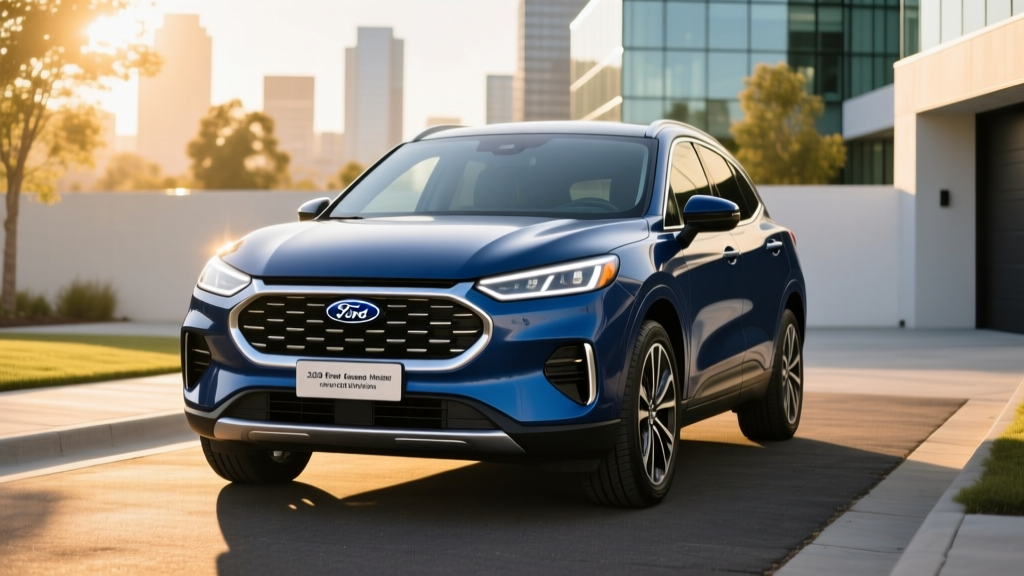
The Ford Escape Hybrid remains one of the most accessible ways to cut fuel costs without committing to a full battery-electric vehicle. For 2026, Ford continues to offer the Escape in both conventional hybrid (HEV) and plug-in hybrid (PHEV) configurations — and lease deals on both versions are drawing attention from budget-conscious SUV shoppers who want electrified efficiency without range anxiety.
This guide breaks down exactly what you're getting with each powertrain, what real-world fuel economy looks like, whether the PHEV qualifies for federal tax incentives, and how to evaluate current Ford Escape Hybrid lease deals before signing.
HEV vs PHEV: Which Ford Escape Hybrid Is Which?
Ford sells two distinct electrified Escape models. Confusing them at the dealership is common — and costly if you lease the wrong one for your driving habits.
| Feature | Escape Hybrid (HEV) | Escape Plug-In Hybrid (PHEV) |
|---|---|---|
| Needs to be plugged in? | No — self-charging via regenerative braking and engine | Yes — plug in to unlock electric-only driving |
| Battery size | ~1.1 kWh (small, assists engine) | 14.4 kWh usable (enables EV-mode driving) |
| Electric-only range | Not applicable | EPA est. 37 miles |
| Total range | EPA est. ~430+ miles | EPA est. ~520 miles (EV + gas combined) |
| DC fast charging | No | No — Level 1 and Level 2 AC only |
| Drivetrain options | FWD or AWD | FWD only |
The HEV operates like a traditional gas car — you fill it up and drive. The electric motor assists the gasoline engine to reduce fuel consumption, particularly in stop-and-go city driving. The PHEV adds a larger battery and more powerful electric motor, letting you complete short commutes entirely on electricity before the gas engine engages.
Fuel Economy: EPA Ratings and Real-World MPG
The headline number for any hybrid lease decision is fuel economy. Here's what the EPA rates each 2026 Escape variant at:
| Model | City MPG | Highway MPG | Combined MPG | PHEV: Combined MPGe |
|---|---|---|---|---|
| Escape Hybrid FWD | 42 | 36 | 39 | — |
| Escape Hybrid AWD | 42 | 36 | 39 | — |
| Escape PHEV (gas mode) | 42 | 36 | 39 | 105 MPGe (EV mode) |
Real-world MPG reality check: Hybrids typically exceed their EPA city rating in moderate-temperature, stop-and-go driving because regenerative braking recaptures more energy. Expect 43–46 MPG city in mild weather. Highway efficiency is where hybrids lose their advantage — sustained 75+ mph driving relies more heavily on the gasoline engine, so plan for 33–35 MPG highway on road trips. Cold weather (below 35°F) can drop combined MPG by 5–10% as the engine runs longer to heat the cabin and battery.
For the PHEV, the 37-mile electric-only range covers the average American's one-way commute. If you charge at home nightly and drive under 35 miles round-trip, you may go weeks without burning gas. Once the battery depletes, the PHEV seamlessly transitions to hybrid mode at the same 39 MPG combined.
Powertrain Specs: What's Under the Hood
| Specification | Escape Hybrid (HEV) | Escape PHEV |
|---|---|---|
| Engine | 2.5L Atkinson-cycle 4-cylinder | 2.5L Atkinson-cycle 4-cylinder |
| Combined system horsepower | 198 hp (FWD) / 210 hp (AWD) | 210 hp |
| Electric motor | Permanent-magnet synchronous (integrated in transaxle) | Larger permanent-magnet synchronous motor |
| Transmission | eCVT (electronic continuously variable) | eCVT |
| 0–60 mph (est.) | ~7.5 sec (AWD) | ~7.8 sec |
| Towing capacity | 1,500 lbs | 1,500 lbs |
The Atkinson-cycle engine sacrifices some peak power for thermal efficiency — it's the same strategy Toyota uses in the RAV4 Hybrid. The eCVT isn't a traditional belt-driven CVT; it uses a planetary gearset to blend engine and motor power, which is mechanically simpler and more durable than a conventional automatic or belt-CVT.
Pricing, Lease Deals, and Tax Credit Eligibility
The 2026 Ford Escape Hybrid starts at approximately $33,000 MSRP for the base FWD ST-Line Hybrid trim, climbing to around $38,500 for the fully equipped Platinum Hybrid AWD. The PHEV commands a premium, starting near $40,500 for the base PHEV trim.
Evaluating Ford Escape Hybrid Lease Deals
Ford typically offers competitive lease rates on the Escape Hybrid through Ford Credit, often with promotional APR subsidies that make leasing more attractive than financing. When evaluating a lease deal, focus on these numbers:
- Capitalized cost (sale price): Negotiate this like a purchase — lease payments are calculated from it.
- Money factor: The lease equivalent of an interest rate. Multiply by 2,400 to get the approximate APR. A competitive money factor in 2026 is around 0.00200 (equivalent to ~4.8% APR).
- Residual value: Typically 55–60% for a 36-month Escape Hybrid lease. Higher residual = lower payments.
- Mileage allowance: Standard is 10,500 or 12,000 miles/year. Excess mileage fees are usually $0.15–$0.25/mile.
Expect monthly lease payments in the $350–$450 range for a well-equipped Hybrid with $3,000–$4,000 due at signing on a 36-month term, depending on trim and regional incentives.
Federal Tax Credit: Who Qualifies?
Important distinction: The federal §30D clean vehicle tax credit applies only to purchased new plug-in vehicles — not leased ones. Under current IRS rules, when you lease a vehicle, the tax credit goes to the lessor (Ford Credit), who may pass the savings on as a reduced lease payment (often called a "lease cash" or "capital cost reduction" incentive). This is not guaranteed — confirm with your dealer.
- PHEV purchase credit: The Escape PHEV may qualify for up to $3,750 under §30D (the $7,500 credit requires meeting both critical-mineral and battery-component sourcing requirements; the Escape PHEV's battery sourcing typically qualifies for the $3,750 critical-minerals portion only — verify current-year eligibility with your dealer).
- HEV (conventional hybrid): Does not qualify for any federal §30D tax credit. It has too small a battery and cannot be plugged in.
- Income caps (2026): AGI must not exceed $150,000 (single), $225,000 (head of household), or $300,000 (joint).
- MSRP cap: SUVs/vans must be under $80,000 MSRP — the Escape clears this easily.
- Point-of-sale transfer: Eligible buyers can transfer the credit to the dealer at purchase, reducing the sale price directly.
Battery Warranty, Reliability, and Replacement Costs
Hybrid battery warranty: Ford covers the Escape Hybrid and PHEV high-voltage battery for 8 years or 100,000 miles (whichever comes first). In states that follow California Air Resources Board (CARB) emissions standards — including CA, NY, MA, WA, and others — the warranty extends to 10 years or 150,000 miles. This covers battery capacity loss below a defined threshold (typically 60–70% of original capacity) and component defects.
Ford's hybrid powertrain has proven durable. The 2.5L Atkinson-cycle engine is under-stressed compared to turbocharged alternatives, and the eCVT has no belts, clutches, or torque converters to wear out. The hybrid battery in the HEV is small (~1.1 kWh) and operates within a narrow state-of-charge window, which significantly reduces degradation. Real-world data from earlier-generation Escape Hybrids (2020–2024) shows minimal battery capacity loss at 100,000+ miles.
Battery Replacement Cost
If the hybrid battery fails outside warranty:
- HEV battery replacement: Approximately $2,500–$4,000 (parts and labor). The small battery pack is relatively affordable.
- PHEV battery replacement: Approximately $6,000–$9,000 (parts and labor). The larger 14.4 kWh pack is significantly more expensive.
For context, most hybrid batteries outlast the vehicle itself. The likelihood of needing a replacement during a typical lease term (3 years) or even a first-ownership cycle (5–7 years) is very low.
Charging the PHEV: Times and Practicalities
The Escape PHEV's 14.4 kWh battery can be charged using standard AC power. It does not support DC fast charging — this is typical for PHEVs in this class.
| Charging Level | Power (kW) | Time to Full (0–100%) | Practical Use |
|---|---|---|---|
| Level 1 (120V household outlet) | ~1.4 kW | ~10–11 hours | Overnight top-up from any standard outlet |
| Level 2 (240V home or public) | ~3.3 kW (vehicle-limited) | ~4–5 hours | Dedicated home charger or workplace charging |
The onboard charger is limited to 3.3 kW, meaning even a 7.2 kW or 11.5 kW Level 2 station will only deliver 3.3 kW to the Escape PHEV. This is adequate for overnight home charging but means mid-day top-ups at public chargers are slower than some competitors.
Practical tip: A standard 120V outlet delivers roughly 4–5 miles of range per hour of charging. For most PHEV owners with a sub-35-mile commute, plugging in overnight on a regular outlet is sufficient — you don't necessarily need to install a Level 2 home charger, which saves $500–$1,500 in installation costs.
Who Should Lease the Escape Hybrid vs. PHEV vs. Full EV?
Choose the Escape Hybrid (HEV) if:
- You don't have access to home or workplace charging
- You want maximum simplicity — no plugs, no charging apps, no behavior change
- You drive a mix of city and highway with no predictable short-commute pattern
- You want AWD availability (PHEV is FWD only)
- Your lease budget is tighter (lower MSRP = lower payments)
Choose the Escape PHEV if:
- You have reliable home charging (even a standard 120V outlet works)
- Your daily round-trip commute is under 35 miles
- You want to minimize gas consumption for local driving while keeping gas-engine range for road trips
- You want the potential benefit of a lease-credit pass-through from the lessor
- You're okay with FWD only
Choose a full EV (like the Ford Mustang Mach-E or Hyundai Ioniq 5) if:
- You have Level 2 home charging and access to DC fast charging for road trips
- You want zero tailpipe emissions and minimal maintenance (no oil changes, no engine)
- Your daily driving is under 250 miles and you can plan charging on longer trips
- You want to maximize federal tax credit eligibility ($7,500 on qualifying EVs)
Pros and Cons of Leasing the 2026 Ford Escape Hybrid
Pros
- Strong city MPG (42 EPA) that often exceeds the sticker in real-world driving
- No charging infrastructure required for the HEV
- AWD available on the HEV — rare for hybrid SUVs in this price range
- Proven, durable powertrain with a simple eCVT design
- Generous 8-year/100,000-mile hybrid battery warranty (10/150k in CARB states)
- PHEV variant offers 37 miles of EV range for gas-free commuting
- Competitive lease pricing through Ford Credit promotional rates
Cons
- Highway MPG (36) is less impressive — highway-heavy commuters see smaller gains
- PHEV is FWD only — no all-wheel-drive option
- PHEV's 3.3 kW onboard charger limits Level 2 charging speed
- Neither variant supports DC fast charging
- Conventional HEV qualifies for no federal tax credit
- PHEV lease credit pass-through depends on the lessor and is not guaranteed
- Acceleration is adequate but not quick (~7.5–7.8 sec 0–60)
Frequently Asked Questions
How many MPG does the Ford Escape Hybrid get?
The 2026 Ford Escape Hybrid is EPA-rated at 42 city / 36 highway / 39 combined MPG for both FWD and AWD configurations. In real-world city driving with moderate temperatures, owners commonly report 43–46 MPG thanks to regenerative braking. Highway-heavy driving at sustained speeds above 70 mph typically yields 33–35 MPG.
How far can the Escape PHEV go on electric only?
The 2026 Ford Escape PHEV has an EPA-estimated 37 miles of electric-only range. This is sufficient for most daily commutes. Once the battery is depleted, the vehicle operates as a conventional hybrid at 39 MPG combined, giving a total range of approximately 520 miles.
Does the Ford Escape Hybrid qualify for a tax credit?
The conventional Escape Hybrid (HEV) does not qualify for any federal tax credit — it lacks a plug and has too small a battery. The Escape PHEV may qualify for up to $3,750 under the federal §30D credit when purchased (not leased), subject to income caps, MSRP caps, and battery-sourcing requirements. On a lease, any credit goes to the lessor and may or may not be reflected in your lease payment.
Is the Ford Escape Hybrid reliable?
The Escape Hybrid's powertrain is mechanically straightforward — a naturally aspirated 2.5L engine paired with an eCVT planetary gearset and electric motor. There are no turbochargers, traditional automatic transmissions, or complex emissions systems to fail. Ford's hybrid battery carries an 8-year/100,000-mile warranty (10 years/150,000 miles in CARB states). Earlier-generation Escape Hybrids have demonstrated strong long-term reliability with minimal battery degradation.
What does a Ford Escape Hybrid battery replacement cost?
Out of warranty, the conventional HEV battery costs approximately $2,500–$4,000 to replace. The PHEV's larger 14.4 kWh battery runs $6,000–$9,000. However, hybrid battery failures during typical ownership (5–10 years) are rare, and the warranty covers defects and significant capacity loss for 8–10 years depending on your state.
Should I lease or buy the Ford Escape Hybrid?
Leasing makes sense if you want lower monthly payments, plan to drive under 12,000 miles/year, and want to upgrade to newer technology in 3 years. Buying makes more sense if you want to capture the PHEV's federal tax credit directly (point-of-sale transfer), plan to keep the vehicle 5+ years, or drive high annual mileage. For the conventional HEV (no tax credit), the lease-vs-buy decision comes down to your cash-flow preference and mileage needs.
Do I need to plug in the Ford Escape Hybrid?
No. The conventional Escape Hybrid (HEV) never needs to be plugged in — it charges its small battery through regenerative braking and the gasoline engine. Only the Escape PHEV benefits from being plugged in, and even the PHEV will operate as a regular hybrid if you never charge it (though you'd miss the 37-mile electric-only range benefit).