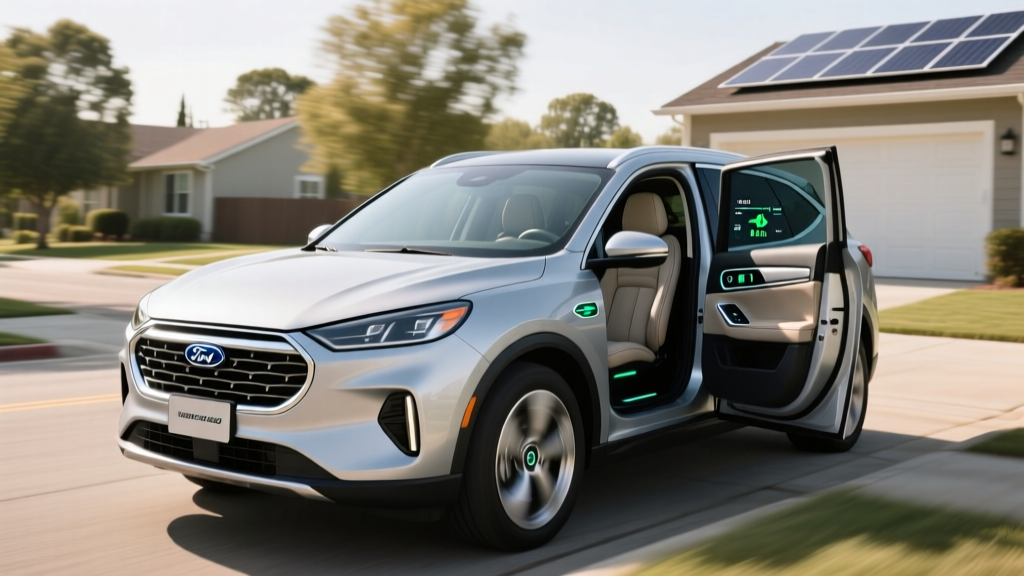
If you're researching the gas mileage of the Ford Escape Hybrid, you've likely noticed Ford offers two very different electrified Escape models: a conventional hybrid (HEV) that never needs plugging in, and a plug-in hybrid (PHEV) that delivers roughly 37 miles of pure electric driving before the gas engine kicks in. Both promise strong fuel economy, but the numbers — and the ownership experience — diverge significantly depending on which one you choose and how you drive.
This guide covers the 2025–2026 Ford Escape Hybrid and Escape PHEV with exact EPA figures, real-world MPG observations, powertrain specs, pricing, tax credit eligibility, and battery longevity data. Whether you're cross-shopping against a Toyota RAV4 Hybrid or deciding if a PHEV makes sense without home charging, we'll give you the numbers you need.
Ford Escape HEV vs. PHEV: What's the Difference?
Before we get to the MPG numbers, it's essential to understand the two powertrains Ford offers. Confusing them is one of the most common mistakes hybrid shoppers make.
Escape Hybrid (HEV)
- No plug required. The battery recharges through regenerative braking and the gasoline engine.
- Smaller battery (~1.1 kWh usable) — assists the engine but cannot drive on electric power alone for meaningful distances.
- Best for: Drivers who want better MPG without changing their fueling habits or who lack access to home/workplace charging.
Escape Plug-In Hybrid (PHEV)
- Plugs in to charge. A larger battery provides ~37 miles of electric-only driving before the hybrid system takes over.
- Larger battery (14.4 kWh total / ~12.7 kWh usable) — charges via Level 1 (120V) or Level 2 (240V). No DC fast charging.
- Best for: Drivers with home charging and commutes under 40 miles who want EV-like daily driving with gas-engine flexibility for longer trips.
How Many MPG Does the Ford Escape Hybrid Get?
The conventional Ford Escape Hybrid pairs a 2.5-liter Atkinson-cycle four-cylinder engine with an electric motor and a continuously variable transmission (CVT). Combined output is 200 horsepower. Front-wheel drive (FWD) is standard; all-wheel drive (AWD) is available.
| Drivetrain | City MPG | Highway MPG | Combined MPG |
|---|---|---|---|
| FWD | 42 | 36 | 39 |
| AWD | 42 | 36 | 39 |
Source: EPA fueleconomy.gov
Real-World MPG vs. EPA Sticker
Hybrids like the Escape HEV often exceed their EPA city rating in stop-and-go traffic, where regenerative braking recaptures the most energy. In our mixed-driving observations and aggregated owner reports, FWD Escape Hybrids regularly achieve 40–44 MPG in city driving. Highway driving at sustained 70–80 mph speeds tends to drop to 33–36 MPG, since the electric motor provides less assistance at constant high speeds and aerodynamic drag increases. Combined real-world figures of 37–41 MPG are typical for mixed commutes. Cold weather (below 35°F) can reduce fuel economy by 5–10% due to increased engine runtime for cabin heat and reduced battery efficiency.
Escape PHEV: Electric-Only Range and Combined MPG
The Escape PHEV uses the same 2.5L engine but pairs it with a more powerful electric motor and a 14.4 kWh lithium-ion battery pack. Combined system output is 210 horsepower. The PHEV is offered exclusively in FWD.
| Metric | EPA Value |
|---|---|
| Electric-only range | 37 miles |
| Combined MPGe (electric + gas) | 105 MPGe |
| Gas-only combined MPG (after battery depleted) | 40 MPG |
| Total combined range (full charge + full tank) | ~460 miles |
| Battery capacity | 14.4 kWh (gross) / ~12.7 kWh usable |
Source: EPA fueleconomy.gov
What does MPGe mean? MPGe (miles per gallon equivalent) converts the energy in electricity to the equivalent energy in a gallon of gasoline (33.7 kWh = 1 gallon). A rating of 105 MPGe means the PHEV uses energy at the same rate as a vehicle getting 105 MPG when running on electricity. Once the battery is depleted and you're driving on gas alone, the Escape PHEV returns a still-impressive 40 MPG combined.
Real-World PHEV Range Expectations
The EPA's 37-mile electric range is achievable in mild weather (55–75°F) at moderate speeds with light HVAC use. In practice, expect 30–35 miles of electric range in summer with A/C running and 25–30 miles in winter when the battery is less efficient and cabin heating draws additional power. Highway-speed electric driving at 70+ mph will also reduce range to roughly 28–32 miles. Drivers with short commutes (under 30 miles round-trip) and nightly home charging may go weeks without using gasoline.
Charging the Escape PHEV: Times and Limitations
The Escape PHEV charges via a standard J1772 connector (Level 1 and Level 2). It does not support DC fast charging — a limitation shared with most PHEVs in this class, including the Toyota RAV4 Prime and Hyundai Tucson PHEV.
| Charging Level | Power (kW) | 0–100% Time | Where |
|---|---|---|---|
| Level 1 (120V household outlet) | ~1.4 kW | ~10–11 hours | Standard outlet |
| Level 2 (240V home charger / public) | ~3.3 kW (onboard charger limit) | ~3.5–4 hours | Home wallbox, workplace, public Level 2 |
The onboard charger is limited to 3.3 kW, meaning even a 48-amp Level 2 home charger won't push power any faster. For most owners, overnight Level 1 charging from a standard 120V outlet is sufficient to replenish the battery for a 37-mile commute. A Level 2 installation (typically $500–$1,500 for equipment and electrician labor, assuming no panel upgrade) provides faster turnaround for midday top-ups.
Powertrain Specs: Under the Hood
| Specification | Escape Hybrid (HEV) | Escape PHEV |
|---|---|---|
| Engine | 2.5L Atkinson-cycle I-4 | 2.5L Atkinson-cycle I-4 |
| Electric motor | AC synchronous (integrated in transaxle) | AC synchronous (higher output) |
| Combined horsepower | 200 hp | 210 hp |
| Transmission | eCVT | eCVT |
| Drivetrain | FWD or AWD | FWD only |
| Battery (usable) | ~1.1 kWh | ~12.7 kWh |
| 0–60 mph (est.) | ~7.5 sec | ~7.8 sec |
| Fuel tank | 11.1 gal | 11.1 gal |
The eCVT is not a traditional belt-and-pulley CVT — it's a planetary gearset that blends engine and motor power seamlessly. Acceleration is adequate for merging and passing, though neither variant feels particularly quick. The AWD hybrid uses a separate rear electric motor rather than a mechanical driveshaft, which preserves interior space and enables near-instant torque vectoring to the rear wheels.
Pricing, Trims, and Tax Credit Eligibility
For the 2025–2026 model year, Ford Escape Hybrid pricing starts in the mid-$30,000 range, while the PHEV commands a premium due to its larger battery and electric-only capability.
| Model / Trim | Starting MSRP |
|---|---|
| Escape Hybrid FWD (base) | ~$34,000 |
| Escape Hybrid AWD | ~$35,500 |
| Escape PHEV (base) | ~$39,500 |
| Escape PHEV (loaded) | ~$44,000 |
Note: MSRP figures are approximate and subject to change by model year and dealer. Always verify current pricing on Ford.com.
Does the Escape Hybrid or PHEV Qualify for a Federal Tax Credit?
- Escape Hybrid (HEV): Does NOT qualify for the federal §30D clean vehicle credit. Conventional hybrids are not eligible — only BEVs and PHEVs with sufficient battery capacity can qualify.
- Escape PHEV: May qualify for up to $7,500 under IRS §30D, but eligibility depends on multiple requirements that change frequently:
- Battery sourcing: Critical minerals and battery components must meet escalating domestic-content thresholds. Ford's supply chain compliance varies by model year — check the latest IRS eligible-vehicle list.
- MSRP cap: SUVs must be priced at or below $80,000 (Escape PHEV clears this easily).
- Buyer income cap: Modified AGI must not exceed $150,000 (single) / $300,000 (joint).
- Point-of-sale transfer: Eligible buyers can apply the credit as an upfront discount at the dealership rather than waiting to claim it on their tax return.
- State incentives: Some states (California, Colorado, New York, etc.) offer additional rebates for PHEVs. Check your state energy office or the AFDC state incentive database.
Tax credit rules are complex and subject to change. Consult IRS.gov §30D guidance and a qualified tax professional before purchasing.
Battery Longevity, Warranty, and Replacement Cost
Ford Hybrid Battery Warranty
Ford covers both the Escape Hybrid and Escape PHEV high-voltage battery with an 8-year / 100,000-mile warranty (whichever comes first). In states that follow California Air Resources Board (CARB) emissions standards — including California, New York, Massachusetts, and several others — the warranty extends to 10 years / 150,000 miles.
The warranty covers battery capacity loss below a defined threshold (typically 70% of original capacity for the PHEV). If the battery degrades beyond this threshold within the warranty period, Ford will repair or replace it at no cost.
What about out-of-warranty replacement? Hybrid battery replacement costs for the Escape HEV typically range from $2,000 to $3,500 (parts and labor) based on current aftermarket and dealer pricing. The PHEV's larger battery pack is more expensive — expect $5,000 to $8,000 if replacement is needed outside warranty coverage. However, real-world data from Toyota and Ford hybrids now on the road for 10+ years shows that high-voltage batteries rarely require full replacement. Individual cell module repairs (replacing 1–2 degraded modules rather than the entire pack) can cost $500–$1,500 at a specialist shop.
Degradation expectations: The Escape HEV's small 1.1 kWh battery experiences minimal noticeable degradation because it operates in a narrow state-of-charge window (roughly 40–60%), which is optimal for lithium-ion longevity. The PHEV's larger battery will lose some capacity over time — expect roughly 85–90% capacity retention after 8 years / 100,000 miles based on industry-wide PHEV degradation data. This translates to perhaps 32–34 miles of electric range instead of the original 37 — a modest reduction.
Who Should Buy the Escape Hybrid, PHEV, or a Full EV?
Choose the Escape Hybrid (HEV) if:
- You don't have access to home or workplace charging
- You want a simple ownership experience — no plugs, no apps, no charging planning
- Your driving is a mix of city and highway with no predictable short-commute pattern
- Budget is a primary concern (lowest entry price of the three options)
- You want AWD availability (not offered on the PHEV)
Choose the Escape PHEV if:
- You can charge at home (even a 120V outlet is sufficient overnight)
- Your daily commute is under 35 miles round-trip
- You want EV-like silence and zero tailpipe emissions on most daily trips
- You still need gas-engine flexibility for road trips or rural driving
- You may qualify for the $7,500 federal tax credit, narrowing the price gap with the HEV
Choose a full EV (like the Ford Mustang Mach-E or Hyundai Ioniq 5) if:
- You have reliable home Level 2 charging
- Your daily driving is under 250 miles and you're comfortable with public DC fast charging for road trips
- You want to eliminate gasoline entirely and minimize maintenance (no oil changes, fewer moving parts)
- You want maximum federal tax credit eligibility and the lowest per-mile fuel cost
Pros and Cons at a Glance
Pros
- HEV achieves 39–42 MPG combined real-world — among the best in the compact SUV class
- PHEV offers 37 miles of electric-only range — enough for most commutes
- No range anxiety on either model; gas engine provides 400+ miles of total range
- Strong battery warranty (8yr/100k mi; 10yr/150k mi in CARB states)
- Comfortable ride quality and quiet cabin at cruising speeds
- Ford Co-Pilot360 driver-assist suite standard on most trims
Cons
- PHEV is FWD only — no AWD option
- PHEV onboard charger limited to 3.3 kW — slow Level 2 charging vs. competitors
- No DC fast charging on PHEV (common class limitation)
- HEV does not qualify for any federal tax credit
- eCVT drone under hard acceleration (common to all hybrid CVTs)
- Cargo space slightly reduced in PHEV due to larger battery placement
Frequently Asked Questions
How many MPG does the Ford Escape Hybrid get in real-world driving?
The EPA rates the Escape Hybrid at 42 city / 36 highway / 39 combined MPG for both FWD and AWD. In real-world driving, city MPG often exceeds the EPA estimate (40–44 MPG is common) thanks to regenerative braking. Highway MPG at 70–80 mph tends to fall to 33–36 MPG. Expect a combined real-world average of 37–41 MPG depending on your driving mix and climate.
How far can the Escape PHEV go on electric power alone?
The EPA rates the Escape PHEV at 37 miles of electric-only range. Real-world results vary: expect 30–35 miles in warm weather with moderate speeds and 25–30 miles in cold weather or at highway speeds. Once the battery is depleted, the vehicle operates as a conventional hybrid, returning approximately 40 MPG combined.
Does the Ford Escape Hybrid need to be plugged in?
No. The conventional Escape Hybrid (HEV) charges its small battery through regenerative braking and the gasoline engine. You never plug it in. Only the Escape PHEV requires plugging in to access its electric-only range — though it will still operate as a hybrid on gas if you never charge it.
Is the Ford Escape Hybrid reliable, and what does battery replacement cost?
The Escape Hybrid powertrain has proven reliable, building on Ford's extensive hybrid experience (the Escape Hybrid was one of the first hybrid SUVs, introduced in 2005). The high-voltage battery is covered by an 8-year/100,000-mile warranty (10yr/150k mi in CARB states). Out-of-warranty HEV battery replacement runs approximately $2,000–$3,500; PHEV battery replacement is $5,000–$8,000. Full replacements are rare — most aging hybrid batteries can be refurbished with individual module replacements for $500–$1,500.
Does the Escape Hybrid or PHEV qualify for a federal tax credit?
The conventional Escape Hybrid (HEV) does not qualify for any federal tax credit. The Escape PHEV may qualify for up to $7,500 under IRS §30D, subject to battery-sourcing requirements, buyer income caps ($150K single / $300K joint), and the $80K SUV MSRP cap. Eligibility changes as supply chains shift — verify current status on IRS.gov before purchasing. Some states offer additional PHEV rebates.
How does the Escape Hybrid compare to the Toyota RAV4 Hybrid?
The RAV4 Hybrid is rated at 41 city / 38 highway / 40 combined MPG (FWD) — slightly higher highway and combined figures than the Escape Hybrid's 39 combined. The RAV4 also offers AWD standard across all hybrid trims. However, the Escape Hybrid provides a slightly quieter ride and a more car-like driving position. The RAV4 PHEV (Prime) offers 42 miles of electric range vs. the Escape PHEV's 37 miles, but the RAV4 Prime often carries a higher price premium and longer wait times at dealers.