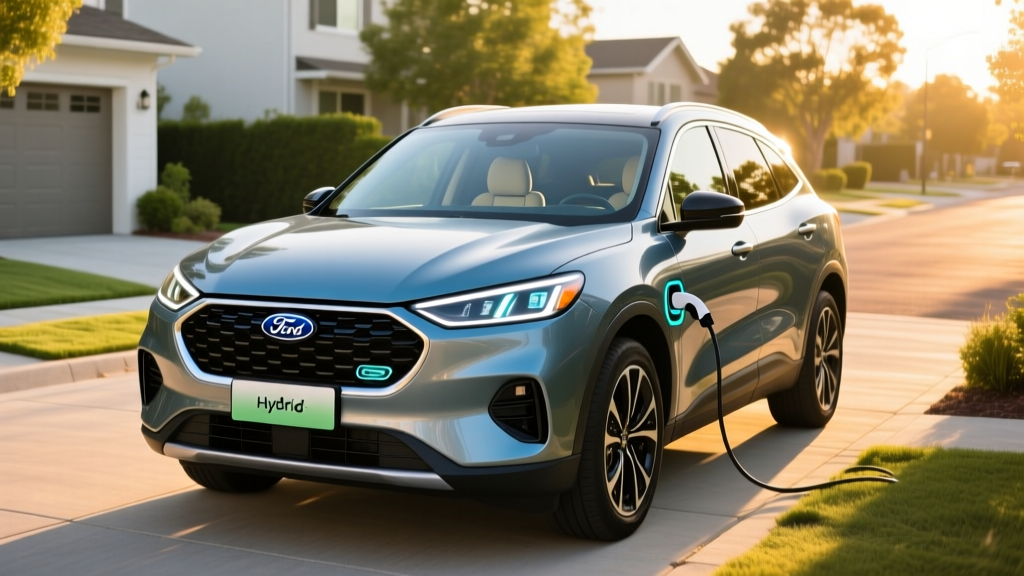
The Ford Escape Hybrid has long been a pragmatic choice for compact-SUV buyers who want better fuel economy without committing to a plug. For 2026, the Escape continues to offer two distinct electrified powertrains: a conventional hybrid (HEV) that requires no plug, and a plug-in hybrid (PHEV) that delivers meaningful electric-only range for daily commuting. If you're researching Ford Escape Hybrid gas mileage, the answer depends heavily on which version you choose — and how you drive it.
Below, we break down the EPA numbers, real-world expectations, powertrain specs, battery warranties, pricing, and tax-credit eligibility for both the Escape HEV and Escape PHEV. Whether you're cross-shopping against the Toyota RAV4 Hybrid, Honda CR-V Hybrid, or a full EV like the Tesla Model Y, this guide gives you the exact data to decide.
Ford Escape Hybrid MPG: EPA Numbers and Real-World Results
The 2026 Ford Escape Hybrid (HEV) comes in front-wheel drive (FWD) and all-wheel drive (AWD) configurations, and the EPA fuel-economy figures differ between them. Here's the official breakdown from fueleconomy.gov:
| Configuration | City MPG | Highway MPG | Combined MPG |
|---|---|---|---|
| FWD Hybrid | 42 | 36 | 39 |
| AWD Hybrid | 38 | 34 | 37 |
Escape PHEV: Electric-Only Range and Combined MPG
The 2026 Ford Escape Plug-In Hybrid (PHEV) is a fundamentally different vehicle for daily use. It pairs a larger battery with the same 2.5-liter Atkinson-cycle four-cylinder engine, giving you the option to drive on pure electricity for most commutes before the hybrid system takes over.
| Metric | Value |
|---|---|
| EPA Electric-Only Range | 37 miles |
| EPA Combined MPGe (EV mode) | 105 MPGe |
| EPA Combined MPG (hybrid mode, battery depleted) | 40 MPG |
| Total Combined Range (EV + gas) | ~430 miles |
| Battery Capacity (usable) | 14.4 kWh (NMC lithium-ion) |
| Level 1 Charge Time (120V, 12A) | ~10–12 hours |
| Level 2 Charge Time (240V, 32A) | ~3.5 hours |
| DC Fast Charging | Not supported |
The 37-mile electric-only range covers the average American's one-way commute. If you can charge at home overnight on a standard 120V outlet or a Level 2 home charger, you may use little to no gasoline on weekdays. On road trips, the Escape PHEV operates as a conventional hybrid once the battery is depleted, returning the EPA-rated 40 MPG combined — slightly better than the HEV FWD thanks to the larger battery buffer assisting the engine.
Important: The Escape PHEV does not support DC fast charging. This is typical for PHEVs with smaller batteries; the charge rate is limited to Level 1 (1.4 kW) and Level 2 (up to 7.7 kW). For PHEV owners, this is rarely an issue — you charge at home or at work, not at highway fast-charging stations.
HEV vs. PHEV: Which Escape Hybrid Is Right for You?
Understanding the difference between a conventional hybrid and a plug-in hybrid is critical before you visit a dealer. Here's a direct comparison:
| Feature | Escape Hybrid (HEV) | Escape Plug-In Hybrid (PHEV) |
|---|---|---|
| Plugging in required? | No — self-charging via regen & engine | Yes — to access EV range & max savings |
| Electric-only driving | Minimal (low-speed assist only) | 37 miles at up to ~85 mph |
| Combined MPG (gas) | 37–39 | 40 (after battery depleted) |
| Battery size | ~1.1 kWh (small buffer) | 14.4 kWh usable |
| Combined horsepower | 210 hp | 210 hp |
| AWD available? | Yes | No (FWD only) |
| Starting MSRP (2026) | ~$33,000 | ~$39,500 |
| Federal tax credit | None | See §30D eligibility below |
Choose the HEV if: You lack access to home or workplace charging, want AWD for snow or rough roads, prefer a lower purchase price, or simply want better fuel economy with zero behavioral change.
Choose the PHEV if: You can charge at home (even a standard 120V outlet works overnight), your daily round-trip commute is under 35 miles, you want to minimize gasoline use without range anxiety on longer trips, and you're comfortable with FWD only.
Powertrain Details: Engine, Motor, and Performance
Both the Escape HEV and PHEV use Ford's fourth-generation 2.5-liter Atkinson-cycle inline-four engine paired with an electric motor integrated into a power-split eCVT transmission. There is no traditional stepped automatic or belt-driven CVT — the eCVT uses planetary gearsets to seamlessly blend engine and motor power.
| Specification | HEV | PHEV |
|---|---|---|
| Engine | 2.5L Atkinson I-4 | 2.5L Atkinson I-4 |
| Engine horsepower | ~163 hp | ~163 hp |
| Electric motor output | ~131 hp | ~131 hp |
| Combined system output | 210 hp | 210 hp |
| Transmission | eCVT (power-split) | eCVT (power-split) |
| 0–60 mph (est.) | ~7.8 sec | ~8.0 sec |
| Drivetrain | FWD or AWD | FWD only |
| Towing capacity | 1,500 lbs | 1,500 lbs |
The 210 combined horsepower puts the Escape Hybrid ahead of the Honda CR-V Hybrid (204 hp) and in the same ballpark as the Toyota RAV4 Hybrid (219 hp). Acceleration is adequate for merging and passing, though the PHEV's added battery weight (roughly 300 lbs more than the HEV) makes it feel slightly less eager off the line. The eCVT operates smoothly without the rubber-band sensation of belt-driven CVTs, and the transition between electric and gasoline power is well-muffled.
Battery Warranty, Reliability, and Replacement Cost
Hybrid battery reliability has proven strong across the industry. Toyota's hybrid systems have demonstrated 200,000+ mile lifespans routinely, and Ford's hybrid powertrains — particularly the eCVT-based system shared with the Fusion Hybrid before it and now the Escape — have shown similar durability. The 2026 Escape's fourth-generation hybrid system benefits from years of iterative refinement.
Battery replacement cost: If the high-voltage battery does fail outside of warranty, expect a replacement cost between $2,500 and $4,500 for the HEV's smaller pack, and $6,000 to $9,000 for the PHEV's larger 14.4 kWh battery (parts and labor). Third-party and refurbished options may reduce these figures. However, out-of-warranty hybrid battery failures remain statistically uncommon for vehicles under 150,000 miles.
For the 12V auxiliary battery (which powers electronics, not propulsion), expect standard replacement costs of $150–$300 every 4–6 years — the same as any conventional vehicle.
Pricing, Trims, and Tax Credit Eligibility
The 2026 Ford Escape Hybrid lineup starts in the low $30,000s for the HEV and approaches $40,000 for the PHEV. Here's a trim-level overview:
| Model / Trim | Approx. MSRP | Drivetrain |
|---|---|---|
| Escape Hybrid FWD (base ST-Line) | $33,000 | FWD |
| Escape Hybrid AWD (ST-Line) | $34,500 | AWD |
| Escape Hybrid Premium AWD | $37,500 | AWD |
| Escape PHEV FWD (base ST-Line) | $39,500 | FWD |
| Escape PHEV Premium FWD | $43,000 | FWD |
Federal tax credit for the Escape PHEV: Under the IRS §30D Clean Vehicle Credit, the Escape PHEV may qualify for a federal tax credit of up to $7,500, but eligibility depends on several conditions that change annually. Key requirements for 2026 include:
- MSRP cap: The vehicle's MSRP must not exceed $80,000 for SUVs (Escape qualifies).
- Buyer income cap: Modified adjusted gross income must not exceed $150,000 (single), $225,000 (head of household), or $300,000 (joint).
- Battery sourcing: Critical minerals and battery components must meet escalating domestic-sourcing thresholds. Ford's supply chain for the Escape PHEV battery may or may not satisfy all 2026 requirements — verify with your dealer and consult the IRS Clean Vehicle Credit page for the latest qualified-vehicle list.
- Point-of-sale transfer: Eligible buyers can transfer the credit to the dealer at purchase, reducing the sale price directly rather than waiting to claim it on their tax return.
The conventional Escape HEV does not qualify for the §30D federal tax credit — it is not a plug-in vehicle. Some states and utilities offer rebates for conventional hybrids, but these vary by jurisdiction. Check your state energy office or utility provider for local programs.
Important: Tax-credit eligibility is complex and subject to change. Always verify current rules on irs.gov and consult a tax professional before basing a purchase decision on incentive assumptions.
Escape Hybrid vs. Full EV vs. Gas: Which Fits Your Life?
The Escape Hybrid exists in a middle ground that serves a specific buyer profile. Here's how it stacks up against a conventional gas-only SUV and a full battery-electric vehicle (BEV):
| Factor | Gas SUV (~28 MPG) | Escape HEV (~39 MPG) | Escape PHEV (EV commute) | Full EV (~3.5 mi/kWh) |
|---|---|---|---|---|
| Annual fuel cost (12,000 mi/yr) | ~$1,500 | ~$1,075 | ~$600–$900 | ~$500–$700 |
| Plug-in required? | No | No | Yes (for max benefit) | Yes |
| Home charger needed? | No | No | Recommended (120V minimum) | Yes (Level 2 ideal) |
| Road-trip convenience | Excellent | Excellent | Excellent | Requires planning |
| Maintenance complexity | Standard | Low (no alternator/starter) | Low | Lowest (no engine) |
The Escape HEV is best for buyers who want to reduce fuel costs by 25–30% compared to a gas-only SUV, need AWD, have no charging access, and want zero change to their fueling habits. It's also a strong choice for apartment dwellers or street parkers who can't install a charger.
The Escape PHEV is best for households with home charging and a predictable commute under 37 miles round-trip. You'll effectively drive an EV most days and a hybrid on weekends and road trips — the best of both worlds, provided you actually plug in. An unplugged PHEV is just a slightly heavier hybrid.
A full EV (like a Tesla Model Y or Hyundai Ioniq 5) is best for drivers with reliable home charging, mostly urban/suburban routines, and willingness to plan around DC fast charging on road trips. A full EV eliminates gasoline entirely and offers the lowest per-mile energy cost, but demands a larger upfront investment and charging infrastructure.
• No home charging + want AWD? → Escape Hybrid HEV AWD
• Home charging + commute < 37 miles? → Escape PHEV (maximize EV mode)
• Home charging + want zero gas + willing to plan road trips? → Full EV
• Long highway commutes, no charging? → Escape Hybrid HEV FWD (best highway MPG of the HEV lineup)
Pros and Cons of the 2026 Ford Escape Hybrid
- 39 MPG combined (FWD HEV) — competitive with RAV4 Hybrid
- PHEV offers 37 miles EV range for gas-free commuting
- No plug-in required for HEV — zero lifestyle change
- AWD available on HEV (rare for hybrid compact SUVs at this price)
- 8 yr / 100k mi battery warranty (10/150k in CARB states)
- Comfortable ride, spacious cargo area (~34 cu ft behind rear seats)
- PHEV may qualify for up to $7,500 federal tax credit
- PHEV is FWD only — no AWD option
- PHEV premium of ~$6,500 over HEV takes years to recoup on fuel savings alone
- Real-world highway MPG falls 2–4 below EPA for HEV
- PHEV does not support DC fast charging
- 210 hp is adequate, not sporty — RAV4 Hybrid is slightly quicker
- PHEV cargo space slightly reduced due to larger battery (~33 cu ft)
- Federal tax credit for PHEV depends on battery-sourcing rules that may change
Frequently Asked Questions
How many MPG does the Ford Escape Hybrid get?
The 2026 Ford Escape Hybrid FWD is EPA-rated at 42 city / 36 highway / 39 combined MPG. The AWD version is rated at 38 city / 34 highway / 37 combined. In real-world city driving, many owners exceed the EPA city figure thanks to regenerative braking. Highway driving typically returns 2–4 MPG below the sticker number.
How far can the Ford Escape PHEV go on electric only?
The 2026 Ford Escape PHEV has an EPA-rated electric-only range of 37 miles. This is sufficient for most daily commutes. Once the battery is depleted, the vehicle operates as a conventional hybrid returning 40 MPG combined. Total combined range (electric + gasoline) is approximately 430 miles.
Does the Ford Escape Hybrid need to be plugged in?
The conventional Escape Hybrid (HEV) does not need to be plugged in — it charges its small battery through regenerative braking and the gasoline engine. The Escape Plug-In Hybrid (PHEV) should be plugged in to take advantage of its 37-mile electric range, but it will still function as a regular hybrid if you never plug it in.
Is the Ford Escape Hybrid reliable, and what does a battery replacement cost?
Ford's hybrid system has demonstrated strong reliability since its introduction in the Fusion Hybrid. The high-voltage battery is warrantied for 8 years / 100,000 miles (10 years / 150,000 miles in CARB states). Out-of-warranty replacement costs range from $2,500–$4,500 for the HEV battery and $6,000–$9,000 for the PHEV battery, though failures before 150,000 miles are uncommon.
Does the Ford Escape Hybrid qualify for a tax credit?
The conventional Escape HEV does not qualify for the federal §30D Clean Vehicle Credit — it is not a plug-in vehicle. The Escape PHEV may qualify for up to $7,500, depending on the buyer's income, the vehicle's MSRP, and current battery-sourcing requirements. Check the IRS qualified-vehicle list and consult a tax professional to confirm eligibility for your situation.
How does the Escape Hybrid compare to the RAV4 Hybrid?
The Toyota RAV4 Hybrid is rated at 41 MPG combined (FWD) and offers standard AWD across all trims at 39 MPG combined. The Escape HEV FWD trails slightly at 39 combined, but the gap is narrow. The RAV4 Hybrid produces 219 hp vs. the Escape's 210 hp. Both carry 8-year/100,000-mile hybrid battery warranties. The Escape's interior materials and infotainment system are competitive, and pricing is comparable. Your choice may come down to dealer availability, styling preference, and whether the Escape PHEV's 37-mile EV range appeals to you — Toyota's RAV4 Prime PHEV offers 42 miles but at a significantly higher starting price (~$45,000).