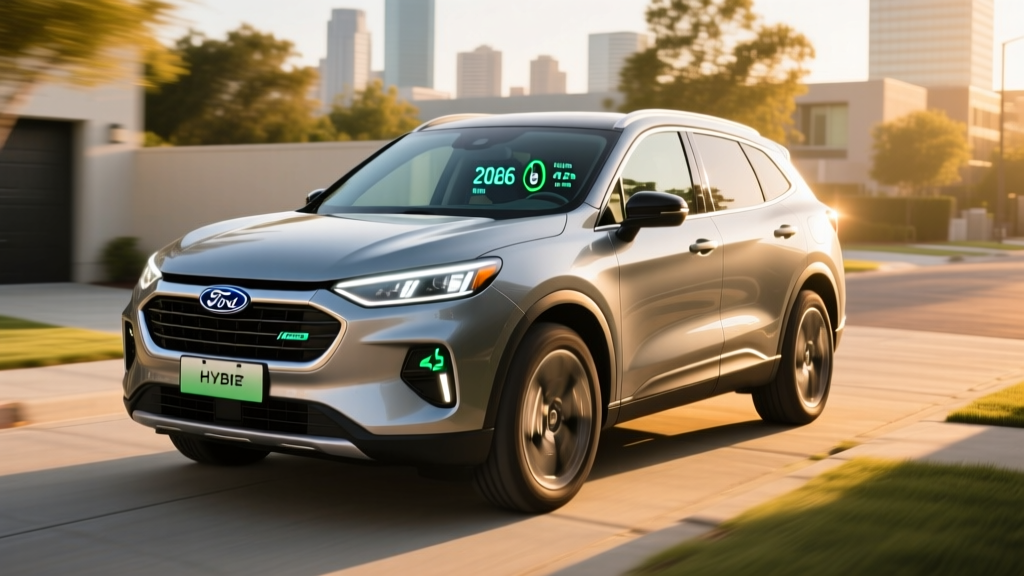
The Ford Escape Hybrid occupies a practical middle ground for compact SUV buyers who want meaningful fuel savings without the range compromises of a full battery-electric vehicle or the charging logistics of a plug-in hybrid. For the 2026 model year, Ford continues the Escape Hybrid as a conventional self-charging hybrid (HEV), while the Escape Plug-In Hybrid (PHEV) serves drivers with reliable home charging access and short commutes. This guide breaks down exactly what the EPA numbers mean, how real-world fuel economy compares, and which version — or whether a full EV — fits your driving pattern.
Ford Escape Hybrid vs Plug-In Hybrid: What's the Difference?
Before examining fuel economy, it's essential to distinguish the two electrified Escape variants Ford offers, because they operate fundamentally differently.
| Attribute | Escape Hybrid (HEV) | Escape Plug-In Hybrid (PHEV) |
|---|---|---|
| Powertrain | 2.5L Atkinson-cycle 4-cyl + electric motor | 2.5L Atkinson-cycle 4-cyl + larger electric motor |
| Combined Horsepower | 192 hp | 210 hp |
| Battery | ~1.1 kWh (self-charging) | 14.4 kWh usable (lithium-ion) |
| Plug-In Required? | No — charges via regen & engine | Yes — plug in to access EV range |
| Electric-Only Range | N/A (EV mode at low speed only, ~1 mi) | 37 miles (EPA) |
| Drivetrain | FWD or AWD | FWD only |
| Starting MSRP | ~$34,995 (ST-Line Hybrid) | ~$40,495 (PHEV) |
The conventional Escape Hybrid never needs to be plugged in. It recovers energy through regenerative braking and uses the gasoline engine to maintain the small battery pack. The PHEV has a substantially larger battery that you charge externally — ideally overnight at home on a Level 2 (240V) charger — and can drive 37 miles on electricity alone before the gasoline engine engages. If you can't charge at home or at work, the PHEV's advantages shrink considerably.
EPA Fuel Economy: Ford Escape Hybrid MPG Breakdown
The headline number for most shoppers: how many miles per gallon does the Escape Hybrid actually deliver? According to EPA data at fueleconomy.gov, the 2026 Ford Escape Hybrid with front-wheel drive returns the following estimates:
| Configuration | City MPG | Highway MPG | Combined MPG |
|---|---|---|---|
| FWD Hybrid | 42 | 36 | 39 |
| AWD Hybrid | 38 | 34 | 36 |
| PHEV (charge-sustaining / gas only) | 40 | 37 | 39 |
| PHEV (with full charge, MPGe) | 105 MPGe combined (electric + gas) | ||
The FWD hybrid's 42 MPG city rating stands out. Hybrid powertrains excel in stop-and-go traffic because regenerative braking recovers kinetic energy that a conventional vehicle wastes as heat, and the electric motor handles low-speed propulsion where gasoline engines are least efficient. Highway MPG drops because aerodynamic drag dominates at speed and there's less braking to recapture energy.
Choosing AWD costs you 3 MPG combined — a trade-off worth considering if you face snow and rain regularly, but expensive if you don't. The PHEV, when its battery is depleted and it operates as a conventional hybrid, achieves nearly identical gas-only MPG to the FWD HEV, which is an important data point: even if you never plug in the PHEV, you're not sacrificing fuel economy compared to the standard hybrid.
Real-World MPG: What Owners Actually Report
EPA estimates are measured under controlled laboratory conditions. Real-world results vary with driving style, terrain, climate, and route composition.
For the Escape Hybrid FWD, owners and independent testers consistently report 38–44 MPG in mixed suburban and city driving, with many exceeding the EPA city estimate. This is a known pattern with Toyota- and Ford-derived hybrid systems: city-heavy routes often produce better-than-EPA results because the test cycle underweights low-speed electric assist. On sustained highway trips at 70–75 mph, expect 33–36 MPG — slightly below the EPA highway number.
Cold weather affects hybrids less dramatically than full EVs, but you will see a dip. In freezing temperatures (below 32°F), the engine runs more frequently to provide cabin heat and warm the catalytic converter, reducing city MPG by roughly 10–15%. Expect 35–38 MPG combined in winter for the FWD hybrid.
The AWD variant's real-world numbers track proportionally lower. Drivers in northern climates who need AWD typically report 33–36 MPG combined year-round.
Suburban/City: 38–44 MPG | Highway (70+ mph): 33–36 MPG | Winter mixed: 35–38 MPG
EPA combined: 39 MPG. Your results will depend heavily on your city-to-highway ratio.
Escape PHEV: Electric-Only Range and Charging
The Escape Plug-In Hybrid's 14.4 kWh usable battery delivers an EPA-rated 37 miles of electric-only range. This covers the average American one-way commute (roughly 16 miles per the Census Bureau) with margin to spare, meaning many PHEV owners burn little or no gasoline on weekdays.
Total combined range — a full battery plus a full 11.1-gallon fuel tank — exceeds 500 miles, eliminating any range-anxiety concern on road trips. Once the battery depletes, the PHEV simply operates as a conventional hybrid at 39 MPG combined.
Charging Times and Capabilities
| Charging Level | Power | 0–100% Time | Notes |
|---|---|---|---|
| Level 1 (120V household outlet) | ~1.4 kW | ~10–11 hours | Works overnight for most commutes |
| Level 2 (240V home/public) | ~3.3 kW (onboard charger limit) | ~3.5–4 hours | Recommended for daily use |
| DC Fast Charge | Not supported | N/A | CCS/NACS DC charging unavailable |
The Escape PHEV's onboard charger maxes out at approximately 3.3 kW, meaning even a 7.2 kW or 11.5 kW Level 2 home station will only deliver 3.3 kW to the vehicle. This is standard for PHEVs in this class — the battery is small enough that fast charging isn't necessary. A full charge on Level 2 takes about 3.5 hours, easily replenished during a workday or overnight. DC fast charging is not available on the Escape PHEV; this is typical for plug-in hybrids, which lack the battery size to justify the added cost and weight of DC hardware.
Powertrain Specs: How the Hybrid System Works
| Specification | HEV | PHEV |
|---|---|---|
| Engine | 2.5L Atkinson-cycle inline-4 | 2.5L Atkinson-cycle inline-4 |
| Engine Output | 163 hp / 155 lb-ft | 163 hp / 155 lb-ft |
| Electric Motor | Permanent-magnet AC synchronous | Permanent-magnet AC synchronous (larger) |
| Combined System Output | 192 hp | 210 hp |
| Transmission | eCVT (power-split device) | eCVT (power-split device) |
| 0–60 mph | ~7.5 sec (est.) | ~7.0 sec (est.) |
| Towing Capacity | 1,500 lbs | 1,500 lbs |
Ford uses a power-split eCVT architecture — mechanically similar to Toyota's Hybrid Synergy Drive — that blends engine and motor output through a planetary gearset. There are no fixed gear ratios and no traditional belt-and-pulley CVT. The result is smooth, stepless acceleration with none of the rubber-band sensation associated with older CVTs. The Atkinson-cycle engine sacrifices some peak power for greater thermal efficiency, which is why the electric motor fills in torque at low RPM where the engine is weakest.
The PHEV's larger motor and battery provide a modest power bump (210 hp combined vs. 192 hp) and noticeably stronger electric-only acceleration. In EV mode, the PHEV can reach highway speeds without engaging the engine — something the conventional hybrid cannot sustain beyond very low speeds.
Pricing, Trims, and Tax Credit Eligibility
For the 2026 model year, Ford positions the Escape Hybrid across several trims, with pricing that reflects its position between the base gas-only Escape and premium competitors:
| Trim | Drivetrain | Approx. MSRP |
|---|---|---|
| ST-Line Hybrid | FWD | $34,995 |
| ST-Line Hybrid | AWD | $36,395 |
| ST-Line Select Hybrid | AWD | $39,595 |
| Premium Hybrid | AWD | $42,095 |
| PHEV (all trims) | FWD only | $40,495 – $44,495 |
Federal Tax Credit Status
Under current IRS §30D rules, the federal clean vehicle credit applies only to plug-in electric vehicles — battery-electric vehicles (BEVs) and plug-in hybrids (PHEVs) that meet battery capacity, critical-mineral sourcing, and MSRP caps. The conventional Escape Hybrid (HEV) does not qualify for any federal tax credit.
The Escape PHEV's eligibility for the up-to-$7,500 federal credit depends on several factors that change periodically:
- MSRP cap: SUVs must be under $80,000 — the Escape PHEV clears this easily.
- Buyer income cap: Modified AGI must not exceed $150,000 (single) or $300,000 (joint).
- Battery sourcing: Critical minerals and battery components must meet phased-in percentages from US or FTA-partner sources. Ford's supply chain compliance varies by model year — verify current-year status on the IRS qualified vehicle list.
- Point-of-sale transfer: As of 2024+, eligible buyers can transfer the credit to the dealer at purchase, reducing the purchase price directly rather than waiting for a tax refund.
Important: Confirm the Escape PHEV's current qualification on the IRS Clean Vehicle list at the time of purchase. Battery-sourcing rules tighten annually, and a vehicle that qualifies in January may lose eligibility if supply chains shift. Consult a tax professional for your specific situation.
Battery Warranty, Reliability, and Replacement Costs
Hybrid battery longevity remains a top concern for buyers, despite two decades of proven reliability in vehicles like the Toyota Prius and Ford Fusion Hybrid.
8 years / 100,000 miles (whichever comes first) — covers the high-voltage hybrid battery against defects and capacity loss below a defined threshold.
In California Air Resources Board (CARB) states, hybrid battery warranty extends to 10 years / 150,000 miles under emissions-component coverage.
Source: Ford Warranty Guide
Ford's hybrid battery packs use proven lithium-ion chemistry managed by conservative thermal controls — the system never charges the pack to 100% or drains it to 0%, preserving long-term health. The small 1.1 kWh HEV battery experiences shallow charge cycles, which dramatically reduces degradation. Real-world data from high-mileage Ford hybrids (fleet taxis, in particular) shows battery packs routinely lasting 150,000–200,000+ miles before significant capacity loss.
If replacement is needed out of warranty, a new OEM hybrid battery for the Escape Hybrid currently costs approximately $2,500–$4,000 including labor. Third-party remanufactured packs are available for $1,500–$2,500. This is substantially less than full-EV battery replacements, which can exceed $10,000–$15,000, because the hybrid pack is far smaller.
The PHEV's 14.4 kWh battery carries the same 8-year/100,000-mile warranty. Replacement cost for the PHEV pack is higher — estimated at $6,000–$9,000 — due to its larger capacity, though failures within the warranty period are rare.
Who Should Choose the Escape Hybrid, PHEV, or a Full EV?
- Choose the Escape Hybrid (HEV) if: You drive 10,000–15,000 miles/year in mixed city/suburban conditions, lack access to home or workplace charging, want maximum simplicity, and prioritize fuel savings over electrification for its own sake. At 39 MPG combined, you'll spend roughly $1,350/year on gas (at $3.50/gal, 12,000 mi/yr) versus ~$1,950 for the gas-only Escape.
- Choose the Escape PHEV if: You can install a Level 2 charger at home, your daily round-trip commute is under 35 miles, you want to drive mostly electric on weekdays but need gas flexibility for weekend road trips, and you may qualify for the federal tax credit. With nightly charging, many PHEV owners use under 200 gallons of gas per year.
- Choose a full EV (e.g., Ford Mustang Mach-E, Hyundai Ioniq 5) if: You have reliable home charging, your daily driving is under 250 miles, you want zero tailpipe emissions, minimal maintenance (no oil changes, no transmission fluid), and access to the full $7,500 federal credit. The trade-off is higher upfront cost and the need to plan longer road trips around DC fast-charging infrastructure.
Escape Hybrid (HEV) — Pros
- 39 MPG combined — top-tier for the compact SUV segment
- No plug-in required — zero lifestyle change from a gas car
- AWD available (PHEV is FWD only)
- Lower starting price than PHEV
- Proven, conservative hybrid system
Escape Hybrid (HEV) — Cons
- No federal tax credit eligibility
- No meaningful electric-only driving
- AWD reduces MPG to 36 combined
- Less power than PHEV variant (192 vs 210 hp)
- Cabin noise under hard acceleration (eCVT drone)
Frequently Asked Questions
How many MPG does the Ford Escape Hybrid get in real-world driving?
The EPA rates the FWD Escape Hybrid at 42 city / 36 highway / 39 combined MPG. In real-world suburban and city driving, owners commonly report 38–44 MPG, often exceeding the EPA city estimate. Sustained highway driving at 75 mph typically yields 33–36 MPG. The AWD variant averages about 3 MPG less across all conditions.
How far can the Escape PHEV drive on electric power alone?
The 2026 Escape PHEV delivers an EPA-rated 37 miles of electric-only range on a full charge. Real-world EV range varies from roughly 30 miles (highway, cold weather, or aggressive driving) to 40+ miles (mild weather, city speeds, gentle acceleration). Once the battery depletes, the gasoline engine engages seamlessly and the vehicle operates as a conventional hybrid at 39 MPG combined.
Does the Ford Escape Hybrid qualify for a federal tax credit?
The conventional Escape Hybrid (HEV) does not qualify for any federal tax credit — §30D credits apply only to plug-in vehicles. The Escape PHEV may qualify for up to $7,500 depending on current-year IRS battery-sourcing rules, buyer income limits ($150K single / $300K joint), and the vehicle's presence on the IRS qualified list at time of purchase. Always verify at irs.gov before buying.
Is the Ford Escape Hybrid reliable, and what does a battery replacement cost?
Ford's hybrid system has a strong reliability track record, particularly in fleet and taxi applications where vehicles exceed 200,000 miles on the original hybrid battery. The high-voltage battery is warrantied for 8 years/100,000 miles (10 years/150,000 miles in CARB states). Out-of-warranty HEV battery replacement runs approximately $2,500–$4,000; the PHEV battery costs $6,000–$9,000. These are estimates — actual costs vary by dealer and region.
Can I charge the regular Escape Hybrid at home?
No. The conventional Escape Hybrid (HEV) has no plug and no charging port. It charges its small battery entirely through regenerative braking and the gasoline engine. Only the Escape PHEV has a charging port and benefits from being plugged in. If you see marketing for the "Escape Hybrid," verify whether it refers to the HEV or PHEV — the distinction matters significantly for fuel cost and daily operation.