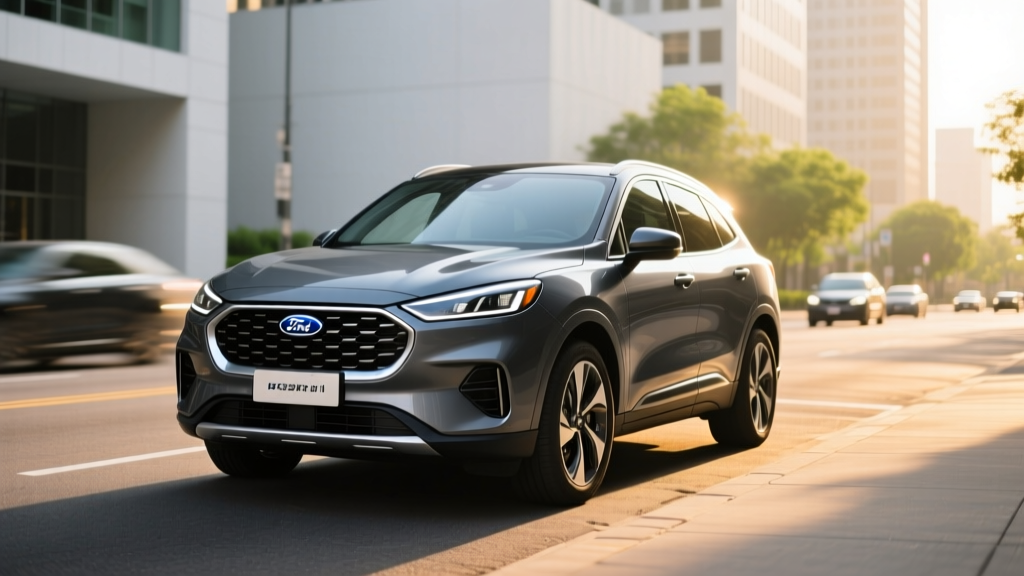
The compact crossover segment is crowded, but the 2025 Ford Escape Hybrid occupies a specific niche: buyers who want electrified efficiency without ever plugging in. Ford's fourth-generation Escape offers both a conventional hybrid (HEV) and a plug-in hybrid (PHEV) variant, and understanding the difference is the single most important decision you'll make before signing a purchase agreement. This guide breaks down the exact EPA numbers, real-world expectations, powertrain specs, and ownership economics for both.
HEV vs PHEV: Which Ford Escape Electrified Model Are You Looking At?
Ford sells two distinct electrified Escape models for 2025. Confusing them at the dealership is easy — and costly if you buy the wrong one for your driving habits.
| Attribute | Escape Hybrid (HEV) | Escape Plug-In Hybrid (PHEV) |
|---|---|---|
| Plug-in Required? | No — self-charging via regenerative braking and engine | Yes — plug in to access electric-only driving |
| Electric-Only Range | Not applicable (motor assists engine only) | EPA-est. 37 miles on battery alone |
| Battery Capacity | ~1.1 kWh (small buffer pack) | 14.4 kWh usable lithium-ion |
| Combined System HP | 210 hp (2.5L Atkinson + electric motor) | 210 hp (2.5L Atkinson + electric motor) |
| Drivetrain | FWD or AWD available | FWD only |
| Best For | No home charging access; long highway commutes | Home charging available; short daily commutes |
The conventional HEV never needs a charging cable. It recovers energy during braking and deceleration to keep a small battery charged, and the electric motor works in tandem with the gasoline engine to reduce fuel consumption. The PHEV, by contrast, has a much larger battery that you charge from a wall outlet or Level 2 station, giving you roughly 37 miles of pure electric driving before the gas engine kicks in as a conventional hybrid.
Fuel Economy: EPA Numbers and Real-World MPG
Fuel economy is the primary reason buyers cross-shop the Escape Hybrid. Here are the official EPA estimates from fueleconomy.gov for the 2025 model year:
| Powertrain | City MPG | Highway MPG | Combined MPG | MPGe (PHEV Electric Mode) |
|---|---|---|---|---|
| Escape Hybrid FWD | 42 | 36 | 39 | N/A |
| Escape Hybrid AWD | 42 | 36 | 39 | N/A |
| Escape PHEV (gas-only mode) | 40 | 37 | 39 | 105 MPGe |
Real-world MPG reality check: Toyota-style planetary-gear hybrids and Ford's power-split hybrid system both tend to exceed EPA city estimates in stop-and-go traffic, where regenerative braking recovers the most energy. Expect 42–46 MPG in urban driving from the HEV. Highway driving is where hybrids lose their advantage — at sustained 70–80 mph speeds, the gasoline engine does nearly all the work, and real-world highway figures often land between 33–36 MPG. Cold weather (below 40°F) reduces MPG by roughly 10–15% due to engine warm-up cycles and reduced battery efficiency.
For the PHEV, the 37 miles of electric-only range means a driver with a 30-mile round-trip commute and home Level 2 charging could go weeks without visiting a gas station. Once the battery depletes, the PHEV operates as a conventional hybrid at the same ~39 MPG combined.
Powertrain Specs: What's Under the Hood
Both the HEV and PHEV variants share Ford's 2.5-liter Atkinson-cycle inline-four engine paired with an electric motor through a power-split eCVT (electronically controlled continuously variable transmission). There is no traditional stepped automatic transmission and no turbocharger.
| Specification | 2025 Escape Hybrid / PHEV |
|---|---|
| Engine | 2.5L Atkinson-cycle i4 |
| Combined System Output | 210 hp |
| Transmission | eCVT (power-split device) |
| 0–60 mph (est.) | ~7.5 seconds (HEV FWD) |
| Drivetrain | FWD (both); AWD (HEV only) |
| HEV Battery | ~1.1 kWh lithium-ion |
| PHEV Battery | 14.4 kWh usable lithium-ion |
| PHEV Level 2 Charge Time | ~3.5 hours (240V, 32A) |
| PHEV Level 1 Charge Time | ~10–11 hours (120V) |
| DC Fast Charging | Not available on either model |
| Towing Capacity (HEV) | 1,500 lbs (with Class II tow package) |
The 210 hp combined output is adequate for merging and passing but not sporty. The eCVT delivers smooth, stepless acceleration without the rubber-band feel that older CVTs had. If towing matters, note the HEV's 1,500-lb limit — this is a light-duty crossover, not a hauler. The PHEV is FWD-only, which may limit its appeal in snow-belt states.
Pricing, Trims, and Tax Credit Eligibility
The 2025 Escape Hybrid starts at an MSRP of approximately $33,000 for the base ST-Line trim with FWD, climbing to roughly $39,000–$42,000 for fully loaded Platinum or PHEV trims. The PHEV variant carries a premium of roughly $4,000–$5,000 over an equivalent HEV trim.
Federal Tax Credit: Does the 2025 Escape Hybrid Qualify?
Under IRS §30D rules for 2025, the Escape PHEV does not currently qualify for the full $7,500 federal tax credit due to battery component and critical mineral sourcing requirements that shifted in 2024–2025. The conventional HEV has never qualified for §30D, which applies only to plug-in vehicles with sufficient battery capacity.
Key §30D eligibility factors for PHEVs:
- Vehicle MSRP must not exceed $80,000 (SUVs/crossovers) — the Escape clears this easily
- Buyer AGI must not exceed $150,000 (single) / $300,000 (joint)
- Battery components must meet North American manufacturing thresholds
- Critical minerals must meet sourcing thresholds from FTA countries
Always verify current eligibility on the IRS Clean Vehicle provisions page or consult a tax professional before relying on credit estimates. Some states offer additional hybrid or PHEV rebates — check your state energy office for local programs.
Battery Longevity, Warranty, and Replacement Costs
Battery anxiety is the top concern for first-time hybrid buyers, and it's worth addressing directly with data rather than reassurance.
| Coverage | Term |
|---|---|
| Hybrid Battery Warranty | 8 years / 100,000 miles (10 yr/150,000 mi in CARB states) |
| Hybrid System Components | 8 years / 100,000 miles |
| Powertrain Warranty | 5 years / 60,000 miles |
| Bumper-to-Bumper | 3 years / 36,000 miles |
Ford's hybrid battery warranty covers defects and capacity loss below a specified threshold (typically 60–70% of original capacity) for 8 years or 100,000 miles. In states that follow California Air Resources Board (CARB) emissions rules — including California, New York, Massachusetts, and others — that warranty extends to 10 years / 150,000 miles.
Real-world degradation data: Ford's power-split hybrid system is mature technology, now in its third generation in the Escape. The HEV's small ~1.1 kWh battery undergoes shallow charge/discharge cycles (the system keeps it between roughly 40–60% state of charge), which is ideal for lithium-ion longevity. Taxi fleets using Ford's hybrid system have logged 200,000+ miles on original batteries. Out-of-warranty replacement for the HEV battery pack typically runs $2,500–$4,000 including labor; the PHEV's larger 14.4 kWh pack would cost significantly more, estimated at $6,000–$9,000. However, widespread failures before 150,000 miles remain uncommon based on NHTSA complaint data and owner forums.
Reliability and Safety Ratings
The 2025 Escape Hybrid carries over the fourth-generation platform that debuted for the 2020 model year. NHTSA has historically rated the Escape at 5 stars overall, though model-year-specific updates should be verified on NHTSA's database. The IIHS has tested the Escape in prior years with Good ratings in most crashworthiness categories.
On the reliability front, Ford's hybrid powertrain is one of the more proven systems on the market — the eCVT power-split device has no clutch packs or bands to wear out, and the Atkinson-cycle engine runs under less thermal stress than a turbocharged alternative. Common trouble spots reported by owners tend to involve infotainment software (SYNC 4 glitches) and 12V auxiliary battery drain, not the hybrid traction system itself.
Who Should Choose the Escape Hybrid, PHEV, or a Full EV?
Choose the Escape Hybrid (HEV) if:
- You have no access to home or workplace charging
- Your commute is mostly highway driving where PHEV electric range provides minimal benefit
- You want lower fuel costs without changing any habits
- You need AWD for snow or rough roads
Choose the Escape PHEV if:
- You can install a Level 2 charger at home (240V outlet or hardwired station)
- Your daily round-trip commute is under 37 miles
- You want to drive on electricity most days but need gas flexibility for road trips
- You don't need AWD
Choose a full EV (like the Ford Mustang Mach-E or Hyundai Ioniq 5) if:
- You have reliable home Level 2 charging
- You want zero tailpipe emissions and minimal maintenance
- You qualify for the full $7,500 federal tax credit on eligible EVs
- Your typical trips fit within a 250–300 mile range envelope, or you're comfortable with DC fast charging on road trips
The Escape HEV's strongest competitive advantage is its simplicity. There's no plug, no range estimation, no charging-app frustration. You fill up at any gas station and get 39 MPG combined — roughly 35% better fuel economy than the gas-only Escape's ~28 MPG combined. Over 15,000 miles per year at $3.50/gallon, that's approximately $550–$650 in annual fuel savings versus the gas model, meaning the hybrid premium pays for itself in roughly 5–7 years at current fuel prices.
Pros and Cons at a Glance
Pros
- 39 MPG combined — excellent for a compact crossover
- No plug-in required (HEV); zero behavior change from a gas car
- AWD available on HEV trims
- Mature, proven hybrid powertrain with strong warranty
- Competitive cargo space: ~34.4 cu ft behind rear seats
Cons
- PHEV is FWD only — no AWD option
- PHEV does not currently qualify for full $7,500 federal tax credit
- eCVT drone under hard acceleration; not a sporty drive
- 1,500-lb tow rating limits utility
- SYNC 4 infotainment can be sluggish
Frequently Asked Questions
How many MPG does the 2025 Ford Escape Hybrid get?
The EPA rates the 2025 Ford Escape Hybrid at 42 MPG city, 36 MPG highway, and 39 MPG combined for both FWD and AWD trims. In real-world city driving with frequent stops, many owners report exceeding the EPA city figure, reaching 43–46 MPG. Highway cruising at 75+ mph typically yields 33–36 MPG.
How far can the Escape PHEV go on electric only?
The EPA estimates 37 miles of electric-only range for the 2025 Escape PHEV on a full charge. Real-world range varies: expect 33–37 miles in mild weather, dropping to 28–32 miles in cold weather (below 35°F) due to cabin heating demand and reduced battery efficiency. Total combined range (electric + gas) exceeds 400 miles.
Does the Ford Escape Hybrid need to be plugged in?
No. The conventional Escape Hybrid (HEV) charges its small battery entirely through regenerative braking and the gasoline engine. You never plug it in. Only the Escape PHEV variant requires plugging in to access its 37 miles of electric-only range.
Is the Ford Escape Hybrid reliable, and what does battery replacement cost?
Ford's hybrid powertrain is well-proven, now in its third generation. The hybrid battery is warrantied for 8 years/100,000 miles (10 years/150,000 miles in CARB states). Out-of-warranty HEV battery replacement typically costs $2,500–$4,000. Widespread battery failures before 150,000 miles are uncommon based on available owner data and NHTSA records.
Does the 2025 Escape Hybrid or PHEV qualify for a federal tax credit?
The conventional Escape Hybrid (HEV) does not qualify for the federal §30D tax credit, which applies only to plug-in vehicles. The Escape PHEV's eligibility for the up-to-$7,500 credit is limited by battery component and critical mineral sourcing rules that tightened in 2024–2025. Verify current eligibility at IRS.gov or with a tax professional before purchasing.
Can the Escape PHEV DC fast charge?
No. The 2025 Escape PHEV supports Level 1 (120V, ~10–11 hours for a full charge) and Level 2 (240V, ~3.5 hours) AC charging only. There is no DC fast charging capability. This is typical for PHEVs, whose smaller batteries don't justify the cost and weight of DC fast-charge hardware.