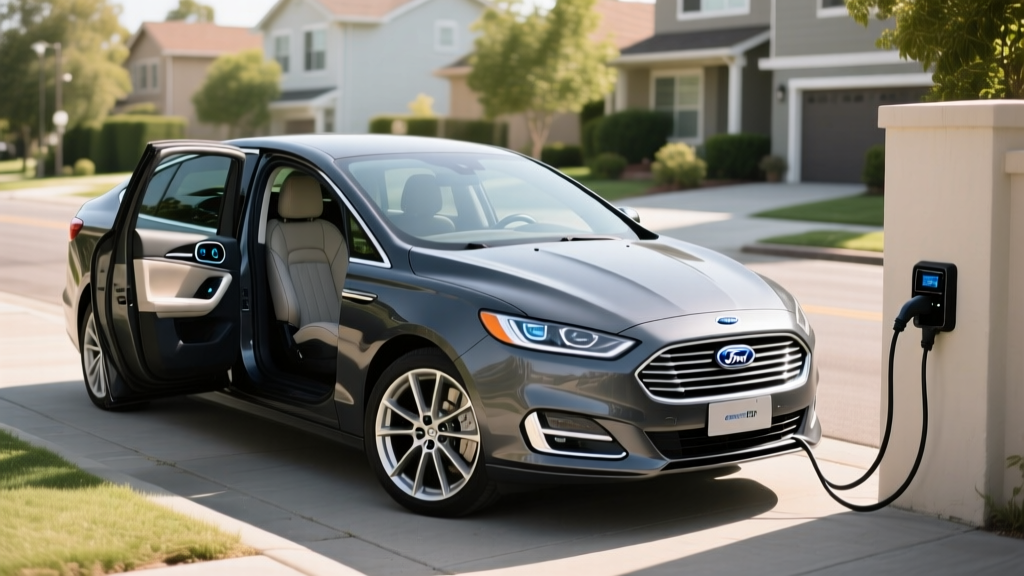
The Ford C-Max SEL Hybrid occupies a specific niche in the electrified-vehicle landscape: a compact hybrid hatchback that delivers strong fuel economy without requiring a plug, a charging routine, or any lifestyle change. While Ford discontinued the C-Max Hybrid after the 2018 model year in the United States, the SEL trim remains a popular target on the used market for buyers who want hybrid efficiency at a fraction of a new vehicle's price. This guide covers everything a prospective buyer needs to know — from real-world MPG and powertrain specs to battery longevity and whether this HEV still makes sense in 2026.
Ford C-Max SEL Hybrid at a Glance
| Specification | Value |
|---|---|
| Powertrain Type | Conventional Hybrid (HEV) — no plug required |
| Engine | 2.0L Atkinson-cycle inline-4 |
| Electric Motor | Permanent-magnet AC synchronous |
| Combined Horsepower | 188 hp (net system) |
| Transmission | electronically-controlled CVT (eCVT) |
| Hybrid Battery | 1.4 kWh lithium-ion (usable ~1.0 kWh) |
| EPA City MPG | 42 MPG |
| EPA Highway MPG | 38 MPG |
| EPA Combined MPG | 40 MPG |
| Fuel Tank Capacity | 14.0 gallons |
| Total Driving Range | ~560 miles |
| 0–60 mph | ~8.1 seconds (tested) |
| Cargo Volume (rear seats up / down) | 24.5 / 52.6 cu ft |
| Drivetrain | Front-wheel drive |
| Battery Warranty (original) | 8 years / 100,000 miles |
The SEL was the higher of two trims (SE and SEL) and added features like leather-trimmed seats, a 10-way power driver's seat, ambient lighting, and an upgraded infotainment system with Ford's SYNC 3 platform. Because Ford exited this segment in the U.S. after 2018, every C-Max Hybrid on the market today is a used vehicle, which changes the purchase calculus considerably.
Fuel Economy: EPA Sticker vs. Real-World MPG
The C-Max Hybrid's EPA ratings have a complicated history. When the car launched for the 2013 model year, Ford initially advertised 47 MPG combined — a figure that drew scrutiny and a class-action lawsuit after owners and independent testers consistently recorded lower numbers. Ford subsequently revised the EPA ratings downward. For the 2017–2018 model years, the official EPA figures settled at 42 city / 38 highway / 40 combined, per fueleconomy.gov.
Based on aggregated owner data from Fuelly and independent testing, most C-Max Hybrid owners report 38–43 MPG combined in mixed driving. City-heavy commutes often push figures toward 44–46 MPG because regenerative braking recovers more energy at lower speeds. Sustained highway driving at 75+ mph can drop efficiency to 35–37 MPG. Cold-weather operation (below freezing) typically reduces MPG by 5–10% due to increased engine idling for cabin heat and reduced battery efficiency.
This is a common pattern for conventional hybrids: city MPG exceeds highway MPG, the opposite of a gas-only car. The Atkinson-cycle engine sacrifices peak power for thermal efficiency, and the electric motor handles low-speed acceleration where internal combustion engines are least efficient.
How Many MPG Does the Ford C-Max SEL Hybrid Get?
Officially, 40 MPG combined. In practice, expect 38–43 MPG depending on your driving mix, tire condition, and climate. Drivers with predominantly urban stop-and-go commutes regularly exceed the EPA combined figure, while those with long highway runs at high speeds will fall slightly below it.
HEV vs. PHEV vs. Full EV: Where Does the C-Max Fit?
The C-Max was sold in two electrified variants during its U.S. run: the C-Max Hybrid (HEV) and the C-Max Energi (PHEV). Understanding the difference is essential before shopping the used market, because the two vehicles have very different ownership profiles.
| Attribute | C-Max Hybrid (HEV) | C-Max Energi (PHEV) |
|---|---|---|
| Plug-in Charging | No — self-charging via engine & regen | Yes — plug in to charge battery |
| Electric-Only Range | ~1 mile at very low speed | ~20 miles (EPA, 2017–2018) |
| Total Range | ~560 miles | ~550 miles (electric + gas) |
| Hybrid Battery | 1.4 kWh lithium-ion | 7.6 kWh lithium-ion |
| EPA Combined MPG (gas mode) | 40 MPG | 42 MPG (charge-sustaining) |
| MPGe (electric mode) | N/A | 97 MPGe |
| DC Fast Charging | No | No — Level 1/Level 2 only |
| Level 2 Charge Time (0–100%) | N/A | ~2.5 hours at 240V |
| Cargo Volume | 24.5 cu ft | 19.2 cu ft (battery encroaches) |
| Federal Tax Credit (original) | None | ~$4,007 (expired for new purchases) |
The C-Max Hybrid (HEV) is the simpler choice: you never plug it in, the battery charges through regenerative braking and the gasoline engine, and you simply drive it like any other car while enjoying better fuel economy. The C-Max Energi (PHEV) offers a 20-mile electric-only commute window but sacrifices cargo space to accommodate its larger battery and requires access to a Level 1 or Level 2 outlet to realize its efficiency advantage.
- Choose the C-Max Hybrid (HEV) if: You want hybrid fuel economy with zero plug-in routine, you lack home charging access, or you want maximum cargo space.
- Choose the C-Max Energi (PHEV) if: Your daily commute is under 20 miles round-trip, you have a garage or outlet for Level 1/2 charging, and you can accept less cargo room.
- Choose a full EV (BEV) instead if: You have reliable home Level 2 charging, your daily driving is under 250 miles, and you want zero tailpipe emissions with minimal maintenance.
Powertrain Deep Dive: 188 HP Hybrid System
The C-Max Hybrid pairs a 2.0-liter Atkinson-cycle four-cylinder engine (producing 141 hp on its own) with a 118-hp permanent-magnet electric motor integrated into the eCVT transaxle. Ford's power-split device allows the engine and motor to work in concert or independently, yielding a net system output of 188 horsepower.
This is a Toyota-style power-split hybrid architecture — Ford licensed the planetary gearset design and developed its own control software. The result is smooth, seamless power delivery with no traditional gear shifts. The eCVT is not a belt-and-cone CVT like those in some Nissan or Subaru models; it uses planetary gears with no friction elements, which contributes to long-term durability.
The 1.4 kWh lithium-ion battery pack is relatively small by modern standards, but that's by design. A conventional hybrid doesn't need a large battery — it only needs enough capacity to buffer energy from regenerative braking, assist during acceleration, and enable brief electric-only operation at low speeds. The smaller pack also keeps weight down (the C-Max Hybrid weighs approximately 3,600 lbs) and preserves cargo space.
Battery Longevity, Warranty, and Replacement Cost
Original warranty: 8 years / 100,000 miles (10 years / 150,000 miles in California Air Resources Board states). This warranty applies from the vehicle's original in-service date and transfers to subsequent owners.
Expected lifespan: Ford's hybrid battery packs in the C-Max platform have demonstrated strong longevity. Many owners report 150,000–200,000+ miles on the original pack with minimal capacity loss. The small battery in an HEV undergoes shallow charge/discharge cycles (typically operating between 40–80% state of charge), which significantly extends cycle life compared to a full EV or PHEV battery.
Replacement cost (if needed): A refurbished or new replacement hybrid battery for the C-Max Hybrid typically runs $2,000–$4,000 including labor at an independent hybrid specialist, or $4,000–$6,000 at a Ford dealership. Given the vehicle's age, most 2013–2018 examples are now outside the original 8-year/100,000-mile warranty window unless the car was sold very late or has unusually low mileage.
Is the Ford C-Max Hybrid Reliable?
The C-Max Hybrid's powertrain has proven generally reliable. The eCVT transmission, being gear-based rather than belt-driven, avoids the failure modes associated with conventional CVTs. The hybrid battery management system is conservative, keeping the pack in a narrow state-of-charge window that minimizes degradation. Consumer Reports historically rated the C-Max Hybrid's powertrain reliability as average to above-average for its class.
Common issues reported by owners include:
- 12V auxiliary battery failures — a standard maintenance item, not unique to hybrids
- Door latch recalls — Ford issued recalls for door latch assemblies on 2013–2016 models; verify recall completion before purchase
- Infotainment glitches — early SYNC systems were problematic; the SYNC 3 system (2016+) is significantly more stable
- Brake actuator concerns — regenerative braking systems use an electric brake booster that can develop faults at high mileage; replacement runs $800–$1,500
Before purchasing any used C-Max Hybrid, check the NHTSA recall database at nhtsa.gov/recalls using the VIN to confirm all recall repairs have been performed.
Used Market Pricing and Tax Credit Eligibility
Because the C-Max Hybrid was discontinued after 2018, there is no new-vehicle MSRP to reference. Used-market pricing in early 2026 varies by model year, mileage, condition, and region:
| Model Year | Typical Mileage | Price Range |
|---|---|---|
| 2013–2014 | 100,000–140,000 mi | $6,500–$9,000 |
| 2015–2016 | 80,000–120,000 mi | $8,500–$12,000 |
| 2017–2018 | 50,000–90,000 mi | $11,000–$16,000 |
Does the Ford C-Max Hybrid Qualify for a Tax Credit?
For new purchases: The C-Max Hybrid never qualified for the federal §30D plug-in EV tax credit because it is a conventional hybrid — it has no plug and cannot operate on grid electricity. This credit is reserved for plug-in vehicles (PHEVs and BEVs) meeting battery capacity and sourcing requirements per IRS guidelines.
Used vehicle credit (§25E): The Inflation Reduction Act introduced a used clean-vehicle credit of up to $4,000 (30% of sale price, capped at $4,000) for qualifying used plug-in vehicles. However, this credit applies only to used PHEVs and BEVs — the C-Max Hybrid (HEV) does not qualify because it is not a plug-in vehicle. The C-Max Energi (PHEV) may qualify for the used credit if all §25E requirements are met, including buyer income caps (AGI ≤ $75,000 single / $150,000 joint), a sale price of $25,000 or less, and purchase from a licensed dealer.
State incentives: A small number of states offer rebates or tax incentives for conventional hybrids, but these are uncommon and vary by jurisdiction. Check your state's energy office or department of revenue for current programs.
Ownership Costs: 5-Year Projection
| Category | Estimated Cost |
|---|---|
| Purchase Price (2017 SEL, ~70k mi) | $13,000 |
| Fuel (40 MPG, $3.40/gal avg, 75,000 mi) | $6,375 |
| Insurance (avg $1,400/yr) | $7,000 |
| Maintenance & Repairs (est.) | $3,500–$5,000 |
| Depreciation (est. resale in 5 yr) | –$5,000 (net loss ~$8,000) |
| Total Estimated 5-Year Cost | ~$21,875–$23,375 |
Compared to a similarly aged gas-only compact car averaging 28 MPG combined, the C-Max Hybrid saves approximately $1,800–$2,200 in fuel costs over five years at 15,000 miles per year. That savings partially offsets the slightly higher used-vehicle price that hybrids command on the secondary market.
Maintenance costs for the C-Max Hybrid are generally lower than a conventional gas car because regenerative braking reduces brake pad wear (many owners report 80,000+ miles on original pads), there's no traditional automatic transmission to service, and the engine operates less frequently in city driving. Oil changes are still required at standard intervals.
Pros and Cons of the C-Max Hybrid SEL
Pros
- 40 MPG combined with no plug-in requirement
- Spacious hatchback cargo area (24.5 cu ft)
- Smooth eCVT powertrain with proven reliability
- 188 hp provides confident merging and passing
- Low brake wear from regenerative braking
- Affordable used-market entry into hybrid ownership
- SYNC 3 infotainment (2016+) is responsive and supports Apple CarPlay/Android Auto
Cons
- Discontinued — no new models available, aging design
- Highway MPG falls below EPA in real-world testing
- Ride quality is firm; road noise is noticeable at highway speeds
- Many examples now outside original battery warranty window
- No eligibility for federal EV/hybrid tax credits
- Interior materials and styling feel dated vs. current models
- Limited dealer support as Ford shifts focus to new EVs
Who Should Buy the Ford C-Max SEL Hybrid in 2026?
The C-Max Hybrid SEL makes sense for a specific buyer profile:
- Budget-conscious commuters who want hybrid efficiency without paying new-car prices. A well-maintained 2017–2018 SEL at $12,000–$15,000 delivers 40+ MPG for a fraction of a new Toyota Prius or Hyundai Ioniq Hybrid.
- Apartment dwellers or renters who cannot install a home charger. The HEV architecture requires zero infrastructure — just fill up with gas and drive.
- Second-car buyers who need a practical hatchback for errands and commuting with low operating costs.
- Buyers skeptical of plug-in complexity who want proven hybrid technology without charging logistics or battery-range planning.
It is not the right choice if you want cutting-edge driver-assistance features, the latest infotainment tech, or eligibility for federal tax incentives — all of which are available in newer hybrid and PHEV models at higher price points.
Frequently Asked Questions
How many MPG does the Ford C-Max SEL Hybrid get?
The EPA rates the 2017–2018 C-Max Hybrid at 42 city / 38 highway / 40 combined MPG. Real-world owner data clusters around 38–43 MPG combined, with city-heavy driving often exceeding the EPA figure and sustained high-speed highway driving falling slightly below it.
Does the C-Max Hybrid need to be plugged in?
No. The C-Max Hybrid is a conventional hybrid (HEV). Its small battery charges through regenerative braking and the gasoline engine. You never plug it in. Only the C-Max Energi (the PHEV variant) requires plug-in charging.
How far can the C-Max Energi PHEV go on electric only?
The 2017–2018 C-Max Energi has an EPA-rated electric-only range of approximately 20 miles on a full charge. After the battery is depleted, it operates as a conventional hybrid at 42 MPG combined. Total combined range is roughly 550 miles.
What is the hybrid battery replacement cost?
If the C-Max Hybrid's lithium-ion battery pack fails outside of warranty, replacement costs typically range from $2,000 to $4,000 at an independent hybrid specialist or $4,000 to $6,000 at a Ford dealership. However, many packs last 150,000–200,000+ miles due to the conservative charge management in the HEV system.
Is the C-Max Hybrid reliable?
The powertrain — the 2.0L Atkinson-cycle engine, electric motor, and eCVT — has demonstrated good long-term reliability. The planetary-gear eCVT avoids the wear issues of belt-driven CVTs. Common non-powertrain issues include door latch recalls (2013–2016 models), early SYNC infotainment bugs, and brake actuator replacements at high mileage. Always verify recall completion via the VIN at nhtsa.gov.
Does the C-Max Hybrid qualify for any tax credit?
No. The C-Max Hybrid is a conventional HEV and does not qualify for the federal §30D new clean-vehicle credit or the §25E used clean-vehicle credit, both of which are limited to plug-in vehicles (PHEVs and BEVs). A few states may offer hybrid-specific incentives, but these are uncommon — check your state's energy office for details.
How does the C-Max Hybrid compare to a Toyota Prius?
The Prius (2016–2018 generation) delivers higher EPA ratings — up to 54 MPG combined for the Prius Eco — and benefits from Toyota's extensive hybrid reliability track record and stronger resale value. The C-Max counters with more horsepower (188 hp vs. 121 hp), a more spacious cargo area, and a more car-like driving feel. On the used market, comparable Prius models often command a $2,000–$4,000 premium over the C-Max Hybrid.