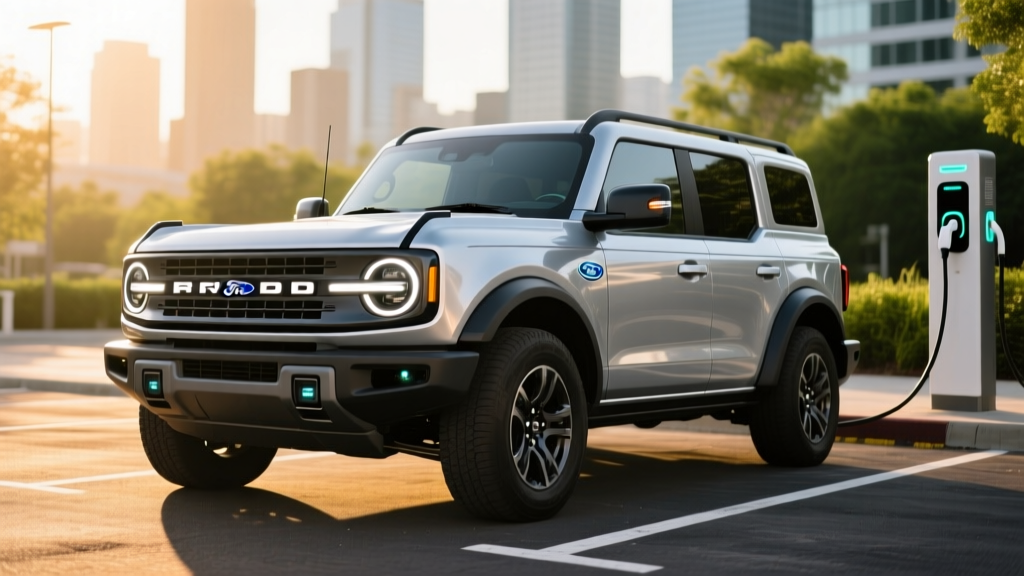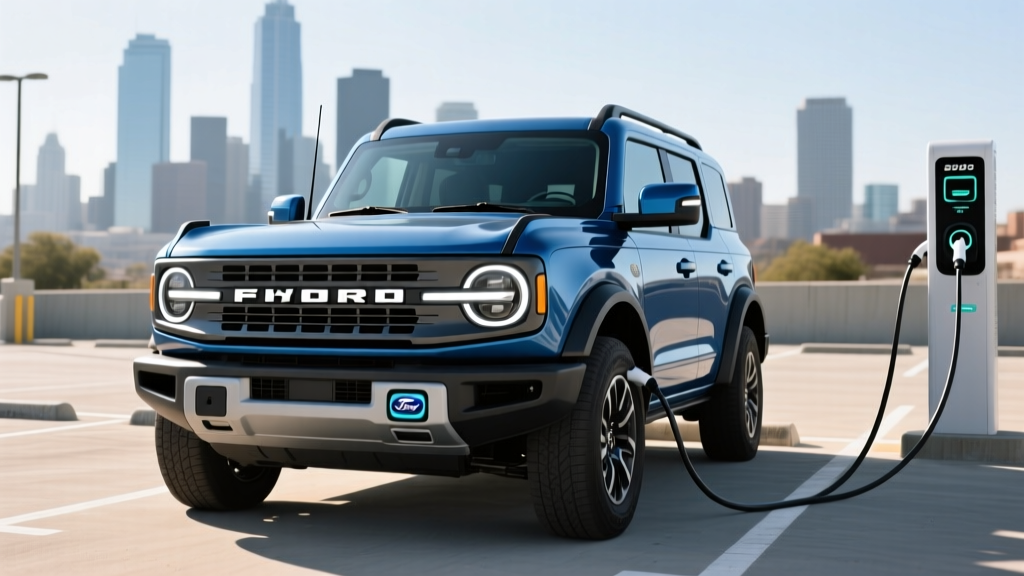
The Ford Bronco has been one of the most requested vehicles for hybrid electrification since its 2021 revival, and the 2026 Ford Bronco Hybrid finally brings a gas-electric powertrain to the iconic off-roader. Whether you're eyeing the conventional hybrid (HEV) variant or hoping for a plug-in hybrid (PHEV) with electric-only commuting range, here's everything confirmed and projected about the Bronco's electrified lineup for the 2026 model year.
HEV vs PHEV: Which Bronco Hybrid Are We Talking About?
Before diving into specs, it's essential to distinguish between the two hybrid architectures Ford could deploy — because they serve very different buyers.
| Feature | Conventional Hybrid (HEV) | Plug-In Hybrid (PHEV) |
|---|---|---|
| Needs to plug in? | No — charges via regenerative braking and engine | Yes — plug in for electric-only range |
| Battery size (est.) | ~1.5–2.0 kWh (small buffer) | ~15–20 kWh usable |
| Electric-only range | None (motor assists engine only) | ~25–35 miles (estimated) |
| Federal tax credit | Not eligible | Potentially up to $3,750–$7,500 (§30D) |
| Best for | No home charging; wants better MPG without behavior change | Home charging access; short commutes on electric |
Ford's initial announcements point to a conventional hybrid (HEV) Bronco using a turbocharged engine paired with an electric motor integrated into the transmission — similar in concept to the F-150 PowerBoost architecture but tuned for the Bronco's smaller platform. A PHEV variant remains possible for later in the generation but has not been officially confirmed for the 2026 model year.
Powertrain and Performance Specs
The leading candidate for the 2026 Bronco Hybrid powertrain is Ford's 2.3-liter EcoBoost four-cylinder engine paired with an electric motor integrated into the modular hybrid transmission. This setup mirrors the approach Ford used successfully in the Maverick Hybrid and the Explorer Hybrid.
| Specification | Value (Estimated) |
|---|---|
| Engine | 2.3L EcoBoost I4 turbo + electric motor |
| Combined horsepower | ~330 hp (combined system output) |
| Combined torque | ~380 lb-ft |
| Transmission | Hybrid-dedicated modular 10-speed / e-CVT |
| Drivetrain | 4WD standard (hybrid-specific transfer case) |
| 0-60 mph | ~6.5 seconds (est.) |
| Towing capacity | ~3,500 lbs (est.) |
| Battery type | Lithium-ion (NMC chemistry, ~1.5–2.0 kWh) |
The electric motor provides low-end torque fill, which is particularly useful off-road where precise throttle control matters. Expect the hybrid system to enable low-speed electric crawling in certain G.O.A.T. modes — a feature Ford has already demonstrated in the F-150 PowerBoost.
Fuel Economy: EPA MPG and Real-World Expectations
This is where the Bronco Hybrid needs to deliver. The current gas-only 2025 Bronco with the 2.3L EcoBoost and 4WD rates at 20 city / 21 highway / 20 combined MPG per fueleconomy.gov. That's thirsty for a daily driver.
| Powertrain | City | Highway | Combined |
|---|---|---|---|
| 2025 Bronco 2.3L Gas 4WD (EPA) | 20 | 21 | 20 |
| 2026 Bronco Hybrid (est.) | 24–27 | 23–25 | 24–26 |
For context, the Toyota 4Runner Hybrid (introduced for 2025) achieves an EPA-estimated 24 combined MPG with a similar body-on-frame architecture. The Ford Explorer Hybrid AWD rates at 23 combined. The Bronco Hybrid should land in this neighborhood, with a slight city advantage from its regenerative braking system.
Pricing, Trims, and Tax Credit Eligibility
Ford has not released official MSRP for the 2026 Bronco Hybrid, but we can project based on the current trim structure and the hybrid premium Ford charges on other models (typically $1,500–$2,500 over the equivalent gas trim).
| Trim | Est. MSRP | Hybrid Availability |
|---|---|---|
| Big Bend | ~$41,000 | Expected |
| Black Diamond | ~$44,500 | Expected |
| Outer Banks | ~$48,000 | Expected |
| Badlands | ~$52,000 | Expected |
| Wildtrak | ~$56,000 | Likely |
| Raptor | ~$70,000+ | Unconfirmed |
Does the Bronco Hybrid Qualify for a Federal Tax Credit?
This depends entirely on which variant Ford produces:
- Conventional Hybrid (HEV): Not eligible for the IRS §30D Clean Vehicle Credit. The federal tax credit applies only to plug-in electric vehicles (BEVs and PHEVs) with a minimum battery capacity of 7 kWh. A conventional hybrid's small ~1.5 kWh battery does not qualify.
- Plug-In Hybrid (PHEV), if offered: Could qualify for a partial or full credit of up to $7,500, subject to current-year §30D rules including: MSRP cap ($80,000 for SUVs), buyer income limits ($150K single / $300K joint AGI), critical minerals and battery component sourcing requirements, and point-of-sale transfer option. Ford's U.S. assembly (Wayne, Michigan) satisfies the domestic manufacturing requirement.
- Vehicle must be a PHEV or BEV (not a conventional HEV)
- MSRP ≤ $80,000 for SUVs/pickups/vans
- Buyer AGI ≤ $150,000 (single) or $300,000 (married filing jointly)
- Battery components and critical minerals must meet phased-in domestic/FRTA sourcing thresholds
- Credit can be transferred to the dealer at point of sale for an instant price reduction
- Consult a tax professional — eligibility depends on your specific situation
Battery Warranty, Reliability, and Replacement Cost
Hybrid battery longevity is the top concern for buyers moving from a conventional gas vehicle. Here's what the data shows and what Ford covers.
Real-World Reliability Data
Ford's hybrid systems have accumulated significant real-world miles. The F-150 PowerBoost hybrid, introduced for the 2021 model year, has shown solid durability in fleet and owner reports, with few widespread battery failure issues. The Maverick Hybrid and Escape Hybrid (which share hybrid architecture) have similarly strong track records.
For battery replacement cost context: a Ford hybrid battery pack replacement currently runs $2,500–$4,500 for the smaller packs used in the Escape/Maverick platform. The Bronco Hybrid's pack should fall in a similar range given its comparable size. However, hybrid battery failures remain rare — most packs outlast the vehicle's useful life, and individual module replacement (rather than full pack swap) is often possible at lower cost.
According to NHTSA data, Ford's hybrid recall history has been minimal compared to early-generation hybrid systems from other manufacturers in the 2000s. Modern lithium-ion hybrid packs with active thermal management degrade far less than the nickel-metal hydride packs of the past.
Who Should Buy the Bronco Hybrid vs a Full EV or Gas Model?
The Bronco Hybrid occupies a specific niche. Here's a decision framework to determine if it's the right electrification choice for your situation.
✅ Choose the Bronco Hybrid If:
- You want 4–6 MPG improvement over the gas Bronco without changing fueling habits
- You don't have access to home Level 2 charging
- You regularly drive off-road and want electric low-speed torque for crawling
- You need the Bronco's removable roof/doors and body-on-frame capability
- You want lower fuel costs on a daily commute but need 350+ mile total range for road trips
- You plan to keep the vehicle 8+ years (warranty covers the battery)
❌ Consider a Full EV or Gas Model If:
- Full EV (e.g., Rivian R1S, Tesla Model Y): You have home charging, commute under 300 miles round-trip, and want zero tailpipe emissions with lower per-mile energy cost
- Gas Bronco: You drive very low annual miles (<8,000/year) where the hybrid premium won't pay back in fuel savings
- Full EV: You want maximum federal tax credit ($7,500) and your income/MSRP qualify
- Gas Bronco: You plan to heavily modify the powertrain or swap components for dedicated off-road use
Hybrid vs PHEV vs EV — Quick Fit Guide
| Your Situation | Best Fit | Why |
|---|---|---|
| No home charging, apartment/condo | HEV (Hybrid) | No plug-in needed; better MPG automatically |
| Home charging, commute <30 mi | PHEV | Daily commute on electricity; gas for road trips |
| Home charging, commute <250 mi | BEV (Full EV) | Lowest cost per mile, least maintenance, max credit |
| Off-road + daily driver | HEV (Bronco Hybrid) | Electric crawl torque, no range anxiety in remote areas |
Charging and Battery Details (PHEV Variant, If Offered)
If Ford introduces a Bronco PHEV alongside the conventional hybrid, expect battery and charging specs in line with the Ford Escape PHEV platform:
| Spec | Estimated (PHEV) |
|---|---|
| Battery capacity (usable) | ~15–18 kWh |
| Electric-only range | ~25–35 miles |
| Total range (electric + gas) | ~400–450 miles |
| Level 1 charge (120V, 1.4 kW) | ~10–12 hours (full) |
| Level 2 charge (240V, 3.6–7.2 kW) | ~2.5–4 hours (full) |
| DC fast charging | Not expected (most PHEVs lack DCFC) |
Note that kW (kilowatts) measures charging power — the rate of energy delivery — while kWh (kilowatt-hours) measures battery energy capacity, analogous to gallons in a fuel tank. A 3.6 kW Level 2 charger delivering power for 4 hours adds approximately 14.4 kWh to the battery.
Off-Road Capability with Hybrid Power
The hybrid system actually enhances the Bronco's off-road credentials in several ways. The electric motor delivers instant torque at zero RPM, enabling more precise low-speed crawling without the surging that a turbocharged gas engine can produce at low speeds. Ford's G.O.A.T. (Goes Over Any Type of Terrain) modes are expected to include a hybrid-specific crawl mode that maximizes electric motor contribution.
Ground clearance, approach/departure/breakover angles, and water fording depth should remain essentially unchanged from the gas Bronco, as the hybrid battery pack mounts under the cargo floor or within the frame rails — protected from trail obstacles. The added weight of the hybrid system (~150–200 lbs) may slightly affect suspension articulation, but Ford's engineers have accounted for this in the hybrid-specific suspension tuning.
Frequently Asked Questions
How many MPG does the 2026 Bronco Hybrid get?
Based on comparable Ford hybrid SUVs and the Bronco's aerodynamic profile, we estimate the 2026 Bronco Hybrid will achieve approximately 24–26 MPG combined (roughly 24–27 city / 23–25 highway). Official EPA numbers will be confirmed closer to launch. Real-world results will vary based on tire choice, driving style, and terrain — expect 22–25 MPG in mixed driving with all-terrain tires.
How far can the Bronco PHEV go on electric only?
A Bronco PHEV, if produced, is estimated to deliver 25–35 miles of electric-only range — sufficient for most daily commutes. This would pair with the gas engine for a total combined range of approximately 400–450 miles. Ford has not confirmed a PHEV Bronco for 2026.
Is the Bronco Hybrid reliable? What does battery replacement cost?
Ford's hybrid powertrains in the F-150 PowerBoost, Maverick Hybrid, and Escape Hybrid have demonstrated strong reliability with few systemic battery issues. The hybrid battery is covered for 8 years/100,000 miles (10 years/150,000 miles in CARB states). Out-of-warranty replacement costs are estimated at $2,500–$4,500 for the battery pack, though full pack replacement is rarely needed — individual module service is often sufficient.
Does the 2026 Bronco Hybrid qualify for a federal tax credit?
A conventional hybrid (HEV) Bronco does not qualify for the IRS §30D Clean Vehicle Credit — this credit is reserved for plug-in vehicles (BEVs and PHEVs). If Ford offers a PHEV variant, it could qualify for up to $7,500 depending on your income, the vehicle's MSRP, and battery sourcing requirements. Always verify current eligibility at irs.gov or consult a tax professional before purchasing.
Can I charge the conventional Bronco Hybrid at home?
No — and you don't need to. The conventional Bronco Hybrid (HEV) charges its small battery entirely through regenerative braking and the gas engine. There is no plug, no charging port, and no need to change your fueling routine. You simply fill up at a gas station as usual and benefit from improved MPG.
Will the hybrid system affect off-road capability?
Ford has engineered the hybrid system to maintain the Bronco's off-road geometry. Ground clearance, approach/departure angles, and skid plate coverage should be comparable to gas models. The hybrid actually adds a benefit: electric motor torque at zero RPM enables more precise low-speed crawling. The hybrid battery is mounted in a protected location within the vehicle's structure.
Sources: U.S. EPA / fueleconomy.gov, IRS §30D Clean Vehicle Credit, Ford Motor Company. Specifications marked as estimates are based on Ford's confirmed hybrid platform data and comparable model certifications. Final 2026 Bronco Hybrid specs subject to change at official launch.