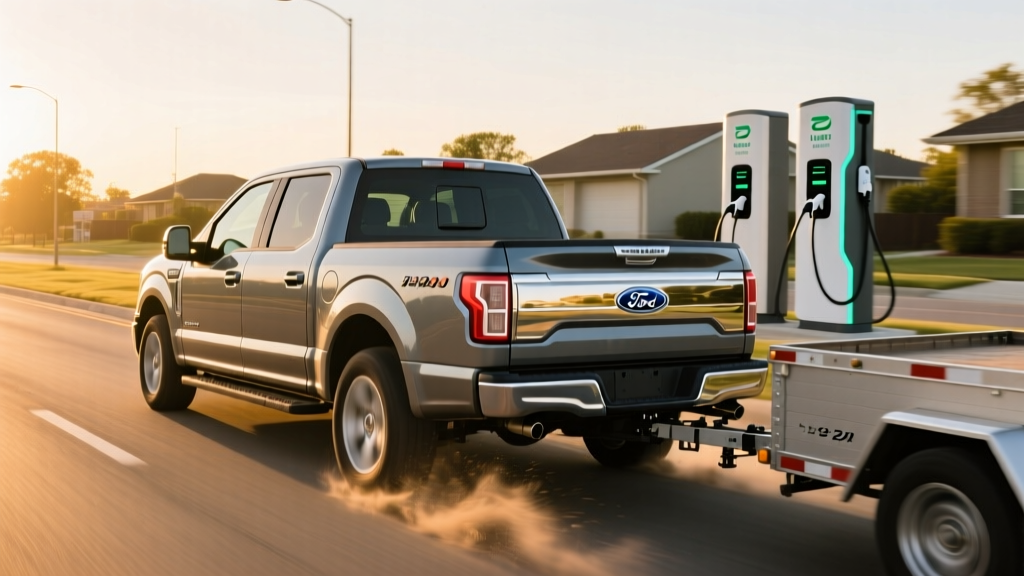
If you need a full-size pickup that can tow over 12,000 pounds but still return mid-20s fuel economy in daily driving, the Ford F-150 PowerBoost occupies a narrow lane. It pairs a twin-turbo 3.5-liter V6 with a 47-hp electric motor sandwiched into the 10-speed automatic transmission, yielding 430 combined horsepower and 570 lb-ft of torque — all without a plug. This is a conventional hybrid (HEV), not a plug-in, meaning you never need to charge it. You simply fuel up and drive.
For the 2025–2026 model years, the PowerBoost remains available across multiple F-150 trims, and it's still the only full-hybrid system offered in a body-on-frame American pickup. Here's everything a buyer needs to know before signing.
HEV vs PHEV: Why the PowerBoost Is a Conventional Hybrid
A common point of confusion in truck shopping is whether the PowerBoost requires plugging in. It does not. Let's clarify the terminology before we go further:
| Feature | Conventional Hybrid (HEV) | Plug-In Hybrid (PHEV) |
|---|---|---|
| Plugs into a charger? | No — charges via regenerative braking & engine | Yes — has a charge port |
| Electric-only driving | Very short distances at low speed (~1 mi) | 20–50 mi typical on battery alone |
| Battery size | Small (1.5–2.0 kWh) | Larger (13–30+ kWh) |
| Federal tax credit | Not eligible under §30D | Up to $7,500 (subject to rules) |
| Example | Ford F-150 PowerBoost | Jeep Wrangler 4xe, Toyota RAV4 Prime |
The PowerBoost's 1.5 kWh lithium-ion battery is small by design. It recovers energy during braking and deceleration, then deploys it for torque fill during acceleration and to enable engine-off coasting at low loads. You get hybrid efficiency gains — especially in stop-and-go city driving — without any change to your fueling routine.
Fuel Economy: EPA Ratings and Real-World MPG
The EPA rates the 4×2 F-150 PowerBoost at 25 MPG city / 26 highway / 25 combined. The 4×4 version drops slightly to 23 city / 24 highway / 24 combined, according to fueleconomy.gov.
| Drivetrain | City | Highway | Combined |
|---|---|---|---|
| F-150 PowerBoost 4×2 | 25 MPG | 26 MPG | 25 MPG |
| F-150 PowerBoost 4×4 | 23 MPG | 24 MPG | 24 MPG |
| F-150 3.5L EcoBoost (non-hybrid, 4×4) | 16 MPG | 22 MPG | 19 MPG |
| F-150 5.0L V8 (4×4) | 16 MPG | 22 MPG | 19 MPG |
Real-world expectation: Hybrids typically beat their EPA city numbers in actual stop-and-go traffic because regenerative braking recovers more energy in heavy congestion. On the highway, expect results closer to or slightly below the sticker — especially when towing or hauling. In mixed suburban driving with moderate loads, owners consistently report 22–26 MPG in the 4×4 configuration. If you tow frequently (5,000+ lbs), expect highway economy to drop to 14–17 MPG, which is still competitive with or better than the non-hybrid EcoBoost under the same load.
Powertrain Specs: 430 HP and Class-Leading Torque
| Specification | Value |
|---|---|
| Engine | 3.5L twin-turbo V6 + 47-hp electric motor |
| Combined horsepower | 430 hp |
| Combined torque | 570 lb-ft |
| Transmission | 10-speed automatic (motor integrated) |
| 0–60 mph | ~5.7 seconds (4×4) |
| Max towing capacity | 12,700 lbs (properly equipped) |
| Max payload | 2,120 lbs |
| Hybrid battery | 1.5 kWh lithium-ion |
| Pro Power Onboard | Up to 7.2 kW (optional) |
The electric motor fills the torque gap at low RPM before the turbos spool fully, which makes the PowerBoost feel more responsive from a stop than the standard 3.5L EcoBoost despite similar peak numbers. The motor also enables seamless start-stop — the engine shuts off at lights and restarts almost imperceptibly.
The available Pro Power Onboard system (up to 7.2 kW) turns the truck into a mobile generator. You can run power tools, a job-site compressor, or even back up essential home circuits through a transfer switch. This is a genuine differentiator versus any gas-only F-150.
Pricing, Trims, and Tax Credit Eligibility
For the 2025–2026 model year, the PowerBoost hybrid powertrain is available as an option on XLT, Lariat, King Ranch, and Platinum trims. The hybrid upgrade typically adds $2,500–$3,500 over the equivalent 3.5L EcoBoost, depending on the trim and package bundling.
| Trim (4×4 SuperCrew) | Approx. MSRP with PowerBoost |
|---|---|
| XLT (302A High pkg) | ~$62,000–$65,000 |
| Lariat (502A High pkg) | ~$70,000–$74,000 |
| King Ranch | ~$78,000–$82,000 |
| Platinum | ~$80,000–$85,000 |
Federal tax credit: The F-150 PowerBoost is a conventional hybrid (HEV), and the IRS §30D New Clean Vehicle Credit applies only to plug-in electric vehicles (BEVs and PHEVs) with a minimum battery capacity of 7 kWh. The PowerBoost's 1.5 kWh battery does not qualify. There is currently no federal tax credit for conventional hybrids. Some states may offer minor incentives for high-efficiency vehicles, but these vary widely — check your state energy office or the Alternative Fuels Data Center for specifics.
- ❌ Vehicle must be a BEV or PHEV (PowerBoost is HEV — does not qualify)
- ❌ Battery must be ≥7 kWh (PowerBoost is 1.5 kWh)
- N/A — MSRP cap, income cap, and critical-mineral sourcing rules do not apply
Reliability, Battery Warranty, and Replacement Cost
The 3.5L EcoBoost engine family has been in production since 2011 and is one of Ford's most thoroughly proven powerplants. The PowerBoost's hybrid-specific components — the electric motor (integrated into the transmission housing), the 1.5 kWh battery pack, and the power electronics — are comparatively simple. There is no large high-voltage pack to degrade, no charge port to maintain, and no thermal management system as complex as a full EV's.
Battery replacement cost: If the hybrid battery fails outside warranty, replacement parts and labor typically run $2,000–$4,000 based on current dealer pricing — substantially less than a full EV battery swap. The small pack is also less prone to significant degradation because it operates within a narrow state-of-charge window, managed by the vehicle's software to maximize longevity.
The 10-speed automatic transmission, which houses the electric motor, has had some historical reports of rough shifting in early model years (2021–2022). Ford issued software updates to address this, and later build dates have been more refined. As always, a pre-purchase inspection on a used example is wise.
Who Should Choose the PowerBoost vs a Full EV or Gas Truck?
Choose the PowerBoost if:
- You tow or haul regularly and need 12,700-lb capacity without range anxiety on remote routes
- You want meaningfully better fuel economy than a gas V6 or V8 without changing your fueling habits
- You value Pro Power Onboard for job-site or emergency-home power
- You don't have reliable access to home or public EV charging
Choose a full EV (e.g., F-150 Lightning) if:
- You mostly drive within 200 miles of home and can charge overnight on Level 2
- You want $7,500 federal tax credit eligibility and lower per-mile energy cost
- You don't regularly tow more than 5,000 lbs (towing drastically cuts EV range)
Choose the gas-only EcoBoost if:
- You want the lowest upfront purchase price and don't drive enough miles to recoup the hybrid premium
- You prefer a simpler powertrain with fewer hybrid-specific components
The financial case for the PowerBoost hinges on your annual mileage and fuel cost. At 15,000 miles per year and $3.50/gallon fuel, the PowerBoost 4×4 (24 MPG combined) saves roughly $450–$600/year versus the non-hybrid 3.5L EcoBoost (19 MPG combined). That means the ~$3,000 hybrid premium pays for itself in about 5–7 years for a typical driver — faster if you drive more or if fuel prices rise.
Pros and Cons at a Glance
- 25 MPG combined in a 5,500-lb body-on-frame truck
- 570 lb-ft torque for strong towing and passing response
- Pro Power Onboard up to 7.2 kW — genuine worksite/home utility
- No plug-in charging required — fuel and go
- 30.6-gal tank yields 730+ miles of range
- No federal tax credit (HEV, not PHEV/BEV)
- $2,500–$3,500 premium over non-hybrid EcoBoost
- MPG advantage shrinks when towing heavy loads
- Early model years (2021–2022) had transmission refinement issues
- Not available on base XL trim (must step up to XLT or above)
Frequently Asked Questions
How many MPG does the 3.5-liter PowerBoost Full Hybrid V6 get?
The EPA rates it at 25 city / 26 highway / 25 combined for the 4×2, and 23/24/24 for the 4×4. Real-world mixed driving typically yields 22–26 MPG in the 4×4, with city driving sometimes exceeding the EPA estimate thanks to regenerative braking.
Does the PowerBoost need to be plugged in?
No. The F-150 PowerBoost is a conventional hybrid (HEV). Its 1.5 kWh battery charges entirely through regenerative braking and the gasoline engine. There is no charge port.
How far can the PowerBoost drive on electric power alone?
Very short distances — roughly 1 mile at low speeds (under 25 mph) in ideal conditions. The system uses the electric motor primarily for torque assist and engine-off coasting, not for sustained electric-only driving. If you need 20+ miles of electric-only range, you need a PHEV or BEV, not a conventional hybrid.
Is the PowerBoost hybrid reliable, and what does a battery replacement cost?
The 3.5L EcoBoost engine has been in production since 2011 and is well-proven. The hybrid battery is warranted for 8 years/100,000 miles (10/150,000 in CARB states). Out-of-warranty replacement runs approximately $2,000–$4,000 — far less than an EV battery.
Does the F-150 PowerBoost qualify for any federal tax credit?
No. The IRS §30D credit requires a plug-in vehicle with at least 7 kWh of battery capacity. The PowerBoost's 1.5 kWh battery classifies it as a conventional hybrid, which is ineligible. Check your state for possible local efficiency incentives via the Alternative Fuels Data Center.
Can I tow with the PowerBoost, and does towing hurt MPG?
Yes — maximum towing capacity is 12,700 lbs when properly equipped. Towing any heavy load (5,000+ lbs) will reduce highway economy significantly, typically to 14–17 MPG. The hybrid system still provides a slight efficiency advantage over the non-hybrid EcoBoost under load, but the gap narrows.
What is Pro Power Onboard and how much power does it provide?
Pro Power Onboard is an available feature that turns the PowerBoost's hybrid system into a mobile generator. It offers 2.0 kW (standard on some trims) or up to 7.2 kW (optional), with 120V and 240V outlets in the bed. It can run power tools, compressors, or — with a proper transfer switch — back up essential home circuits during an outage.