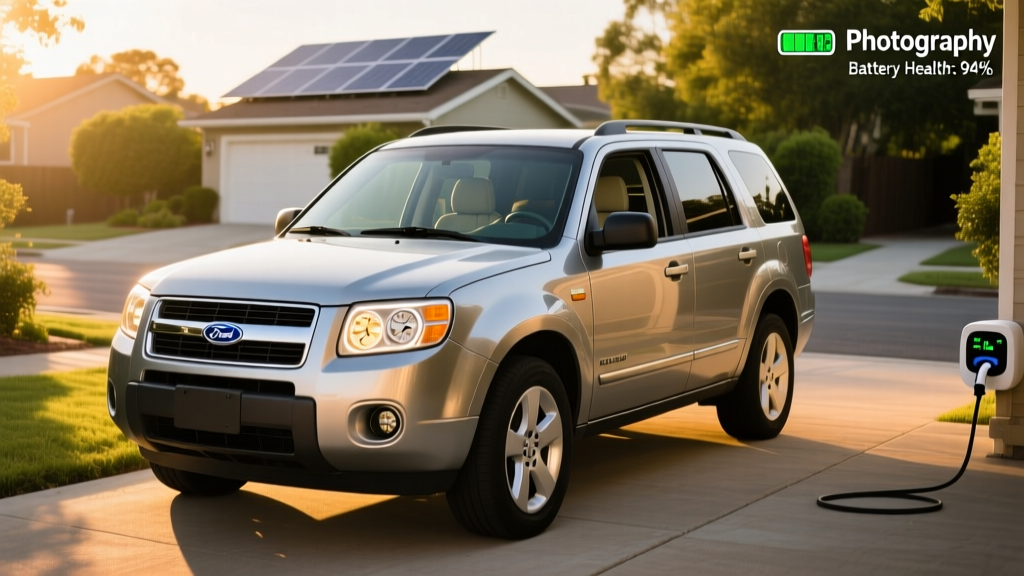
The Ford 2008 Escape Hybrid was one of the first mainstream compact SUVs to pair a gasoline engine with an electric motor in a package that didn't look or drive like a science experiment. Nearly two decades later, thousands of these vehicles are still on the road. For budget-conscious buyers, used-car shoppers, or anyone researching early hybrid technology, the 2008 Escape Hybrid remains a relevant data point — especially when comparing its real-world efficiency against modern HEVs, PHEVs, and full EVs.
This guide covers the exact EPA fuel economy figures, the powertrain architecture, battery longevity and replacement costs, and where this first-generation hybrid stands against the electrified vehicles you can buy today.
Fuel Economy: EPA Numbers and Real-World MPG
The 2008 Ford Escape Hybrid came in two drivetrains: front-wheel drive (FWD) and all-wheel drive (AWD/4WD). EPA ratings differ between them, and real-world results often diverge from the sticker — particularly in city driving, where hybrids shine.
| Drivetrain | City MPG | Highway MPG | Combined MPG |
|---|---|---|---|
| FWD | 34 | 30 | 32 |
| AWD (4WD) | 29 | 27 | 28 |
Source: EPA fueleconomy.gov
The 2008 Escape Hybrid's Atkinson-cycle engine and regenerative braking system deliver their best efficiency in stop-and-go city traffic, where the electric motor handles low-speed propulsion and the engine shuts off at stops. Many owners report 33–36 MPG in mixed city driving with the FWD model — slightly above the EPA city estimate. Highway driving, where the gasoline engine does most of the work and aerodynamic drag increases, typically yields 27–30 MPG. Cold weather and short trips reduce these figures by 10–15%, as the engine runs longer to heat the cabin and catalytic converter.
Powertrain Specs: Engine, Motor, and Combined Output
The 2008 Escape Hybrid uses Ford's second-generation hybrid system, co-developed with Aisin (a Toyota Group supplier). It pairs a 2.3-liter Atkinson-cycle four-cylinder gasoline engine with a permanent-magnet AC synchronous electric motor, connected through an electronically controlled continuously variable transmission (eCVT).
| Engine | 2.3L Atkinson-cycle I4 |
| Engine Power | 133 hp @ 6,000 rpm |
| Electric Motor | Permanent-magnet AC synchronous |
| Motor Power | 94 hp (70 kW) |
| Combined System Output | 155 hp |
| Transmission | eCVT (planetary gearset) |
| Hybrid Battery | NiMH (Nickel-Metal Hydride), ~1.3 kWh (nominal, not plug-in) |
| 0–60 mph | ~10.5 seconds (FWD) |
| Drivetrain Options | FWD or AWD |
| Towing Capacity | 1,000 lbs (hybrid; lower than gas models) |
This is a conventional hybrid (HEV), not a plug-in. The battery charges exclusively through regenerative braking and the gasoline engine. There is no charge port, no plug, and no electric-only driving range to speak of — the motor assists the engine and enables brief low-speed electric-only movement (typically under ~25 mph for short distances), but it cannot sustain highway speeds on battery power alone.
HEV vs. PHEV vs. EV: Where the 2008 Escape Hybrid Fits
Understanding the distinction between hybrid architectures is essential if you're comparing this used vehicle against modern alternatives.
| Feature | HEV (e.g., 2008 Escape Hybrid) | PHEV (e.g., 2026 Ford Escape PHEV) | BEV (e.g., 2026 Ford Mustang Mach-E) |
|---|---|---|---|
| Plug-in Charging | No | Yes (Level 1/2) | Yes (Level 1/2/DC) |
| Battery Capacity | ~1.3 kWh (NiMH) | ~14.4 kWh (NMC lithium-ion) | 70–91 kWh (NMC/LFP) |
| Electric-Only Range | Minimal (low-speed assist) | ~37 miles (EPA) | 230–320 miles (EPA) |
| Gasoline Engine | Yes (primary power) | Yes (backup + highway) | None |
| Fuel Required | Yes | Yes (reduced) | No |
| Federal Tax Credit (§30D) | No (used HEV ineligible) | Up to $7,500 (new, if eligible) | Up to $7,500 (new, if eligible) |
| Used EV Credit (§25E) | No (HEV excluded) | Potentially (check eligibility) | Up to $4,000 |
The 2008 Escape Hybrid is firmly an HEV. It requires no behavioral change from a conventional gas car — you fuel it at the pump and drive. The trade-off is that efficiency gains are modest (32 MPG combined vs. ~22 MPG for the contemporaneous gas-only Escape) and there's no electric-only commuting capability.
Battery Longevity, Warranty, and Replacement Cost
The high-voltage NiMH battery pack is the single biggest ownership question for any 15+ year-old hybrid. Here's what the data shows.
Ford warranted the 2008 Escape Hybrid battery for 8 years / 100,000 miles (10 years / 150,000 miles in California Air Resources Board states). As of 2026, all original factory battery warranties have expired for this model year.
Real-world battery lifespan: NiMH packs in the Escape Hybrid have proven durable. Many owners report the original battery lasting 150,000–200,000+ miles before significant capacity loss triggers a check-engine light or noticeable fuel-economy decline. Unlike lithium-ion packs, NiMH degrades gradually rather than experiencing sudden failure, and individual cell modules can sometimes be reconditioned.
Battery replacement cost (2026 estimates):
- OEM new battery from Ford: ~$3,500–$5,000 (parts + labor at dealership), though OEM availability for the 2008 model year is increasingly limited
- Remanufactured/reconditioned battery: ~$1,500–$2,800 installed through independent hybrid specialists
- Used salvage battery: ~$500–$1,200 (risky — age and remaining life unknown)
If you're buying a 2008 Escape Hybrid today, budget $2,000–$3,000 as a contingency for battery replacement. Check whether the previous owner already replaced it — ask for receipts. A hybrid battery diagnostic scan (available at most hybrid-specialist shops) can reveal remaining capacity percentage and cell balance.
Reliability and Common Issues
The 2008 Escape Hybrid benefits from a powertrain architecture derived from Toyota's Hybrid Synergy Drive (licensed to Ford). The eCVT planetary gearset has no belts, no clutch packs, and no conventional transmission fluid changes — it's one of the most reliable drivetrain components in any vehicle, hybrid or otherwise.
Common issues reported by owners:
- Hybrid battery degradation — expected at this vehicle's age; see replacement costs above
- 12V auxiliary battery drain — the conventional 12V battery can drain if the vehicle sits for extended periods, preventing the hybrid system from starting. A jump-start or 12V replacement resolves this.
- Brake actuator / regenerative braking faults — some model years of this generation experienced issues with the electrohydraulic brake unit. A diagnostic scan will reveal stored codes.
- Electric power steering (EPS) — the 2008 model year was part of a broader Ford EPS recall. Verify recall completion via NHTSA's VIN lookup.
Overall, the hybrid powertrain itself is among the most reliable systems Ford has ever produced. The surrounding vehicle (suspension, interior, electronics) ages like any other 2008-era compact SUV.
Pricing in 2026: Used Market Value
The 2008 Ford Escape Hybrid is long discontinued and available only on the used market. Pricing as of early 2026:
- High mileage (150,000+ mi), fair condition: $2,500–$4,000
- Average mileage (100,000–150,000 mi), good condition: $4,000–$6,500
- Low mileage (under 100,000 mi), excellent condition: $6,500–$9,000
These prices assume a functioning hybrid battery. A vehicle needing a battery replacement should be discounted by $2,000–$3,000.
Tax Credits and Incentives
The 2008 Escape Hybrid does not qualify for any current federal tax credit. Here's why:
- §30D New Clean Vehicle Credit: Only for new vehicles. The 2008 Escape Hybrid is neither new nor a plug-in vehicle.
- §25E Used Clean Vehicle Credit: Applies to used BEVs and PHEVs (plug-in vehicles only). Conventional HEVs are excluded from this credit.
- Original hybrid tax credit (expired): When new, the 2008 Escape Hybrid qualified for a federal income tax credit of up to $2,200 under the Energy Policy Act of 2005. This credit phased out for Ford hybrids after March 31, 2009, and is no longer claimable.
Some states and municipalities offer registration discounts, HOV lane access, or emissions-test exemptions for older hybrids. Check your state's DMV or environmental agency for current programs. Consult a tax professional for eligibility specifics — rules at IRS.gov apply to current plug-in vehicles only.
Who Should Buy the 2008 Escape Hybrid Today?
Pros
- Strong city MPG (34 EPA, often exceeded in real-world stop-and-go)
- Proven, durable hybrid powertrain (Toyota-derived eCVT)
- No plug-in required — zero behavioral change from a gas car
- Low purchase price ($3,000–$7,000 used)
- Compact SUV practicality with decent cargo room (29.2 cu ft behind rear seats)
- Simple to maintain — no turbo, no complex transmission
Cons
- Hybrid battery likely at or past end-of-life — $2,000–$3,000 replacement risk
- No electric-only range — not a PHEV or EV
- Modest power (155 hp combined) — slow by modern standards
- Dated interior, safety tech, and infotainment
- No federal tax credit eligibility
- AWD model loses 4 MPG combined vs. FWD
- Towing limited to 1,000 lbs
Choose the 2008 Escape Hybrid if: You need a cheap, fuel-efficient daily driver for city commuting, want hybrid efficiency without plugging in, and can budget for a potential battery replacement. It's a strong budget pick for a second car, a commuter beater, or a first car for a new driver.
Choose a modern PHEV (e.g., 2026 Toyota RAV4 Prime or Ford Escape PHEV) if: You want 30–40 miles of electric-only commuting, qualify for the §30D federal tax credit, and have home Level 2 charging access.
Choose a full BEV (e.g., 2026 Hyundai Ioniq 5 or Ford Mustang Mach-E) if: You have reliable home charging, want zero gasoline costs, and your daily driving fits within 250–300 miles of range.
Frequently Asked Questions
How many MPG does the 2008 Ford Escape Hybrid get?
The FWD model is rated at 34 city / 30 highway / 32 combined MPG by the EPA. The AWD model drops to 29 city / 27 highway / 28 combined. Real-world city driving often yields 33–36 MPG for the FWD model; highway driving typically returns 27–30 MPG.
Is the 2008 Escape Hybrid a plug-in hybrid?
No. The 2008 Escape Hybrid is a conventional hybrid (HEV). It has no charge port and cannot be plugged in. The battery charges through regenerative braking and the gasoline engine. There is no meaningful electric-only driving range.
How much does it cost to replace the hybrid battery?
Expect $1,500–$2,800 for a remanufactured battery installed at an independent hybrid shop, or $3,500–$5,000 for an OEM replacement at a Ford dealer (if still available). Used/salvage batteries run $500–$1,200 but carry unknown remaining life.
Is the 2008 Escape Hybrid reliable?
The hybrid powertrain — especially the eCVT planetary gearset — is among the most reliable components Ford has produced. The main risk at this vehicle's age is hybrid battery degradation, which is a maintenance cost rather than a catastrophic failure. Check for completed recalls (especially electric power steering) via NHTSA.
Does the 2008 Escape Hybrid qualify for any tax credit?
No. The original federal hybrid tax credit (up to $2,200) expired for Ford in 2009. The current §30D credit applies only to new plug-in vehicles, and the §25E used credit excludes conventional hybrids. No federal tax credit is available for this vehicle in 2026.
How does the 2008 Escape Hybrid compare to a modern hybrid like the 2026 Toyota RAV4 Hybrid?
The 2026 RAV4 Hybrid delivers 41 city / 38 highway / 40 combined MPG — roughly 25% more efficient — with 219 hp, modern safety tech (Toyota Safety Sense 3.0), and a new hybrid battery warranty of 10 years / 150,000 miles. The trade-off is price: a new RAV4 Hybrid starts around $33,000 vs. $3,000–$7,000 for a used 2008 Escape Hybrid.
Can the 2008 Escape Hybrid run on electric power alone?
Only at very low speeds (typically under 25 mph) and for short distances (a few hundred yards). The gasoline engine is the primary power source. This is normal for early HEVs and is not comparable to a PHEV's 30+ mile electric-only range or a BEV's 200+ mile range.