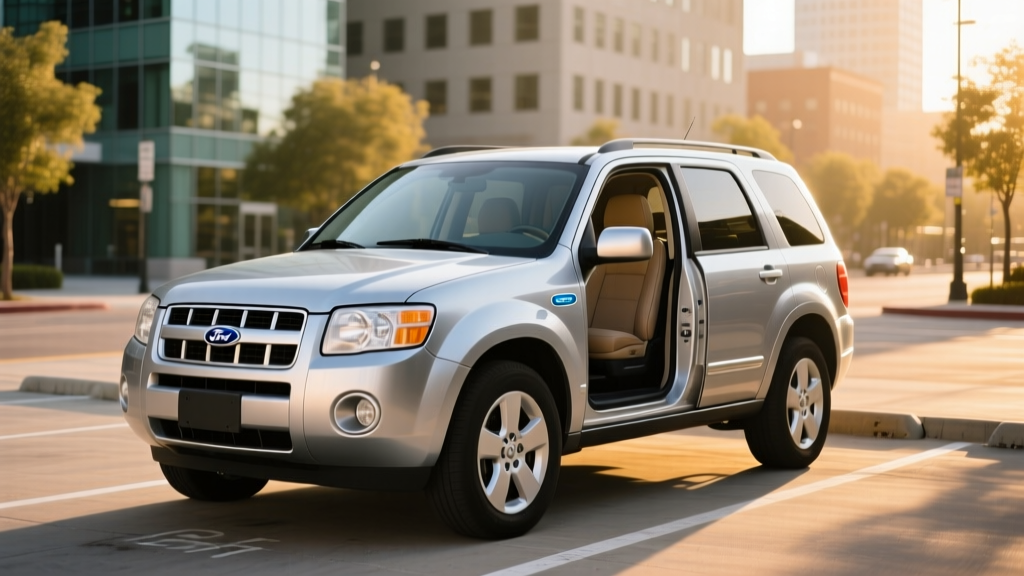
The Ford 2005 Escape Hybrid holds a distinct place in automotive history: it was the first hybrid SUV ever sold in the United States, beating the Toyota Highlander Hybrid to market by several months. Nearly two decades later, this compact crossover remains a fixture on used-car lots and in the driveways of budget-conscious commuters who want hybrid fuel economy without the complexity or cost of a modern plug-in vehicle. If you are researching the Ford 2005 Escape Hybrid as a potential used purchase, a project car, or simply out of curiosity about early hybrid technology, this guide breaks down every number that matters — from real-world MPG to battery replacement costs and reliability data.
What the 2005 Escape Hybrid Is (and Isn't)
The 2005 Escape Hybrid is a conventional hybrid electric vehicle (HEV). It is not a plug-in hybrid (PHEV) and not a battery-electric vehicle (BEV). You never plug it in. The gasoline engine and regenerative braking system recharge a small nickel-metal hydride (NiMH) battery pack, which powers an electric motor that assists the engine during acceleration and enables low-speed electric-only driving for brief distances — typically under one mile at speeds below about 25 mph.
HEV vs. PHEV — Why It Matters for This Vehicle:
- HEV (this vehicle): No plug. Small battery (~1.3 kWh). Electric motor assists the gas engine. You fuel it like any conventional car. EPA MPG applies at all times.
- PHEV (e.g., modern Ford Escape PHEV): Plugs in. Larger battery (~14.4 kWh). Can drive 30+ miles on electricity alone before the gas engine engages. Requires home or public charging to realize full efficiency benefits.
The 2005 Escape Hybrid has zero electric-only range in any practical sense. Its electric motor is an assist device, not a primary propulsion source. This is a critical distinction if you are comparing it to modern PHEVs.
Fuel Economy: EPA MPG and Real-World Numbers
Fuel economy is the primary reason anyone considers the Ford 2005 Escape Hybrid. Here is the official EPA breakdown, sourced from fueleconomy.gov:
| Drivetrain | City MPG | Highway MPG | Combined MPG |
|---|---|---|---|
| FWD (Front-Wheel Drive) | 36 | 31 | 33 |
| 4WD (Four-Wheel Drive) | 33 | 29 | 31 |
The city MPG advantage is significant and typical of conventional hybrids. The electric motor handles low-speed stop-and-go driving where gasoline engines are least efficient, resulting in city figures that exceed highway numbers — the opposite of a conventional gas car.
Real-World MPG: What Owners Actually Report
Based on owner-reported data aggregated on Fuelly and Edmunds forums, the real-world combined MPG for the 2005 Escape Hybrid FWD typically falls between 28 and 33 MPG, with many owners averaging around 30 MPG in mixed driving. City-heavy commuters often see 32–35 MPG, while sustained highway driving at 70+ mph drops efficiency to 27–29 MPG. Cold weather (below freezing) can reduce MPG by 10–15%, as the engine runs more frequently to maintain cabin heat and battery temperature.
For context, the non-hybrid 2005 Escape with the 2.3L four-cylinder and automatic transmission was EPA-rated at 20 city / 25 highway / 22 combined. The hybrid delivers roughly a 50% improvement in combined fuel economy over its gas-only sibling — a substantial gain even by modern standards.
Powertrain Specs: Engine, Motor, and Combined Output
| Specification | Detail |
|---|---|
| Gasoline Engine | 2.3L Atkinson-cycle inline-4 |
| Engine Horsepower | 133 HP @ 6,000 RPM |
| Engine Torque | 129 lb-ft @ 4,500 RPM |
| Electric Motor | Permanent-magnet synchronous (integrated in eCVT) |
| Motor Horsepower | 94 HP |
| Combined System Output | 155 HP (net) |
| Transmission | Electronic Continuously Variable (eCVT) |
| 0–60 mph | ~10.8 seconds |
| Battery Type | Nickel-Metal Hydride (NiMH) |
| Battery Capacity | ~1.3 kWh (gross) |
| Battery Location | Under the cargo floor |
The 2.3L Atkinson-cycle engine sacrifices some peak power for greater thermal efficiency — a hallmark of hybrid powertrains that Toyota pioneered with the Prius and Ford licensed for this application. The eCVT is not a traditional belt-and-pulley CVT; it uses a planetary gearset to blend engine and motor power seamlessly. This design has proven exceptionally durable, with no belts or clutches to wear out.
Battery Reliability, Lifespan, and Replacement Cost
Original Battery Warranty: Ford covered the 2005 Escape Hybrid battery for 8 years / 100,000 miles (10 years / 150,000 miles in California Air Resources Board states). That warranty has long expired for every 2005 model on the road.
Real-World Battery Longevity: NiMH battery packs in the 2005–2012 Escape Hybrid have demonstrated strong longevity. Many owners report 150,000–200,000+ miles on the original pack with minimal capacity loss. Unlike lithium-ion packs, NiMH degrades gradually rather than experiencing sudden capacity cliffs.
Replacement Cost (2026): A refurbished NiMH battery pack for the 2005 Escape Hybrid typically costs $1,500–$2,500 installed at an independent hybrid specialist. A new OEM pack from Ford (if still available) runs $3,000–$4,000. Third-party rebuild services can replace individual failed cells for $800–$1,200, which is often the most economical route for a vehicle of this age.
Battery failure is not a certainty — or even a probability — for a well-maintained 2005 Escape Hybrid. The NiMH chemistry is inherently stable and less prone to thermal degradation than early lithium-ion packs. The most common hybrid-system failures on this generation involve the cooling fan for the battery pack (located under the rear cargo area) rather than the cells themselves. Keeping the cargo-area vents unobstructed and replacing the cabin air filter regularly helps maintain battery health.
Is the 2005 Escape Hybrid Reliable Overall?
Beyond the battery, the first-generation Escape Hybrid shares its platform with the conventional 2005–2007 Escape and Mercury Mariner. Common mechanical issues include:
- Power steering leaks: The hydraulic power steering rack is a known wear item across all Escape models of this era.
- Suspension components: Front lower control arm bushings and rear trailing arm bushings deteriorate with age and mileage.
- Brake actuator assembly: The hybrid's regenerative brake system uses an electrohydraulic brake actuator that can fail at high mileage (150,000+ miles). Replacement costs $1,200–$1,800. This is the single most expensive non-battery repair unique to the hybrid.
- Rust: Particularly on the rear wheel arches and subframe in salt-belt states.
The eCVT transmission itself is among the most reliable components in the vehicle. Because it uses a planetary gearset with no friction bands or torque converter, internal failures are rare.
Hybrid vs. PHEV vs. Full EV: Which Fits You?
Choose the 2005 Escape Hybrid (used HEV) if:
- Your budget is under $5,000–$7,000 for a used vehicle
- You have no access to home or workplace charging
- You want better fuel economy with zero behavioral change — just fill up with gas
- You drive primarily in city or suburban stop-and-go traffic where hybrid efficiency shines
- You want a simple, proven powertrain with widely available used parts
Choose a modern PHEV (e.g., 2025–2026 Ford Escape PHEV) if:
- You can install a Level 2 home charger or have workplace charging
- Your daily commute is under 35 miles and you want to drive mostly on electricity
- You want to qualify for the federal §30D tax credit (up to $3,750–$7,500 depending on battery sourcing and your income — see IRS.gov for current eligibility rules)
- You want modern safety features (AEB, lane-keeping, blind-spot monitoring) not available on a 2005 vehicle
Choose a full EV (e.g., Hyundai Ioniq 5, Tesla Model Y) if:
- You have reliable home Level 2 charging
- Your typical trips fall within the vehicle's real-world range (250–320 miles for most modern EVs)
- You want the lowest per-mile fuel cost and minimal drivetrain maintenance
- You are willing to plan around DC fast charging on road trips
Pricing and Tax Credit Eligibility
As of early 2026, a used 2005 Ford Escape Hybrid in drivable condition typically sells for $3,000–$6,500 depending on mileage, condition, and region. Low-mileage examples (under 100,000 miles) in good condition can command $7,000–$8,500, though at that price point you are competing with newer, more conventional used crossovers.
Federal Tax Credit: The 2005 Escape Hybrid does not qualify for the new-vehicle §30D clean vehicle credit — it is long out of production. However, if you purchase one from a licensed dealer for under $25,000, it may qualify for the Used Clean Vehicle Credit (30% of the sale price, up to $4,000), provided:
- The vehicle is at least two model years old (obviously satisfied)
- The sale price is $25,000 or less
- Your modified adjusted gross income does not exceed $75,000 (single) / $150,000 (married filing jointly)
- You purchase from a licensed dealer (private-party sales do not qualify)
- The vehicle has a minimum 4 kWh battery capacity — this is a disqualifier. The 2005 Escape Hybrid's ~1.3 kWh NiMH pack does not meet the 4 kWh minimum threshold under IRC §25D/§30D definitions.
In practice, the 2005 Escape Hybrid does not qualify for any federal tax credit due to its battery capacity falling below the statutory minimum. Buyers should not factor any credit into their purchase decision.
Pros and Cons at a Glance
Pros
- 33 MPG combined (FWD) — strong for an SUV of any era
- City MPG (36) exceeds highway — ideal for commuters
- eCVT is extremely durable with no wear components
- NiMH battery proven to last 150K–200K+ miles
- Very low purchase price on the used market
- No plug-in required — zero infrastructure dependency
- Cargo space unaffected (battery under floor)
Cons
- No electric-only range — it's a gas car with hybrid assist
- No federal tax credit eligibility (battery under 4 kWh)
- Outdated safety: no AEB, no electronic stability control on early builds
- 10.8-second 0–60 time — sluggish by modern standards
- Brake actuator replacement is expensive ($1,200–$1,800)
- Interior materials and infotainment are dated
- No DC fast charging (not applicable — HEV)
Frequently Asked Questions
How many MPG does the Ford 2005 Escape Hybrid get?
The FWD model is EPA-rated at 36 city / 31 highway / 33 combined. The 4WD model is rated at 33 city / 29 highway / 31 combined. Real-world averages typically fall between 28 and 33 MPG depending on driving style, climate, and route mix.
Can the 2005 Escape Hybrid drive on electric power alone?
Only at very low speeds (under ~25 mph) and for extremely short distances (a few hundred yards). The electric motor is designed to assist the gasoline engine, not replace it. There is no meaningful electric-only range — this is a conventional hybrid, not a plug-in.
Is the 2005 Escape Hybrid reliable?
The hybrid powertrain (engine, eCVT, motor, and NiMH battery) has proven very reliable, with many examples exceeding 200,000 miles. The main reliability concerns are the electrohydraulic brake actuator at high mileage and standard wear items shared with the gas Escape (power steering, suspension bushings, rust).
How much does it cost to replace the hybrid battery?
A refurbished NiMH battery pack costs $1,500–$2,500 installed. Individual cell repair through a hybrid specialist runs $800–$1,200. A new OEM pack (if available) costs $3,000–$4,000. Most owners never need a full replacement — the NiMH pack degrades gradually and often lasts the life of the vehicle.
Does the 2005 Escape Hybrid qualify for a tax credit?
No. The vehicle's ~1.3 kWh battery pack falls below the 4 kWh minimum required by federal clean vehicle credit rules. Additionally, the vehicle is long out of production and only the used-vehicle credit could theoretically apply — but the battery capacity disqualifies it regardless.
How does the 2005 Escape Hybrid compare to a modern hybrid like the Toyota RAV4 Hybrid?
The 2025 Toyota RAV4 Hybrid delivers 41 city / 38 highway / 40 combined — roughly 20% better fuel economy with 219 combined HP, modern safety features (AEB, lane tracing, blind-spot monitoring), and a new-vehicle warranty. However, a used RAV4 Hybrid costs $25,000–$35,000 compared to $3,000–$6,500 for the 2005 Escape Hybrid. The value proposition depends entirely on your budget and priorities.
Should I buy a 2005 Escape Hybrid in 2026?
If you need an ultra-low-cost, fuel-efficient compact SUV with no charging requirement and accept the trade-offs (outdated safety, aged interior, potential high-mileage repairs), it remains a rational choice. If your budget allows $20,000+, a modern hybrid or PHEV delivers meaningfully better efficiency, safety, technology, and warranty coverage.
The Ford 2005 Escape Hybrid proved that hybrid technology could work in a mainstream American SUV — and its powertrain durability over two decades has vindicated that bet. For buyers who understand what it is and what it isn't, it remains a compelling budget option in a market where used-car prices continue to climb.