Ask most people when the first hybrid car was invented and they'll guess the Toyota Prius in 1997. The real answer reaches back more than a century earlier — to a young Ferdinand Porsche working in Vienna at the turn of the 20th century. Understanding that origin story isn't just trivia; it explains why modern hybrid and plug-in hybrid powertrains work the way they do, and it frames the buying decision you face today between a conventional hybrid (HEV), a plug-in hybrid (PHEV), and a full battery-electric vehicle (BEV).
The First Hybrid Car Invented: Lohner-Porsche Mixte (1900)
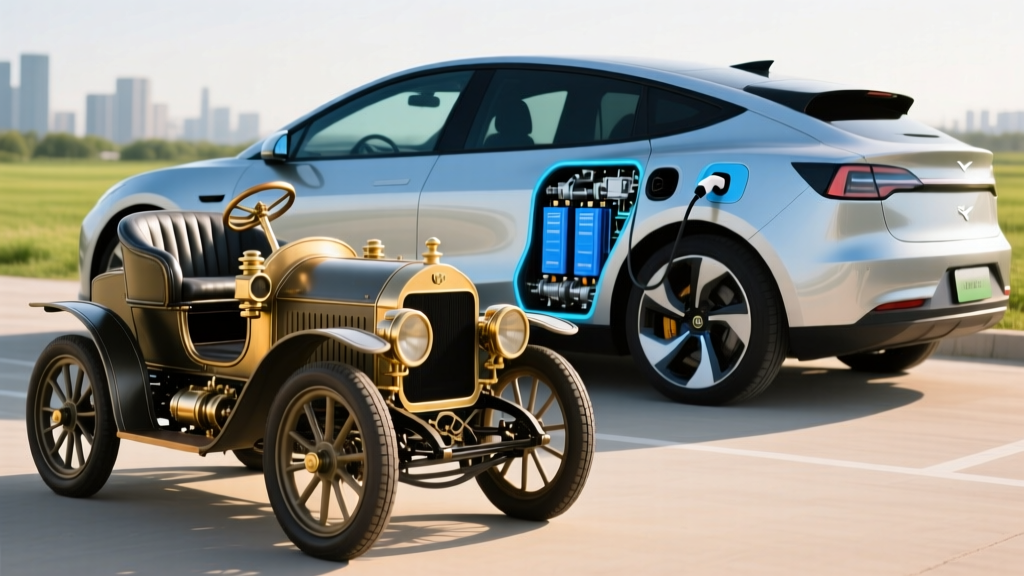
The vehicle widely recognized as the first hybrid car invented is the Lohner-Porsche Mixte Hybrid, developed by Ferdinand Porsche in collaboration with carriage maker Ludwig Lohner. Introduced in 1900 in Vienna, Austria, the Mixte used a series-hybrid architecture: a gasoline-powered Daimler engine drove a generator, which produced electricity to power hub-mounted electric motors in the front wheels. There was no mechanical linkage between the engine and the wheels — the engine existed solely to generate electricity.
This is significant because the same series-hybrid concept powers modern vehicles like the BMW i3 REx (range-extended) and, in a more sophisticated form, the Chevrolet Volt's Voltec powertrain before it was discontinued. Porsche's Mixte could reach roughly 35 mph and had a combined range limited by its small fuel tank and primitive lead-acid batteries. Only a handful were built, primarily for wealthy customers and racing events, but the engineering principle — using an internal combustion engine as a generator to supplement electric drive — was established.
It would take nearly a century for battery technology, power electronics, and emissions regulations to converge and make hybrids commercially viable at scale.
The Modern Hybrid Timeline: From Prius to Today's PHEVs
The 1997 Toyota Prius (first generation, Japan-only) became the world's first mass-produced hybrid passenger car. It used a parallel-hybrid system called the Toyota Hybrid System (THS), combining a 1.5-liter gasoline engine with an electric motor and a nickel-metal hydride (NiMH) battery pack. The Prius arrived in the US for the 2001 model year rated at approximately 42 MPG combined by the EPA — a figure that stunned the American market accustomed to 20–25 MPG sedans.
Key milestones since:
- 2004: Second-gen Prius redesign jumps to ~55 MPG combined EPA, becomes a cultural icon.
- 2010: Chevrolet Volt launches as a PHEV (extended-range electric), offering ~35 miles electric-only before the gas engine engages.
- 2012: Toyota Prius Plug-in Hybrid introduces ~11 miles of electric-only range.
- 2016: Hyundai Ioniq launches in HEV, PHEV, and BEV variants.
- 2021: Toyota RAV4 Prime PHEV delivers 42 miles electric-only and 302 combined HP — the performance hybrid era arrives.
- 2024–2026: PHEV battery packs grow to 15–25 kWh, with electric-only ranges reaching 40–50 miles and DC fast charging appearing on select models.
HEV vs PHEV vs BEV: Which Powertrain Fits You?
| Attribute | HEV (Conventional Hybrid) | PHEV (Plug-in Hybrid) | BEV (Battery Electric) |
|---|---|---|---|
| Plug in to charge? | No — regenerates energy internally | Yes — has a charge port | Yes — charge port required |
| Electric-only range | 0 miles (motor assists engine only) | 20–50 miles typical | 200–400+ miles |
| Battery size | 0.5–2.0 kWh | 10–25 kWh | 50–120 kWh |
| Gas engine? | Yes (primary power + regen) | Yes (backup after battery depletes) | No |
| Home charging needed? | No | Recommended (Level 2 ideal) | Essential |
| Federal tax credit (§30D)? | No | Up to $7,500 (if eligible) | Up to $7,500 (if eligible) |
| Best for | No home charging, high-mileage commuters | Short daily commutes + road-trip flexibility | Home charging access, low running costs |
The core distinction: a conventional hybrid (HEV) never plugs in. It captures energy through regenerative braking and the engine to charge a small battery that assists the gas motor. A plug-in hybrid (PHEV) has a larger battery you charge from a wall outlet or charging station, giving you genuine electric-only driving for daily commutes, with a gas engine for longer trips.
Today's Best Hybrids and PHEVs: MPG, Range, and Pricing
To make the history concrete, here's how the top-selling hybrid and PHEV models stack up for the 2025–2026 model years. All figures sourced from EPA fueleconomy.gov and manufacturer specifications.
| Model (MY 2025–2026) | Type | EPA MPG (City/Hwy/Combined) | Electric-Only Range | Battery (kWh) | Combined HP | Base MSRP |
|---|---|---|---|---|---|---|
| Toyota Prius | HEV | 57 / 56 / 57 | N/A | ~1.0 (NiMH/Li-ion) | 194 | $28,350 |
| Toyota Prius Prime | PHEV | 52 (hybrid mode) / 127 MPGe | 44 mi | 13.6 kWh (Li-ion) | 220 | $33,445 |
| Toyota RAV4 Hybrid | HEV | 41 / 38 / 40 | N/A | ~1.6 (NiMH) | 219 | $33,575 |
| Toyota RAV4 Prime | PHEV | 40 (hybrid) / 94 MPGe | 42 mi | 18.1 kWh (Li-ion) | 302 | $44,515 |
| Honda CR-V Hybrid | HEV | 43 / 36 / 40 | N/A | ~1.1 (Li-ion) | 204 | $35,395 |
| Hyundai Tucson PHEV | PHEV | 37 (hybrid) / 80 MPGe | 33 mi | 13.8 kWh (Li-ion) | 261 | $39,750 |
| Ford Maverick Hybrid | HEV | 42 / 33 / 38 | N/A | ~1.1 (Li-ion) | 191 | $28,345 |
Real-World MPG vs EPA: What Owners Actually See
Hybrids, particularly Toyota's THS system, frequently exceed EPA city ratings in real-world driving because stop-and-go traffic maximizes regenerative braking. The Prius HEV, rated at 57 MPG combined, routinely delivers 60–65 MPG in urban driving among careful drivers. Highway MPG tends to track closer to or slightly below EPA estimates because regenerative opportunities are minimal at sustained speeds.
For PHEVs, real-world electric-only range varies with temperature and driving style. A RAV4 Prime rated at 42 miles electric-only may deliver 35–38 miles in cold weather (below 40°F) due to cabin heating load and reduced battery efficiency, and 40–45 miles in mild conditions. Once the battery depletes, PHEVs switch to hybrid mode and typically achieve MPG figures within 1–3 MPG of their EPA hybrid-mode ratings.
PHEV Charging: Battery Size, Charge Times, and DC Fast Charging
PHEV batteries range from roughly 10 kWh to 25 kWh in current models. Charging times depend on the onboard charger and the power source:
| Charging Method | Power (kW) | Typical PHEV 0–100% Time | Notes |
|---|---|---|---|
| Level 1 (120V household outlet) | ~1.4 kW | 8–14 hours | Works for overnight; sufficient for most PHEV batteries |
| Level 2 (240V home/public) | 3.3–7.2 kW | 2–4 hours | Ideal for daily top-ups; some PHEVs limited to 3.3 kW onboard |
| DC Fast Charge (CCS/NACS) | 25–50 kW (where equipped) | ~25–35 min (10–80%) | Only available on select PHEVs (e.g., newer European models); most US-market PHEVs lack DC fast charging |
Critical note on kW vs kWh: kW (kilowatts) measures the rate of power delivery — how fast energy flows into the battery. kWh (kilowatt-hours) measures total energy capacity — how much the battery holds. A 13.6 kWh battery charged at 3.3 kW takes roughly 4 hours from empty to full (13.6 ÷ 3.3 ≈ 4.1 hours, minus tapering near 100%).
Most US-market PHEVs, including the Prius Prime and RAV4 Prime, do not support DC fast charging. They rely on Level 1 or Level 2 AC charging. This is a practical limitation worth considering: if you need to recharge mid-trip, you'll be waiting hours, not minutes. However, since PHEV batteries are small, overnight Level 1 charging from a standard 120V outlet is usually sufficient to restore full electric range by morning.
Federal Tax Credits for PHEVs: §30D Eligibility Rules
2026 §30D Federal Tax Credit — Key Requirements for PHEVs:
- Credit amount: Up to $7,500 (split: $3,750 for battery components + $3,750 for critical minerals sourcing)
- Battery capacity: Vehicle must have at least 7 kWh of battery capacity
- MSRP caps: Vans/SUVs/pickups ≤ $80,000; sedans/other ≤ $55,000
- Buyer income caps (MAGI): $300,000 joint / $225,000 head of household / $150,000 single
- North American final assembly: Required
- Battery sourcing: Increasing percentages of critical minerals and battery components must be sourced from the US or FTA partners (thresholds rise annually)
- Point-of-sale transfer: Eligible buyers can transfer the credit to the dealer for an upfront price reduction
- FEOC restriction: Vehicles with battery components from a "foreign entity of concern" (e.g., certain Chinese suppliers) may lose partial or full credit
Source: IRS §30D Clean Vehicle Credit. Eligibility changes frequently — always verify specific VIN eligibility at fueleconomy.gov before purchasing.
Conventional hybrids (HEVs) do not qualify for the §30D federal tax credit because they cannot be plugged in and their batteries are below the 7 kWh threshold. This is a significant cost consideration: a PHEV like the Prius Prime ($33,445 MSRP) may effectively cost less than the base Prius HEV ($28,350) after applying a partial or full credit, depending on your tax situation and the vehicle's sourcing compliance.
Some states offer additional rebates or credits for PHEVs (e.g., California's CVRP, Colorado's state credit). These vary by jurisdiction and are subject to funding availability — check your state energy office for current programs.
Hybrid and PHEV Battery Reliability, Warranty, and Replacement Costs
Hybrid battery longevity is one of the most researched topics among prospective buyers, and the data is reassuring. Toyota's hybrid batteries — both NiMH and lithium-ion — have demonstrated exceptional durability. It is common for Prius and RAV4 Hybrid batteries to exceed 150,000–200,000 miles with minimal degradation (typically 10–15% capacity loss over 10 years). The taxi fleet in cities like Vancouver and Los Angeles has documented Prius units surpassing 300,000 miles on original hybrid batteries.
Hybrid/PHEV Battery Warranty — Industry Standard:
- Federal minimum (EPA/CARB mandate): 8 years / 100,000 miles for hybrid battery and emissions-related components
- CARB states (CA, NY, MA, and others): 10 years / 150,000 miles for PZEV/SULEV certified vehicles (most Toyota/Honda hybrids)
- Capacity retention threshold: Warranty typically covers failure to maintain ≥ 60–70% of original capacity
- Replacement cost (out of warranty):
- — HEV battery: $2,000–$4,000 (e.g., Prius ~$2,500–$3,500; RAV4 Hybrid ~$3,000–$4,000)
- — PHEV battery: $4,000–$8,000 (larger pack, higher cost; RAV4 Prime ~$6,000–$8,000)
- Refurbished/reconditioned options: Available for $1,000–$2,500 from third-party suppliers for popular models
PHEV batteries face more charge cycles than HEV batteries because they're regularly depleted and recharged from the grid. However, modern PHEV thermal management systems (liquid cooling in the RAV4 Prime, Tucson PHEV) keep cell temperatures within optimal ranges, and manufacturers engineer significant buffer — you may see 18.1 kWh labeled on the RAV4 Prime's pack, but only ~14.5 kWh is usable, protecting the cells from deep discharge and overcharge stress.
Decision Framework: Should You Buy an HEV, PHEV, or Full EV?
Choose a Conventional Hybrid (HEV) If:
- You cannot install a home charger (apartment, street parking, no garage)
- You drive 30,000+ miles/year and want maximum MPG without plug-in hassle
- You want the lowest upfront cost (no PHEV premium, no home electrical work)
- You frequently drive long highway stretches where PHEV electric range offers minimal benefit
- You value proven, decades-tested reliability with minimal new technology risk
Choose a Plug-in Hybrid (PHEV) If:
- You have home or workplace charging (even a 120V outlet works overnight)
- Your daily commute is under 30–40 miles round-trip (most PHEVs cover this on electricity alone)
- You want EV-like daily driving but need gas-engine range for road trips or rural travel
- You want to qualify for the federal §30D tax credit (up to $7,500)
- You live in a region with expensive electricity but cheap gas — you can optimize when to use each
Quick Decision Test:
- No plug access + high mileage → HEV (Prius, RAV4 Hybrid, CR-V Hybrid)
- Plug access + short commute + road trips → PHEV (Prius Prime, RAV4 Prime, Tucson PHEV)
- Plug access + mostly under 250 mi/day + low running cost priority → BEV (Tesla Model Y, Ioniq 5, Equinox EV)
From Lohner-Porsche to Your Driveway: 125 Years of Hybrid Evolution
The first hybrid car invented in 1900 solved a problem that still resonates: how to combine the energy density of liquid fuel with the efficiency and torque of electric drive. Ferdinand Porsche's series-hybrid Mixte was impractical for mass adoption — heavy lead-acid batteries, hand-built components, and an infrastructure that didn't exist. But the architecture was sound.
Today's PHEVs represent the mature realization of that concept. A 2026 Toyota RAV4 Prime delivers 302 combined horsepower, 42 miles of electric-only range, 40 MPG in hybrid mode, and a total system range exceeding 600 miles — all while qualifying for federal tax incentives that Ferdinand Porsche could never have imagined. The engineering lineage is unbroken.
Whether you choose an HEV for its simplicity, a PHEV for its flexibility, or a BEV for its zero tailpipe emissions, you're benefiting from more than a century of iterative development. The question isn't whether hybrid technology works — it's which variant fits your driving pattern, your charging access, and your budget.
Frequently Asked Questions
Who invented the first hybrid car?
Ferdinand Porsche, working with Viennese carriage maker Ludwig Lohner, developed the Lohner-Porsche Mixte Hybrid in 1900. It used a gasoline engine to drive a generator that powered electric hub motors — a series-hybrid architecture that predates the Toyota Prius by 97 years.
How many MPG does a modern hybrid get?
The 2025 Toyota Prius HEV achieves an EPA-rated 57 MPG combined (57 city / 56 highway). The RAV4 Hybrid delivers 40 MPG combined (41 city / 38 highway). Real-world city driving often exceeds EPA estimates by 3–8 MPG due to regenerative braking efficiency in stop-and-go traffic.
How far can a PHEV go on electric only?
Current PHEVs offer 25–50 miles of electric-only range. The Toyota Prius Prime achieves 44 miles, the RAV4 Prime delivers 42 miles, and the Hyundai Tucson PHEV provides 33 miles. Cold weather (below 40°F) typically reduces electric-only range by 15–25%.
Do conventional hybrids need to be plugged in?
No. Conventional hybrids (HEVs) never plug in. They charge their small battery through regenerative braking and the gasoline engine. Only plug-in hybrids (PHEVs) and battery-electric vehicles (BEVs) require external charging.
Is a hybrid battery expensive to replace?
Hybrid battery replacement costs $2,000–$4,000 for HEVs and $4,000–$8,000 for PHEVs out of warranty. However, most hybrid batteries last 150,000–200,000+ miles with only 10–15% degradation. Federal warranty requirements mandate coverage for at least 8 years / 100,000 miles (10 years / 150,000 miles in CARB states).
Does a PHEV qualify for the federal tax credit?
Many PHEVs qualify for up to $7,500 under IRS §30D, provided they meet battery-sourcing, critical-minerals, MSRP cap ($80,000 SUVs / $55,000 sedans), buyer income cap ($150,000–$300,000 MAGI), and North American assembly requirements. Conventional hybrids (HEVs) do not qualify. Always verify VIN eligibility at fueleconomy.gov and consult a tax professional.
Hybrid vs PHEV vs EV — which should I buy?
Choose an HEV if you lack home charging and drive high annual mileage. Choose a PHEV if you can charge at home, commute under 40 miles daily, but need gas-engine range for road trips. Choose a BEV if you have reliable charging access and want the lowest per-mile operating cost with zero tailpipe emissions.