Quick Verdict: The PowerBoost Is a Working Hybrid, Not a Plug-In
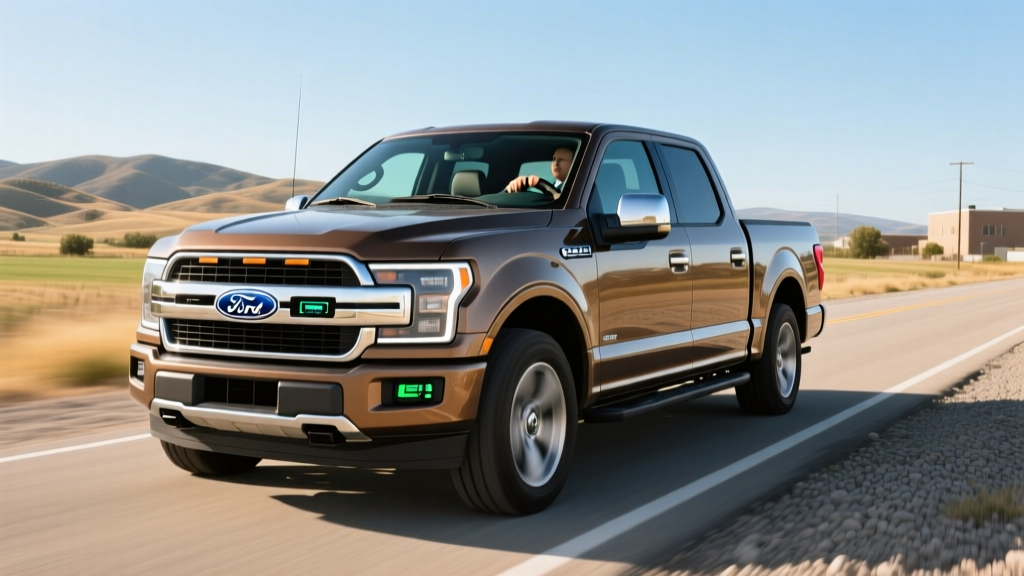
The Ford F-150 PowerBoost hybrid pairs a 3.5-liter twin-turbo V6 with a 35 kW electric motor integrated into the 10-speed automatic transmission. This is a conventional hybrid (HEV), not a plug-in. You never plug it in — the 1.5 kWh lithium-ion battery recharges through regenerative braking and the engine. The payoff is 430 horsepower, 570 lb-ft of torque, and an EPA-estimated 22–25 MPG depending on drivetrain, all while maintaining a maximum towing capacity of up to 11,200 pounds when properly equipped.
For the 2026 model year, the PowerBoost remains Ford's answer for truck buyers who want meaningful fuel savings without range anxiety, charging infrastructure, or the upfront cost premium of a full battery-electric vehicle like the F-150 Lightning. It occupies a practical middle ground: more efficient than the gas-only 3.5L EcoBoost, simpler to own than a plug-in, and available across multiple trims from XLT through Platinum.
HEV vs PHEV vs EV: Where the PowerBoost Fits
A common question from truck shoppers is whether the PowerBoost is a plug-in hybrid. It is not. Understanding the distinction matters for your daily routine and fuel budget.
| Category | F-150 PowerBoost (HEV) | Hypothetical Truck PHEV | F-150 Lightning (BEV) |
|---|---|---|---|
| Plugs in? | No | Yes | Yes |
| Electric-only range | N/A (motor assists engine) | 20–40 mi typical | 230–320 mi (EPA) |
| Battery size | 1.5 kWh | 15–20 kWh typical | 98–131 kWh usable |
| Fuel/energy | Gasoline only | Gasoline + electricity | Electricity only |
| Home charging needed? | No | Yes (Level 2 ideal) | Yes (Level 2 essential) |
| Maintenance | Standard engine + hybrid system | Engine + hybrid + plug system | Minimal (no engine) |
The PowerBoost's hybrid system is transparent in operation. The electric motor provides low-end torque fill, smooths out stop-start driving, and enables brief engine-off coasting. You'll notice the engine shutting off at stoplights and during light-load cruising, but there is no electric-only driving mode with meaningful range. If you need 20–30 miles of pure electric commuting, you'd need a PHEV — and Ford does not currently offer a plug-in F-150 in the U.S. market.
Fuel Economy: EPA Ratings vs Real-World MPG
Fuel economy varies by drivetrain configuration. The rear-wheel-drive PowerBoost achieves the highest EPA numbers, while 4x4 models see a modest reduction. Here is the breakdown per fueleconomy.gov:
| Configuration | City MPG | Highway MPG | Combined MPG |
|---|---|---|---|
| 4x2 (RWD) | 25 | 26 | 25 |
| 4x4 | 22 | 24 | 23 |
Real-world expectations: Hybrid trucks tend to match or slightly exceed EPA city estimates because stop-and-go driving maximizes regenerative braking and engine-off time. Highway driving is where the advantage narrows — at sustained 70–80 mph, the aerodynamic drag of a full-size pickup dominates, and the hybrid system contributes less. Expect 21–23 MPG highway in a 4x4 model on flat terrain, dropping to 18–20 MPG when towing or hauling heavy loads. In cold weather (below 30°F), expect a 1–2 MPG reduction as the engine runs more frequently for cabin heat and battery conditioning.
For context, the gas-only 3.5L EcoBoost V6 4x4 rates at 18 city / 23 highway / 20 combined. The PowerBoost 4x4's 23 MPG combined represents roughly a 15% improvement — meaningful over 15,000 annual miles, saving approximately 75–100 gallons of fuel per year at current prices.
Powertrain and Performance Specs
| Specification | F-150 PowerBoost Hybrid |
|---|---|
| Engine | 3.5L twin-turbo V6 + 35 kW electric motor |
| Combined horsepower | 430 hp |
| Combined torque | 570 lb-ft |
| Transmission | 10-speed automatic (motor integrated) |
| Battery | 1.5 kWh lithium-ion (under floor) |
| 0–60 mph | ~5.5 seconds (est.) |
| Max towing (properly equipped) | 11,200 lbs |
| Max payload | ~2,120 lbs |
| Pro Power Onboard | Up to 7.2 kW (available) |
The PowerBoost's 430 hp and 570 lb-ft place it between the standard 3.5L EcoBoost (400 hp / 500 lb-ft) and the high-output variant in the Raptor. The electric motor's contribution is most noticeable at low RPMs, where it fills the torque gap before the turbos spool fully. This translates to confident highway merging and responsive launches from a stop.
The available Pro Power Onboard system is a standout feature for job-site and camping use. In its 7.2 kW configuration, it provides four 120V outlets and one 240V outlet in the bed, capable of running power tools, a welder, or campsite appliances directly from the truck's hybrid system — the engine starts automatically to sustain output when battery reserves deplete.
Pricing, Trims, and Tax Credit Eligibility
The PowerBoost hybrid powertrain is available as an option on XLT, Lariat, King Ranch, and Platinum trims for the 2026 model year. Pricing for the hybrid option typically adds $2,500–$3,500 over the equivalent 3.5L EcoBoost, depending on trim and configuration. Base MSRPs for PowerBoost-equipped models generally start in the mid-$50,000 range for an XLT 4x4 and climb past $75,000 for a fully loaded Platinum.
Federal Tax Credit (§30D): The F-150 PowerBoost is a conventional hybrid, not a plug-in electric vehicle. It does not qualify for the federal §30D Clean Vehicle Credit, which requires a minimum 7 kWh battery and plug-in capability. The PowerBoost's 1.5 kWh battery falls well below this threshold. Some states may offer modest incentives for hybrid vehicles, but these vary by jurisdiction — check your state's energy office or the AFDC state law database for current programs.
The lack of a federal tax credit is the primary financial disadvantage compared to the F-150 Lightning, which may qualify for up to $7,500 under §30D (subject to MSRP caps, buyer income limits, and battery-sourcing requirements per IRS guidelines). However, the PowerBoost's lower purchase price, no charging infrastructure requirement, and familiar fueling routine offset this for many buyers.
Battery Warranty, Reliability, and Replacement Cost
Ford covers the PowerBoost hybrid battery and related components under its hybrid system warranty: 8 years or 100,000 miles, whichever comes first. In states that follow California Air Resources Board (CARB) emissions standards — including California, New York, Massachusetts, and several others — the hybrid battery warranty extends to 10 years or 150,000 miles.
The 1.5 kWh battery is relatively small and operates within a conservative state-of-charge window (never fully charged or fully depleted), which significantly reduces degradation stress compared to a full EV battery. Ford's hybrid systems in the Escape and Fusion have demonstrated strong long-term reliability, with many examples exceeding 150,000 miles without battery replacement.
Replacement cost estimate: If the hybrid battery does require replacement out of warranty, expect a parts-and-labor cost in the range of $2,500–$4,500 based on current Ford hybrid service pricing. This is substantially less than an EV battery replacement ($10,000–$20,000+) because the PowerBoost pack is small and accessible. The electric motor and power electronics are similarly covered under the hybrid warranty and have proven durable in Ford's broader hybrid fleet.
General reliability for the PowerBoost powertrain has been solid since its 2021 introduction, though early model-year trucks saw some software-related complaints around the hybrid system's stop-start behavior and transmission calibration. Ford issued several technical service bulletins (TSBs) to address these, and 2024+ models reflect the updated calibrations. The 3.5L EcoBoost engine itself is well-proven with hundreds of thousands of units in service.
Who Should Choose the PowerBoost vs a Full EV or Gas Truck?
Choose the PowerBoost If:
- You tow or haul regularly and need maximum range without fuel stops (600+ miles per tank)
- You lack home charging access or live in an area with sparse DC fast-charging infrastructure
- You want better fuel economy than a gas truck without changing your fueling habits
- You need Pro Power Onboard for job-site or off-grid use
- You want a lower purchase price than the F-150 Lightning while still gaining efficiency
- You frequently drive in rural areas or take long road trips where charging is impractical
Consider a Full EV (Lightning) or Gas Instead If:
- You have home Level 2 charging and most daily drives are under 100 miles (Lightning saves more on fuel)
- You want to qualify for the $7,500 federal tax credit (Lightning may qualify; PowerBoost does not)
- You want zero tailpipe emissions and minimal maintenance (no oil changes, no spark plugs)
- You rarely tow or haul and a smaller, more efficient vehicle would suffice
- The upfront cost premium of the hybrid option doesn't pencil out against your annual mileage
The math: If you drive 15,000 miles per year and the gas-only F-150 4x4 averages 20 MPG while the PowerBoost averages 23 MPG, you save roughly 98 gallons annually. At $3.50/gallon, that's about $343 per year — meaning the ~$3,000 hybrid option pays for itself in roughly 8–9 years. If you drive more (20,000+ miles/year), tow frequently in city conditions where the hybrid advantage is greatest, or if gas prices rise significantly, the payback shortens. For high-mileage commercial fleets, the PowerBoost often makes strong economic sense.
Frequently Asked Questions
How many MPG does the F-150 PowerBoost hybrid get?
The EPA rates the 4x4 PowerBoost at 22 city / 24 highway / 23 combined MPG, and the 4x2 at 25/26/25 MPG. Real-world city driving often matches or slightly exceeds EPA estimates, while highway and towing MPG will be lower.
Does the F-150 PowerBoost need to be plugged in?
No. The PowerBoost is a conventional hybrid (HEV). The battery charges automatically through regenerative braking and the gasoline engine. There is no plug, no charging cable, and no electric-only driving range to manage.
Does the F-150 PowerBoost qualify for a federal tax credit?
No. The §30D Clean Vehicle Credit requires plug-in capability and a minimum 7 kWh battery. The PowerBoost's 1.5 kWh battery does not meet these requirements. Check your state for any hybrid-specific incentives.
How long will the PowerBoost hybrid battery last?
Ford warranties the hybrid battery for 8 years/100,000 miles (10 years/150,000 miles in CARB states). The conservative charge-discharge strategy and small battery size suggest long service life, with many Ford hybrids exceeding 150,000 miles without battery issues.
What is the hybrid battery replacement cost?
Out-of-warranty replacement is estimated at $2,500–$4,500 for parts and labor. This is significantly less than a full EV battery replacement due to the small 1.5 kWh pack size.
Can the PowerBoost tow as much as the gas F-150?
Yes. When properly equipped, the PowerBoost 4x2 can tow up to 11,200 pounds — competitive with the gas 3.5L EcoBoost. The hybrid system's additional torque can actually improve low-speed trailer maneuvering.
Is the PowerBoost available with 4x4?
Yes. The PowerBoost is available in both 4x2 and 4x4 configurations across multiple trims. The 4x4 version carries a slight fuel economy penalty (23 vs 25 MPG combined) but retains full hybrid functionality.