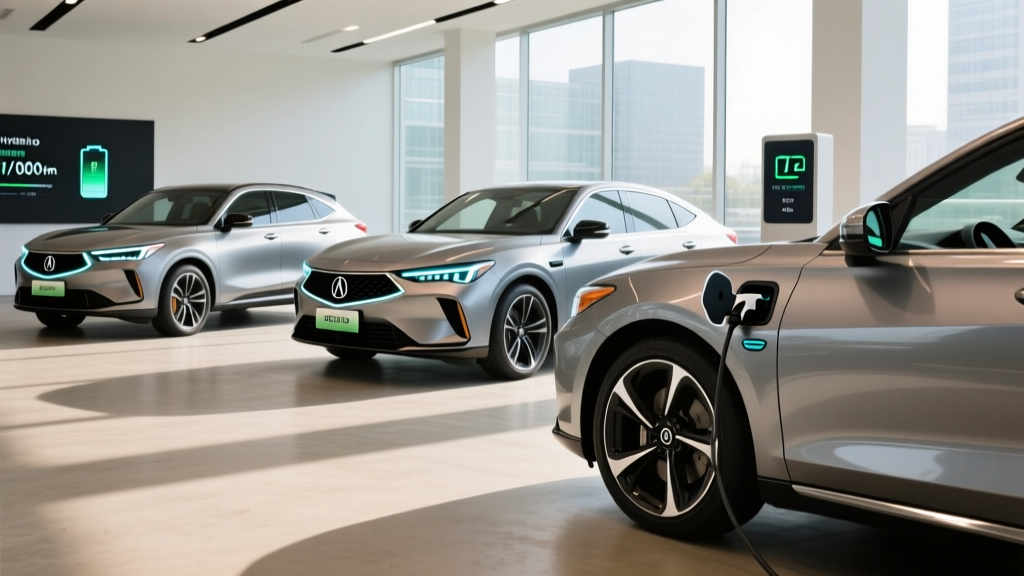
If you've been browsing Acura's showroom wondering whether the brand offers any electrified options, the short answer is yes — but the details matter. Acura sells both a conventional hybrid (HEV) and a plug-in hybrid (PHEV) in its 2026 lineup, and the two serve very different drivers. This guide walks through every current Acura hybrid model with exact EPA fuel economy, electric-only range, powertrain output, pricing, and real-world ownership considerations so you can decide whether an Acura hybrid fits your commute — or whether a full BEV or a gas model makes more sense.
Does Acura Make a Hybrid? The 2026 Lineup at a Glance
Acura currently offers two electrified vehicles in the U.S. market:
- Acura Integra (HEV) — a conventional hybrid sedan that never needs to be plugged in, introduced for the 2025 model year and continuing into 2026.
- Acura MDX PHEV (Type S) — a plug-in hybrid three-row SUV with a usable electric-only range and a 1.5-liter turbocharged four-cylinder paired with electric motors.
Acura previously sold the MDX Sport Hybrid (a conventional HEV) through the 2020 model year before discontinuing it. The current PHEV replaced that slot in the lineup. If you're shopping for an Acura hybrid today, your two choices are the Integra HEV and the MDX PHEV.
HEV vs PHEV — What's the Difference?
Conventional Hybrid (HEV): Uses a small battery (typically 1–2 kWh) recharged by the engine and regenerative braking. You never plug it in. It improves fuel economy, especially in city driving, but has no electric-only range.
Plug-in Hybrid (PHEV): Carries a larger battery (15–25 kWh) that you can charge from a wall outlet or Level 2 charger. It offers a meaningful electric-only range (typically 25–50 miles) before the gas engine kicks in, functioning as a hybrid afterward.
Acura Integra Hybrid: EPA MPG and Powertrain Specs
The Acura Integra HEV pairs a 2.0-liter Atkinson-cycle four-cylinder engine with a two-motor hybrid system. Combined output is approximately 200 horsepower, routed through an e-CVT transmission to the front wheels. The system prioritizes electric-motor propulsion at low speeds, switching seamlessly to the gasoline engine at highway cruising speeds.
| Spec | Value |
|---|---|
| Powertrain | 2.0L 4-cyl + 2-motor hybrid system |
| Combined Horsepower | 200 hp |
| Drivetrain | FWD, e-CVT |
| EPA MPG (City / Hwy / Combined) | 50 / 42 / 47 mpg |
| Fuel Tank | 12.4 gal |
| Total Range | ~580 miles |
| 0–60 mph (est.) | ~7.2 sec |
| Starting MSRP | $34,500 |
How Many MPG Does the Acura Integra Hybrid Get?
The EPA rates the 2026 Integra HEV at 50 mpg city / 42 mpg highway / 47 mpg combined, per fueleconomy.gov. These are strong numbers that rival the Honda Civic Hybrid, which shares its underlying platform.
Real-world MPG note: Conventional hybrids typically exceed their EPA city estimate in stop-and-go traffic, where regenerative braking and electric-motor assist do the heavy lifting. Owners who drive predominantly in urban environments often report 50–54 mpg in warm weather. Highway-heavy commutes will trend closer to 40–43 mpg, since the gasoline engine carries more of the load at sustained speeds. In cold weather (below 30°F), expect a 5–10% reduction as the engine runs more frequently to provide cabin heat and maintain battery temperature.
Acura MDX PHEV: Electric-Only Range and Powertrain
The Acura MDX PHEV (badged as the Type S PHEV in some trims) is the brand's only plug-in hybrid. It uses a turbocharged engine paired with a more powerful electric motor system and a larger lithium-ion battery pack mounted under the floor. Unlike the discontinued MDX Sport Hybrid, the PHEV can be plugged in and driven on electricity alone for daily commuting.
| Spec | Value |
|---|---|
| Powertrain | 2.0L turbo 4-cyl + electric motor system |
| Combined Horsepower | 362 hp (Type S PHEV) |
| Drivetrain | SH-AWD |
| Battery Capacity (usable) | 17.5 kWh |
| EPA Electric-Only Range | 32 miles |
| EPA MPGe (electric + gas) | 84 MPGe |
| EPA MPG (gas only, after battery depleted) | 24 city / 26 hwy / 25 combined |
| Total Combined Range | ~410 miles |
| Level 2 Charging Time (0–100%) | ~4.5 hours at 3.6 kW |
| DC Fast Charging | Not supported |
| 0–60 mph | 5.6 sec |
| Starting MSRP | $62,600 |
How Far Can the Acura MDX PHEV Go on Electric Only?
The EPA rates the MDX PHEV at 32 miles of electric-only range. In real-world driving, expect 26–30 miles in mixed conditions and as low as 20–24 miles in cold weather or at sustained highway speeds above 65 mph. The electric motor can propel the MDX PHEV up to approximately 80 mph before the gasoline engine intervenes, making it viable for most suburban commutes without burning fuel.
Charging the MDX PHEV: The 17.5 kWh battery charges via a J1772 connector at up to 3.6 kW on a Level 2 (240V) home charger, reaching a full charge in roughly 4.5 hours. On a standard 120V household outlet (Level 1), expect about 12–14 hours for a full charge. The MDX PHEV does not support DC fast charging — this is common for PHEVs, whose smaller batteries make Level 2 charging adequate for overnight replenishment.
Fuel Economy Comparison: Acura Hybrids vs Key Competitors
| Vehicle | City | Highway | Combined | EV Range (mi) | MSRP |
|---|---|---|---|---|---|
| Acura Integra HEV | 50 | 42 | 47 | — | $34,500 |
| Honda Civic Hybrid | 50 | 43 | 47 | — | $30,350 |
| Toyota Prius | 57 | 56 | 57 | — | $28,550 |
| Acura MDX PHEV | 24* | 26* | 25* | 32 | $62,600 |
| BMW X5 xDrive50e PHEV | 22* | 24* | 23* | 38 | $73,200 |
| Volvo XC90 Recharge PHEV | 26* | 27* | 27* | 32 | $76,800 |
* Gas-only MPG after battery is depleted. PHEVs use electricity first; MPG applies only once the battery is exhausted.
Battery Warranty, Reliability, and Replacement Cost
Hybrid Battery Warranty Coverage
Acura Integra HEV: Hybrid battery covered for 8 years / 100,000 miles (10 years / 150,000 miles in CARB states including CA, NY, MA, and others).
Acura MDX PHEV: High-voltage battery covered for 8 years / 100,000 miles (extended to 10 years / 150,000 miles in CARB states). Federal law mandates a minimum of 8 years / 80,000 miles for all hybrid and EV battery packs.
Battery replacement cost: If out of warranty, an Integra HEV battery replacement typically runs $2,500–$4,000 (parts and labor). The MDX PHEV's larger pack is more expensive at $6,000–$9,000. However, hybrid battery failures within the first 10–15 years are statistically uncommon — Toyota and Honda hybrid systems, which underpin Acura's technology, have demonstrated strong long-term reliability across millions of vehicles.
Acura's hybrid systems benefit from Honda's decades of hybrid engineering, dating back to the original Insight in 1999. The two-motor system used in the Integra HEV is a proven architecture shared with the Accord Hybrid and Civic Hybrid. Independent reliability data from sources like Consumer Reports generally rates Honda/Acura hybrid powertrains as above average, with most reported issues relating to 12V auxiliary batteries or infotainment software rather than the high-voltage hybrid system itself.
Tax Credits and Incentives for Acura Hybrids
This is where HEV and PHEV diverge sharply:
- Acura Integra HEV: Conventional hybrids do not qualify for the federal §30D clean vehicle tax credit. That credit is reserved for plug-in vehicles (BEVs and PHEVs) meeting battery-sourcing and critical-mineral requirements. Some states may offer small rebates for HEVs, but these are uncommon and vary by jurisdiction — check your state energy office for current programs.
- Acura MDX PHEV: The MDX PHEV may qualify for up to $7,500 under the IRS §30D credit, but eligibility depends on several conditions that change frequently:
- Buyer adjusted gross income must not exceed $150,000 (single) / $300,000 (joint) / $225,000 (head of household)
- Vehicle MSRP must not exceed $80,000 for SUVs (the MDX PHEV qualifies)
- Battery components and critical minerals must meet domestic-sourcing thresholds that tighten annually — per IRS.gov, these requirements may reduce or eliminate the credit for certain models depending on the tax year
- The credit can now be transferred to the dealer at point of sale, reducing your purchase price directly
Important: Tax credit eligibility rules under §30D are subject to legislative and regulatory changes. Consult a tax professional and verify current eligibility on the IRS Clean Vehicle Credit page before relying on the credit in your purchase decision.
Hybrid vs PHEV vs Full EV: Which Acura Is Right for You?
Choose the Integra HEV If…
- You want maximum MPG without ever plugging in
- You live in an apartment or lack home charging access
- Your budget is under $40,000
- You drive a mix of city and highway and want 580+ miles of total range
- You want a proven, low-maintenance hybrid system
Choose the MDX PHEV If…
- You have home charging (Level 2 or even a 120V outlet) and a commute under 30 miles
- You want to drive mostly on electricity on weekdays but need gas-engine range for road trips
- You need three rows of seating and SH-AWD
- You want 362 hp with the Type S performance variant
- You may qualify for the §30D federal tax credit
Consider a Full BEV Instead If…
- You have reliable home Level 2 charging and want zero gasoline expenses
- Your daily driving is under 250 miles and you rarely tow
- You want the lowest per-mile energy cost and minimal drivetrain maintenance
- You're open to brands like Tesla, Hyundai, BMW, or Rivian that Acura doesn't compete with in BEVs
The Bottom Line on Acura's Hybrid Strategy
Acura's hybrid lineup in 2026 is small but purposeful. The Integra HEV delivers class-leading fuel economy for a luxury compact sedan, leveraging Honda's proven two-motor hybrid system to hit 47 mpg combined without ever needing a plug. The MDX PHEV fills a different niche — a three-row family hauler that can handle most weekday commutes on electricity while eliminating range anxiety for longer trips.
What Acura does not yet offer is a fully electric vehicle. Parent company Honda has been slower to market with BEVs than competitors, though the Acura ZDX (a battery-electric SUV developed with GM's Ultium platform) was offered for the 2024 model year before being discontinued. If a fully electric Acura is a priority, you'll need to watch for future announcements — as of 2026, the Integra HEV and MDX PHEV are the brand's electrified options.
Frequently Asked Questions
Does Acura make a fully electric car in 2026?
Not currently. The Acura ZDX, an all-electric SUV built on GM's Ultium platform, was sold for the 2024 model year but has been discontinued. As of the 2026 model year, Acura's electrified lineup consists of the Integra HEV (conventional hybrid) and the MDX PHEV (plug-in hybrid).
How many MPG does the Acura Integra Hybrid get in real-world driving?
The EPA rates it at 50 city / 42 highway / 47 combined. In real-world city driving, many owners report 50–54 mpg in warm weather. Highway-heavy driving tends to yield 40–43 mpg. Cold weather reduces efficiency by roughly 5–10%.
Does the Acura MDX PHEV qualify for the $7,500 federal tax credit?
It may, but eligibility depends on your income, the vehicle's battery-sourcing compliance for the current tax year, and MSRP caps. The MDX PHEV's MSRP is under the $80,000 SUV cap. Check the IRS Clean Vehicle Credit page and consult a tax professional for your specific situation.
Do I need to plug in the Acura Integra Hybrid?
No. The Integra HEV is a conventional hybrid — its small battery is recharged by the gasoline engine and regenerative braking. You fuel it like any other gas car and never need a charger or outlet.
How long will the hybrid battery last in an Acura?
Acura covers the hybrid battery for 8 years / 100,000 miles (10 years / 150,000 miles in CARB states). Based on long-term data from Honda's hybrid systems, these batteries commonly last 12–15 years or 150,000+ miles before significant degradation. Out-of-warranty replacement costs $2,500–$4,000 for the Integra HEV and $6,000–$9,000 for the MDX PHEV.
Can the Acura MDX PHEV charge at a DC fast-charging station?
No. Like most plug-in hybrids, the MDX PHEV only supports Level 1 (120V) and Level 2 (240V) AC charging via a J1772 connector. Its 17.5 kWh battery charges fully in about 4.5 hours on a Level 2 home charger. DC fast charging is not supported and is generally unnecessary for PHEV battery sizes.
Hybrid vs PHEV vs EV — which fits my lifestyle?
Choose a conventional hybrid (HEV) if you want better MPG with zero lifestyle change — no plugs, no charging, no range anxiety. Choose a PHEV if you can charge at home and want to drive most weekdays on electricity while keeping gas-engine flexibility for road trips. Choose a full EV (BEV) if you have reliable home charging, want the lowest operating cost, and your driving patterns fit within a 250–350 mile range.