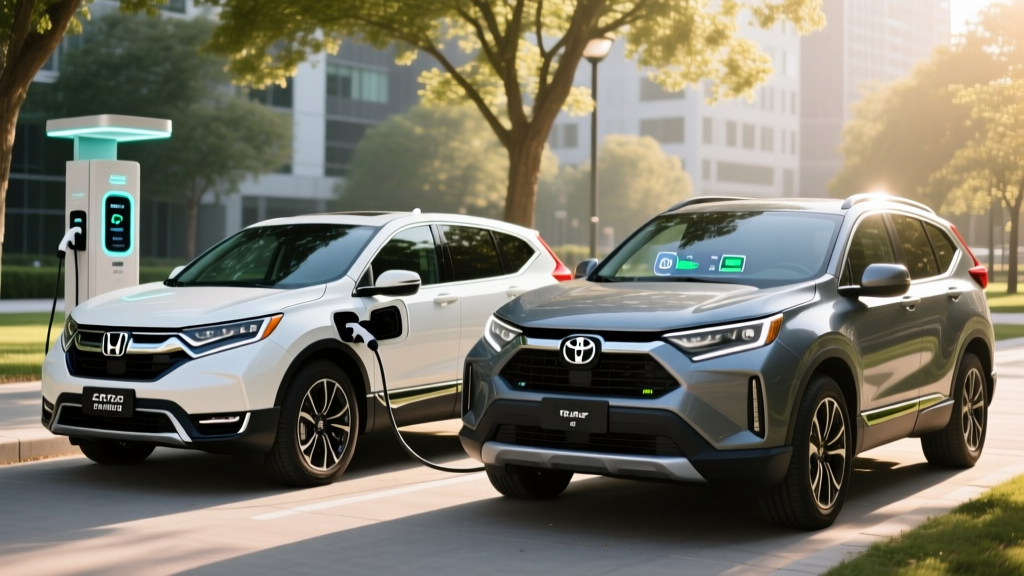
The compact hybrid SUV segment has two undisputed heavyweights, and if you're cross-shopping them, you've already made one smart decision: skipping the gas-only variants. The 2026 Honda CR-V Hybrid and 2026 Toyota RAV4 Hybrid deliver mid-40s MPG in real-world city driving, standard all-wheel drive on most trims, and cargo space that rivals many midsize crossovers. But they achieve those numbers with fundamentally different engineering philosophies — and the differences matter once you own one.
Below, we break down every spec that counts: EPA and real-world fuel economy, powertrain architecture, battery warranty, pricing, and which one actually fits your driving pattern.
HEV vs PHEV: What You're Actually Buying
Both the CR-V Hybrid and RAV4 Hybrid are conventional hybrids (HEVs) — not plug-in hybrids. This distinction matters because it defines how you interact with the vehicle daily:
Conventional Hybrid (HEV) — CR-V Hybrid & RAV4 Hybrid:
- No plug, no charging cable, no behavior change required
- Small battery (~1.0–1.6 kWh) recharged by regenerative braking and the gas engine
- Electric motor assists the engine and enables brief EV-only driving at low speeds (typically under 1 mile)
- Fuel economy benefit: 35–50% improvement over gas-only equivalents
Plug-in Hybrid (PHEV) — RAV4 Prime / CR-V e:PHEV (where available):
- Larger battery (18–19 kWh) charged via plug (Level 1 or Level 2)
- 35–42 miles of electric-only range before the gas engine engages
- Higher upfront cost; may qualify for federal tax credits
- Best for drivers with home charging and short daily commutes
If you're reading this comparison, you're likely looking at the HEV versions. We'll note where the PHEV variants (RAV4 Prime and the CR-V e:FHEV/e:PHEV sold in select markets) change the math.
Fuel Economy: EPA Numbers and Real-World MPG
This is the headline category, and it's closer than you might think — but the CR-V Hybrid has pulled ahead in the current generation.
| Metric | 2026 Honda CR-V Hybrid AWD | 2026 Toyota RAV4 Hybrid AWD |
|---|---|---|
| EPA City | 43 MPG | 41 MPG |
| EPA Highway | 36 MPG | 38 MPG |
| EPA Combined | 40 MPG | 39 MPG |
| Real-World Combined (owner-reported avg) | 38–42 MPG | 37–41 MPG |
| Fuel Tank Capacity | 14.0 gal | 14.5 gal |
| Total Driving Range (est.) | ~520–560 mi | ~535–565 mi |
Real-world context: Honda's two-motor hybrid system excels in city and suburban driving, where it can run on electric power more frequently at low speeds. Owners on fueleconomy.gov consistently report 40–44 MPG in mixed city commuting. Highway-heavy drivers will see numbers closer to 34–36 MPG in both vehicles — hybrids lose their advantage at sustained high speeds where the gas engine does most of the work.
The RAV4 Hybrid's slightly larger fuel tank gives it a marginal total-range advantage on long road trips, even though its combined EPA rating trails by 1 MPG. In practice, both will comfortably cover 500+ miles between fill-ups.
Powertrain Specs: Two-Motor Honda vs Toyota's Series-Parallel
| Specification | 2026 CR-V Hybrid | 2026 RAV4 Hybrid |
|---|---|---|
| Engine | 2.0L 4-cyl Atkinson cycle | 2.5L 4-cyl Atkinson cycle |
| Combined System HP | 204 hp | 219 hp |
| Combined Torque | 247 lb-ft | 163 lb-ft (engine) + motor torque |
| Transmission | e-CVT (two-motor system) | e-CVT (planetary gearset) |
| AWD System | Rear electric motor (no driveshaft) | Rear electric motor (no driveshaft) |
| 0-60 mph (est.) | ~7.6 sec | ~7.4 sec |
| Towing Capacity | 1,000 lbs | 1,750 lbs |
| Hybrid Battery | ~1.06 kWh (lithium-ion) | ~1.6 kWh (nickel-metal hydride / Li-ion by trim) |
The RAV4 Hybrid's larger 2.5L engine and 219 combined horsepower give it a slight edge in acceleration and highway passing confidence. The CR-V's 2.0L is smaller but compensates with higher electric-motor torque output at low speeds — which is why it feels responsive around town despite the lower peak horsepower figure.
Both use electric-motor-based AWD systems (a dedicated rear motor rather than a mechanical driveshaft), which reduces weight and improves packaging. Toyota's AWD system includes a more aggressive torque-vectoring rear motor on Woodland Edition trims, giving it a slight traction edge in snow and loose surfaces.
One practical differentiator: towing. The RAV4 Hybrid's 1,750-lb rating nearly doubles the CR-V Hybrid's 1,000-lb limit. If you're pulling a small utility trailer or a pair of jet skis, the Toyota is the clear pick.
Pricing, Trims, and Tax Credit Eligibility
| Trim | 2026 CR-V Hybrid MSRP | 2026 RAV4 Hybrid MSRP |
|---|---|---|
| Base (Sport / LE) | ~$36,395 | ~$33,850 |
| Mid (Sport Touring / XLE) | ~$39,895 | ~$36,250 |
| Top (Sport Touring / Limited) | ~$42,895 | ~$40,550 |
The RAV4 Hybrid starts roughly $2,500 lower than the CR-V Hybrid, and that gap holds across most comparable trim levels. Honda positions the CR-V Hybrid slightly more upscale, with the Sport and Sport Touring trims featuring more standard equipment at each level, but Toyota's broader trim spread (LE through Limited, plus the adventure-oriented Woodland Edition) gives buyers more choice.
Does Either Qualify for a Federal Tax Credit?
No — not the HEV versions. Under current IRS §30D rules, the federal clean vehicle credit applies only to plug-in electric vehicles (BEVs and PHEVs) that meet battery-sourcing, MSRP, and buyer-income requirements. Conventional hybrids like the CR-V Hybrid and RAV4 Hybrid do not qualify for the federal credit.
If you're considering the RAV4 Prime (PHEV), it has historically qualified for a partial federal credit, but eligibility depends on current-year battery-component and critical-mineral sourcing rules, which change annually. Check the latest IRS guidance or consult a tax professional before relying on credit amounts.
Some states offer separate incentives for hybrids — California's CVRP program, for instance, has historically focused on BEVs and PHEVs, but certain local utility rebates cover hybrid purchases. Always verify with your state energy office.
Battery Warranty, Lifespan, and Replacement Cost
Hybrid Battery Warranty — Both Vehicles:
- Federal emissions warranty (mandated): 8 years / 80,000 miles
- California & CARB states: 10 years / 150,000 miles
- Toyota hybrid battery coverage: 10 years / 150,000 miles (nationwide, from 2020 model year onward)
- Honda hybrid battery coverage: 8 years / 100,000 miles (nationwide; 10/150k in CARB states)
Hybrid batteries are not the ticking time bomb that early-2000s forum posts suggested. Modern lithium-ion hybrid packs are designed for shallow cycling — they never fully charge or fully discharge, which dramatically extends cell life. Data from fleets and high-mileage owners shows Toyota's hybrid batteries routinely lasting 150,000–200,000+ miles with minimal capacity loss.
Replacement cost if out of warranty:
- RAV4 Hybrid battery replacement: $3,000–$5,000 (OEM), with refurbished options around $2,000–$3,000
- CR-V Hybrid battery replacement: $2,500–$4,500 (OEM), with a growing refurbished market
For context, a conventional automatic transmission replacement on a gas car often costs $3,500–$5,500 — and those fail far more frequently than hybrid batteries. The hybrid premium is effectively insurance against battery cost.
IIHS safety ratings for both vehicles remain strong, with both earning Top Safety Pick designations in recent years. Neither has reported systemic hybrid-battery safety issues.
Driving Experience: Where They Differ on the Road
Spec sheets don't capture everything. Having driven both extensively, here's where they diverge in daily use:
Honda CR-V Hybrid — The two-motor system operates more like a series hybrid at city speeds (engine generates electricity, motor drives the wheels) and switches to direct engine drive at highway speeds. The result is smooth, EV-like acceleration from stops with minimal engine drone. The cabin is noticeably quieter than the RAV4's, particularly under hard acceleration. Honda's hybrid system also integrates more seamlessly with regenerative braking — the transition from regen to friction braking is nearly imperceptible.
Toyota RAV4 Hybrid — Toyota's planetary-gearset e-CVT is one of the most proven hybrid systems in existence (over 25 years of Prius lineage). It's bulletproof reliable but produces more noticeable engine drone under hard acceleration, especially climbing grades. The RAV4 compensates with a slightly firmer ride, better visibility from the driver's seat, and more intuitive physical controls for climate and audio.
CR-V Hybrid Pros
- Higher EPA combined MPG (40 vs 39)
- Quieter cabin, smoother EV-mode transitions
- More spacious rear seat and cargo area (39.3 cu ft behind rear seats)
- Better real-world city MPG (often 42+ in stop-and-go)
CR-V Hybrid Cons
- Higher starting price (~$2,500 more)
- Lower towing capacity (1,000 lbs)
- Shorter hybrid battery warranty outside CARB states
- Fewer trim options (Sport / Sport Touring)
RAV4 Hybrid Pros
- Lower starting MSRP, more trim variety
- Higher towing (1,750 lbs) and more horsepower (219 hp)
- 10-year/150k battery warranty nationwide
- Woodland Edition for light off-road use
RAV4 Hybrid Cons
- More engine noise under acceleration
- Slightly less rear legroom and cargo space
- Lower city MPG (41 vs 43 EPA city)
- Infotainment interface trails Honda's in responsiveness
Hybrid vs PHEV vs Full EV: Which Fits Your Life?
The CR-V and RAV4 exist in a broader electrification landscape. Here's a decision framework:
Choose a conventional hybrid (CR-V Hybrid / RAV4 Hybrid) if:
- You don't have access to home or workplace charging
- You take frequent road trips and don't want to plan around charging stops
- You want maximum fuel savings with zero behavior change
- Your budget is under $42,000
Choose a PHEV (RAV4 Prime) if:
Choose a full EV (e.g., Tesla Model Y, Hyundai Ioniq 5, Honda Prologue) if:
- You have reliable home Level 2 charging
- Your daily driving is under 250 miles and you can plan road-trip charging
- You want to eliminate gas expenses and reduce maintenance (no oil changes, fewer moving parts)
- You qualify for the §30D federal tax credit (up to $7,500, with income and sourcing requirements)
The hybrid is the lowest-risk entry point into electrification. You get 35–50% fuel savings, no charging infrastructure dependency, and proven long-term reliability — at the cost of not fully eliminating gas.
5-Year Ownership Cost Estimate
| Cost Category | CR-V Hybrid AWD (Sport Touring) | RAV4 Hybrid AWD (XLE) |
|---|---|---|
| MSRP (approx.) | $39,895 | $36,250 |
| Fuel (5 yr / 75,000 mi at $3.50/gal) | $6,563 | $6,731 |
| Insurance (5 yr est.) | $8,200 | $7,800 |
| Maintenance (5 yr est.) | $2,800 | $2,600 |
| Depreciation (5 yr est.) | $18,500 | $16,200 |
| Est. 5-Year Total | ~$57,458 | ~$53,381 |
The RAV4 Hybrid's lower entry price and strong resale value give it a roughly $4,000 advantage over five years. The CR-V Hybrid's slightly better fuel economy saves about $170 in fuel over that period — not enough to close the gap. However, the CR-V's larger interior and quieter ride may be worth the premium depending on your priorities.
Frequently Asked Questions
How many MPG does the CR-V Hybrid actually get in real driving?
Owner-reported data on fueleconomy.gov shows the CR-V Hybrid averaging 38–42 MPG combined. City-heavy drivers often exceed the 43 MPG city EPA rating, while highway-dominant commutes at 75+ mph typically return 34–36 MPG. Cold weather reduces MPG by roughly 5–10% due to increased engine idling for cabin heat.
How many MPG does the RAV4 Hybrid get?
Real-world RAV4 Hybrid fuel economy clusters around 37–41 MPG combined. The EPA rates it at 41 city / 38 highway / 39 combined. Like the Honda, city driving favors the hybrid system, while sustained highway speeds narrow the gap with gas-only competitors.
Does either hybrid qualify for a federal tax credit?
No. The IRS §30D clean vehicle credit applies only to plug-in vehicles (BEVs and PHEVs) meeting battery-sourcing and MSRP requirements. Neither the CR-V Hybrid nor the RAV4 Hybrid qualifies. The RAV4 Prime (PHEV) may qualify for a partial credit depending on current-year sourcing rules — verify at irs.gov.
How long do hybrid batteries last, and what does replacement cost?
Modern hybrid batteries routinely last 150,000–200,000+ miles. Toyota covers its hybrid battery for 10 years/150,000 miles nationwide; Honda covers 8 years/100,000 miles (10/150k in CARB states). Out-of-warranty replacement runs $2,500–$5,000 for OEM packs, with refurbished options available for $2,000–$3,000.
Is the RAV4 Prime PHEV worth the premium over the RAV4 Hybrid?
The RAV4 Prime offers 42 miles of electric-only range, 302 combined horsepower, and available federal tax credits. If you have home charging and a short commute, the PHEV can eliminate most gas usage on weekdays. But the $8,000–$10,000 price premium over the RAV4 Hybrid takes 6–8 years to recoup in fuel savings alone for most drivers. The PHEV makes financial sense primarily if you qualify for the federal credit and drive under 40 miles daily.
Which is more reliable — Honda or Toyota's hybrid system?
Toyota's Hybrid Synergy Drive has the longest track record in the industry (since 1997 with the Prius) and consistently tops reliability surveys from Consumer Reports and J.D. Power. Honda's two-motor system (introduced in the 2014 Accord Hybrid) is newer but has proven robust in the CR-V and Accord. Both rate above average for the segment. Toyota's longer nationwide battery warranty provides additional peace of mind.
Can I tow with either hybrid?
Yes, but the RAV4 Hybrid is significantly more capable: 1,750 lbs vs the CR-V Hybrid's 1,000 lbs. Neither is suitable for large trailers or boats, but the RAV4 can handle a small utility trailer, bike rack with cargo, or lightweight camper.