Quick Verdict: The Corolla XLE Hybrid at a Glance
The Toyota Corolla XLE Hybrid occupies a narrow but important lane: it's the premium-trim conventional hybrid (HEV) in Toyota's most affordable sedan lineup. For 2026, the Corolla XLE Hybrid pairs a 1.8-liter four-cylinder engine with Toyota's fifth-generation hybrid transaxle and electronic on-demand all-wheel drive, returning an EPA-estimated 50 MPG combined. Starting around $28,600, it undercuts most plug-in hybrids and full EVs on price while eliminating range anxiety entirely — you fuel it like any gasoline car and never plug in.
This is not a plug-in hybrid. There is no electric-only driving mode, no charging port, and no federal EV tax credit. What the XLE Hybrid does offer is exceptional city fuel economy, proven Toyota hybrid reliability, and the SofTex-trimmed interior and tech upgrades that distinguish the XLE from the base LE Hybrid. If your commute is stop-and-go urban or suburban and you lack home charging access, this powertrain makes more financial sense than a PHEV or BEV.
Corolla XLE Hybrid Fuel Economy: EPA and Real-World MPG
| Metric | Value |
|---|---|
| City MPG | 53 |
| Highway MPG | 46 |
| Combined MPG | 50 |
| Fuel Tank Capacity | 11.4 gallons |
| Total Driving Range | ~570 miles |
Source: EPA / fueleconomy.gov
HEV vs PHEV vs EV: Which Powertrain Fits You?
The Corolla XLE is available only as a conventional hybrid (HEV). Toyota does not offer a Corolla plug-in hybrid in the U.S. market. Understanding the distinction is essential before cross-shopping:
| Feature | HEV (Corolla Hybrid) | PHEV (e.g., Prius Prime) | BEV (e.g., bZ4X) |
|---|---|---|---|
| Plug-in Required? | No | Yes (Level 1/2) | Yes (Level 2/DC) |
| Electric-Only Range | None (assist only) | ~40–44 miles | 220–252 miles |
| Fuel Type | Gasoline | Gasoline + Electricity | Electricity only |
| Federal Tax Credit (§30D) | Not eligible | Up to $7,500* | Up to $7,500* |
| Typical Starting MSRP | ~$28,600 | ~$33,400 | ~$37,000+ |
| Home Charging Needed? | No | Recommended | Essential |
*Federal §30D credit eligibility depends on MSRP caps, buyer income limits, battery critical-mineral sourcing, and point-of-sale transfer rules. Always verify current-year eligibility at IRS.gov.
Choose the Corolla XLE Hybrid (HEV) If:
- You rent or live where home charging installation isn't feasible
- Your budget is under $30,000 and you want minimal operating cost
- You drive mostly city/suburban miles where hybrid regen excels
- You want zero behavioral change from your current gas car routine
Consider a PHEV or BEV Instead If:
- You have reliable Level 2 home charging and want to drive mostly on electricity
- You qualify for the full $7,500 federal credit, which can erase the PHEV price premium
- Your daily commute is under 40 miles round-trip (PHEV covers it on battery alone)
Powertrain Specs: What Moves the Corolla XLE Hybrid
| Specification | Detail |
|---|---|
| Engine | 1.8L 4-cylinder Atkinson-cycle |
| Hybrid System | Toyota Hybrid System (5th gen) |
| Combined Net Horsepower | 138 hp |
| Drivetrain | Electronic On-Demand AWD |
| Transmission | Continuously Variable (eCVT) |
| 0–60 mph (est.) | ~9.0 seconds |
| Hybrid Battery | Lithium-ion, ~1.0 kWh (not plug-in) |
| Regenerative Braking | Yes, with B-mode for stronger regen |
The 138 hp combined output is modest by modern standards, but the electric motor's instant torque fills in the low-end response that small displacement engines typically lack. The eCVT is a power-split device — not a belt-driven CVT — so there is no rubber-band sensation during acceleration. AWD is standard on all Corolla Hybrid trims via a separate rear-mounted electric motor that engages when slip is detected.
The hybrid battery pack is small (~1.0 kWh usable) because it functions as a buffer: it captures braking energy and assists the gas engine during acceleration, but it cannot propel the car on electricity alone for meaningful distances. This is the fundamental distinction between an HEV and a PHEV.
Pricing, Trims, and Tax Credit Eligibility
| Trim | Starting MSRP | XLE-Specific Features |
|---|---|---|
| LE Hybrid | ~$24,600 | — |
| XLE Hybrid | ~$28,600 | SofTex seats, 8" touchscreen, wireless CarPlay/Android Auto, 7" digital cluster, ambient lighting, Smart Key on all doors |
The XLE trim adds roughly $4,000 over the LE Hybrid. The primary upgrades are interior materials and convenience tech — not powertrain differences. Both trims share the same 138 hp hybrid system, AWD, and 50 MPG combined rating.
Federal Tax Credit Status
The Corolla Hybrid does not qualify for the IRS §30D Clean Vehicle Credit. That credit applies only to plug-in electric vehicles (PHEVs and BEVs) with battery capacities of at least 7 kWh and meeting critical-mineral and battery-component sourcing requirements. The Corolla Hybrid's ~1.0 kWh battery is far below the threshold.
Some states offer their own incentives for efficient hybrids, but these are increasingly rare as state programs shift toward plug-in vehicles. Check your state's energy office or department of environmental quality for current programs.
Battery Warranty, Reliability, and Replacement Cost
Toyota's hybrid battery longevity is among the best-documented in the industry. The Prius, which shares hybrid architecture lineage with the Corolla, has demonstrated hybrid battery packs lasting 150,000–200,000+ miles before significant degradation. The Corolla Hybrid's lithium-ion pack is smaller and less stressed than a PHEV or BEV battery, since it never deep-cycles — it operates in a narrow state-of-charge window (roughly 40–80%) managed by the hybrid control system.
If the hybrid battery does require replacement outside warranty, expect a cost of approximately $2,000–$3,500 for a new OEM pack from a Toyota dealer, or $1,000–$2,000 for a refurbished unit from independent hybrid specialists. This is dramatically less than a BEV battery replacement, which can exceed $10,000–$20,000.
Overall Reliability
Toyota consistently ranks at or near the top of J.D. Power and Consumer Reports reliability surveys. The hybrid transaxle has fewer wear components than a conventional automatic transmission — no clutch packs, torque converter, or gear sets to fail. Brake pad life is extended significantly (often 80,000+ miles) because regenerative braking handles most deceleration. The 12V auxiliary battery is the most common replacement item and costs $150–$250.
XLE Interior, Tech, and Safety
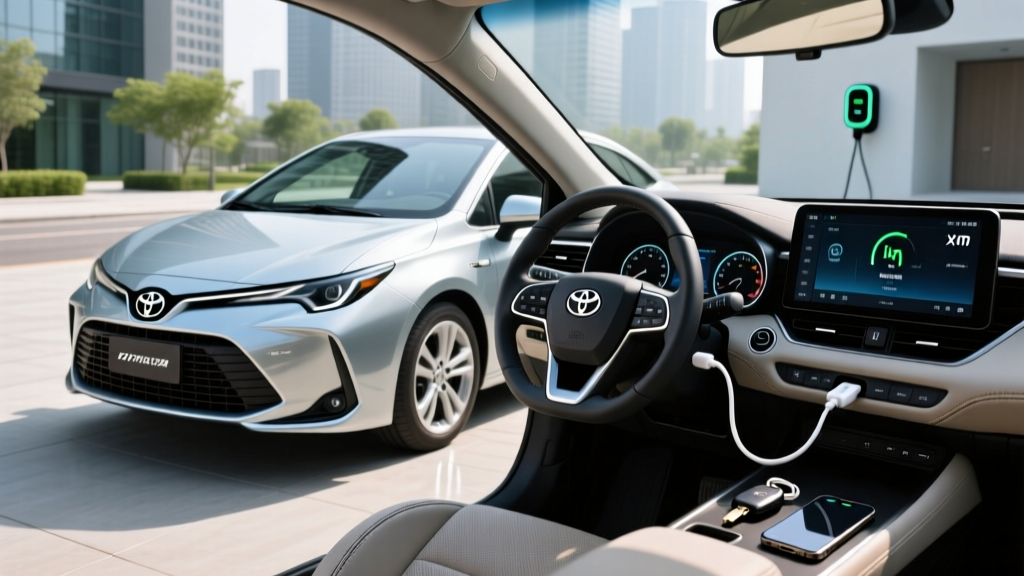
The XLE trim's value proposition centers on cabin upgrades that the LE Hybrid lacks:
- Upholstery: SofTex synthetic leather (more durable and easier to clean than cloth)
- Infotainment: 8-inch touchscreen with wireless Apple CarPlay and Android Auto
- Instrument Cluster: 7-inch digital display with hybrid energy-flow monitor
- Climate: Automatic single-zone with rear vents
- Convenience: Smart Key system on all four doors, push-button start, auto-dimming rearview mirror
- Lighting: LED headlights with auto high-beam, ambient interior lighting
Toyota Safety Sense 3.0 is standard across all trims and includes:
- Pre-Collision System with Pedestrian Detection
- Full-Speed Range Dynamic Radar Cruise Control
- Lane Departure Alert with Steering Assist
- Lane Tracing Assist
- Road Sign Assist
- Proactive Driving Assist (gentle braking when approaching slower vehicles or curves)
This is a Level 1 driver-assistance suite per SAE classification. It supports the driver but does not automate steering and acceleration simultaneously in the way Level 2 systems (like Toyota's own Advanced Drive on newer models) do. The driver remains fully responsible at all times.
5-Year Ownership Cost Snapshot
| Category | Estimated Cost |
|---|---|
| Purchase Price (XLE Hybrid) | $28,600 |
| Fuel (50 MPG, $3.40/gal avg) | ~$5,100 |
| Insurance (national avg) | ~$6,500 |
| Maintenance (oil, filters, brakes, tires) | ~$2,200 |
| Federal Tax Credit | $0 (not eligible) |
| Estimated 5-Year Depreciation | ~$10,500 |
| Total Estimated 5-Year Cost | ~$31,900 |
For comparison, a similarly equipped gas-only compact sedan averaging 30 MPG combined would cost roughly $8,500 in fuel over the same period — a $3,400 fuel penalty. The Corolla Hybrid's fuel savings largely offset its higher purchase price within the first three years of ownership.
Frequently Asked Questions
How many MPG does the Corolla XLE Hybrid get?
The EPA rates it at 53 city / 46 highway / 50 combined MPG. Real-world results typically fall between 46–54 MPG depending on driving style, terrain, and temperature. City driving yields the best results because regenerative braking recaptures energy at every stop.
Does the Corolla Hybrid need to be plugged in?
No. The Corolla Hybrid is a conventional HEV — it charges its own small battery through regenerative braking and the gasoline engine. There is no charging port. You simply fill it with gasoline like any other car.
Is there a plug-in hybrid (PHEV) version of the Corolla?
Not in the U.S. market. Toyota offers the Prius Prime as its compact PHEV, with approximately 44 miles of electric-only range and a combined 52 MPG once the battery is depleted. The Prius Prime starts around $33,400 and may qualify for a partial or full federal tax credit depending on current-year sourcing rules.
Is the Corolla Hybrid battery reliable and what does replacement cost?
Toyota's hybrid batteries are covered for 10 years / 150,000 miles. Real-world data from Prius fleets shows packs routinely lasting 150,000–200,000+ miles. Out-of-warranty replacement costs $2,000–$3,500 for a new OEM unit or $1,000–$2,000 for a refurbished pack.
Does the Corolla XLE Hybrid qualify for any tax credit?
No. The IRS §30D Clean Vehicle Credit requires a plug-in vehicle with a battery capacity of at least 7 kWh. The Corolla Hybrid's ~1.0 kWh pack does not qualify. Only PHEVs and BEVs are eligible. Verify current rules at IRS.gov.
Is the AWD system always active?
No. The electronic on-demand AWD engages the rear electric motor only when the system detects front-wheel slip — during rain, snow, or hard cornering. Under normal dry-road conditions, the Corolla Hybrid operates in front-wheel drive to maximize fuel economy. There is no driver-selectable AWD mode.
How does the Corolla XLE Hybrid compare to the Prius?
The 2026 Prius offers more combined horsepower (194 hp on AWD models), a lower starting price (~$28,350 for LE AWD), and slightly better EPA combined MPG (57 for FWD, 54 for AWD). The Corolla XLE Hybrid trades some efficiency for a more traditional sedan profile, a quieter ride, and SofTex-trimmed XLE interior appointments. If performance matters, the Prius is the stronger pick. If cabin comfort and a conventional aesthetic matter more, the Corolla XLE Hybrid holds its ground.