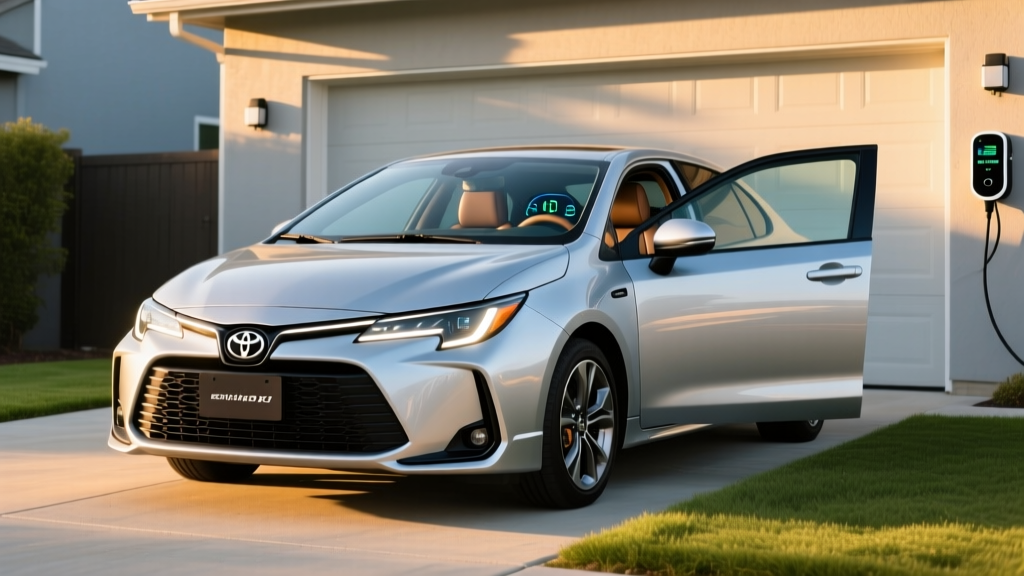
The Toyota Corolla has been America's default compact sedan for decades, but the Corolla Hybrid XLE represents the sweet spot in Toyota's electrified lineup: top-trim comfort, all-wheel drive availability, and fuel economy that routinely exceeds 50 MPG in real-world city driving. For buyers weighing a conventional hybrid against a plug-in hybrid or full EV, the 2026 Corolla Hybrid XLE makes a compelling case for simplicity — no charging cord required, no range anxiety, and a proven hybrid powertrain backed by one of the industry's longest battery warranties.
This review covers the 2026 Corolla Hybrid XLE's exact EPA fuel economy, real-world MPG observations, powertrain specs, pricing, federal tax credit eligibility, and battery longevity — everything you need to decide if this is the right electrified vehicle for your daily commute.
2026 Corolla Hybrid XLE: Quick Specs at a Glance
| Specification | Value |
|---|---|
| Powertrain Type | Conventional Hybrid (HEV) — no plug-in required |
| Engine | 1.8L 4-cylinder Atkinson-cycle + dual electric motors |
| Combined Horsepower | 138 hp (net system output) |
| Drivetrain | AWD (Electronic On-Demand, standard on XLE) |
| EPA MPG (City / Highway / Combined) | 53 / 46 / 50 MPG |
| Fuel Tank Capacity | 11.4 gallons |
| Total Range (estimated) | ~570 miles |
| Hybrid Battery | Lithium-ion, ~1.3 kWh (not plug-in chargeable) |
| 0-60 mph | ~9.1 seconds (estimated) |
| Battery Warranty | 10 years / 150,000 miles |
| Base MSRP (XLE AWD) | $28,850 (before destination) |
| Federal Tax Credit | Not eligible (§30D requires plug-in capability) |
EPA vs. Real-World MPG: What You'll Actually See
The EPA rates the 2026 Corolla Hybrid XLE at 53 city / 46 highway / 50 combined MPG with its standard all-wheel-drive system. These figures come from fueleconomy.gov, and they tell only part of the story.
In real-world driving, Toyota's fifth-generation hybrid system tends to outperform its EPA city rating. During mixed urban and suburban driving with moderate temperatures, owners commonly report 52-58 MPG in city conditions, where regenerative braking recovers the most energy. Highway driving at sustained 70-75 mph speeds typically yields 43-47 MPG, slightly below the EPA highway figure, as aerodynamic drag dominates at higher speeds and the electric motor assists less.
- City / Suburban: 52-58 MPG (often exceeds EPA 53)
- Highway (65-75 mph): 43-47 MPG (slightly below EPA 46)
- Mixed Daily Commute: 48-54 MPG depending on route profile
- Cold Weather (below 30°F): Expect 5-10% reduction due to cabin heating and reduced battery efficiency
Unlike full EVs, which can lose 20-30% of range in extreme cold, the Corolla Hybrid's gasoline engine provides cabin heat efficiently, minimizing winter fuel-economy penalties. The hybrid battery's small capacity also means cold-weather degradation has minimal impact on overall efficiency.
HEV vs. PHEV vs. EV: Where Does the Corolla Hybrid Fit?
A common question from shoppers is whether the Corolla Hybrid is a plug-in hybrid. It is not. The Corolla Hybrid is a conventional hybrid electric vehicle (HEV) — it generates all its electricity internally through regenerative braking and the gasoline engine. You never plug it in.
| Feature | HEV (Corolla Hybrid) | PHEV (e.g., Prius Prime) | BEV (e.g., Tesla Model 3) |
|---|---|---|---|
| Plug-in Required? | No | Yes (Level 1 or 2) | Yes (Level 2 or DC fast) |
| Electric-Only Range | ~1 mile at low speed | 30-44 miles typical | 250-360+ miles |
| Total Range | ~570 miles | ~400-500+ miles combined | 250-360+ miles |
| Fuel/Energy Cost per Mile | ~$0.06-$0.08 | ~$0.03-$0.05 (electric mode) | ~$0.03-$0.05 |
| Federal Tax Credit (§30D) | Not eligible | Up to $7,500 (if eligible) | Up to $7,500 (if eligible) |
| Home Charging Needed? | No | Recommended for max savings | Essential |
| Best For | No home charging access, long commutes | Short commutes + home charger | Home charging + daily driving under 300 mi |
The Corolla Hybrid XLE is ideal if you lack reliable home or workplace charging infrastructure. It delivers hybrid-level fuel savings without any change to your refueling habits. If you do have access to a Level 2 home charger and a commute under 40 miles, a PHEV like the Prius Prime or a full EV may save more on fuel costs and qualify for the federal tax credit.
Powertrain and Performance: 138 HP with AWD
The 2026 Corolla Hybrid XLE uses Toyota's fifth-generation hybrid system, pairing a 1.8-liter Atkinson-cycle 4-cylinder engine with a front-mounted electric motor and a rear-mounted electric motor that provides electronic on-demand all-wheel drive. The combined system output is 138 horsepower.
Performance is adequate rather than exciting. The 0-60 mph time of approximately 9.1 seconds places it squarely in the "comfortable commuter" category. Where this powertrain excels is low-speed responsiveness — the electric motor provides instant torque from a stop, making the Corolla Hybrid feel peppy in city traffic and at stoplights. The continuously variable transmission (eCVT) is smooth and virtually imperceptible, with none of the "rubber-band" drone that plagued earlier CVT designs.
The AWD system engages the rear motor automatically when front-wheel slip is detected — in rain, snow, or hard acceleration. Unlike mechanical AWD systems, there is no driveshaft or weight penalty; the rear motor simply activates as needed and freewheels otherwise. This makes the Corolla Hybrid XLE one of the most fuel-efficient AWD vehicles available.
Pricing, Trim Features, and Tax Credit Eligibility
The 2026 Corolla Hybrid XLE carries a base MSRP of approximately $28,850 (before the $1,095 destination charge), making it one of the most affordable top-trim hybrids on the market. The XLE is the highest trim in the Corolla Hybrid lineup and includes:
- 16-inch alloy wheels
- Toyota Safety Sense 3.0 (adaptive cruise, lane-keeping, pre-collision, blind-spot monitor)
- 8-inch touchscreen with wireless Apple CarPlay and Android Auto
- Heated front seats and heated steering wheel
- Smart Key with push-button start
- LED headlights and taillights
- Dual-zone automatic climate control
While the lack of a federal tax credit is a disadvantage compared to PHEVs and EVs, the Corolla Hybrid XLE's lower base price partially offsets this. A comparably equipped PHEV sedan typically starts $5,000-$10,000 higher, meaning the Corolla Hybrid can be more cost-effective for buyers who don't qualify for the full credit or who lack home charging.
Battery Warranty, Longevity, and Replacement Costs
Hybrid battery longevity is the single most common concern among first-time hybrid buyers. Toyota addresses this with one of the strongest hybrid battery warranties in the industry.
- Coverage: 10 years or 150,000 miles (whichever comes first)
- What's covered: Hybrid battery pack, hybrid control module, inverter, and related components
- Transferable: Yes, to subsequent owners — supports resale value
- Capacity threshold: Toyota replaces the battery if it fails to maintain adequate charge capacity to operate the hybrid system
In practice, Toyota's hybrid batteries routinely last 150,000 to 200,000+ miles before requiring replacement. The Corolla Hybrid's lithium-ion pack is significantly smaller and less stressed than a full EV battery — it never deep-cycles between 0% and 100%, and the hybrid system manages charge within a narrow, battery-friendly window (typically 40-80% state of charge). This shallow cycling dramatically extends cell life.
If replacement is needed out of warranty, a new OEM hybrid battery for the Corolla Hybrid typically costs $2,000-$3,500 installed at a Toyota dealer. Third-party refurbished options are available for $1,000-$2,000. This is a fraction of EV battery replacement costs, which can exceed $10,000-$15,000.
According to Toyota's warranty documentation, the hybrid system warranty also covers the hybrid transaxle, hybrid battery ECU, and hybrid control module for the same 10-year/150,000-mile period, providing comprehensive protection for the entire electrified powertrain.
5-Year Ownership Cost Estimate
To put the Corolla Hybrid XLE's value in context, here's a 5-year/75,000-mile ownership estimate assuming $3.50/gallon gasoline and 15,000 miles driven annually:
| Category | Corolla Hybrid XLE (50 MPG) | Corolla XLE Gas (33 MPG) |
|---|---|---|
| Purchase Price (MSRP) | $28,850 | $26,350 |
| Fuel Cost (75,000 mi) | $5,250 | $7,955 |
| Fuel Savings vs. Gas | $2,705 saved over 5 years | |
| Insurance (est. annual avg) | $1,650/yr | $1,500/yr |
| Maintenance (est. 5-yr) | $2,200 | $2,800 |
| 5-Year Total (purchase + fuel + maint) | ~$36,300 | ~$37,105 |
The hybrid premium of ~$2,500 at purchase is recovered within approximately 4-5 years through fuel savings alone, with additional savings from reduced brake wear (regenerative braking extends pad life significantly) and slightly lower maintenance costs. After 5 years, the Corolla Hybrid XLE is typically cheaper to own than its gas-only counterpart — and the gap widens if gas prices rise.
Who Should Choose the Corolla Hybrid XLE?
✓ Choose the Corolla Hybrid XLE If:
- You don't have access to home or workplace charging
- Your commute involves heavy stop-and-go traffic (where hybrids shine)
- You want AWD capability with 50+ MPG
- You prefer a traditional refueling experience with no plug-in learning curve
- You want proven Toyota hybrid reliability with a 10-year battery warranty
- Budget is under $30,000 and you want top-trim features
✗ Look Elsewhere If:
- You have home charging and a short commute (a PHEV saves more on fuel)
- You want to eliminate gasoline entirely (consider a BEV like the Chevy Equinox EV)
- You need the $7,500 federal tax credit to make the math work
- You want brisk acceleration (138 hp is adequate, not quick)
- You need more than 13.1 cu-ft of trunk space (hybrid battery slightly reduces cargo room)
Frequently Asked Questions
How many MPG does the 2026 Corolla Hybrid XLE get?
The EPA rates it at 53 city / 46 highway / 50 combined MPG with standard AWD. In real-world driving, expect 48-58 MPG depending on your route profile. City driving with frequent stops tends to exceed the EPA estimate thanks to regenerative braking, while sustained highway driving at 75+ mph may fall slightly below.
Does the Corolla Hybrid need to be plugged in?
No. The Corolla Hybrid is a conventional hybrid (HEV), not a plug-in hybrid (PHEV). It charges its own battery through regenerative braking and the gasoline engine. You refuel it exactly like a standard gas car — at a gas station.
Does the Corolla Hybrid qualify for any federal tax credit?
No. The IRS §30D Clean Vehicle Credit requires plug-in capability and a minimum 7 kWh battery. The Corolla Hybrid's ~1.3 kWh self-charging system does not qualify. Some state-level programs may offer incentives for high-efficiency hybrids — check your state's energy or environmental agency for current offers.
How long will the Corolla Hybrid battery last?
Toyota warranties the hybrid battery for 10 years or 150,000 miles. Real-world data from Toyota's hybrid fleet (Prius, Camry Hybrid, RAV4 Hybrid) shows most hybrid batteries last 150,000-200,000+ miles before replacement is needed. The small battery in the Corolla Hybrid operates in a narrow state-of-charge window that minimizes degradation.
What does it cost to replace the Corolla Hybrid battery?
An OEM replacement hybrid battery typically costs $2,000-$3,500 installed at a Toyota dealer. Third-party refurbished batteries are available for $1,000-$2,000. Given the 10-year/150,000-mile warranty and typical battery longevity, most original owners will never face this cost.
Is the Corolla Hybrid XLE AWD system good in snow?
The electronic on-demand AWD system engages the rear electric motor automatically when front-wheel slip is detected. It's effective for light snow, wet roads, and icy intersections. It's not a substitute for dedicated winter tires in heavy snow, but it provides meaningful traction improvement over front-wheel drive in adverse conditions.
Corolla Hybrid vs. Prius: which is better?
The Prius offers slightly better fuel economy (up to 57 MPG combined on LE FWD), more cargo space due to its liftback design, and a PHEV variant (Prius Prime) with 44 miles of electric-only range. The Corolla Hybrid XLE counters with a traditional sedan trunk, a slightly lower price, and a more conventional driving position. Both share Toyota's hybrid reliability and 10-year battery warranty. If you prioritize maximum MPG and cargo versatility, the Prius wins. If you prefer a sedan form factor and a lower price point, the Corolla Hybrid XLE is the stronger choice.