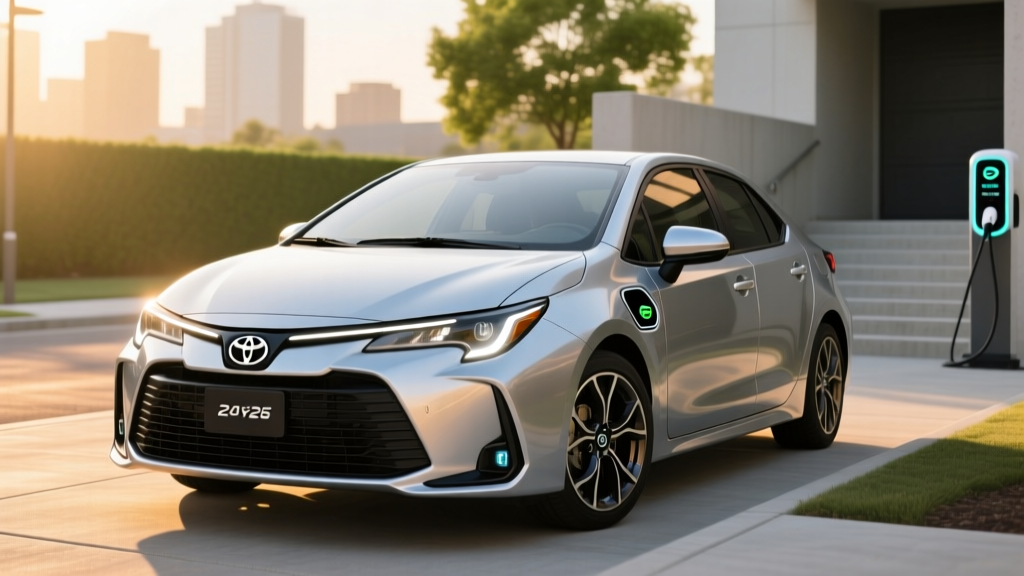
The Toyota Corolla Hybrid Hatchback occupies a rare sweet spot in the 2026 compact car market: genuine hybrid efficiency with the cargo versatility of a hatchback body style. Unlike Toyota's plug-in hybrid offerings (such as the Prius Prime), the Corolla Hybrid is a conventional hybrid electric vehicle (HEV) — meaning it requires no plug, no charging routine, and no behavior change from the driver. You fill it with gas and go, while the hybrid system silently slashes fuel consumption, particularly in city driving where regenerative braking does its best work.
For 2026, the Corolla Hybrid Hatchback continues with Toyota's fifth-generation hybrid powertrain, refined packaging, and the available electronic all-wheel-drive (AWD-e) system that sets it apart from front-wheel-drive rivals. Below, we break down every number that matters — EPA fuel economy, real-world MPG, powertrain specs, pricing, battery longevity, and where this car fits against full EVs, PHEVs, and conventional gas hatchbacks.
EPA Fuel Economy vs. Real-World MPG
The headline number for the Corolla Hybrid Hatchback is its EPA-estimated fuel economy. Front-wheel-drive models achieve the highest ratings, while the available AWD-e system imposes a modest penalty.
| Drivetrain | City MPG | Highway MPG | Combined MPG |
|---|---|---|---|
| FWD | 53 | 46 | 50 |
| AWD-e | 50 | 43 | 47 |
Source: fueleconomy.gov
Real-World MPG: What Owners Actually See
Hybrids routinely outperform their EPA city estimates in stop-and-go traffic because regenerative braking recovers kinetic energy that a gas car wastes as heat. Expect 52–56 MPG in urban commuting with the FWD model. Highway driving is a different story: sustained speeds above 70 mph reduce the hybrid system's advantage, and real-world highway MPG typically lands 2–4 MPG below the EPA sticker, in the 42–44 MPG range for FWD.
Cold weather (below 40°F) reduces efficiency by roughly 5–8% as the engine runs longer to generate cabin heat and the battery's internal resistance increases. In mixed driving across seasons, most owners report averaging 47–51 MPG overall — closely tracking the EPA combined figure.
Powertrain Specs: Engine, Motors, and Horsepower
The 2026 Corolla Hybrid Hatchback pairs a 1.8-liter four-cylinder Atkinson-cycle engine with Toyota's latest hybrid transaxle and a nickel-metal hydride (NiMH) hybrid battery pack. FWD models use a single front motor-generator, while AWD-e variants add a second, independent rear motor for traction assistance.
| Specification | Detail |
|---|---|
| Engine | 1.8L 4-cyl Atkinson-cycle |
| Net Combined Horsepower | 138 hp |
| Transmission | Electronically controlled CVT (eCVT) |
| Hybrid Battery | NiMH, ~1.3 kWh (self-charging, not plug-in) |
| Drivetrain (standard) | FWD |
| Drivetrain (available) | AWD-e (electronic rear motor) |
| 0–60 mph | ~9.0 seconds (estimated) |
The 138 hp combined output is adequate for commuting and highway merging but not sporty. The eCVT eliminates shift shock and keeps the engine in its most efficient RPM band. The AWD-e rear motor engages only when front-wheel slip is detected or during hard acceleration from a stop — it does not provide continuous all-wheel drive, which preserves fuel economy.
HEV vs. PHEV vs. EV: Which Powertrain Fits You?
The Corolla Hybrid Hatchback is a conventional HEV. It is not a plug-in hybrid and cannot drive on electric power alone for meaningful distances. Here's how the three electrified powertrain types compare for a buyer cross-shopping this car:
| Factor | HEV (Corolla Hybrid) | PHEV (e.g., Prius Prime) | BEV (e.g., Chevy Bolt EV) |
|---|---|---|---|
| Plug-in Required? | No | Yes (for EV range benefit) | Yes (always) |
| Electric-Only Range | ~1 mi at low speed | 35–44 mi | 230–259 mi |
| Total Range | ~547 mi | ~400+ mi (EV + gas) | 230–259 mi |
| Home Charging Needed? | No | Recommended (Level 2) | Essential |
| Federal Tax Credit (§30D) | Not eligible | Up to $7,500 (if eligible) | Up to $7,500 (if eligible) |
| Best For | No home charging access; long road trips | Short commutes + home charging | Daily driving + home charging + low running cost |
Choose the Corolla Hybrid Hatchback (HEV) if: You lack access to home or workplace charging, frequently take road trips exceeding 300 miles, or want maximum simplicity with no plug-in routine. The HEV's advantage is zero behavioral change — it works like a gas car but burns far less fuel.
Choose a PHEV instead if: You can install a Level 2 home charger and your daily commute is under 40 miles round-trip. A PHEV like the Prius Prime lets you drive most days on electricity alone while retaining a gas engine for longer trips.
Choose a full BEV instead if: You have reliable home charging, want the lowest cost-per-mile, and are comfortable planning DC fast-charging stops on road trips.
Pricing, Trims, and Tax Credit Eligibility
The 2026 Corolla Hybrid Hatchback is offered in SE and XSE trims. Pricing is competitive within the hybrid compact segment:
| Trim | Drivetrain | MSRP (est.) |
|---|---|---|
| SE Hybrid | FWD | $25,500 |
| SE Hybrid | AWD-e | $26,900 |
| XSE Hybrid | FWD | $28,500 |
| XSE Hybrid | AWD-e | $29,900 |
Federal Tax Credit Status
Under current IRS §30D rules, conventional hybrids like the Corolla Hybrid Hatchback do not qualify for the federal Clean Vehicle Credit. The §30D credit applies only to plug-in electric vehicles (BEVs and PHEVs) that meet battery capacity, critical-mineral sourcing, MSRP cap, and buyer income requirements.
However, some states offer rebates or reduced registration fees for high-efficiency hybrids. Check your state's energy office or the Alternative Fuels Data Center for local incentives. The fuel savings alone — roughly $800–$1,100 per year versus a 30 MPG gas compact — often offset the absence of a federal credit within the first few years of ownership.
Battery Warranty, Lifespan, and Replacement Cost
Hybrid battery longevity is consistently the top concern among first-time hybrid buyers. Toyota addresses this with one of the strongest warranties in the segment.
Real-World Battery Longevity
Toyota's hybrid battery packs — particularly the NiMH units used in the Corolla Hybrid — have an extensive track record. Data from Prius fleets and consumer reports indicate that most Toyota hybrid batteries last 150,000–200,000+ miles before significant degradation. The hybrid system's battery management software keeps the pack within a narrow state-of-charge window (roughly 40–80%), which dramatically reduces stress and extends cycle life.
Replacement Cost if Needed
If a hybrid battery does fail outside warranty, a new OEM replacement from Toyota typically costs between $2,000 and $3,500 installed. Refurbished or reconditioned packs are available for $1,000–$2,000. Given the 10-year/150,000-mile warranty and the proven durability of Toyota's NiMH packs, out-of-pocket replacement during typical ownership is uncommon.
Reliability, Safety, and Ownership Costs
Toyota's hybrid system is among the most proven in the automotive industry, with over 25 years of continuous production since the original Prius. The Corolla platform itself carries strong reliability ratings. Key ownership considerations:
- Brake pad life: Regenerative braking reduces wear on the friction brakes. Many owners report original brake pads lasting 80,000–100,000 miles.
- No plug-in infrastructure cost: Unlike PHEVs and BEVs, there's no need for a Level 2 home charger installation ($500–$2,000+).
- Insurance: Hybrid compact insurance premiums are typically comparable to gas equivalents — no EV surcharge applies.
- Resale value: Toyota hybrids historically retain value well, often outperforming gas-only counterparts at the 5-year mark.
For safety, the Corolla Hatchback comes standard with Toyota Safety Sense 3.0, which includes pre-collision braking with pedestrian detection, lane departure alert with steering assist, full-speed-range adaptive cruise control, and lane tracing assist. These are SAE Level 1–2 driver-assistance features — the driver must remain engaged at all times.
Cargo, Interior, and Daily Practicality
The hatchback body style is the Corolla Hybrid's key practicality advantage over the sedan. Cargo volume behind the rear seats measures approximately 17.8 cubic feet — enough for a week's groceries, two carry-on bags, or a full gym setup. Folding the 60/40 rear seat expands capacity to roughly 47 cubic feet.
The hybrid battery is packaged under the rear seat, preserving the flat cargo floor and avoiding the trunk intrusion that plagued earlier hybrid conversions. The cabin accommodates four adults comfortably; the rear middle seat is best reserved for short trips.
Standard and available tech includes an 8-inch touchscreen with wireless Apple CarPlay and Android Auto, a 7-inch digital driver display, wireless phone charging (XSE), and available JBL premium audio. A heat pump is not equipped (that's an EV feature); cabin heat is provided by the gasoline engine, which slightly reduces winter efficiency.
Pros, Cons, and Verdict
- 50 MPG combined (FWD) — among the best in the compact segment
- No plug-in charging required; zero behavior change
- Available AWD-e for snow/rain traction
- 10-year/150,000-mile hybrid battery warranty
- Hatchback cargo versatility
- Strong Toyota reliability and resale value
- 138 hp is modest — highway passing requires planning
- No federal tax credit (HEV, not PHEV/BEV)
- Rear-seat space tighter than some compact rivals
- No DC fast charging capability (not applicable to HEV)
- AWD-e reduces fuel economy by ~3 MPG combined
Frequently Asked Questions
How many MPG does the Corolla Hybrid Hatchback get?
The FWD model achieves an EPA-estimated 53 city / 46 highway / 50 combined MPG. The AWD-e model rates 50 city / 43 highway / 47 combined. Real-world averages typically fall within 47–51 MPG depending on driving style and climate.
Can the Corolla Hybrid Hatchback drive on electric power only?
Only for very short distances at low speeds (roughly under 1 mile, under 25 mph). As a conventional HEV, it is not designed for meaningful electric-only driving. If electric-only commuting is your goal, look at a PHEV like the Prius Prime (up to 44 miles EV range) or a full BEV.
Does the Corolla Hybrid Hatchback qualify for a tax credit?
No. The federal §30D Clean Vehicle Credit applies only to plug-in vehicles (BEVs and qualifying PHEVs). The Corolla Hybrid is a conventional HEV and is not eligible. Some state-level incentives may apply — check the Alternative Fuels Data Center for details.
How long will the hybrid battery last?
Toyota covers the hybrid battery for 10 years / 150,000 miles. Real-world data from Toyota's hybrid fleet shows most packs lasting 150,000–200,000+ miles. The battery management system's conservative charge window (40–80% SoC) is the primary reason for this longevity.
What does it cost to replace the hybrid battery?
An OEM replacement runs approximately $2,000–$3,500 installed. Refurbished options are available for $1,000–$2,000. Given the warranty coverage and proven durability, most owners will never face this cost.
Is the Corolla Hybrid Hatchback better than a gas Corolla?
If fuel economy matters to you, yes. The gas Corolla Hatchback achieves roughly 35 MPG combined versus the hybrid's 50 MPG — a 43% improvement. Over 15,000 annual miles at $3.50/gallon, the hybrid saves approximately $850 per year in fuel, paying back any price premium within 2–3 years.
Should I buy the Corolla Hybrid or a full EV?
Choose the Corolla Hybrid if you lack home charging access, take frequent long road trips, or want zero change to your fueling routine. Choose a full EV if you can charge at home, want the lowest per-mile cost (electricity at ~$0.04–$0.06/mile vs. gasoline at ~$0.08–$0.10/mile for this hybrid), and are comfortable with DC fast charging on longer trips.