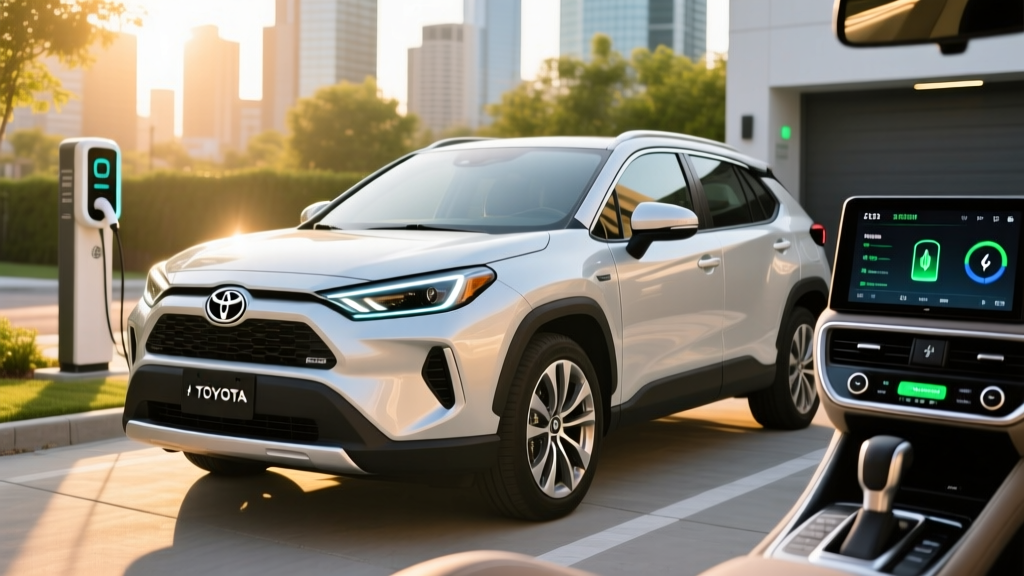
The 2026 Toyota Corolla Cross Hybrid occupies a narrow but valuable lane: a compact crossover that delivers genuine hybrid efficiency without the complexity or price premium of a plug-in hybrid or full EV. With an EPA-rated 42 MPG combined and standard electronic all-wheel drive, it targets buyers who want electrified fuel savings but aren't ready to install a home charger or commit to a battery-electric vehicle.
This guide covers the exact powertrain specs, real-world fuel economy expectations, battery longevity data, and whether any tax incentives apply — everything you need to decide if this is the right electrified vehicle for your driveway.
HEV vs. PHEV: What the Corolla Cross Hybrid Actually Is
Before diving into numbers, it's essential to clarify what you're buying. The 2026 Corolla Cross Hybrid is a conventional hybrid electric vehicle (HEV), not a plug-in hybrid (PHEV). Toyota does not currently offer a plug-in variant of the Corolla Cross.
HEV vs. PHEV — Key Distinctions
| Feature | Corolla Cross Hybrid (HEV) | Typical PHEV (e.g., RAV4 Prime) |
|---|---|---|
| Plug-in charging | No — never needs plugging in | Yes — charges via outlet or station |
| Electric-only range | ~1 mile at very low speeds | 25–42 miles on battery alone |
| Battery capacity | ~1.0 kWh (small buffer) | 13–18 kWh usable |
| Home charging required | No | Yes (Level 2 recommended) |
| Federal tax credit (§30D) | Not eligible | Up to $7,500 if requirements met |
The Corolla Cross Hybrid recovers energy through regenerative braking and uses its electric motor to assist the gas engine. You fuel it like any conventional car — no plugs, no charging apps, no range anxiety about finding a station.
Powertrain Specs: 196 HP With Electronic AWD
Toyota's fifth-generation hybrid system powers the 2026 Corolla Cross Hybrid. Here's the complete breakdown:
| Specification | Value |
|---|---|
| Engine | 2.0L 4-cylinder Atkinson-cycle |
| Combined net horsepower | 196 hp |
| Drivetrain | Electronic AWD (e-AWD) — standard on all trims |
| Rear motor | Separate electric motor powering rear axle |
| Transmission | eCVT (electronically controlled) |
| Hybrid battery | Lithium-ion, ~1.0 kWh nominal |
| 0–60 mph | ~7.5 seconds (est.) |
| Towing capacity | Not rated for towing |
The e-AWD system is worth noting: unlike mechanical AWD with a driveshaft, the rear axle is powered entirely by a dedicated electric motor. This means instant torque distribution to the rear wheels when the system detects slip, with no mechanical parasitic loss during normal driving. The 196 hp combined output makes this the most powerful Corolla Cross variant — noticeably quicker than the 169 hp gas-only model.
Fuel Economy: EPA Ratings and Real-World MPG
| Cycle | MPG |
|---|---|
| City | 45 |
| Highway | 38 |
| Combined | 42 |
Source: fueleconomy.gov — verify exact figures for your trim.
Real-World MPG: What to Actually Expect
Toyota hybrids consistently outperform their EPA city ratings in stop-and-go driving because regenerative braking recovers energy that gas cars waste as heat. In urban and suburban driving, owners frequently report 44–48 MPG. However, highway efficiency tells a different story:
- Sustained 75+ mph highway driving: Expect 34–37 MPG. The Atkinson-cycle engine is optimized for efficiency at lower loads, and aerodynamic drag at highway speeds reduces the hybrid advantage.
- Cold weather (below 35°F): MPG drops 10–15% because the engine runs more often to provide cabin heat and maintain battery temperature. Expect 36–38 MPG combined in winter conditions.
- Mountain driving: Regenerative braking on descents partially offsets the efficiency loss on climbs, but sustained high-altitude grades will reduce economy.
For a driver covering 12,000 miles annually with a mix of city and highway, the 42 MPG combined rating translates to roughly 286 gallons per year — compared to 462 gallons for the 26 MPG combined gas-only Corolla Cross. At $3.50/gallon, that's approximately $618 in annual fuel savings.
Pricing, Trims, and Tax Credit Eligibility
The 2026 Corolla Cross Hybrid is offered in three trims, all with standard AWD:
| Trim | Starting MSRP | Key Additions |
|---|---|---|
| S | ~$29,850 | 8-inch touchscreen, wireless CarPlay/Android Auto, TSS 3.0 |
| SE | ~$31,350 | Sport-tuned suspension, SofTex seats, 18-inch alloy wheels |
| XSE | ~$33,500 | JBL audio, panoramic roof option, heated front seats |
Destination charge (~$1,350) not included. Verify pricing on Toyota's official site.
Federal Tax Credit: Not Eligible
The Corolla Cross Hybrid does not qualify for the IRS §30D Clean Vehicle Credit. That credit applies only to plug-in electric vehicles (BEVs and PHEVs) with batteries of at least 7 kWh. As a conventional hybrid with a ~1.0 kWh battery, the Corolla Cross Hybrid falls outside the program's scope. There is currently no federal tax credit for conventional hybrids.
Some states offer rebates for hybrids — check your state's energy office or IRS §30D guidance for the latest rules.
Battery Longevity, Warranty, and Replacement Cost
Battery reliability is the most common concern among first-time hybrid buyers. Here's what the data shows for Toyota's hybrid systems:
Hybrid Battery Warranty
Toyota Hybrid Battery Warranty: 10 years / 150,000 miles (whichever comes first)
Hybrid System Components: 8 years / 100,000 miles
This warranty covers capacity loss and defects. Toyota's hybrid battery warranty has been 10yr/150k since the 2020 model year across all US states.
Real-World Battery Lifespan
Toyota's hybrid battery packs are engineered for longevity rather than energy density. The Corolla Cross Hybrid uses a relatively small lithium-ion pack that operates within a narrow state-of-charge window (roughly 40–80%), which dramatically reduces degradation stress. Based on data from millions of Toyota hybrids on the road:
- Typical hybrid battery lifespan: 15–20 years / 200,000+ miles before significant degradation
- Failure rate within warranty period: Well under 1% based on fleet data from prior-generation Toyota hybrids
- Out-of-warranty replacement cost: $2,000–$4,000 for the hybrid battery pack (significantly less than a BEV battery replacement, which can exceed $10,000–$15,000)
Many Prius taxis have exceeded 300,000 miles on original hybrid batteries. The Corolla Cross Hybrid's fifth-generation system benefits from improved thermal management and cell chemistry over earlier generations.
Reliability and Ownership Costs
Toyota's hybrid powertrain is among the most proven in the industry. The eCVT transmission has no traditional gears, belts, or clutch packs — it uses a planetary gearset that has demonstrated exceptional durability. Key ownership considerations:
- No plug-in infrastructure needed: No home charger installation ($500–$2,000 savings vs. EV/PHEV setup)
- Brake pad life: Regenerative braking reduces wear — expect 80,000–100,000+ miles on original brake pads
- Insurance: Typically comparable to the gas Corolla Cross; hybrid surcharges that existed a decade ago have largely disappeared
- Resale value: Toyota hybrids historically retain value well; the hybrid variant commands a premium over gas models in the used market
Toyota Safety Sense 3.0 comes standard on all trims, including pre-collision braking, lane departure alert, lane tracing assist, and full-speed dynamic radar cruise control. The NHTSA and IIHS ratings should be checked closer to the on-sale date for the 2026 model year, but the platform earned top marks in prior years.
Who Should Buy the Corolla Cross Hybrid?
✓ Choose This Hybrid If
- You want 40+ MPG without changing your fueling habits
- You lack access to home or workplace charging (apartment, street parking)
- You want AWD capability for snow or rain without a fuel penalty
- You drive 10,000–15,000 miles/year and want to cut fuel costs ~35%
- You want Toyota's proven reliability with a 10-year battery warranty
✗ Consider a BEV or PHEV Instead If
- You have home Level 2 charging and want to eliminate gas entirely (consider a BEV)
- You want electric-only commuting with gas backup (consider the RAV4 Prime PHEV)
- You want to claim the $7,500 federal tax credit (BEV/PHEV only)
- Your daily commute is under 30 miles and you want zero tailpipe emissions (a BEV fits better)
- You want the lowest possible per-mile energy cost (home-charged EVs cost ~$0.04/mile vs. ~$0.08/mile for this hybrid)
Corolla Cross Hybrid vs. Alternatives
| Vehicle | Combined MPG | HP | AWD | Starting MSRP |
|---|---|---|---|---|
| Toyota Corolla Cross Hybrid | 42 | 196 | Standard | ~$29,850 |
| Honda CR-V Hybrid | 40 (AWD) | 204 | Available | ~$35,000 |
| Kia Niro HEV | 53 | 139 | No (FWD only) | ~$28,500 |
| Subaru Crosstrek Hybrid | 35 (PHEV: 17 mi EV) | 148 | Standard | ~$37,000 |
The Corolla Cross Hybrid's combination of standard AWD, sub-$30,000 pricing, and 42 MPG combined is difficult to match. The Kia Niro achieves higher MPG but lacks AWD. The CR-V Hybrid is larger and more powerful but costs roughly $5,000 more at the base hybrid trim.
Frequently Asked Questions
How many MPG does the 2026 Corolla Cross Hybrid get?
The EPA rates it at 45 city / 38 highway / 42 combined. In real-world city driving, many owners see 44–48 MPG thanks to regenerative braking. Highway-only driving at 75+ mph typically yields 34–37 MPG.
Does the Corolla Cross Hybrid need to be plugged in?
No. It is a conventional hybrid (HEV). The battery recharges through regenerative braking and the gas engine. You fuel it at any gas station like a conventional car.
Is the Corolla Cross Hybrid reliable?
Toyota's hybrid system is one of the most proven powertrains on the road, with over 25 years of production history and millions of units in service. The hybrid battery carries a 10-year/150,000-mile warranty, and real-world data shows most batteries last 15–20 years.
What does a hybrid battery replacement cost?
Out-of-warranty replacement for the Corolla Cross Hybrid battery is estimated at $2,000–$4,000 (parts and labor). This is substantially less than a full EV battery replacement. However, based on Toyota's track record, most owners will never need a replacement during typical ownership.
Does the Corolla Cross Hybrid qualify for a federal tax credit?
No. The IRS §30D Clean Vehicle Credit applies only to plug-in vehicles (BEVs and PHEVs). Conventional hybrids do not qualify. Some states may offer separate incentives — check your local programs.
Hybrid vs. PHEV vs. EV — which should I choose?
Choose the HEV (Corolla Cross Hybrid) if you can't charge at home and want maximum simplicity.
Choose a PHEV (like the RAV4 Prime) if you have home charging and want 25–42 miles of electric commuting with a gas engine for road trips.
Choose a full BEV if you have reliable home charging, drive under 250 miles daily, and want the lowest per-mile energy cost plus federal tax credit eligibility.