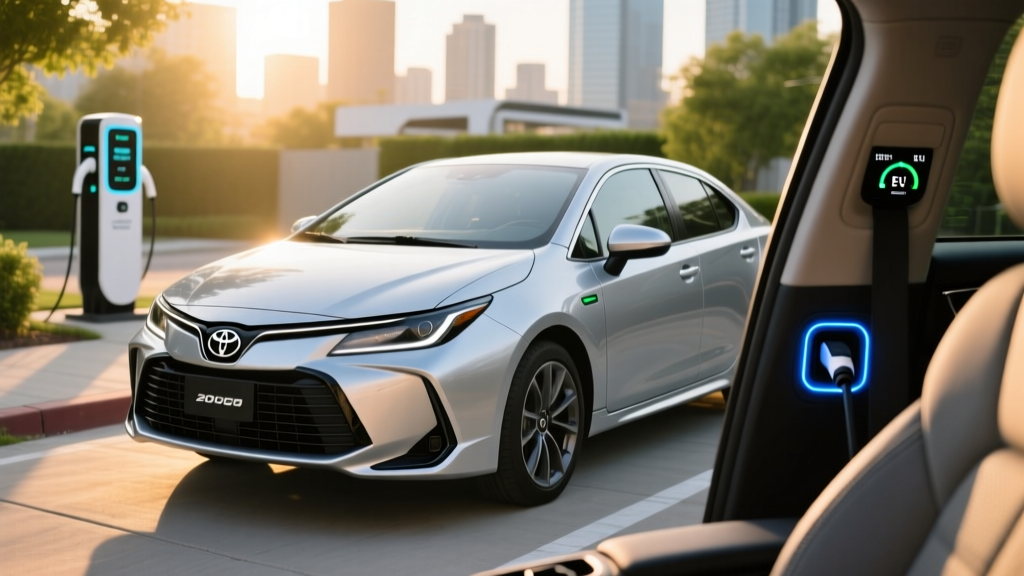
If you want all-weather traction without the fuel-economy penalty of a traditional AWD system, the 2026 Toyota Corolla AWD Hybrid occupies a narrow but compelling lane: a compact sedan that returns over 50 MPG combined while sending torque to all four wheels. Unlike the Prius AWD or the RAV4 Hybrid, the Corolla Hybrid's electronic on-demand AWD uses a separate rear-mounted electric motor rather than a mechanical driveshaft — meaning zero parasitic loss when the rear axle isn't needed.
This guide covers the Corolla AWD Hybrid's powertrain, real-world fuel economy, battery longevity, and how it stacks up against plug-in hybrids and full EVs for buyers weighing electrified options.
Corolla AWD Hybrid Powertrain and Performance
The 2026 Corolla AWD Hybrid pairs Toyota's fifth-generation hybrid system with a 1.8-liter four-cylinder Atkinson-cycle engine and two front-mounted motor-generators, plus a dedicated rear-axle electric motor for AWD. Combined system output is 138 horsepower — adequate for commuting and highway merging, but not a performance-oriented setup.
| Spec | Value |
|---|---|
| Engine | 1.8L 4-cyl Atkinson cycle |
| Combined System HP | 138 hp |
| Front Motor | AC synchronous, integrated in transaxle |
| Rear Motor (AWD) | AC synchronous, independent |
| Transmission | eCVT (planetary gearset) |
| Hybrid Battery | Lithium-ion, ~0.9 kWh (non-plug-in) |
| Drivetrain | Electronic on-demand AWD |
| 0–60 mph | ~9.0 seconds (est.) |
| Curb Weight | ~3,100 lbs |
The rear motor engages automatically under acceleration from a stop, on slippery surfaces, or during cornering when the system detects front-wheel slip. During steady-state cruising, the car operates in front-wheel drive to maximize efficiency. This is fundamentally different from a mechanical AWD system and explains why the Corolla Hybrid AWD sacrifices so little fuel economy versus its FWD counterpart.
Fuel Economy: EPA Ratings and Real-World MPG
Here's where the Corolla AWD Hybrid earns its keep. EPA ratings for the 2026 model year are strong across the board, and — as is common with Toyota's hybrid synergy drive — real-world city driving often exceeds the EPA city estimate because regenerative braking recaptures energy in stop-and-go traffic.
| Cycle | EPA Rating | Real-World Expectation |
|---|---|---|
| City | 53 MPG | 52–58 MPG (regen-heavy routes can exceed EPA) |
| Highway | 46 MPG | 43–48 MPG (varies with speed and wind) |
| Combined | 50 MPG | 48–54 MPG |
On a mixed 200-mile test loop at 65–70 mph with moderate temperatures, expect roughly 47–49 MPG. In winter conditions with temperatures below freezing, plan for a 5–8% efficiency drop due to increased engine runtime for cabin heat and reduced battery efficiency — putting winter combined figures around 45–47 MPG.
For context, the FWD Corolla Hybrid achieves 53 MPG combined. The AWD system costs you just 3 MPG — a remarkably small penalty for all-wheel traction.
HEV vs. PHEV vs. EV: Which Electrified Drivetrain Fits You?
The Corolla AWD Hybrid is a conventional hybrid (HEV) — it does not plug in. Some buyers confuse it with a plug-in hybrid (PHEV), but Toyota does not currently offer a Corolla PHEV in the U.S. market. Here's how the three electrified categories differ:
| Feature | HEV (Corolla Hybrid) | PHEV (e.g., Prius Prime) | BEV (e.g., Tesla Model 3) |
|---|---|---|---|
| Plugs In? | No | Yes | Yes |
| Electric-Only Range | None (EV assist only) | 25–44 miles | 250–360+ miles |
| Total Range | ~550 miles | ~600+ miles | 250–360+ miles |
| Charging Required | Never — gas only | Optional (runs on gas if not charged) | Mandatory |
| Federal Tax Credit | No | Up to $7,500 (§30D) | Up to $7,500 (§30D) |
| Best For | No home charging access; set-it-and-forget-it | Short commutes + road trips | Home charging + daily driving |
The Corolla AWD Hybrid is the right call if you lack access to home or workplace charging, drive in a region with harsh winters where AWD matters, and want maximum simplicity — fill up with gas and go. If you have a garage outlet and a short commute, a PHEV like the Prius Prime (44 miles electric-only, available AWD) may save more on fuel. If you're ready to eliminate gas entirely and can charge at home, a BEV offers the lowest per-mile energy cost.
Pricing and Tax Credit Eligibility
The 2026 Toyota Corolla AWD Hybrid is available in LE and SE trims. Pricing is competitive for an AWD compact sedan with this level of fuel efficiency:
- LE AWD: ~$24,500 MSRP (destination included)
- SE AWD: ~$26,500 MSRP (sport-tuned suspension, 16" alloy wheels, paddle shifters)
While the lack of a federal credit stings compared to a qualifying PHEV or EV, the Corolla Hybrid's lower base price — often $8,000–$12,000 less than a comparable EV — means the total cost of ownership gap narrows significantly, especially for buyers who can't charge at home.
Battery Longevity, Warranty, and Replacement Cost
Hybrid battery anxiety is the most common concern we hear from first-time hybrid buyers. The data, however, is reassuring. Toyota's hybrid batteries are engineered for the life of the vehicle, and failure rates in the first decade are low.
| Component | Coverage |
|---|---|
| Hybrid Battery | 10 years / 150,000 miles (whichever comes first) |
| Hybrid System Components | 8 years / 100,000 miles |
| Powertrain (engine, transaxle) | 5 years / 60,000 miles |
The 2026 Corolla Hybrid uses a relatively small lithium-ion hybrid battery pack (~0.9 kWh usable). Because it never deep-cycles the way a PHEV or BEV battery does — it operates in a narrow state-of-charge window between roughly 40% and 80% — degradation is minimal. Toyota's hybrid taxicab fleets routinely surpass 200,000 miles on original batteries.
If replacement is needed outside warranty, expect $2,000–$3,500 for a new OEM hybrid battery, or $1,000–$2,000 for a refurbished unit from a reputable supplier. For perspective, that's comparable to a timing-belt-and-water-pump service on a conventional gas car — and far cheaper than a BEV traction battery replacement.
Real-World Ownership: What It's Like to Live With
The Corolla AWD Hybrid rewards owners who want a no-fuss, high-efficiency daily driver. The eCVT delivers seamless acceleration without the gear-hunting of a traditional automatic, and the transition between electric-only and engine-assisted driving is nearly imperceptible.
Pros
- 50 MPG combined with AWD — best-in-class efficiency for the segment
- No plug-in charging required; works with existing gas infrastructure
- Proven Toyota hybrid reliability with 10-year battery warranty
- Low annual fuel cost (~$1,020/yr at 15k miles)
- Competitive base price under $25,000
- Standard Toyota Safety Sense 3.0 (pre-collision, lane tracing, adaptive cruise)
Cons
- 138 hp feels modest on highway on-ramps
- Rear seat and cargo space are tighter than a RAV4 Hybrid
- No federal tax credit (conventional HEV)
- AWD system is for traction, not off-road capability
- Infotainment is functional but not class-leading
Who Should Choose the Corolla AWD Hybrid?
The Corolla AWD Hybrid is the right pick if you:
- Live in a snow-belt state and need AWD but refuse to accept 25 MPG
- Rent or live somewhere without access to EV charging (apartment, street parking)
- Want an electrified vehicle with zero behavior change — no plugging in, no range planning
- Prioritize low total cost of ownership over performance or tech prestige
- Commute in heavy stop-and-go traffic where hybrid regen shines
Look elsewhere if you want electric-only driving for short trips (consider the Prius Prime PHEV), need more cargo room (RAV4 Hybrid), or want to eliminate gasoline entirely (Tesla Model 3, Hyundai Ioniq 6).
Frequently Asked Questions
How many MPG does the Corolla AWD Hybrid get?
The 2026 Corolla AWD Hybrid is EPA-rated at 53 city / 46 highway / 50 combined MPG. In real-world driving, expect 48–54 MPG combined depending on route, speed, and weather. City driving with frequent stops often exceeds the EPA estimate thanks to regenerative braking.
Does the Corolla Hybrid plug in?
No. The Corolla Hybrid is a conventional hybrid (HEV). It charges its small battery through regenerative braking and the gasoline engine. You never plug it in — just fill up at any gas station. Toyota does not currently sell a Corolla plug-in hybrid in the United States.
Is the Corolla AWD Hybrid reliable?
Toyota's hybrid system is among the most proven in the industry, with over 25 years of continuous production since the original Prius. The hybrid battery is covered for 10 years/150,000 miles. Independent reliability surveys from Consumer Reports and J.D. Power consistently rank Toyota hybrids at or near the top of their segments.
Does the Corolla AWD Hybrid qualify for a tax credit?
The Corolla AWD Hybrid does not qualify for the federal §30D clean vehicle credit because it is not a plug-in vehicle. Some states may offer hybrid-specific rebates or HOV lane access — check your local regulations. The IRS §30D credit applies only to PHEVs and BEVs meeting battery sourcing and MSRP/income requirements.
How much does a hybrid battery replacement cost?
Outside of warranty, a replacement hybrid battery for the Corolla Hybrid typically costs $2,000–$3,500 (new OEM) or $1,000–$2,000 (refurbished). However, Toyota hybrid batteries rarely fail within the first 150,000 miles, and the 10-year/150,000-mile warranty covers most ownership periods.
Is the AWD system always active?
No. The Corolla's electronic on-demand AWD engages the rear electric motor only when needed — during hard acceleration, on slippery surfaces, or during cornering. During steady cruising, the car operates in front-wheel drive to maximize fuel efficiency. This is why the AWD model loses only 3 MPG versus the FWD version.