For years, "hybrid" meant one thing in the minds of most car shoppers: a sensible, if uninspiring, commuter pod. That era is over. Automakers have spent the last half-decade proving that electrified powertrains can live inside vehicles that turn heads at a stoplight — not just ones that turn heads at a gas station because you're never there.
Whether you want a sleek sports car, a rugged off-roader, or a design-forward daily driver, there's a hybrid that matches. Here are five of the best-looking hybrids on the market right now, broken down by exact EPA fuel economy, powertrain specs, pricing, and the real-world ownership data that matters most.
HEV vs PHEV — What's the Difference?
Conventional Hybrid (HEV): Uses a small battery and electric motor to assist the gas engine. You never plug it in — it charges via regenerative braking and the engine. Think Toyota Prius.
Plug-in Hybrid (PHEV): Has a larger battery you can charge from a wall outlet or public charger, giving you 20-50 miles of electric-only driving before the gas engine kicks in. Think Toyota RAV4 Prime or Jeep Wrangler 4xe.
Both improve fuel economy over gas-only cars. PHEVs offer EV-like commuting if you charge daily; HEVs require zero behavior change.
Toyota Prius (2026): The Comeback Kid
Nobody expected the Prius to become a design icon, yet the current generation (introduced for 2023, refreshed for 2025) is genuinely striking. The low-slung silhouette, sharp creases, and slim LED headlights transformed it from an Uber staple into something people actually want to be seen in. It also became the fastest Prius ever, with up to 196 hp in the AWD variant.
| Spec | LE FWD | XLE AWD | Prius Plug-in (PHEV) |
|---|---|---|---|
| EPA Combined MPG | 57 MPG | 52 MPG | 52 MPG (gas) / 127 MPGe (combined) |
| EPA City / Highway | 57 city / 56 hwy | 53 city / 50 hwy | 53 city / 51 hwy (gas mode) |
| Combined HP | 194 hp | 196 hp | 220 hp |
| 0-60 mph | 7.2 sec | 7.0 sec | 6.6 sec |
| Electric-Only Range (PHEV) | N/A | N/A | 44 miles (EPA) |
| PHEV Battery | N/A | N/A | 13.6 kWh (usable ~10.5 kWh) |
| PHEV Charging (Level 2) | N/A | N/A | ~4 hours at 3.3 kW; no DC fast charge |
| Starting MSRP | $28,350 | $32,100 | $33,450 |
Source: EPA / fueleconomy.gov, Toyota USA
Real-World MPG vs. EPA
The Prius HEV is one of the rare vehicles where real-world fuel economy often exceeds the EPA sticker in city driving, thanks to frequent regenerative braking opportunities. Expect 55-60 MPG in mixed city commuting. On sustained highway trips at 75+ mph, expect 48-52 MPG — slightly below the sticker, as with any vehicle. Cold weather (below 30°F) can knock 5-8 MPG off combined figures during short trips while the engine warms up.
Tax Credit Eligibility
The conventional Prius HEV does not qualify for any federal tax credit. The Prius Plug-in Hybrid (PHEV) qualifies for the IRS §30D Clean Vehicle Credit — up to $3,750 depending on critical-mineral and battery-component sourcing requirements. The PHEV model's MSRP falls under the $55,000 sedan cap, and buyer income limits apply ($150K single / $300K joint). The credit can be transferred to the dealer at point of sale as of 2024 onward. Confirm current-year eligibility with your tax professional, as sourcing rules tighten annually.
Hyundai Tucson PHEV: Rugged Meets Refined
The Tucson's angular, geometric design language — Hyundai calls it "Parametric Dynamics" — gives it a concept-car presence that stands out in the compact crossover segment. The PHEV variant adds meaningful electric-only range for daily commuting without sacrificing the cargo space and AWD capability buyers want.
| Spec | Value |
|---|---|
| EPA Combined MPG (gas mode) | 35 MPG combined / 80 MPGe |
| EPA City / Highway | 35 city / 35 hwy (gas) |
| Combined HP | 261 hp (1.6L turbo + electric motor) |
| 0-60 mph | 7.1 sec |
| Electric-Only Range | 33 miles (EPA) |
| Battery Size | 13.8 kWh (usable ~11.5 kWh), NMC chemistry |
| Charging (Level 2) | ~2 hours at 7.2 kW; no DC fast charge |
| Starting MSRP | $39,250 (SEL Convenience) |
Real-World Electric Range and MPG
In mild weather (50-75°F), expect 30-35 electric-only miles from the Tucson PHEV — close to the EPA sticker. In winter cold, that drops to 22-28 miles as cabin heating and battery thermal management draw energy. Once the battery depletes, the 1.6L turbo hybrid system delivers a solid 33-36 MPG combined, which is strong for a 4,000-lb AWD crossover. For context, the gas-only Tucson AWD gets 26 MPG combined — the PHEV effectively doubles your fuel economy on short commutes.
Chevrolet Corvette E-Ray: Supercar Style, Hybrid Efficiency
This is the hybrid that silences anyone who says electrified cars can't be exciting. The Corvette E-Ray pairs the C8 Stingray's 6.2L V8 with a front-axle electric motor, creating Chevrolet's first all-wheel-drive Corvette and its quickest production 'Vette ever — 0-60 in 2.5 seconds. The design is unchanged from the mid-engine C8 that redefined the Corvette's image: wide fenders, dramatic scoops, and a low, predatory stance.
| Spec | Value |
|---|---|
| Combined HP | 655 hp (495 hp V8 + 160 hp front e-motor) |
| 0-60 mph | 2.5 sec |
| Top Speed | 183 mph |
| EPA Combined MPG | 19 MPG combined (est.) |
| Electric-Only Range | ~4-5 miles (stealth mode, low speed) |
| Battery | 1.9 kWh (performance buffer, not for range) |
| Charging | Regen only — no plug-in capability |
| Starting MSRP | $106,595 (1LZ coupe) |
The E-Ray is a mild hybrid in the performance sense — the electric motor provides instant torque for launch and enables quiet electric-only driving through neighborhoods (Chevy calls it "Stealth Mode"). It is not a plug-in and does not prioritize fuel economy. This is a $100K+ supercar that happens to use hybrid technology for performance gains, similar to how Formula 1 uses ERS. No federal tax credit applies.
Toyota RAV4 Prime: The Practical Head-Turner
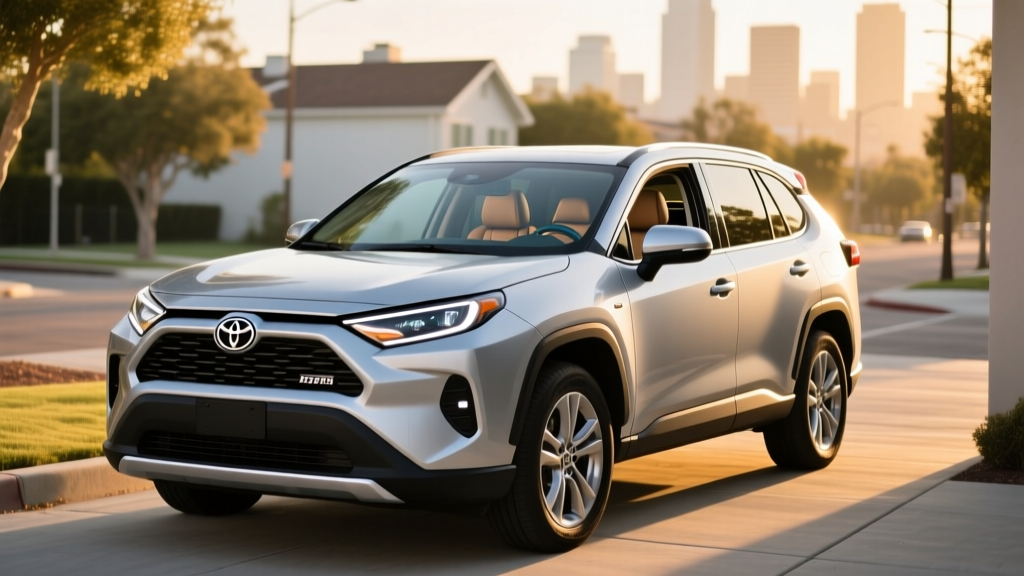
The RAV4 Prime may not be exotic, but in its SE and XSE trims with the black roof, red accent stitching, and aggressive lower fascia, it has a sporty presence that the standard RAV4 lacks. More importantly, it's one of the most capable PHEVs ever built — 42 miles of electric range, 302 hp, and standard AWD, all in a package that holds its value aggressively.
| Spec | Value |
|---|---|
| EPA Combined MPG (gas mode) | 38 MPG combined / 94 MPGe |
| EPA City / Highway (gas) | 40 city / 36 hwy |
| Combined HP | 302 hp (2.5L + dual motors) |
| 0-60 mph | 5.7 sec |
| Electric-Only Range | 42 miles (EPA) |
| Battery Size | 18.1 kWh (usable ~14.5 kWh), NMC |
| Charging (Level 2) | ~2.5 hours at 6.6 kW; no DC fast charge |
| Starting MSRP | $44,515 (SE) |
Real-World PHEV Performance
Owners consistently report 38-44 electric-only miles in spring and fall conditions. In winter, expect 30-35 miles. Once the battery depletes, the hybrid system delivers an impressive 36-39 MPG combined — remarkable for a 4,200-lb AWD SUV with 302 hp. On a full tank and full charge, total range exceeds 600 miles.
Tax Credit Status
As of 2026, the RAV4 Prime's eligibility for the §30D credit depends on battery-component and critical-mineral sourcing, which changes annually. Check the latest fueleconomy.gov tax credit listings for current eligibility. The RAV4 Prime's MSRP is under the $80,000 SUV cap, and income limits apply.
BMW 330e xDrive: Sport Sedan Elegance
The G20-generation BMW 3 Series has always been one of the best-looking sport sedans on the road — the kidney grille controversy aside, its proportions, crease lines, and Hofmeister kink are textbook BMW design. The 330e xDrive PHEV wraps that styling around a turbocharged four-cylinder and electric motor that combine for 288 hp and a usable electric commute.
| Spec | Value |
|---|---|
| EPA Combined MPG (gas mode) | 28 MPG combined / 60 MPGe |
| EPA City / Highway (gas) | 26 city / 31 hwy |
| Combined HP | 288 hp (2.0L turbo + e-motor, xDrive) |
| 0-60 mph | 5.6 sec |
| Electric-Only Range | 22 miles (EPA, xDrive) |
| Battery Size | 12.0 kWh (usable ~9.1 kWh), NMC |
| Charging (Level 2) | ~3 hours at 3.7 kW; no DC fast charge |
| Starting MSRP | $46,895 (RWD) / $48,895 (xDrive) |
The 330e's shorter electric range (22 miles EPA for xDrive) is its main limitation versus competitors. However, for commutes under 20 miles with home charging, it effectively operates as an EV most weekdays. The driving dynamics — steering feel, chassis balance, and that ZF 8-speed — remain class-leading. The trunk is slightly reduced due to battery placement (13.2 cu ft vs 17 cu ft in the gas 330i).
Hybrid Battery Reliability and Replacement Costs
Battery Warranty Coverage
All hybrids and PHEVs sold in the US carry a minimum hybrid-battery warranty of 8 years / 100,000 miles (10 years / 150,000 miles in California and CARB-adopting states). Toyota, Hyundai, and BMW all meet or exceed this standard.
Hybrid batteries are designed to last the life of the vehicle. Toyota's hybrid battery packs routinely exceed 200,000 miles with minimal degradation. PHEV batteries see more charge cycles but are larger and buffered more conservatively.
Replacement costs if out of warranty:
- Prius HEV battery: $2,000-$4,000 (refurbished options available from $1,500)
- RAV4 Prime PHEV battery: $8,000-$12,000
- Tucson PHEV battery: $6,000-$9,000
- Corvette E-Ray battery: $3,000-$5,000 (small pack, less costly)
In practice, hybrid battery failures before 150K miles are rare. Individual cell replacement (rather than full pack) is increasingly available from independent shops for $500-$1,500.
Hybrid vs PHEV vs Full EV: Which Is Right for You?
Choose a Conventional Hybrid (HEV) If:
- You can't charge at home or work
- You want maximum MPG with zero behavior change
- Your budget is under $35,000
- You take frequent long road trips
- You live in an extreme climate (hot or cold)
Top picks above: Toyota Prius (57 MPG, $28K)
Choose a Plug-in Hybrid (PHEV) If:
- You can charge at home (Level 1 or 2)
- Your daily commute is under 30-40 miles
- You want EV-like commuting with gas-engine road-trip range
- You may qualify for the §30D tax credit
- You're not ready to commit to full EV range limitations
Top picks above: RAV4 Prime (42 mi EV, 302 hp), Tucson PHEV (33 mi EV)
Choose a Full EV (BEV) If:
- You have reliable home Level 2 charging
- Your daily driving is under 250 miles
- You want the lowest per-mile fuel cost (~$0.04/mi vs $0.12/mi hybrid)
- You want maximum federal tax credit ($7,500 on eligible models)
- You want minimal maintenance (no oil, no spark plugs)
Consider instead: Tesla Model Y, Hyundai Ioniq 5, Chevrolet Equinox EV
Frequently Asked Questions
Do hybrid cars need to be plugged in?
No. Conventional hybrids (HEVs) like the Toyota Prius LE never plug in — they charge their small battery through regenerative braking and the gas engine. Only plug-in hybrids (PHEVs) like the RAV4 Prime or Tucson PHEV require plugging in to access their electric-only range. You can drive a PHEV without ever plugging in, but you'll miss the electric-commuting benefit and just operate as a conventional hybrid.
How many MPG do these hybrids actually get in real driving?
Real-world results vary by driving style, climate, and trip length. The Prius HEV consistently achieves 52-58 MPG combined in mixed driving. The RAV4 Prime gets 36-39 MPG once the battery depletes. The Tucson PHEV delivers 33-36 MPG in gas mode. The Corvette E-Ray achieves roughly 17-21 MPG — it's a 655-hp supercar, and efficiency isn't the point. Cold weather typically reduces hybrid MPG by 5-12% on short trips.
How far can PHEVs go on electric only?
Among the PHEVs covered here: the RAV4 Prime delivers 42 EPA miles electric-only (real-world 30-44 depending on temperature), the Tucson PHEV achieves 33 EPA miles (real-world 22-35), and the BMW 330e xDrive manages 22 EPA miles (real-world 16-24). The Corvette E-Ray offers ~4-5 miles of low-speed electric-only "Stealth Mode" — it's not designed for EV commuting.
Are hybrid batteries expensive to replace?
Hybrid battery replacement costs range from $2,000-$4,000 for a conventional Prius to $8,000-$12,000 for a larger PHEV pack like the RAV4 Prime. However, failures before 150,000 miles are uncommon. All hybrid batteries carry at minimum an 8-year/100,000-mile warranty (10/150K in CARB states). Many Prius batteries exceed 200,000 miles. Refurbished and individual-cell replacement options have also reduced out-of-pocket costs significantly.
Do any of these hybrids qualify for a federal tax credit?
Conventional hybrids (HEVs) do not qualify for the federal §30D Clean Vehicle Credit — only plug-in hybrids (PHEVs) and full EVs are eligible. Among the PHEVs here, the RAV4 Prime, Tucson PHEV, and BMW 330e may qualify for up to $3,750-$7,500 depending on current-year battery sourcing requirements, MSRP caps ($80,000 for SUVs, $55,000 for sedans), and buyer income limits ($150K single / $300K joint). Always verify current eligibility at irs.gov or with your tax professional before purchasing.
Pros of Stylish Hybrids
- No range anxiety — gas backup always available
- 30-57 MPG combined (HEV) or 22-42 mi EV range (PHEV)
- No charging infrastructure required (HEV)
- Lower upfront cost than most EVs
- Strong resale value (especially Toyota)
- Proven long-term reliability
Cons of Stylish Hybrids
- Still burning gas (emissions, fuel cost)
- PHEVs require home charging to maximize value
- Higher maintenance than EVs (oil changes, spark plugs)
- Most PHEVs lack DC fast charging
- HEVs don't qualify for federal tax credits
- Some trunks reduced by battery placement
The era of the boring hybrid is firmly in the rearview mirror. Whether you're drawn to the Prius's dramatic redesign, the Corvette E-Ray's supercar drama, or the RAV4 Prime's blend of rugged looks and 42 miles of electric range, there's a hybrid that matches both your aesthetic taste and your practical needs. The key decision remains HEV vs PHEV: if you can charge at home and your commute is under 40 miles, a PHEV gives you the best of both worlds. If you just want excellent MPG without changing a single habit, a conventional hybrid still can't be beat.