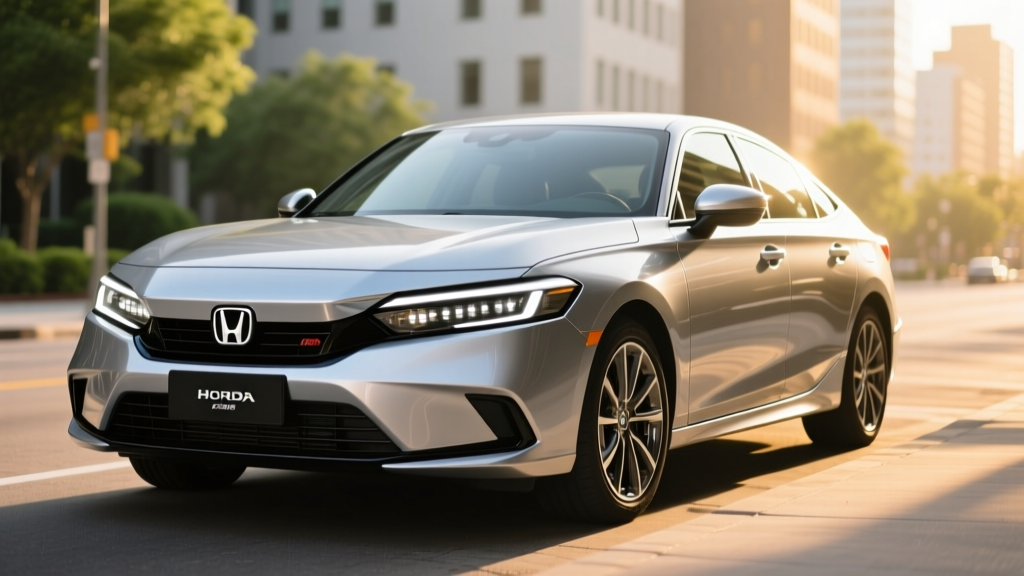
The Honda Civic Touring Hybrid sits at the top of the Civic lineup, pairing Honda's two-motor hybrid system with the most complete feature set the nameplate offers. For buyers who want electrified efficiency without plugging in, the Touring trim delivers premium tech, strong fuel economy, and Honda's reputation for long-term reliability. This review breaks down the exact numbers — EPA MPG, powertrain specs, pricing, battery warranty, and real-world ownership costs — so you can decide whether the Civic Touring Hybrid fits your daily driving needs.
2026 Civic Touring Hybrid at a Glance: Key Specifications
| Specification | 2026 Honda Civic Touring Hybrid |
|---|---|
| Powertrain Type | Conventional Hybrid (HEV) — no plug-in required |
| Engine | 2.0L Atkinson-cycle 4-cylinder + two electric motors |
| Combined Horsepower | 200 hp (146 hp engine + 184 hp drive motor) |
| Combined Torque | 232 lb-ft (electric motor) |
| Transmission | e-CVT (direct drive, no traditional gears) |
| EPA Fuel Economy (City / Hwy / Combined) | 50 / 47 / 49 MPG |
| Fuel Tank Capacity | 10.6 gallons |
| Total Driving Range | ~519 miles (EPA combined) |
| Drivetrain | Front-wheel drive |
| 0–60 mph | ~7.2 seconds |
| Starting MSRP (Touring Trim) | ~$32,450 |
| Hybrid Battery Warranty | 8 years / 100,000 miles (10 yr / 150,000 mi in CARB states) |
The Touring trim is the Civic Hybrid's fully loaded variant, bundling leather-trimmed seats, a 12-speaker Bose premium audio system, a 9-inch touchscreen with wireless Apple CarPlay and Android Auto, a 10.2-inch digital instrument cluster, wireless phone charging, and Honda's full Honda Sensing suite of driver-assistance features. You're paying a premium over the Sport Hybrid and Sport Touring Hybrid, but the Touring sedan is the most complete package Honda offers in the Civic lineup.
Fuel Economy: EPA Ratings vs. Real-World MPG
| Driving Scenario | MPG | Notes |
|---|---|---|
| EPA City | 50 MPG | Hybrid system excels in stop-and-go traffic |
| EPA Highway | 47 MPG | Engine takes over more at sustained speeds |
| EPA Combined | 49 MPG | Weighted 55% city / 45% highway per EPA formula |
| Real-World City (observed) | 48–53 MPG | Hybrids often beat EPA city estimates in moderate climates |
| Real-World Highway (observed) | 42–46 MPG | Aerodynamic drag and engine-only cruising reduce efficiency |
| Cold Weather Combined | 40–44 MPG | Engine runs more often for cabin heat; battery less efficient below 30°F |
One of the defining characteristics of conventional hybrids like the Civic Touring Hybrid is that they tend to outperform their EPA city rating in real-world urban driving. The two-motor system recovers energy during braking and low-speed deceleration, and the electric motor handles most launches from a stop. In warmer climates with frequent stoplights, owners routinely report 50–53 MPG in city driving.
Highway efficiency tells a different story. At sustained speeds above 65 mph, the gasoline engine shoulders most of the load, and aerodynamic drag becomes the dominant energy consumer. Expect 42–46 MPG on the highway in real-world conditions — a few ticks below the EPA's 47 MPG sticker. Cold weather compounds this: below freezing, the engine runs more frequently to provide cabin heating and maintain battery temperature, pulling combined efficiency down to the low-to-mid 40s.
For context, the non-hybrid Civic Touring with its 1.5L turbocharged engine achieves 31 city / 38 highway / 34 combined MPG according to fueleconomy.gov. The hybrid's 49 MPG combined represents a 44% improvement over the gas-only counterpart.
Hybrid vs. Plug-In Hybrid vs. Full EV: Which Is Right for You?
Conventional Hybrid (HEV) — Civic Touring Hybrid
- No plug-in required. The battery recharges through regenerative braking and the gasoline engine.
- Best for: Drivers without home charging access, apartment dwellers, or those who want efficiency gains with zero behavioral change.
- Trade-off: No electric-only driving range. The engine is always available and frequently active.
Plug-In Hybrid (PHEV) — e.g., Toyota Prius Prime, Hyundai Tucson PHEV
- Plugs in to charge a larger battery (typically 10–20 kWh), enabling 25–45 miles of electric-only driving.
- Best for: Drivers with home Level 2 charging and short daily commutes who want EV-like daily driving with a gas backup for longer trips.
- Trade-off: Higher purchase price, added weight, and reduced cargo space from the larger battery.
Battery Electric Vehicle (BEV) — e.g., Tesla Model 3, Hyundai Ioniq 6
- 100% electric — no gasoline engine. Range from ~250 to 350+ miles depending on model.
- Best for: Drivers with reliable home charging who want zero tailpipe emissions and the lowest per-mile fuel cost.
- Trade-off: Requires planning for road trips, access to DC fast charging, and acceptance of range variability in cold weather.
The Civic Touring Hybrid is an HEV — a conventional hybrid. It does not plug in, has no electric-only range, and cannot be charged from a wall outlet or public charger. If you're looking for a Civic with plug-in capability, Honda does not currently offer a Civic PHEV in the U.S. market. You would need to look at competitors like the Toyota Prius Prime (PHEV, ~44 miles electric-only) or step up to a full EV.
Two-Motor Hybrid Powertrain: How It Works
Honda's hybrid system in the Civic Touring uses a 2.0-liter Atkinson-cycle four-cylinder engine paired with two electric motors in a series-parallel configuration. Here's how the power flows in different driving scenarios:
- Low-speed / city driving: The gasoline engine acts primarily as a generator, producing electricity that powers the drive motor. The car drives like an EV in these conditions — smooth, instant torque, quiet.
- Cruising at highway speeds: A lock-up clutch connects the engine directly to the drive wheels, bypassing the electric motor for maximum efficiency at steady-state speeds.
- Hard acceleration: Both the engine and drive motor work together, delivering the full 200 combined horsepower and 232 lb-ft of torque.
- Deceleration and braking: The drive motor reverses function to become a generator, capturing kinetic energy and storing it in the hybrid battery pack.
The result is a powertrain that feels responsive off the line (electric motor torque is instant) while maintaining the efficiency of a small-displacement engine at cruise. The 200 hp combined output makes the Civic Touring Hybrid notably quicker than many hybrid competitors — it's within a second of the non-hybrid Civic Sport Touring's turbocharged 1.5L, and the electric motor's torque delivery makes it feel even quicker in daily driving.
Pricing, Tax Credits, and Total Cost of Ownership
The 2026 Honda Civic Touring Hybrid carries an MSRP of approximately $32,450, including destination charges. This positions it roughly $4,000–$5,000 above the non-hybrid Civic Touring and about $6,000 above the Civic Sport Hybrid, which shares the same powertrain but with fewer premium features.
Federal Tax Credit Eligibility
Under current IRS §30D rules, conventional hybrids (HEVs) do not qualify for the federal EV tax credit. The §30D credit of up to $7,500 applies only to plug-in electric vehicles — battery electric vehicles (BEVs) and plug-in hybrids (PHEVs) that meet battery capacity, critical-mineral sourcing, MSRP caps, and buyer income requirements. The Civic Touring Hybrid, as a self-charging HEV, is ineligible.
Some states offer separate incentives for hybrid vehicles, though these are far less common than EV incentives. Check your state's energy or environmental agency website for current programs.
Fuel Cost Savings vs. Gas-Only Civic
At $3.50/gallon for regular unleaded and 15,000 miles driven annually:
| Vehicle | Combined MPG | Annual Fuel Cost | 5-Year Fuel Cost |
|---|---|---|---|
| Civic Touring Hybrid | 49 MPG | ~$1,071 | ~$5,357 |
| Civic Touring (1.5T gas) | 34 MPG | ~$1,544 | ~$7,721 |
| 5-Year Savings (Hybrid) | ~$473/yr | ~$2,364 |
The hybrid premium over the gas Civic Touring is approximately $1,000–$1,500 at the trim level, meaning the fuel savings alone pay back the price difference in roughly 2–3 years. Beyond that, every mile driven is net savings. Factor in potentially lower brake wear (regenerative braking reduces friction brake usage) and the ownership economics tilt further in the hybrid's favor.
Battery Warranty, Lifespan, and Replacement Costs
Honda Hybrid Battery Warranty:
- Standard coverage: 8 years / 100,000 miles (whichever comes first)
- CARB states (CA, CO, CT, ME, MD, MA, NJ, NY, OR, RI, VT, WA, and others adopting California emissions standards): 10 years / 150,000 miles
- What's covered: Hybrid battery pack capacity loss below a defined threshold (typically ~60–70% of original capacity) and defects in hybrid system components
The Civic Touring Hybrid uses a relatively small lithium-ion battery pack — approximately 1.1 kWh of total capacity — because it only needs to buffer energy for short bursts of electric assist and regenerative capture, not sustain miles of electric-only driving. This small pack experiences shallow charge/discharge cycles, which is far less stressful on battery chemistry than the deep cycles in a BEV or PHEV.
Real-world longevity: Honda's hybrid systems have demonstrated strong durability. The earlier-generation Insight and Accord Hybrid models routinely reach 150,000–200,000+ miles on the original battery pack. The Civic Hybrid's battery management system keeps the pack in a narrow state-of-charge window (roughly 40–80%), avoiding the extreme highs and lows that accelerate degradation.
Replacement cost: If the hybrid battery does require replacement outside of warranty, expect to pay between $2,000 and $4,000 for a new OEM pack, depending on the model year and dealership. Refurbished or aftermarket packs are available for $1,000–$2,000. Given the battery's track record and the generous warranty coverage, this is a low-probability expense for most owners.
Driving Impressions, Tech, and Daily Livability
The Civic Touring Hybrid drives like a slightly heavier, notably smoother version of the standard Civic. The two-motor system eliminates the rubber-band sensation that plagued older CVTs — there's no traditional transmission shifting, and the engine RPM is well-managed during acceleration. Honda's engineering team has done commendable work making the hybrid powertrain feel natural rather than compromised.
The Touring trim includes Honda Sensing as standard, which bundles:
- Adaptive Cruise Control (ACC) with Low-Speed Follow
- Lane Keeping Assist System (LKAS)
- Road Departure Mitigation (RDM)
- Collision Mitigation Braking System (CMBS)
- Traffic Sign Recognition
- Blind Spot Information System with Cross Traffic Monitor
These are SAE Level 1 driver-assistance features — they support the driver but do not replace active engagement. You must keep your hands on the wheel and eyes on the road at all times. The Civic does not offer Level 2 hands-free driving systems like GM's Super Cruise or Ford's BlueCruise.
Cargo space is competitive: the hybrid battery is packaged under the rear seats, preserving the Civic sedan's 14.8 cubic feet of trunk volume. This is a meaningful advantage over some PHEVs, where the larger battery pack intrudes on cargo area.
Pros and Cons of the Civic Touring Hybrid
Pros
- 49 MPG combined EPA — among the most efficient non-PHEV sedans available
- 200 hp and instant electric torque make it genuinely quick for the class
- No plug-in required — zero behavioral change from a gas car
- Touring trim is fully loaded: Bose audio, leather, wireless everything
- 8–10 year hybrid battery warranty with strong real-world longevity
- Preserved trunk space (battery under rear seats)
- Lower brake wear from regenerative braking
Cons
- No electric-only driving — always burns some gasoline
- Ineligible for the $7,500 federal EV tax credit (§30D)
- ~$1,000–$1,500 price premium over the gas Civic Touring
- FWD only — no AWD option for snow-belt buyers
- Highway MPG drops noticeably in real-world and cold-weather conditions
- No DC fast charging capability (not applicable — this is an HEV)
Who Should Buy the Civic Touring Hybrid?
The Civic Touring Hybrid is the right call if you:
- Can't charge at home. You live in an apartment, park on the street, or lack access to a Level 2 charger. The HEV requires zero infrastructure.
- Drive a mix of city and highway miles and want maximum fuel savings without range planning or charging stops.
- Want a premium compact sedan without stepping to luxury-brand pricing. The Touring trim delivers near-luxury features at a mainstream price.
- Plan to own the car 5+ years. The fuel savings compound, the battery warranty protects you, and Honda's resale values remain strong.
Consider a full EV instead if you have reliable home charging, want zero tailpipe emissions, and drive under 300 miles daily. A PHEV makes more sense if you have home charging and a short commute (under 30 miles) but still want gas-engine flexibility for road trips.
Frequently Asked Questions
How many MPG does the 2026 Civic Touring Hybrid get?
The EPA rates the Civic Touring Hybrid at 50 MPG city, 47 MPG highway, and 49 MPG combined. In real-world city driving, many owners report matching or slightly exceeding the 50 MPG city figure. Highway driving typically yields 42–46 MPG, and cold weather can reduce combined efficiency to the low-to-mid 40s.
Does the Civic Touring Hybrid need to be plugged in?
No. The Civic Touring Hybrid is a conventional hybrid (HEV). Its small lithium-ion battery recharges through regenerative braking and the gasoline engine. There is no plug, no charging port, and no electric-only driving range. You fuel it exactly like a gas car.
Does the Civic Touring Hybrid qualify for any tax credit?
No. Under IRS §30D rules, only plug-in electric vehicles (BEVs and PHEVs) qualify for the federal EV tax credit. Conventional hybrids like the Civic Touring Hybrid are not eligible. Some states may offer separate hybrid incentives — check your state's energy agency for details. Always consult a tax professional for advice specific to your situation.
How long will the Civic Hybrid battery last, and what does replacement cost?
Honda warrants the hybrid battery for 8 years/100,000 miles (10 years/150,000 miles in CARB states). Real-world data from Honda's hybrid lineup suggests the battery routinely lasts 150,000–200,000+ miles. If replacement is needed out of warranty, expect $2,000–$4,000 for a new OEM pack.
How does the Civic Touring Hybrid compare to the Toyota Prius?
The Toyota Prius (LE trim) achieves up to 57 MPG combined EPA, beating the Civic Hybrid's 49 MPG. However, the Civic offers more horsepower (200 hp vs. 194 hp for the Prius), a more premium interior in the Touring trim, and arguably better driving dynamics. The Prius also offers an AWD-e option. If maximum MPG is the sole priority, the Prius wins. If you want a more refined, feature-rich compact sedan, the Civic Touring Hybrid is the stronger pick.
Is the Civic Touring Hybrid reliable?
Honda's hybrid powertrain has a strong reliability track record. The two-motor system has fewer moving parts than a traditional automatic transmission (no torque converter, no gear shifts), and the engine operates under less stress due to the Atkinson cycle and electric motor assist. Honda consistently earns above-average reliability ratings from sources like Consumer Reports and J.D. Power for its hybrid models. The comprehensive hybrid system warranty provides additional long-term protection.
Sources: fueleconomy.gov (EPA fuel economy data), Honda Automobiles (manufacturer specifications), IRS.gov (§30D clean vehicle credit rules).