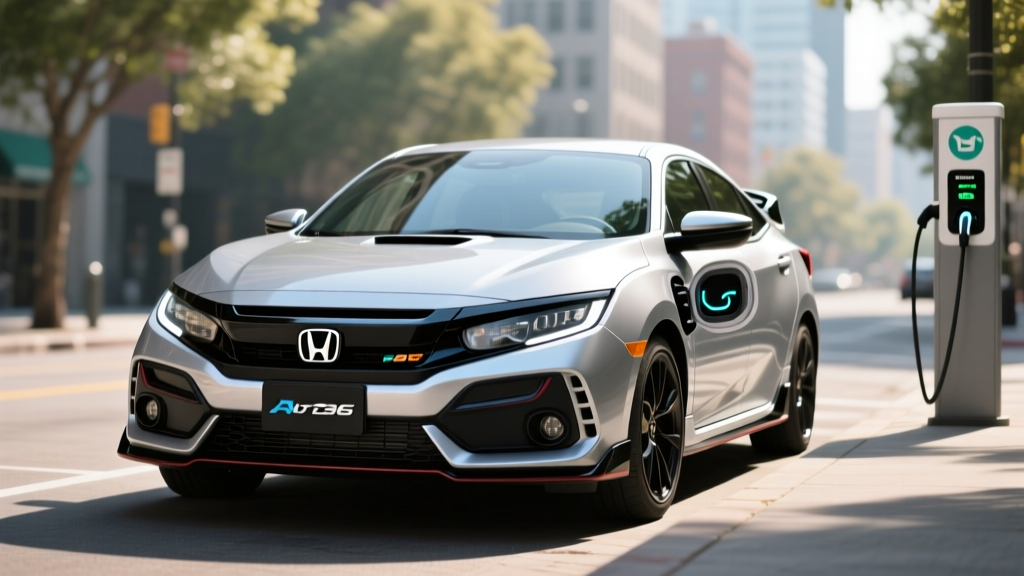
The 2026 Honda Civic Sport Hybrid Hatchback occupies a specific niche: buyers who want hatchback utility and hybrid efficiency without ever plugging in. It's a conventional hybrid (HEV), not a plug-in hybrid (PHEV), meaning there's no electric-only range to manage, no charging cable to deal with, and no range anxiety to speak of. You fill it with gas and drive.
But with an EPA-estimated 50 MPG combined, does the real-world efficiency match the sticker? And how does it stack up against the growing field of plug-in hybrids and affordable EVs? We break down every spec that matters.
Fuel Economy: EPA Numbers and Real-World MPG
The Civic Sport Hybrid Hatchback's two-motor hybrid system is optimized for city driving, where the electric motor handles low-speed propulsion and the 2.0-liter Atkinson-cycle engine acts primarily as a generator. This is why the city MPG actually exceeds the highway figure — the opposite of most gas cars.
| Metric | Value |
|---|---|
| City MPG | 50 |
| Highway MPG | 47 |
| Combined MPG | 49 |
| Fuel Tank Capacity | 12.4 gallons |
| Total Range (estimated) | ~607 miles |
Source: fueleconomy.gov
Hybrid vs. Plug-In Hybrid: What's the Difference Here?
This is where buyer confusion runs rampant, so let's be precise. The Civic Sport Hybrid Hatchback is a conventional hybrid (HEV). It has a small lithium-ion battery (approximately 1.1 kWh) that charges exclusively through regenerative braking and the gasoline engine. You never plug it in. There is no electric-only driving range — the electric motor assists the engine and enables brief low-speed EV mode, but the gas engine is always part of the equation.
HEV vs. PHEV vs. EV — Which Fits You?
| Factor | HEV (This Civic) | PHEV (e.g., Toyota Prius Prime) | BEV (e.g., Chevy Equinox EV) |
|---|---|---|---|
| Plug in required? | No | Yes (for max benefit) | Yes (always) |
| Electric-only range | None (motor assist only) | 25–44 miles typical | 250–350+ miles |
| Home charging needed? | No | Recommended (120V or 240V) | Essential (240V strongly recommended) |
| Federal tax credit (§30D) | No | Up to $7,500 (if eligible) | Up to $7,500 (if eligible) |
| Best for | No home charging access; long highway miles | Short daily commute + home charging | Home charging + mostly under 300 mi/day |
If you can install a Level 2 home charger and your daily commute is under 40 miles, a PHEV or BEV will likely save you more on fuel. If you live in an apartment, street-park, or regularly drive 400+ miles without stopping, the Civic HEV's no-plug convenience is the right call.
Powertrain and Performance Specs
Honda's fourth-generation two-motor hybrid system pairs a 2.0-liter direct-injected Atkinson-cycle four-cylinder with two electric motors. The result is respectable acceleration for a compact hatchback and seamless transitions between electric and gas power.
| Specification | Value |
|---|---|
| Engine | 2.0L Atkinson-cycle 4-cylinder |
| Combined System Horsepower | 200 hp |
| Combined System Torque | 232 lb-ft |
| Transmission | e-CVT (direct-drive with lock-up clutch) |
| Drivetrain | Front-wheel drive |
| 0–60 mph (estimated) | ~7.2 seconds |
| Battery Type | Lithium-ion (~1.1 kWh) |
| Regenerative Braking | Yes, with selectable deceleration paddles |
The 200 hp combined output puts the Civic Sport Hybrid ahead of the non-hybrid Civic Sport (which makes 180 hp from its 1.5L turbo) and gives it confident highway merging ability. The e-CVT avoids the rubber-band feel of older CVTs thanks to a lock-up clutch that creates a direct mechanical connection at cruising speeds.
Pricing, Trims, and Tax Credit Eligibility
The 2026 Civic Sport Hybrid Hatchback is positioned as the value-oriented hybrid trim. Here's where pricing lands before destination charges:
| Trim | MSRP |
|---|---|
| Sport Hybrid Hatchback | ~$30,750 |
| Sport Touring Hybrid Hatchback | ~$34,350 |
Pricing based on Honda's announced 2026 MSRP. Confirm with Honda's official site for current figures.
Battery Warranty, Reliability, and Replacement Cost
Hybrid battery longevity is the number-one concern for buyers considering a used or new hybrid. Honda addresses this with a robust warranty, and the track record for their hybrid systems is strong.
- Hybrid Battery: 8 years / 100,000 miles (10 years / 150,000 miles in CARB states)
- Powertrain: 5 years / 60,000 miles
- New Vehicle Limited: 3 years / 36,000 miles
Honda's hybrid batteries are designed to last the life of the vehicle under normal use. The lithium-ion pack is small (~1.1 kWh) and is never fully charged or fully depleted — the system maintains a state-of-charge buffer between roughly 20% and 80%, which dramatically reduces degradation. Real-world data from earlier Honda hybrid models (Insight, Accord Hybrid) shows batteries routinely lasting 150,000–200,000+ miles before significant capacity loss.
If replacement is needed out of warranty, a Civic hybrid battery pack currently costs approximately $2,000–$3,500 installed at a dealership, and less through independent hybrid specialists. This is significantly cheaper than EV battery replacements ($8,000–$20,000+) because the pack is small.
Hatchback Practicality: Cargo, Tech, and Safety
The hatchback body style is the Civic's practicality play. With the rear seats up, you get approximately 24.5 cubic feet of cargo space — enough for a week's groceries, a stroller, or camping gear for two. Fold the rear seats and that expands to roughly 46 cubic feet.
The Sport Hybrid trim includes Honda Sensing (adaptive cruise control, lane-keeping assist, automatic emergency braking, traffic sign recognition), a 7-inch touchscreen with wireless Apple CarPlay and Android Auto, and a 10.2-inch digital instrument cluster. The Sport Touring Hybrid adds a 9-inch touchscreen, Bose premium audio, wireless phone charging, and heated rear seats.
Safety ratings from both NHTSA and IIHS have historically placed the Civic Hatchback at the top of its class. The 2026 model continues to earn strong marks — check IIHS and NHTSA for final ratings as they're published.
Who Should Buy the Civic Sport Hybrid Hatchback?
Choose This If:
- You want 50 MPG without plugging in
- You lack access to home or workplace charging
- You drive long highway stretches where EV range drops
- You want hatchback cargo room under $35K
- You prefer proven hybrid reliability over EV tech risk
Look Elsewhere If:
- You have home charging and want electric-only commuting
- You want federal tax credit eligibility (consider a PHEV or BEV)
- You need AWD (the Civic hybrid is FWD only — consider the Toyota Prius AWD)
- You want a manual transmission or sport-tuned suspension
Frequently Asked Questions
How many MPG does the Civic Sport Hybrid Hatchback get?
The EPA rates it at 50 city / 47 highway / 49 combined. Real-world city driving often yields 50–53 MPG, while sustained highway driving at higher speeds may return 42–45 MPG.
Does the Civic Hybrid need to be plugged in?
No. It's a conventional hybrid (HEV). The battery charges through regenerative braking and the gasoline engine. You never plug it in — just fill up at the gas station like any other car.
Does it qualify for any tax credit?
Not the federal §30D credit, which is reserved for plug-in vehicles (PHEVs and BEVs). Some states offer separate hybrid rebates — check your state energy office for current programs.
How long will the hybrid battery last?
Honda warranties the hybrid battery for 8 years/100,000 miles (10 years/150,000 miles in CARB states). Real-world data from Honda's hybrid lineup suggests these batteries routinely last 150,000–200,000+ miles with normal use.
What does a replacement hybrid battery cost?
Out of warranty, expect approximately $2,000–$3,500 installed at a Honda dealer. Independent hybrid specialists may offer lower pricing. This is substantially less than EV battery replacements due to the small pack size (~1.1 kWh).
How does it compare to a PHEV like the Prius Prime?
The Prius Prime offers ~44 miles of electric-only range and qualifies for the federal tax credit (up to $7,500 if eligible), but requires home charging access to maximize value. The Civic Hybrid sacrifices electric-only driving for total simplicity — no plug, no range management, just fill up and go.