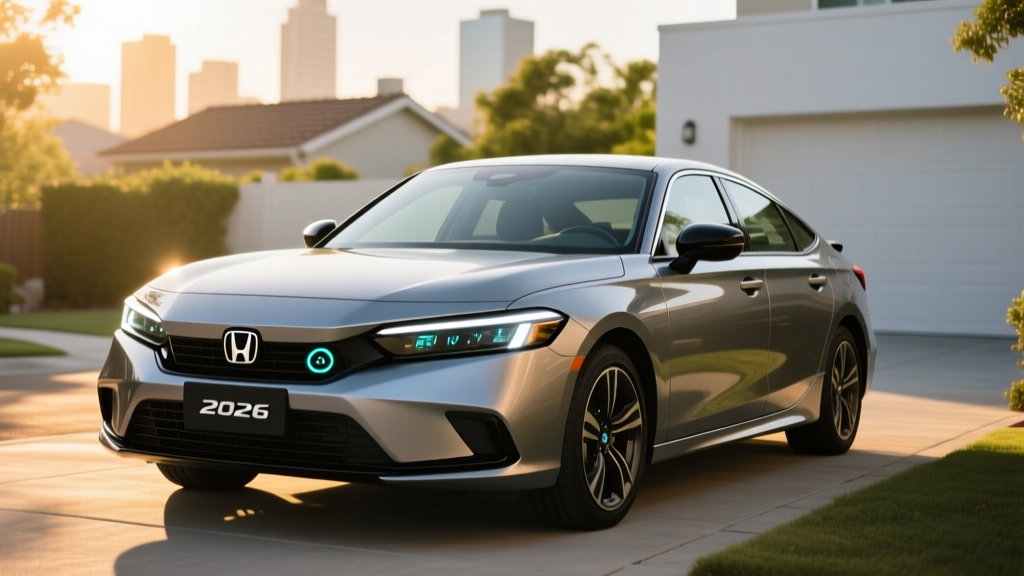
The Honda Civic has been a compact-car benchmark for decades, but the addition of a hybrid powertrain has transformed it into one of the most efficient vehicles in its class without sacrificing the driving dynamics Honda is known for. The 2026 Honda Civic Sedan Hybrid carries forward the two-motor hybrid system introduced with the eleventh-generation refresh, delivering EPA-rated fuel economy that rivals dedicated hybrid models while maintaining the Civic's practical cabin, composed ride, and strong resale value.
For buyers weighing a hybrid against a plug-in hybrid or a full battery-electric vehicle, the Civic Sedan Hybrid occupies a specific and compelling niche: maximum efficiency with zero lifestyle change. No plug, no range anxiety, no charging infrastructure required — just fill up with gas and drive. Here's everything you need to know about the numbers, the powertrain, and whether this hybrid fits your next purchase.
2026 Civic Sedan Hybrid: Powertrain and Performance Specs
The Civic Sedan Hybrid uses Honda's fourth-generation two-motor hybrid system, which pairs a 2.0-liter Atkinson-cycle four-cylinder engine with two electric motors and a lithium-ion battery pack. Unlike simpler hybrid systems that use the electric motor only to assist the gas engine, Honda's system primarily drives the wheels electrically at low and moderate speeds, engaging the gas engine directly only at highway cruising speeds where it's most efficient.
| Specification | 2026 Civic Sedan Hybrid |
|---|---|
| Powertrain | 2.0L Atkinson-cycle I-4 + two-motor hybrid system |
| Combined Horsepower | 200 hp |
| Combined Torque | 232 lb-ft |
| Transmission | Single-speed direct drive (e-CVT) |
| Drivetrain | Front-wheel drive |
| 0–60 mph (est.) | ~7.2 seconds |
| Hybrid Battery Type | Lithium-ion (non-plug-in HEV) |
| Hybrid System Generation | Honda 4th-gen two-motor |
The result is a powertrain that feels more like an EV around town than a traditional hybrid. Torque delivery from the electric motor is immediate, giving the Civic Hybrid surprisingly brisk acceleration from stops. The 200 combined horsepower and 232 lb-ft of torque represent a meaningful bump over the standard 1.5L turbo Civic (180 hp), and you feel it in daily driving — passing maneuvers and highway merges are confident and composed.
Fuel Economy: EPA Ratings vs. Real-World MPG
Fuel efficiency is the headline number for any hybrid buyer, and the Civic Sedan Hybrid delivers strong results across the board. According to EPA data on fueleconomy.gov, the 2026 Civic Hybrid achieves:
| Driving Cycle | EPA Rating |
|---|---|
| City | 50 MPG |
| Highway | 47 MPG |
| Combined | 49 MPG |
One of the defining characteristics of conventional hybrids like the Civic is that city MPG often equals or exceeds highway MPG. This is the opposite of gas-only cars and stems from regenerative braking recapturing energy in stop-and-go traffic and the electric motor handling low-speed driving where gas engines are least efficient. If most of your driving is urban or suburban, you'll likely see results at or above the EPA combined figure.
HEV vs. PHEV vs. EV: Which Powertrain Fits You?
The Civic Sedan Hybrid is a conventional hybrid (HEV). It does not plug in, has no electric-only driving range to speak of (the battery is small and serves as a buffer, not a primary energy source), and requires no charging infrastructure. This is a deliberate distinction from plug-in hybrids (PHEVs) and battery-electric vehicles (BEVs), and choosing among the three depends on your driving patterns, home setup, and budget.
| Factor | HEV (Civic Hybrid) | PHEV (e.g., Toyota Prius Prime) | BEV (e.g., Tesla Model 3) |
|---|---|---|---|
| Plugs in? | No | Yes | Yes |
| Electric-only range | ~1 mile (low speed) | 25–44 miles typical | 250–360+ miles |
| Home charging needed? | No | Recommended (Level 2 ideal) | Essential (Level 2 required for practicality) |
| Fuel/energy cost per mile | ~$0.07 (at $3.50/gal) | ~$0.04 electric / $0.07 gas | ~$0.03–0.05 (home charging) |
| Upfront price premium | Low ($1,000–2,000 over gas) | Moderate ($4,000–7,000 over gas) | Higher ($5,000–15,000+ over gas) |
| Federal tax credit (§30D) | Not eligible | Up to $7,500 (if eligible) | Up to $7,500 (if eligible) |
| Best for | No home charging, long trips, simplicity | Short commutes + road trips, home charging available | Home charging, daily commuting, lowest running costs |
The Civic Hybrid is the right call if you lack reliable access to home or workplace charging, take regular road trips where charging infrastructure is sparse, or simply want the lowest-complexity path to significantly better fuel economy. It's also the most affordable entry point into electrified driving — no electrical work, no charging apps, no trip planning required.
If you have a garage with a 240V outlet and a commute under 40 miles, a PHEV like the Prius Prime or a BEV like the Chevy Equus EV may deliver lower per-mile costs and access to the federal §30D clean vehicle credit. But for drivers who want efficiency without any infrastructure dependency, the Civic Hybrid is hard to beat.
Pricing, Trims, and Tax Credit Eligibility
The 2026 Honda Civic Sedan Hybrid is available in Sport and Sport Touring trims, positioned above the standard gas-powered LX and Sport models. Pricing reflects the added powertrain technology and, in the Sport Touring, a significant equipment upgrade.
| Trim | MSRP (approx.) | Key Features |
|---|---|---|
| Hybrid Sport | $30,450 | 200 hp hybrid, 18" wheels, Honda Sensing, 7" touchscreen, wireless CarPlay/Android Auto |
| Hybrid Sport Touring | $33,450 | Leather, Bose 12-speaker audio, 9" touchscreen, wireless charging, heated front seats, navigation |
While the lack of a federal tax credit is a disadvantage compared to qualifying PHEVs and BEVs, the Civic Hybrid's lower base price partially offsets this. A PHEV might net a $7,500 credit but start $5,000–$8,000 higher, narrowing the effective gap — especially when you factor in that the Civic Hybrid needs no home charging investment.
Hybrid Battery Warranty, Lifespan, and Replacement Cost
Battery longevity is consistently the top concern among first-time hybrid buyers, and it's a fair question: the hybrid battery is the most expensive unique component in the powertrain. Honda addresses this with robust warranty coverage.
• Standard coverage: 8 years / 100,000 miles
• CARB-state coverage: 10 years / 150,000 miles (California and states adopting California emissions standards, including NY, MA, CT, NJ, OR, WA, CO, and others)
• Coverage threshold: Battery capacity below approximately 60–70% of original capacity or failure of battery components
• Powertrain warranty: 5 years / 60,000 miles (covers hybrid motor, inverter, and related components)
In practice, Honda's lithium-ion hybrid batteries have proven durable. The hybrid battery in the Civic is relatively small (approximately 1.0 kWh total capacity — it's a buffer, not a traction battery) and operates within a narrow state-of-charge window, which significantly reduces stress and degradation. Unlike a BEV's large battery that cycles deeply, the Civic's hybrid battery experiences shallow, frequent cycles that are far less damaging to cell longevity.
Based on data from earlier Honda hybrid models (Insight, Accord Hybrid, CR-V Hybrid), most hybrid batteries last well beyond the warranty period — commonly reaching 150,000–200,000 miles without significant degradation. When replacement is eventually needed, a refurbished or new Honda hybrid battery typically costs between $2,000 and $4,000 installed, depending on the source (dealer vs. independent hybrid specialist). Third-party refurbished units are often available for $1,500–$2,500.
According to Honda's official Civic specifications, the hybrid system is designed for the life of the vehicle under normal operating conditions, and the battery management system actively prevents the deep discharge and overcharge states that accelerate cell wear.
Driving Impressions and Daily Practicality
The Civic Sedan Hybrid doesn't drive like a stereotypical fuel-sipper. The electric motor's instant torque makes it feel responsive and eager in city traffic, and the transition between electric and gas propulsion is nearly imperceptible — a hallmark of Honda's mature hybrid system. The e-CVT avoids the rubber-band sensation of older CVTs because the two-motor architecture doesn't rely on a belt-and-pulley variator; instead, it uses a direct-drive clutch for highway cruising and electric motor ratio for everything else.
Ride quality is firm but well-damped, consistent with the Civic's sporty positioning. Road noise is moderate — improved over the previous generation but still noticeable on coarse pavement. The cabin is practical for four adults, with 14.8 cubic feet of trunk space (unchanged from the gas Civic, since the hybrid battery is packaged under the rear seats rather than in the cargo area).
Honda Sensing — the brand's Level 2 driver-assistance suite — is standard across all trims and includes adaptive cruise control, lane-keeping assist, collision mitigation braking, and traffic sign recognition. It's a competent highway companion but requires continuous driver attention; this is SAE Level 2 automation, not autonomous driving.
- 49 MPG combined EPA — among the best in the compact segment
- 200 hp feels genuinely quick for a fuel-efficient sedan
- No plug-in or charging infrastructure required
- Strong 8yr/100k-mile hybrid battery warranty
- Practical trunk (14.8 cu ft), comfortable rear seats
- Excellent Honda resale value and reliability reputation
- No federal tax credit (HEV, not PHEV/BEV)
- Only available in Sport and Sport Touring trims (higher entry price)
- Road noise on rough surfaces
- FWD only — no AWD option unlike some competitors
- Not eligible for HOV lane stickers in most states
Who Should Buy the Civic Sedan Hybrid?
- You want 45–50+ MPG without plugging in or changing your fueling habits
- You don't have access to home or workplace Level 2 charging
- You take regular road trips and don't want to plan around charging stations
- You want a proven, low-complexity hybrid from a brand with strong reliability data
- You value a fun-to-drive compact sedan that happens to be extremely efficient
- You have home charging and a short commute (a PHEV could eliminate most gas use)
- You want access to the $7,500 federal tax credit to offset a higher purchase price
- You want to minimize or eliminate tailpipe emissions entirely (BEV)
- You want HOV lane access in states that offer it for plug-in vehicles
Frequently Asked Questions
How many MPG does the 2026 Civic Sedan Hybrid get?
The EPA rates the 2026 Civic Sedan Hybrid at 50 MPG city, 47 MPG highway, and 49 MPG combined. Real-world results commonly match or slightly exceed these figures in mixed city/suburban driving, with highway-only driving at higher speeds dropping to the low-to-mid 40s.
Does the Civic Hybrid need to be plugged in?
No. The Civic Sedan Hybrid is a conventional hybrid (HEV). It charges its small lithium-ion battery through regenerative braking and the gas engine. You never plug it in — just fill it with regular unleaded gasoline.
How far can the Civic Hybrid drive on electric power alone?
Effectively about one mile at very low speeds (under 25 mph) on a fully charged hybrid battery. The system is designed to use electric propulsion as the primary drive mode at low and moderate speeds, but the battery is too small for meaningful electric-only range. This is by design — the system optimizes for overall fuel efficiency, not EV-mode distance.
Is the Civic Hybrid reliable, and what does a battery replacement cost?
Honda's hybrid systems have a strong reliability track record across the Accord Hybrid, CR-V Hybrid, and earlier Insight models. The hybrid battery is warrantied for 8 years/100,000 miles (10 years/150,000 miles in CARB states). If replacement is needed outside warranty, expect $2,000–$4,000 installed for a new or refurbished unit. Most hybrid batteries last 150,000+ miles.
Does the Civic Hybrid qualify for any tax credits?
The Civic Sedan Hybrid does not qualify for the federal IRS §30D Clean Vehicle Credit, which is limited to plug-in vehicles (PHEVs and BEVs). Some states may offer small incentives for high-efficiency hybrids — check your state energy office. The Civic Hybrid's lower purchase price (vs. PHEVs/BEVs) partially offsets the lack of a federal credit.
How does the Civic Hybrid compare to the Toyota Corolla Hybrid?
The Corolla Hybrid (53 MPG combined EPA) edges out the Civic on fuel economy by about 4 MPG combined and offers available AWD. The Civic Hybrid counters with significantly more power (200 hp vs. 138 hp), a more refined interior, more cargo space, and a sportier driving experience. If pure MPG is the top priority, the Corolla wins; if you want efficiency plus performance and refinement, the Civic is the stronger choice.
What is the total driving range on a full tank?
With a 12.4-gallon fuel tank and 49 MPG combined, the Civic Hybrid delivers approximately 607 miles of total range — competitive with the best in the segment and far exceeding any current BEV. This makes it an excellent choice for long-distance drivers who don't want to stop frequently.
The 2026 Honda Civic Sedan Hybrid is a compelling argument that you don't need to plug in to benefit from electrification. Its 49 MPG combined, 200-hp powertrain, and zero-infrastructure requirement make it one of the most practical efficiency upgrades on the market — particularly for apartment dwellers, road trippers, and anyone who wants to spend less time (and money) at the gas station without adding complexity to their routine.