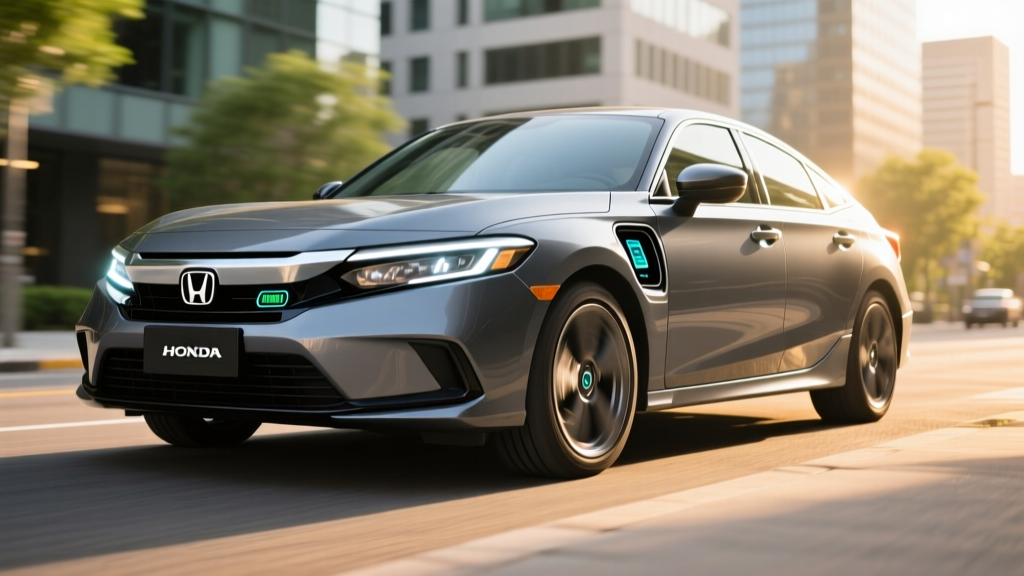
If you've been searching for the Civic Hybrid 0-60 time before pulling the trigger on Honda's electrified compact, you're not alone. The 2026 Honda Civic Hybrid pairs a 2.0-liter Atkinson-cycle four-cylinder with a two-motor hybrid system to deliver 200 combined horsepower and a manufacturer-confirmed 0-60 mph sprint of approximately 7.2 seconds. That's meaningfully quicker than the non-hybrid Civic's 2.0L naturally aspirated engine and lands in territory that makes highway merging and on-ramp acceleration genuinely confident.
But straight-line speed is only one piece of the Civic Hybrid story. This is a conventional hybrid (HEV) — not a plug-in — meaning it never needs to be plugged in and recovers all its energy through regenerative braking and the gasoline engine. Below, we break down every spec that matters: EPA fuel economy, real-world MPG expectations, battery warranty, pricing, and how the Civic Hybrid stacks up against PHEVs and full EVs for different types of drivers.
2026 Civic Hybrid Powertrain: Engine, Motors, and Horsepower
The 2026 Civic Hybrid uses Honda's fourth-generation two-motor hybrid system, the same architecture found in the Accord Hybrid and CR-V Hybrid but tuned for the Civic's lighter platform. Here's the full powertrain breakdown:
| Component | Specification |
|---|---|
| Engine | 2.0L DOHC Atkinson-cycle 4-cylinder |
| Engine Output | 146 hp @ 6,100 rpm / 134 lb-ft torque |
| Electric Motors | Dual-motor hybrid system |
| Combined System Output | 200 hp / 232 lb-ft torque |
| Transmission | e-CVT (no traditional gears) |
| Drivetrain | Front-wheel drive |
| 0-60 mph | ~7.2 seconds (manufacturer estimate) |
| Battery Type | Lithium-ion (self-charging, ~1.1 kWh usable) |
The 232 lb-ft of combined torque is what you actually feel in daily driving. Unlike turbocharged gas engines that need to spool up, the Civic Hybrid's electric motors deliver torque nearly instantaneously from low RPM. This makes the car feel punchier than its 0-60 number alone suggests, especially in city driving and suburban stop-and-go traffic. Honda's e-CVT uses a direct-drive clutch that engages at highway speeds to reduce the "rubber band" effect typical of older CVTs.
Civic Hybrid MPG: EPA Ratings and Real-World Fuel Economy
Fuel economy is the Civic Hybrid's headline act. The EPA rates the 2026 Civic Hybrid Sport Touring sedan at 50 mpg city / 47 mpg highway / 49 mpg combined, according to fueleconomy.gov. The Sport Touring trim's larger 18-inch wheels drop highway efficiency slightly compared to the Sport trim, but the difference is marginal.
| Trim Level | City MPG | Highway MPG | Combined MPG |
|---|---|---|---|
| Civic Hybrid Sport (sedan) | 50 | 47 | 49 |
| Civic Hybrid Sport Touring (sedan) | 50 | 47 | 49 |
| Civic Hybrid Sport Touring (hatchback) | 50 | 45 | 48 |
Real-world MPG reality check: Honda's hybrid system is one of the few powertrains that routinely meets or exceeds EPA city estimates in actual use. The Atkinson-cycle engine runs less frequently in city driving because the electric motors handle low-speed propulsion, and regenerative braking recaptures energy at every stop. In warm-weather city driving, owners consistently report 51-54 mpg. Highway driving is where real-world numbers tend to dip slightly — expect 43-46 mpg at sustained 75-80 mph speeds, particularly in colder weather or with headwinds. Over a mixed 15,000-mile annual driving cycle, plan on averaging roughly 47-50 mpg combined in moderate climates.
With a 12.4-gallon fuel tank, the Civic Hybrid delivers an effective driving range of approximately 595-620 miles per tank in real-world mixed driving. That's exceptional for a compact sedan and eliminates any range concern whatsoever.
HEV vs PHEV vs EV: Which Powertrain Fits Your Life?
The Civic Hybrid is a conventional hybrid (HEV), meaning it generates all its own electricity. You never plug it in. This is fundamentally different from a plug-in hybrid (PHEV) or a battery electric vehicle (BEV). Here's how the three architectures compare for different buyer profiles:
HEV vs PHEV vs BEV — Quick Decision Matrix
| Factor | HEV (Civic Hybrid) | PHEV | Full EV (BEV) |
|---|---|---|---|
| Plug-in required? | No | Yes (for EV range) | Yes |
| Electric-only range | 0 miles | 25-50 miles typical | 200-400 miles |
| Home charging needed? | No | Strongly recommended | Essential |
| Fuel cost (annual, 15k mi) | ~$900-1,100 | ~$500-800 (with EV commute) | ~$400-700 |
| Maintenance | Low (oil changes, less brake wear) | Low-moderate | Minimal |
| Best for | No home charging access | Short commute + road trips | Home charging + mostly <250 mi trips |
Choose the Civic Hybrid (HEV) if: You don't have access to home or workplace charging, you want maximum simplicity with no behavioral changes, you take frequent road trips where charging infrastructure is sparse, or you want the lowest upfront cost among electrified options.
Consider a PHEV if: You have home Level 2 charging and a commute under 40 miles round-trip — you'd drive on electricity most weekdays and use gas only for longer trips. The tradeoff: PHEVs cost $5,000-$10,000 more upfront than comparable HEVs.
Go full EV if: You have reliable home charging, your typical trips fall within the vehicle's range, and you want to eliminate gasoline entirely. EVs have the lowest operating costs but require the biggest upfront investment and lifestyle adjustment.
Pricing, Trims, and Tax Credit Eligibility
The 2026 Honda Civic Hybrid is available in two trim levels for the sedan and one for the hatchback:
| Trim | Body Style | MSRP (incl. destination) |
|---|---|---|
| Sport | Sedan | $29,845 |
| Sport Touring | Sedan | $32,245 |
| Sport Touring | Hatchback | $33,245 |
Federal tax credit status: The Civic Hybrid does not qualify for the federal §30D new clean vehicle tax credit of up to $7,500. Under current IRS rules, the §30D credit applies only to plug-in electric vehicles (PHEVs and BEVs) with battery capacities of at least 7 kWh. The Civic Hybrid's small lithium-ion battery pack (approximately 1.1 kWh usable) falls well below this threshold. This is standard for all conventional hybrids — the Toyota Prius, Hyundai Elantra Hybrid, and Ford Maverick Hybrid similarly do not qualify.
Some states and utilities offer their own incentives for hybrid purchases, though these are less common and typically smaller than EV incentives. Check your state's energy office or your local utility's website for any current hybrid rebate programs. These vary significantly by jurisdiction and change frequently.
Battery Warranty, Longevity, and Replacement Cost
Hybrid battery anxiety is the single most common concern among first-time hybrid buyers. Here's the data to put it in perspective:
Honda Civic Hybrid Battery Warranty
- Hybrid battery warranty: 8 years / 100,000 miles (10 years / 150,000 miles in CARB states including CA, NY, MA, and others)
- Powertrain warranty: 5 years / 60,000 miles
- Capacity threshold: Honda warrants the hybrid battery against defects and abnormal capacity loss
Honda's hybrid battery packs have proven exceptionally durable in real-world use. The lithium-ion chemistry used in the Civic Hybrid operates within a narrow state-of-charge window — typically between 20% and 80% — which dramatically reduces degradation compared to an EV battery that regularly cycles from near-empty to full. Many Honda hybrid owners (particularly those with the Accord Hybrid and Insight) report well over 150,000 miles on the original battery pack with no issues.
If replacement is needed out of warranty: A Honda hybrid battery replacement typically costs between $2,000 and $3,500 including parts and labor at a dealership. Independent hybrid specialists often offer refurbished or reconditioned packs for $1,200-$2,000. For context, this is comparable to a major transmission repair on a conventional gas car and far less than an EV battery replacement, which can run $8,000-$20,000 depending on the vehicle.
Driving Dynamics: Where the 0-60 Time Meets the Road
The 7.2-second 0-60 mph time places the 2026 Civic Hybrid squarely in "adequately quick" territory. For reference, the non-hybrid Civic with the 2.0L engine hits 60 mph in roughly 8.1 seconds, while the Civic Si drops to about 6.7 seconds. The Hybrid splits the difference while delivering substantially better fuel economy than either.
What the spec sheet doesn't fully capture is how the hybrid system behaves in real driving scenarios. Honda's hybrid system primarily operates as a series hybrid at low and moderate speeds — the engine acts as a generator, and the electric motors drive the wheels. This means throttle response is immediate and linear, with no turbo lag and no transmission hesitation. Only at sustained highway speeds does the system engage a direct-drive clutch, coupling the engine mechanically to the wheels for efficiency.
The Civic Hybrid also features selectable drive modes (ECON, Normal, Sport) and adjustable regenerative braking via steering-wheel paddles. In Sport mode with maximum regen, you can approximate one-pedal-like driving in city traffic, though the Civic Hybrid doesn't come to a complete stop on regen alone like a full EV would. The Sport Touring trim adds an adaptive damper system that firms up the ride in Sport mode, giving the car a more planted feel on twisty roads.
Who Should Buy the Civic Hybrid — and Who Shouldn't
Pros
- 49 mpg combined EPA — among the best in its class
- 200 hp / 232 lb-ft makes it genuinely quick for a hybrid
- No plug-in required — zero lifestyle change
- ~600-mile driving range per tank
- Strong 8yr/100k mi hybrid battery warranty
- Under $30K starting MSRP
- Excellent Honda Sensing safety suite standard
Cons
- No federal tax credit (HEV, not PHEV/BEV)
- FWD only — no AWD option (unlike some hybrid competitors)
- Only two trim levels available
- Highway MPG dips at sustained 80+ mph
- Small trunk battery reduces cargo space slightly vs gas Civic
- No EV-only driving mode
The Civic Hybrid is ideal for: Commuters, rideshare drivers, budget-conscious buyers who want low running costs without the complexity or upfront premium of a PHEV or EV, apartment dwellers without charging access, and anyone who regularly drives in stop-and-go city traffic where the hybrid system shines brightest.
Look elsewhere if: You need all-wheel drive (consider the Toyota Prius AWD or a hybrid SUV), you want any electric-only driving capability (look at PHEVs), or you're ready to eliminate gasoline entirely and have home charging infrastructure for a full EV.
Frequently Asked Questions
What is the Honda Civic Hybrid 0-60 time?
The 2026 Honda Civic Hybrid reaches 0-60 mph in approximately 7.2 seconds, according to Honda. This applies to both the Sport and Sport Touring sedan trims. The hatchback variant is marginally slower due to its slightly higher curb weight.
How many MPG does the Civic Hybrid get in real driving?
The EPA rates the Civic Hybrid at 50 city / 47 highway / 49 combined mpg. In real-world use, most owners report meeting or slightly exceeding the city estimate (51-54 mpg) while highway driving at 75-80 mph tends to return 43-46 mpg. Annual mixed-driving averages typically land between 47 and 50 mpg.
Does the Civic Hybrid need to be plugged in?
No. The Civic Hybrid is a conventional hybrid (HEV), not a plug-in hybrid. It charges its own small lithium-ion battery through regenerative braking and the gasoline engine. You simply fill it with gas and drive — no plug, no charging cable, no behavioral change required.
Does the 2026 Civic Hybrid qualify for a federal tax credit?
No. Under current IRS §30D rules, the federal clean vehicle credit applies only to plug-in vehicles (PHEVs and BEVs) with battery capacities of 7 kWh or more. The Civic Hybrid's ~1.1 kWh battery does not meet this threshold. No conventional hybrid currently qualifies for the federal credit.
How long will the Civic Hybrid battery last?
Honda covers the hybrid battery with an 8-year/100,000-mile warranty (10 years/150,000 miles in CARB states). In practice, Honda's hybrid battery packs have demonstrated strong longevity, with many examples exceeding 150,000 miles on the original pack. The battery operates in a narrow charge window that minimizes degradation. If replacement is ever needed, expect to pay $2,000-$3,500 at a dealership.
Is the Civic Hybrid faster than the regular Civic?
Yes. The Civic Hybrid's 200 combined horsepower and 232 lb-ft of torque deliver a 0-60 time of ~7.2 seconds, compared to approximately 8.1 seconds for the standard 2.0L gasoline Civic. The hybrid's electric motor torque also makes it feel more responsive in everyday city driving, even though the gap narrows at higher speeds.