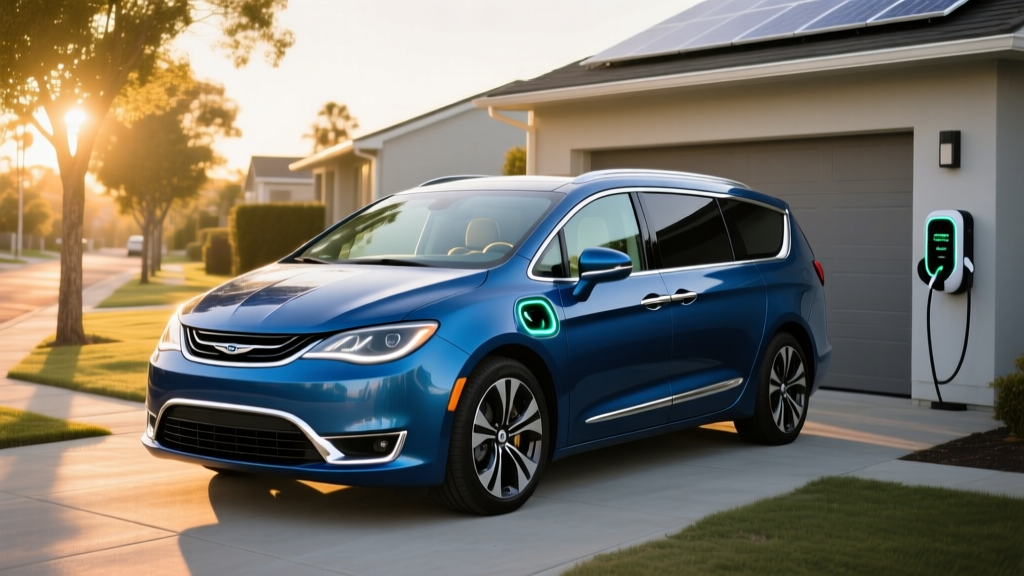
If you need a three-row family hauler but aren't ready to commit to a fully electric vehicle, the Chrysler Pacifica Plug-In Hybrid occupies a narrow but compelling lane. It remains the only plug-in hybrid minivan on the US market, offering a usable electric-only range for school runs and grocery trips with a gas engine standing by for road trips. Here's exactly what the Pacifica PHEV delivers — and where it falls short — based on EPA data, real-world ownership patterns, and current pricing.
HEV vs PHEV: Understanding the Two Pacifica Options
Chrysler actually sells the Pacifica in two electrified flavors, and confusing them is the most common buyer mistake. Here's the breakdown:
| Attribute | Pacifica Hybrid (HEV) | Pacifica Plug-In Hybrid (PHEV) |
|---|---|---|
| Drivetrain | Self-charging hybrid — no plug needed | Plug-in hybrid with 16 kWh battery |
| Electric-Only Range | None (EV assist only at low speeds) | 32 miles (EPA) |
| EPA Combined MPG / MPGe | 30 MPG combined | 82 MPGe (electric + gas) / 30 MPG (gas only) |
| Battery | ~1.0 kWh (small buffer) | 16 kWh lithium-ion |
| Plug-In Required? | No — regenerates via braking/engine | Yes — plug in to access EV range |
| Stow 'n Go Seating (2nd row) | Yes | No — battery occupies under-floor space |
The conventional HEV never plugs in. It captures energy through regenerative braking and engine optimization to boost fuel economy. The PHEV has a much larger battery you charge at home or at public stations, giving you genuine zero-tailpipe-emission miles before the gas engine engages. If you can charge at home and your daily driving stays under ~30 miles, the PHEV operates mostly as an EV during the week.
Electric-Only Range and Total Driving Range
The Pacifica PHEV's 16 kWh battery pack delivers an EPA-estimated 32 miles of electric-only range. That figure holds across all PHEV trims (Select, Limited, Pinnacle).
Real-World Range Expectation: The EPA's 32-mile estimate assumes mixed city/highway driving at moderate temperatures. In our experience and owner reports, expect roughly 28–30 miles of EV range on warm days with gentle city driving. Highway speeds above 65 mph and winter temperatures below freezing can drop usable EV range to 22–25 miles. The minivan's weight (over 5,000 lbs curb) and boxy aerodynamics work against efficiency at speed.
Once the battery depletes, the Pacifica PHEV operates as a conventional hybrid, delivering an EPA-estimated 30 MPG combined on gasoline alone. With a 14.5-gallon fuel tank, total combined range (EV + gas) reaches approximately 460–520 miles depending on conditions — plenty for any cross-country trip without range anxiety.
Fuel Economy: EPA Numbers vs Real-World MPG
Fuel economy on a PHEV depends entirely on how often you charge. The EPA expresses this two ways:
| Mode | City | Highway | Combined |
|---|---|---|---|
| Charge-Depleting (EV mode) | 82 MPGe | ||
| Charge-Sustaining (gas hybrid mode) | 29 MPG | 30 MPG | 30 MPG |
MPGe (miles per gallon equivalent) converts electricity consumption into a gasoline-comparable figure. The 82 MPGe rating means the Pacifica PHEV uses energy at a rate equivalent to an 82 MPG gas car when operating on its battery.
Real-world reality check: Owners who plug in nightly and drive under 30 miles daily report using gasoline only on weekend road trips — achieving effective "fuel economy" well above 100 MPGe over a month. Owners who never plug in operate strictly at ~30 MPG, identical to the regular Pacifica Hybrid but carrying 400+ lbs of unused battery weight. The PHEV only saves fuel if you actually charge it.
According to fueleconomy.gov, annual fuel cost for the Pacifica PHEV is estimated at approximately $1,450 assuming 15,000 miles/year, 55% city driving, and regular charging. Without charging, expect costs closer to $2,100/year at current national gas prices.
Powertrain and Performance Specs
| Powertrain | 3.6L V6 Atkinson-cycle + 2 electric motors (eFlite EVT) |
| Combined System Horsepower | 260 hp |
| Battery Capacity | 16 kWh (lithium-ion NMC) |
| EV Range (EPA) | 32 miles |
| MPGe (EPA) | 82 MPGe combined |
| Gas-Only MPG (EPA) | 30 combined (29 city / 30 highway) |
| Total Range | ~520 miles (EV + gas) |
| Level 2 Charge Time (0–100%) | ~2 hours at 7.2 kW |
| Level 1 Charge Time (120V) | ~14 hours |
| DC Fast Charging | Not supported |
| 0–60 mph | ~7.1 seconds |
| Drivetrain | Front-wheel drive |
| Towing Capacity | Not rated (PHEV); HEV rated 1,750 lbs |
| Cargo Volume (behind 3rd row) | 32.3 cu ft |
| Base MSRP (Select trim) | $51,095 |
The Pacifica PHEV uses Chrysler's eFlite electrically variable transmission, pairing two electric motors with the Pentastar V6 running in efficient Atkinson-cycle mode. The result is seamless electric-priority operation with the engine engaging only when needed. Acceleration is adequate for merging and passing — 260 hp in a 5,000-lb minivan won't win drag races, but 0–60 in roughly 7 seconds is competitive for the segment.
One trade-off worth noting: the PHEV's battery pack lives under the second-row floor, which eliminates Chrysler's signature Stow 'n Go second-row seating. The second-row captain's chairs are removable but not foldable into the floor. If maximum cargo flexibility is paramount, the conventional HEV retains full Stow 'n Go functionality.
Charging: Level 1, Level 2, and What You Need at Home
The Pacifica PHEV comes with a portable Level 1 (120V) charging cord, which delivers a full charge in approximately 14 hours — functional for overnight top-ups if your daily EV use is modest.
For practical daily ownership, a Level 2 (240V) home charger is strongly recommended. The Pacifica PHEV accepts up to 7.2 kW on Level 2, bringing a full 0–100% charge time down to roughly 2 hours. That's fast enough to fully recharge during a work-from-home lunch break or between an evening commute and a morning school run.
| Level | Power | Time (0–100%) | Best For |
|---|---|---|---|
| Level 1 (120V outlet) | ~1.2 kW | ~14 hours | Overnight, low daily mileage |
| Level 2 (240V, 32A) | 7.2 kW | ~2 hours | Home daily charging |
| DC Fast Charging | N/A | N/A | Not supported on this vehicle |
No DC fast charging: Unlike some PHEVs from other brands (the Toyota RAV4 Prime, for instance, also lacks DCFC), the Pacifica PHEV cannot use public DC fast chargers. This is typical for minivans and many PHEVs with smaller batteries. For a 16 kWh pack, Level 2 at 7.2 kW is the practical ceiling.
Home Level 2 installation typically costs $500–$2,000 depending on your electrical panel's capacity and the distance from panel to charger location. Budget for a 40-amp circuit and a hardwired or NEMA 14-50 outlet. Always have installation performed by a licensed electrician.
Pricing, Trims, and Federal Tax Credit Eligibility
The 2026 Chrysler Pacifica PHEV is available in three trims:
- Select — Starting at ~$51,095 MSRP
- Limited — Starting at ~$55,095 MSRP
- Pinnacle — Starting at ~$59,095 MSRP
All trims share the same powertrain, battery, and EV range. Differences are in interior materials, infotainment, and driver-assist features.
Federal Tax Credit (§30D) — Current Rules:
- Credit amount: Up to $7,500, but PHEV eligibility depends on battery capacity and critical-mineral/battery-component sourcing requirements.
- MSRP cap: Vans/minivans classified as SUVs may qualify up to $80,000 MSRP; other passenger vehicles are capped at $55,000. The Pacifica PHEV's classification and eligibility should be verified on the IRS clean vehicle credit list.
- Buyer income limits: AGI must not exceed $300,000 (joint), $225,000 (head of household), or $150,000 (single).
- Battery sourcing: Vehicles must meet escalating critical-mineral and battery-component requirements that tighten annually. Check IRS.gov for the current eligible-vehicle list before purchasing.
- Point-of-sale transfer: Eligible buyers can transfer the credit to the dealer at purchase, reducing the out-of-pocket price immediately rather than waiting for tax filing.
Tax credit rules change frequently. Consult a tax professional and verify eligibility on the IRS website before making a purchase decision.
If the Pacifica PHEV qualifies for the full $7,500 credit, the effective starting price drops from ~$51,095 to roughly $43,595 — competitive with well-equipped non-hybrid minivans once you factor in fuel savings. However, credit eligibility is not guaranteed and depends on current-year sourcing rules. Some state incentives may also apply; check your state's energy or DMV website for details.
Reliability, Battery Warranty, and Replacement Cost
Battery & Powertrain Warranty:
- Hybrid/EV battery: 10 years / 100,000 miles (whichever comes first)
- Powertrain: 5 years / 60,000 miles
- Basic vehicle: 3 years / 36,000 miles
Chrysler warrants the high-voltage battery to retain at least 70% of its original capacity during the warranty period. If degradation exceeds 30%, Chrysler will repair or replace the battery at no cost.
The Pacifica PHEV's powertrain — the Pentastar V6 and eFlite transmission — has been in production since the 2017 model year, giving it a lengthy track record. The 3.6L V6 is one of the most widely deployed engines in the Stellantis lineup, with generally solid reliability data.
That said, the Pacifica PHEV has faced some service bulletins related to the high-voltage battery system and power inverter module in earlier model years. Chrysler issued recalls on certain 2017–2019 models for battery-related fire risk; these were addressed through software updates and module replacements. Current (2024–2026) models benefit from revised components and updated software.
Battery replacement cost: If out of warranty, a Pacifica PHEV high-voltage battery replacement runs approximately $7,000–$9,000 including parts and labor. This is a significant expense, but the 10-year/100,000-mile warranty provides substantial coverage. Most PHEV batteries from major manufacturers show 10–15% degradation over 100,000 miles based on industry data — well within the warranty threshold.
For reliability ratings, check NHTSA.gov for current recall and complaint data on the specific model year you're considering.
Who Should Choose the Pacifica PHEV vs a Full EV or Gas Minivan?
Choose the Chrysler Pacifica Plug-In Hybrid if:
- You need three rows and minivan cargo space but want to drive on electricity most weekdays
- You can charge at home (Level 1 or Level 2) and your daily round-trip driving is under 30 miles
- You take regular road trips where EV charging infrastructure is sparse or unpredictable
- You want to reduce fuel consumption without committing to a full EV
Choose a full EV (like the Kia EV9 or upcoming electric minivans) if:
- You have reliable home charging and your daily driving rarely exceeds 200 miles
- You want zero tailpipe emissions and minimal maintenance (no oil changes, no engine)
- You're willing to plan longer road trips around DC fast-charging stops
Choose the conventional Pacifica Hybrid (HEV) if:
- You cannot charge at home or at work
- You need Stow 'n Go second-row seating for maximum cargo flexibility
- You want hybrid fuel savings without the PHEV price premium
Choose a gas-only minivan if:
- Upfront cost is the primary concern and you drive fewer than 10,000 miles/year
- You need AWD (available on gas Pacifica, not on PHEV)
Pros and Cons: The Honest Assessment
Pros
- Only plug-in hybrid minivan available in the US — no direct competitor
- 32 miles of EV range covers most daily school/errand trips
- 82 MPGe is excellent for a 5,000-lb family vehicle
- Seamless transition between EV and gas — no range anxiety on road trips
- 10-year/100,000-mile battery warranty
- Family-friendly features: built-in vacuum, dual-screen rear entertainment, sliding doors
- Federal tax credit may reduce effective price significantly
Cons
- No DC fast charging — Level 2 is the maximum charge speed
- Stow 'n Go second-row seating eliminated on PHEV (battery in the way)
- No AWD option (PHEV is FWD only)
- $51,000+ starting price is steep for a minivan before incentives
- Towing not rated on PHEV (HEV and gas models can tow)
- PHEV premium over gas Pacifica takes years of fuel savings to recoup
- Earlier model years had battery/inverter recall issues (verify service history on used)
Frequently Asked Questions
How many MPG does the Chrysler Pacifica Plug-In Hybrid get?
The Pacifica PHEV achieves 82 MPGe when operating on battery power and 30 MPG combined (29 city / 30 highway) when the battery is depleted and the vehicle runs as a conventional hybrid. Your real-world economy depends entirely on how often you charge — daily plug-in users may go weeks without visiting a gas station.
How far can the Pacifica PHEV go on electric only?
The EPA rates the Pacifica PHEV at 32 miles of electric-only range. In real-world conditions, expect 28–30 miles in warm weather city driving and 22–25 miles in cold weather or sustained highway driving. Once the battery depletes, the gas engine takes over seamlessly.
Does the Chrysler Pacifica Plug-In qualify for a tax credit?
The Pacifica PHEV may qualify for up to $7,500 under the federal §30D clean vehicle credit, but eligibility depends on current-year battery sourcing requirements, buyer income limits, and MSRP caps. The credit can be transferred to the dealer at point of sale. Always verify current eligibility on IRS.gov and consult a tax professional before purchasing.
Is the Pacifica PHEV reliable, and what does a battery replacement cost?
The Pacifica PHEV's powertrain has been in production since 2017 and carries a 10-year/100,000-mile battery warranty. Earlier model years had some battery-related recalls that were addressed. Out-of-warranty battery replacement costs approximately $7,000–$9,000. Most PHEV batteries retain 85–90% capacity after 100,000 miles based on industry data.
Should I buy the Pacifica PHEV, the regular Hybrid, or a gas minivan?
If you can charge at home and drive under 30 miles daily, the PHEV offers the lowest operating cost and genuine EV commuting. If you can't charge at home, the conventional Pacifica Hybrid (HEV) gives you 30 MPG combined with no plug needed and retains Stow 'n Go seating. If upfront cost is the priority and mileage is low, a gas Pacifica is the most affordable entry point and the only option with AWD.
Can the Pacifica PHEV tow a trailer?
No. Chrysler does not rate the PHEV variant for towing due to the additional battery weight and powertrain calibration. The gas Pacifica can tow up to 3,600 lbs, and the conventional Hybrid is rated for 1,750 lbs.
How long does it take to charge the Pacifica PHEV at home?
On a Level 2 (240V) charger at 7.2 kW, the Pacifica PHEV charges from empty to full in approximately 2 hours. On a standard 120V household outlet (Level 1), a full charge takes roughly 14 hours. The vehicle does not support DC fast charging.