Quick Verdict: The Only Plug-In Hybrid Minivan That Matters
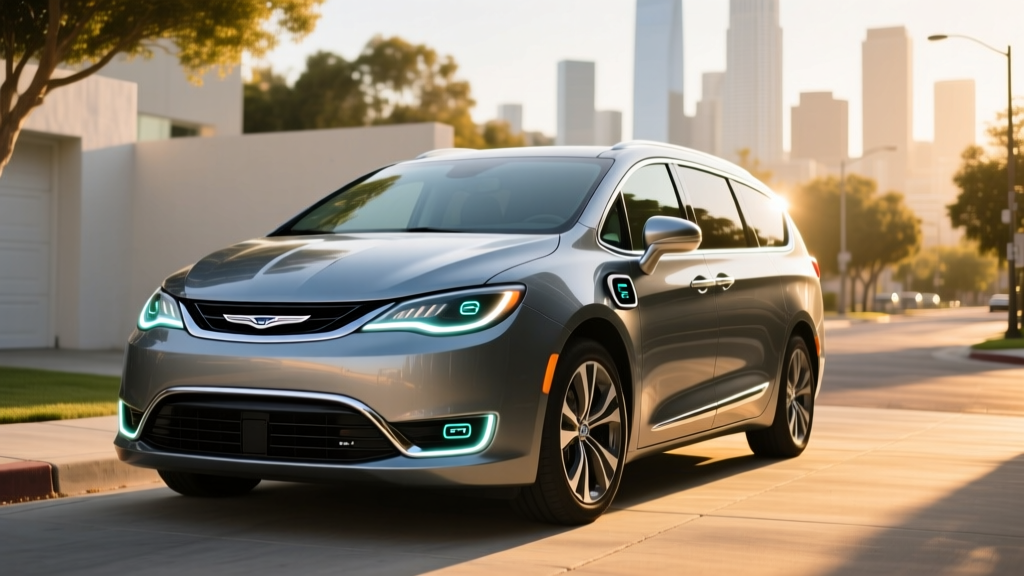
The Chrysler Pacifica Plug-In Hybrid occupies a segment of one. No other minivan on the US market offers a plug-in hybrid powertrain with meaningful electric-only range, making it the default choice for families who want to commute on electricity without sacrificing the cargo space and sliding doors that only a minivan provides. For 2026, the Pacifica PHEV continues with its proven 32-mile EPA electric range, 82 MPGe combined rating, and a total system range exceeding 460 miles. Starting around $51,120 before incentives, it is not cheap — but for households with home charging and a sub-30-mile daily commute, the fuel savings are substantial.
| Spec | Value |
|---|---|
| EPA Electric-Only Range | 32 miles |
| EPA Combined MPGe | 82 MPGe |
| Gas-Only MPG (combined) | 30 MPG |
| Total Combined Range | ~460 miles |
| Battery Capacity | 16 kWh (usable ~13 kWh) |
| Battery Chemistry | NMC (Nickel Manganese Cobalt) |
| Combined System Horsepower | 260 hp |
| Engine | 3.6L V6 Atkinson-cycle + 2 electric motors |
| Level 2 Charge Time (0–100%) | ~2 hours at 7.2 kW |
| DC Fast Charging | Not available |
| 0–60 mph | ~7.5 seconds |
| Base MSRP (2026) | ~$51,120 |
| Battery Warranty | 10 years / 100,000 miles |
HEV vs PHEV: What Chrysler Actually Offers
Chrysler's minivan lineup can be confusing if you are not tracking the distinctions. Here is how it breaks down:
| Feature | Pacifica Hybrid (HEV) | Pacifica Plug-In Hybrid (PHEV) |
|---|---|---|
| Plug-In Charging | No — self-charging only | Yes — plug in for electric-only miles |
| Electric-Only Range | None (motor assists engine) | 32 miles EPA |
| Battery Size | ~1.1 kWh (small buffer) | 16 kWh |
| Combined MPG | 30 MPG | 30 MPG (gas) / 82 MPGe (electric+gas) |
| Starting Price | ~$47,120 | ~$51,120 |
| Best For | No home charging access | Home charging + short commutes |
A conventional hybrid (HEV) never plugs in. It uses regenerative braking and the engine to keep a small battery charged, and the electric motor assists the gas engine for better fuel economy. A plug-in hybrid (PHEV) has a much larger battery that you charge from a wall outlet or Level 2 charger, enabling real electric-only driving for daily commutes before the engine kicks in.
Chrysler does not sell a non-electrified Pacifica alongside these in all trims, but the key decision is whether you can plug in at home. If yes, the PHEV is the clear upgrade. If you park on the street with no charging access, the conventional hybrid still delivers strong efficiency without any lifestyle change.
Electric-Only Range and Real-World Efficiency
The EPA rates the Pacifica PHEV at 32 miles of electric-only range. In real-world testing, that number holds up reasonably well in mild weather around town, where regenerative braking recaptures energy at every stoplight. Expect 28–32 miles in spring and fall conditions with mixed suburban driving.
However, minivans are heavy — the Pacifica PHEV tips the scales at over 5,000 pounds — and that mass works against efficiency in two scenarios:
- Highway driving at 70+ mph: Electric range drops to roughly 24–27 miles due to aerodynamic drag and no regen benefit at steady speed.
- Cold weather (below 30°F): Battery chemistry slows, cabin heating draws significant energy, and expect electric range to fall to 22–26 miles. The Pacifica PHEV uses engine coolant heat, which can engage the gas engine sooner in deep cold.
Once the battery is depleted, the Pacifica operates as a conventional hybrid, returning its EPA-rated 30 MPG combined. In city driving, many owners report exceeding that figure — 32–34 MPG is common in stop-and-go traffic where the hybrid system excels. Highway gas-only efficiency settles around 27–28 MPG.
| Scenario | EPA Rating | Real-World Expectation |
|---|---|---|
| Electric-Only Range | 32 miles | 24–32 miles (weather/terrain dependent) |
| Combined MPGe | 82 MPGe | 70–85 MPGe depending on charge frequency |
| City MPG (gas-only) | 30 MPG | 31–34 MPG (hybrids excel in city) |
| Highway MPG (gas-only) | 29 MPG | 27–28 MPG |
| Combined MPG (gas-only) | 30 MPG | 29–31 MPG |
The total system range — battery plus a 14.5-gallon fuel tank — exceeds 460 miles, eliminating range anxiety entirely on road trips. You simply fill up like any other vehicle once the battery is spent.
Charging: Level 2 Only, No DC Fast Charge
The Pacifica PHEV charges exclusively via AC — there is no DC fast-charging capability, which is typical for PHEVs in this class. Here is what to expect:
| Level | Power | Time (0–100%) | Notes |
|---|---|---|---|
| Level 1 (120V household) | ~1.4 kW | ~10–12 hours | Overnight from a standard outlet |
| Level 2 (240V) | 7.2 kW | ~2 hours | Requires home Level 2 charger or public station |
| DC Fast Charge | N/A | N/A | Not supported — J1772 AC port only |
A Level 2 home charger is strongly recommended. The onboard charger accepts up to 7.2 kW, meaning a 32-amp or 40-amp Level 2 unit will fully replenish the battery in about two hours. This is practical for topping up midday if you return home for lunch, effectively doubling your daily electric miles.
Level 1 charging from a standard 120V outlet is viable but slow — roughly 5–6 miles of range per hour of charging. If your commute uses the full 32-mile battery, a 10-hour overnight session on Level 1 may not fully recharge it. Budget $500–$1,200 for a quality Level 2 home charger and professional installation, plus $300–$1,500 more if your electrical panel needs an upgrade to support a 240V circuit.
The Pacifica PHEV uses the J1772 connector for AC charging. This is the universal standard for non-Tesla EVs and PHEVs in North America, so compatibility with public Level 2 stations (ChargePoint, EVgo, Blink) is straightforward. Note that the industry-wide transition to NACS does not affect AC-charging PHEVs — NACS primarily impacts DC fast-charging connectors.
Powertrain and Performance
The Pacifica PHEV pairs Chrysler's 3.6-liter Pentastar V6, tuned for Atkinson-cycle efficiency, with a dual-motor electric drive unit integrated into the transmission. Combined system output is 260 horsepower. The two electric motors handle different duties — one primarily drives the wheels while the other can act as a generator or provide additional torque.
Acceleration to 60 mph takes approximately 7.5 seconds, which is adequate for a family hauler. The electric motors deliver immediate torque off the line, making the Pacifica PHEV feel surprisingly responsive in city driving and merging situations. The transition between electric and gas power is generally smooth, though you will notice the engine engage under hard acceleration or when the battery depletes.
All-wheel drive is not available on the PHEV variant. If AWD is a priority for your climate, Chrysler offers it on the gas-only Pacifica but not on the plug-in hybrid — a notable limitation for buyers in snow-belt states.
Pricing, Tax Credits, and Ownership Costs
The 2026 Chrysler Pacifica PHEV starts at approximately $51,120 for the base Select trim, rising to roughly $56,000–$58,000 for the Limited and Pinnacle trims. That is a significant premium over the conventional hybrid ($47,120) and the gas-only Pacifica (starting around $40,000).
Federal Tax Credit Eligibility (§30D)
The Pacifica PHEV's eligibility for the federal §30D clean vehicle credit is complex and subject to change. Under current IRS rules, PHEVs can qualify for up to $7,500 if they meet:
- Battery capacity: At least 7 kWh — the Pacifica's 16 kWh pack clears this easily
- MSRP cap: Vans and SUVs must be under $80,000 — the Pacifica qualifies
- Buyer income limits: $150,000 single / $225,000 head of household / $300,000 joint (modified AGI)
- Critical minerals and battery component sourcing: Phased-in percentages that tighten annually through 2026 — this is the variable that most affects eligibility year to year
- North American final assembly: The Pacifica is built in Windsor, Ontario, Canada — this satisfies the assembly requirement
The credit can now be transferred at the point of sale, meaning the dealer applies it as an immediate price reduction rather than waiting for you to claim it on your tax return. Always verify current eligibility on fueleconomy.gov before purchasing, as battery-sourcing compliance can change with model-year production updates.
Additionally, some states offer their own PHEV incentives — California's CVRP, Colorado's innovative motor vehicle credit, and various utility rebates may stack with the federal credit. Check your state energy office or utility provider for current programs.
Five-Year Cost Snapshot
Assuming 15,000 miles/year, $3.50/gallon gas, and $0.14/kWh electricity:
- Pacifica PHEV (charging daily, 80% electric commutes): ~$1,100–$1,400/year in combined fuel and electricity
- Pacifica Hybrid (HEV, no plug-in): ~$1,750/year in fuel
- Pacifica Gas (22 MPG combined): ~$2,385/year in fuel
Over five years, the PHEV can save $3,000–$5,000 in energy costs versus the gas-only model, partially offsetting its higher purchase price. Insurance premiums for the PHEV run 5–10% higher than the gas model due to the battery replacement cost exposure.
Battery Longevity, Warranty, and Replacement
Battery Warranty: Chrysler covers the Pacifica PHEV's high-voltage battery for 10 years or 100,000 miles (whichever comes first) in all 50 states. In CARB states (California, New York, Massachusetts, and others adopting California emissions standards), the warranty extends to 10 years / 150,000 miles. The warranty covers defects and capacity loss below a defined threshold — typically around 60–70% of original capacity, though Chrysler's specific retention threshold should be confirmed in your purchase documentation.
The Pacifica PHEV's NMC battery has proven durable in real-world ownership. PHEV batteries experience less stress than full EV batteries because they operate in a narrower state-of-charge window — the vehicle's software maintains a buffer at both the top and bottom of the pack, preventing the deep cycles that accelerate degradation.
Based on data from Pacifica PHEVs now reaching 6–8 years on the road, most owners report minimal noticeable degradation — perhaps losing 1–3 miles of electric range over that span. The relatively small battery and conservative charge management contribute to this longevity.
If the battery does require replacement out of warranty, expect a cost in the range of $6,000–$9,000 for the pack plus labor, based on current dealer pricing. This is a meaningful expense, but the 10-year warranty provides substantial coverage, and the PHEV's battery is smaller and less costly to replace than a full EV pack.
Who Should Buy the Chrysler Pacifica PHEV?
Pros
- Only PHEV minivan available — no direct competition
- 32-mile electric range covers most school runs and commutes
- 460+ mile total range eliminates road-trip anxiety
- Stow 'n Go seating still available (second row does not fold into floor on PHEV due to battery, but third row does)
- Smooth, quiet electric driving around town
- 10-year / 100,000-mile battery warranty
Cons
- Starting price above $51,000 — premium over gas Pacifica
- No DC fast charging — Level 2 only
- No AWD option on the PHEV
- Second-row seats do not fold into the floor (battery occupies that space)
- Electric range drops noticeably in cold weather and at highway speed
- Tax credit eligibility varies by year and sourcing rules
Decision Framework
Choose the Pacifica PHEV if: You have home Level 2 charging, your daily driving is under 35 miles, you need minivan space, and you want to minimize fuel costs without committing to a full EV.
Choose the Pacifica Hybrid (HEV) if: You lack home charging access but still want better fuel economy than the gas model, or you want to save $4,000 on purchase price.
Choose a full EV (e.g., Kia EV9, Tesla Model X) if: You want zero gas engine maintenance, have reliable home and public charging, and your road trips are infrequent or along well-served charging corridors.
Choose the gas Pacifica if: Budget is the primary concern, you drive mostly highway miles where hybrid advantage shrinks, or you need AWD for winter conditions.
Frequently Asked Questions
How many MPG does the Chrysler Pacifica Plug-In Hybrid get?
The EPA rates the Pacifica PHEV at 82 MPGe when combining electric and gas operation. Once the battery is depleted, it operates as a conventional hybrid at 30 MPG combined (30 city / 29 highway). In real-world city driving, many owners see 31–34 MPG on gas alone thanks to the hybrid system's stop-and-go efficiency.
How far can the Pacifica PHEV go on electric only?
The EPA rates it at 32 miles electric-only. Real-world range varies from about 24 miles (highway, cold weather) to 32 miles (mild weather, suburban driving). For families with a sub-30-mile daily commute and nightly charging, the gas engine may not engage for weeks at a time.
Does the Chrysler Pacifica PHEV qualify for a tax credit?
It may qualify for up to $7,500 under the federal §30D credit, depending on current battery-sourcing compliance, your income level, and the MSRP cap (which it clears at under $80,000). Eligibility changes as sourcing requirements tighten. Always check fueleconomy.gov and consult a tax professional before relying on the credit.
Is the Pacifica PHEV reliable, and what does battery replacement cost?
The Pacifica PHEV's powertrain has proven reasonably reliable, with the 3.6L V6 being one of Stellantis's most widely used engines. The high-voltage battery is warrantied for 10 years / 100,000 miles. Out-of-warranty replacement runs approximately $6,000–$9,000. Real-world data from early-model owners shows minimal battery degradation over 6+ years of use.
Can the Pacifica PHEV charge at Tesla Superchargers?
No. The Pacifica PHEV uses a J1772 AC charging port and cannot DC fast charge at all. Tesla Superchargers provide DC power and, even with the NACS adapter ecosystem expanding, the Pacifica's lack of DC charging hardware means Supercharger access is irrelevant. Stick to Level 2 public networks like ChargePoint, EVgo, and Blink for away-from-home AC charging.
Hybrid vs PHEV vs EV — which is right for my family?
If you can charge at home and your daily driving is under 35 miles, the PHEV gives you electric commuting with gas-engine backup for road trips — the best of both worlds for a family vehicle. A conventional hybrid (HEV) is ideal if you cannot plug in but want better MPG. A full EV (BEV) makes sense if you want zero engine maintenance, have good charging infrastructure, and are comfortable planning longer trips around DC fast-charging stops.
Does the Pacifica PHEV have all-wheel drive?
No. All-wheel drive is available on the gas-only Pacifica but not on the plug-in hybrid. The PHEV is front-wheel drive only. If AWD is essential for your climate, you will need to choose between the gas Pacifica with AWD or look at AWD-equipped PHEV SUVs like the Toyota RAV4 Prime or Hyundai Tucson PHEV — though neither offers minivan space.